
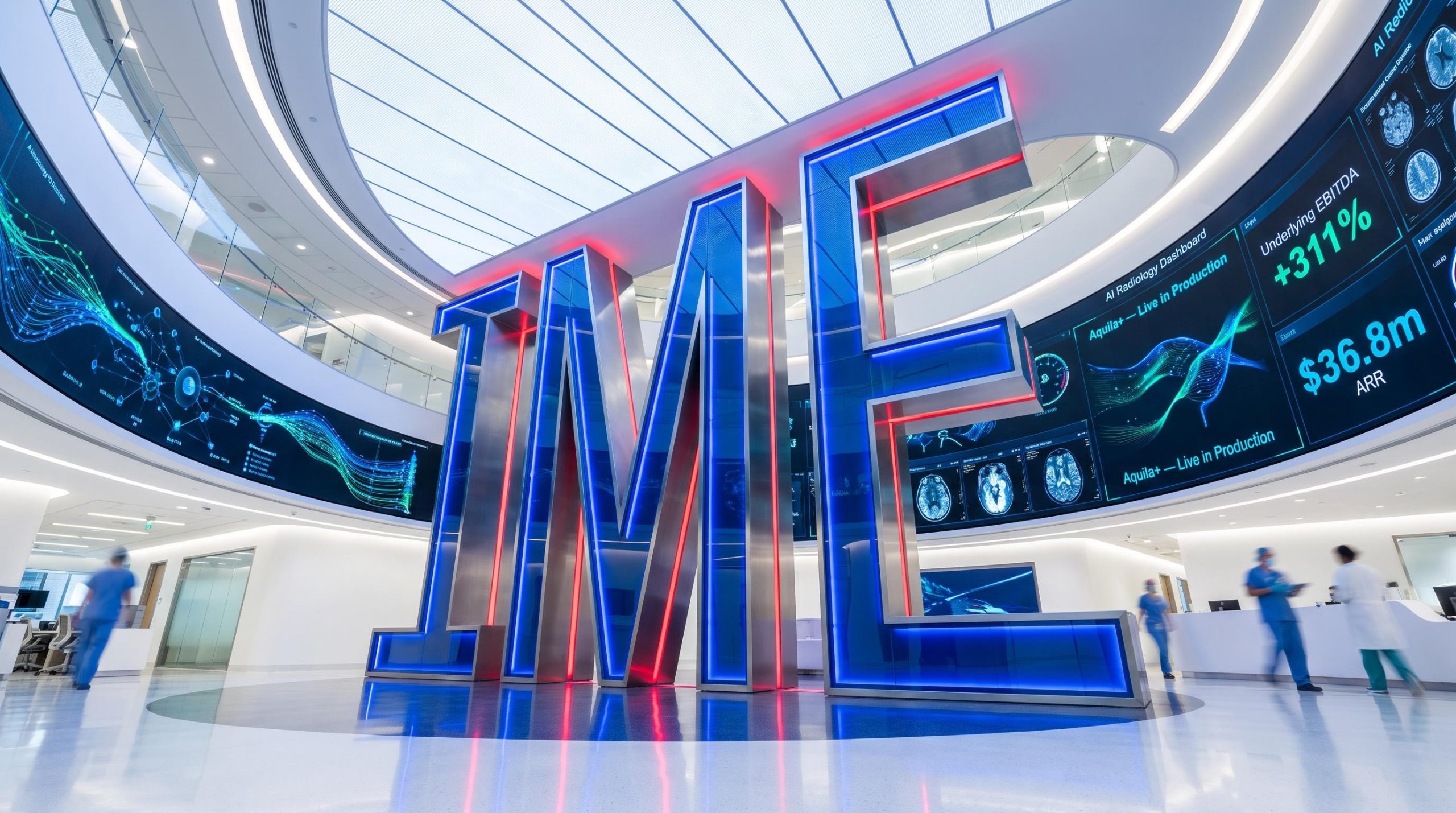
IMEXHS turns AI-native radiology into production reality as 1H FY26 EBITDA jumps 311%
In its 1H FY26 results presentation, released 2 September 2026, IMEXHS Limited (ASX: IME) detailed a half in which underlying EBITDA rose 311% and its proprietary agentic AI platform, Aquila+, moved from launch to live production inside a public-sector hospital network.
The company operates two businesses: cloud-based medical imaging software, and radiology services delivered through RIMAB. The AI agents built by the Software business run inside RIMAB’s own operation, proven against real volume and real cost before they are sold.
Management set an honest tone throughout the presentation. In its own words, the commercial transformation “is progressing. It is not complete.”
When big ASX news breaks, our subscribers know first
1H FY26 financial results at a glance
For the half ended 30 June 2026, IMEXHS delivered revenue growth in both reported and constant currency terms, while underlying EBITDA improved materially on the prior corresponding period.
| Metric | 1H FY26 | Change |
|---|---|---|
| Sales Revenue | $16.0m | Up 17% yoy (up 13% on a constant currency basis) |
| Annual Recurring Revenue (ARR) | $36.8m | Up 12% yoy (flat on a constant currency basis) |
| Underlying EBITDA | $1.27m | +311% vs pcp |
| Cash | $2.0m | vs $3.3m at 31 December 2025 |
| Debt | $0.25m | vs $0.5m at 31 December 2025 |
Underlying EBITDA excludes the impact of FX, share-based payments and goodwill impairment, which was $nil in 1H FY26. Cash declined from $3.3m at 31 December 2025 to $2.0m over the half, while debt was reduced from $0.5m to $0.25m.
How the two businesses performed
The two segments delivered contrasting drivers over the half, with radiology earnings ahead of plan and software EBITDA pressured by currency movement rather than operational factors.
-
Software: Revenue of $4.8m, ARR of $11.8m and underlying EBITDA of $0.8m, down from $1.3m in the prior corresponding period. The decline was driven by USD/COP/AUD FX movement, with 73% of software priced in USD.
-
Radiology (RIMAB): Revenue of $11.2m, up 24% on the prior corresponding period, ARR of $25.0m, up 20%, and underlying EBITDA of $1.1m, up from $0.3m.
-
Corporate costs: $0.6m, down $0.7m from $1.3m in the prior corresponding period.

What “agentic AI radiology” actually means
Imaging demand is compounding, but the radiologist workforce is not keeping pace. Management noted that delay, error and cost do not concentrate in the reading itself. They concentrate in the operational tasks around the radiologist, including scheduling, triage, distribution, monitoring and follow-up.
The industry response, the presentation stated, has been to add single-point AI to legacy workflows, delivering incremental gains inside an unchanged process. IMEXHS instead rebuilt the workflow around agents that operate inside the process itself, resolving operational tasks autonomously. This is what “AI-native” means in practice.
“No competitor known to the Company addresses the radiology workflow this comprehensively.”
Aquila+ comprises eight proprietary agents spanning the imaging workflow. Their status at 30 June 2026 was outlined as follows:
-
Scheduling — development complete (up to 80% lower call-centre staffing; 50–60% shorter patient wait times).
-
Prioritisation — final testing.
-
Distribution — live across the client base.
-
Monitoring — live across the client base.
-
Reading co-pilot — Phase 1 stabilised, Phase 2 in development (exclusive to Aquila+).
-
Hanging protocols — complete.
-
Annotation suggestion — in development.
-
Survey image suggestion — in quality assurance.
Management summarised the status as “two live · two development-complete · two in test or QA · two in development.” It further emphasised that “All eight agents are proprietary IMEXHS intellectual property, developed and owned by the Company.”
Why the AI platform compounds the investment case
The presentation framed four compounding effects, ordered by how directly each reaches the profit and loss.
-
Cross-sell inside the installed base: 569 installations are already contracted, integrated and trained. Each new agent is a product with no new customer to acquire.
-
Displacement in procurement: Full-workflow automation changes the basis of comparison, with tenders decided on operational outcome rather than RIS/PACS specification and price.
-
Switching cost: Each agent embeds further into a client’s operating process, so displacing the platform means rebuilding the operation, not migrating a database.
-
Unit economics: Less human effort per study for clients and for the company’s own radiology operation, allowing volume to grow without proportional cost.
Together, these effects underpin the recurring-revenue thesis: installed-base leverage combined with rising switching costs.
Commercial execution — momentum building, engine not yet repeatable
Management presented a balanced view of commercial progress, describing the half as “One transformational win. Not yet a repeatable engine.”
-
New software ARR written in the half totalled $1.1m.
-
Reliance on episodic large wins, rather than steady mid-market flow, remains the principal commercial challenge.
-
Enterprise wins included the Zacatecas public tender in Mexico at $384,000 NARR; Pulso Salud in Peru at $163,000 NARR; Hospital La Misericordia at $68,000 NARR; and CESAC IPS in Cartagena.
The Zacatecas public tender, won through distributor partner GOBA, deployed five proprietary AI workflow agents alongside two Gleamer diagnostic algorithms across 20 hospitals, representing one of the most comprehensive AI-integrated radiology rollouts in the Latin American public health sector.
Contracted-but-not-yet-billing backlog stood at $4.40m, representing 12% of ARR at 30 June 2026. This was up 163% versus $1.68m at 31 December 2025, and up 106% versus $2.14m at 30 June 2025. SANITAS, within the Radiology segment, is the single largest contract in this bucket at $1.9m.
Partner programme scaling
The partner channel remains the primary route to market and, per the presentation, is now proven at enterprise scale.
-
47 partners, up 22 on the prior corresponding period, across 13 LATAM countries.
-
75% of software NARR in the half was generated through partners.
-
569 live installations across 18 countries, an increase of 20 sites on the prior corresponding period.
A full SAGRILAFT review, covering anti-money-laundering, terrorist-financing and proliferation-financing controls, was completed across the active partner network. All active partners passed without exception.
Colombia operating environment and RIMAB positioning
Healthcare-sector liquidity pressure, driven by delays in government payments to healthcare insurers, persisted through the half and through the election period, which concluded with a runoff in June 2026. Management observed early signs of improved business sentiment while remaining deliberately cautious about the implications for cash.
“Improved sentiment is not improved payment – yet.”
In response, management outlined tightened credit controls, conservative pricing assumptions, prudent working-capital management, and selective exit from customers under financial distress.
The RIMAB operation spans 38 sites, 157 radiologists and 90,000 procedures per month. Two new contracts, Sanitas and Colsanitas, commence in Q3, together adding approximately $2.0m in ARR.
Strategic priorities and FY26 guidance
Management set out five strategic priorities for the period ahead:
-
AI-First Product Strategy — embed AI agents progressively across the radiology workflow.
-
Product & Tech Consolidation — a standardised, modular and cloud-native Aquila+ platform.
-
Protect & Expand Installed Base — retention, migration, satisfaction and cross-sell.
-
Profitable Growth — accelerate software revenue and ARR growth.
-
Operational Simplification — automation, standardisation and more efficient resource allocation.
The company issued FY26 guidance as its forward-looking anchor.
| Metric | FY26 Guidance | Change vs prior year |
|---|---|---|
| Revenue | $31.4m – $33.7m | Up 8% to 16% |
| Underlying EBITDA | $2.4m – $2.7m | Up 48% to 66% |
For the second half of FY26, management outlined the following priorities:
-
Convert large-deal capability into repeatable, territory-balanced NARR.
-
Commence billing on the contracted software book.
-
Move the scheduling agent into first production deployment.
-
Treat collections and working capital as the first-order priority for Radiology.
-
Commence the Sanitas and Colsanitas contracts.
Leadership changes
Mr Fabio Carrillo was appointed Chief Financial Officer, effective 1 August 2026. He is a Chartered Accountant with a Bachelor of Commerce (Professional Accounting) from Macquarie University and 20 years in public practice across tax and business advisory.
Ms Kamille Dietrich of Automic Group was appointed Company Secretary from 27 July 2026. Outgoing Chief Financial Officer Ms Reena Minhas, who served since October 2020, was thanked by the Board and management for the financial governance and reporting discipline she established at IMEXHS.
What it means for investors
The presentation set out a company with a production-live agentic AI platform, a 311% improvement in underlying EBITDA, and FY26 guidance implying underlying EBITDA growth of 48% to 66%. These represent tangible progress against the company’s stated AI-native strategy.
The remaining challenge, as management acknowledged directly, is commercial repeatability. New software ARR still depends heavily on episodic large wins rather than a steady, territory-balanced flow of deals.
Management framing
“The commercial transformation is progressing. It is not complete.”
Don’t Miss the Next Healthcare Tech Breakout
Big News Blast delivers FREE breaking ASX healthcare and technology news directly to your inbox within minutes of release, complete with in-depth analysis. Join 20,000+ subscribers already staying ahead of the market. Click the “Free Alerts” button at Big News Blast to get the next market-moving announcement the moment it drops.