
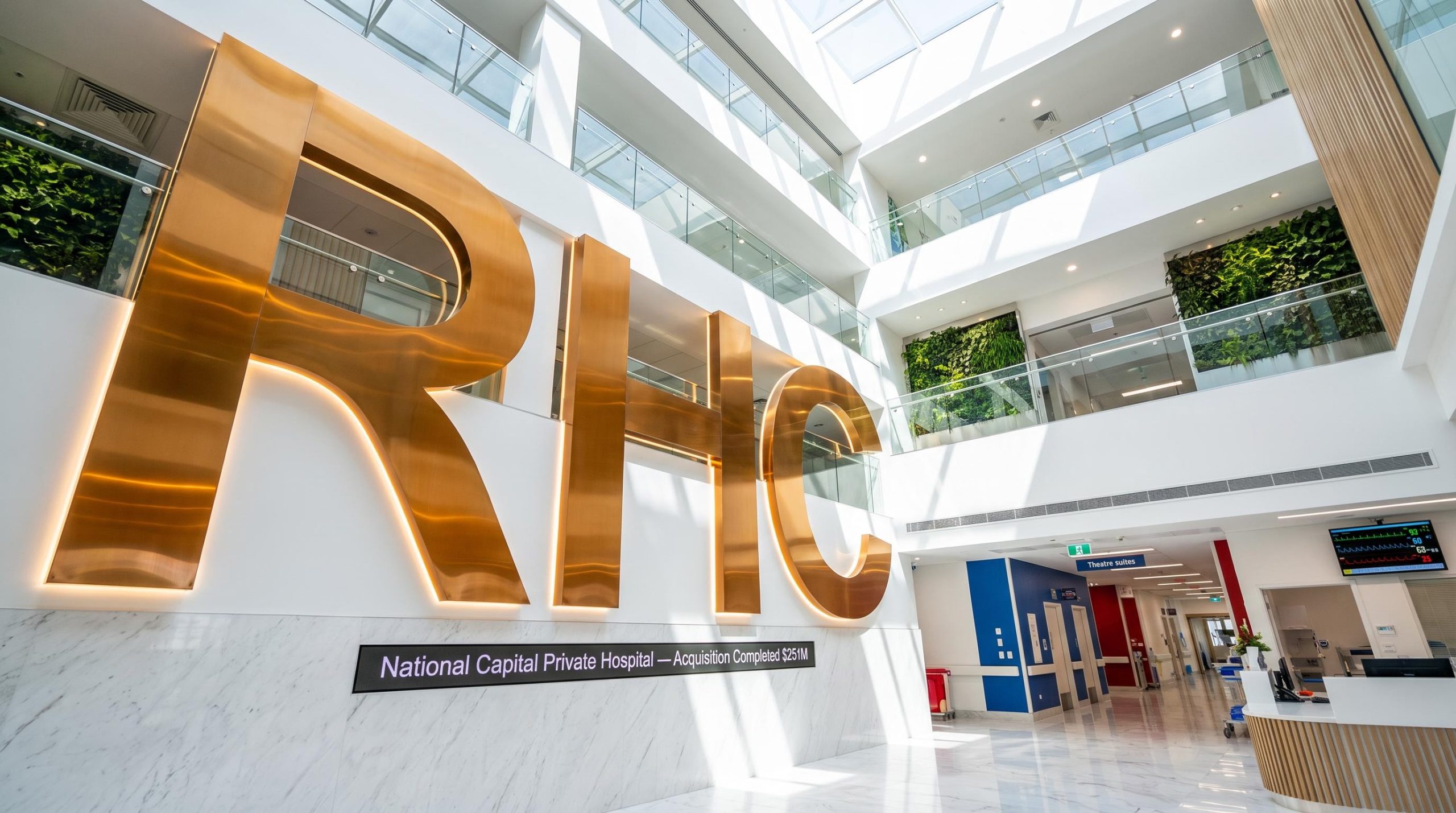
Ramsay completes $251m National Capital Private Hospital acquisition
Ramsay Health Care (ASX: RHC) has completed the acquisition of the assets and operations of National Capital Private Hospital, marking a material expansion of its Australian private hospital footprint. The transaction was announced on Tuesday 1 September 2026.
The net acquisition price of $251m (ex GST) has been funded from Ramsay’s existing debt facilities. The hospital was acquired from the relevant Healthscope Group entities, acting through their appointed receivers and managers.
For investors, the standout point is the earnings profile. The acquisition is expected to be EPS accretive in the first 12 months of Ramsay’s ownership.
When big ASX news breaks, our subscribers know first
What Ramsay acquired in Canberra
National Capital Private Hospital sits in the catchment area of Garran in Canberra. It is co-located with the public Canberra Hospital and adjacent to the Australian National University Medical School, a positioning Ramsay describes as strategically attractive.
The facility has strength in Ramsay’s target therapeutic areas of Cardiac, Orthopaedics and Oncology. According to Ramsay, its clinical quality, governance and safety performance has been strong over a long period, driven by an experienced leadership team and strong doctor partnerships.
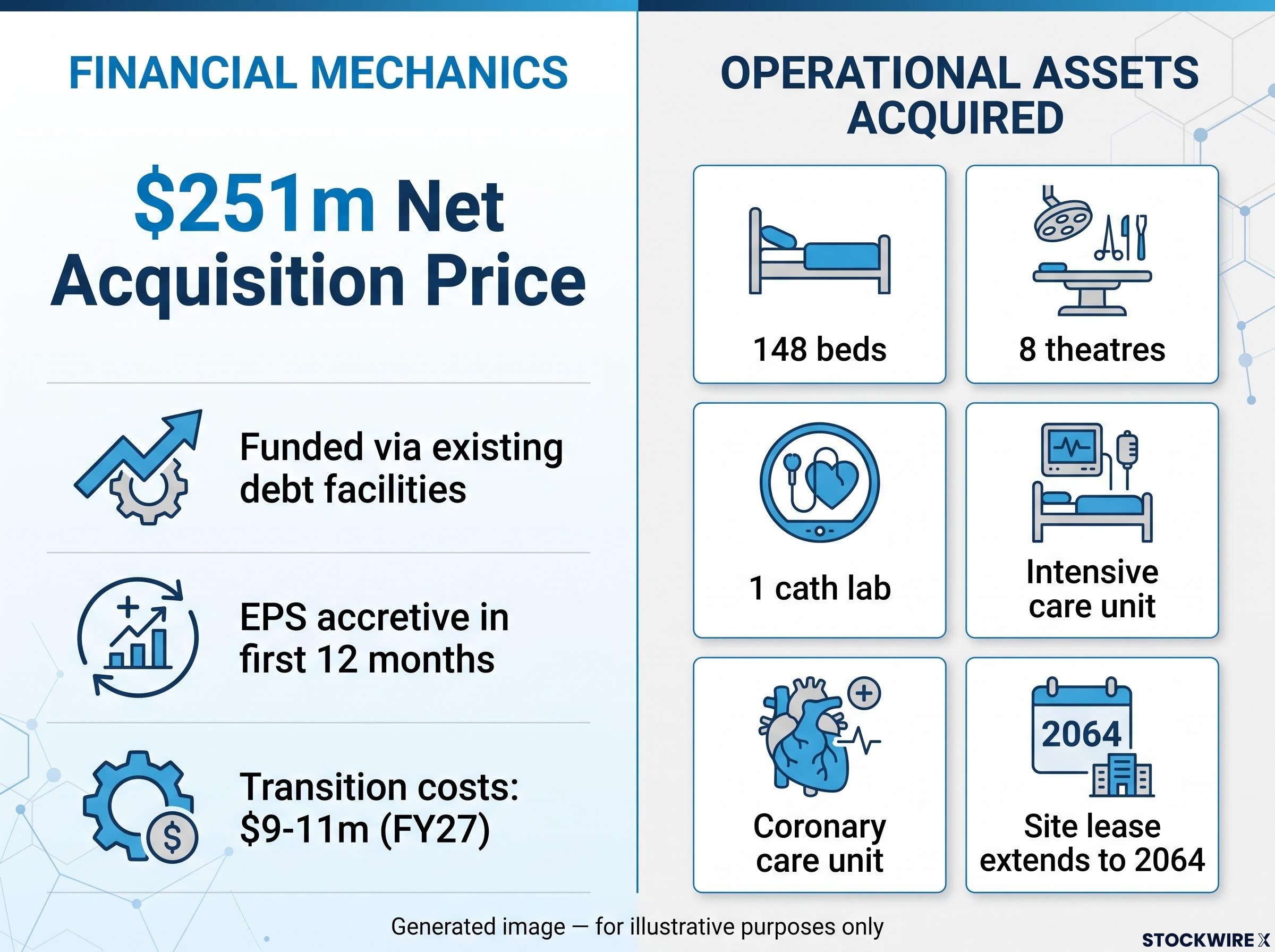
The hospital operates on a site leased from Canberra Health Services on terms that extend to 2064, providing long-dated operational tenure. Its operational assets include:
-
8 theatres
-
1 cath lab
-
148 beds
-
Intensive care unit
-
Coronary care unit
-
Capability to service a higher acuity patient mix
The numbers and the near-term cost picture
The table below summarises the key deal mechanics and their significance for investors.
| Item | Detail | Investor significance |
|---|---|---|
| Net acquisition price | $251m (ex GST) | Funded from existing debt facilities, no equity raise implied |
| Funding source | Existing debt facilities | No new dilution |
| EPS impact | Accretive in first 12 months | Immediate earnings contribution |
| Transition costs | $9–11m in FY27 (skewed to 1H) | Excluded from Underlying Earnings |
| Site lease term | Extends to 2064 | Long-dated operational tenure |
One point warrants clarity. Separate from the acquisition price, transition costs of $9–11m are expected to be incurred in FY27, skewed to 1H FY27, and will be excluded from Underlying Earnings.
Ramsay FY26 results, reported in August 2026, showed Underlying NPAT rising 22.9% in constant currency to $364m, with the Australian hospital segment delivering EBIT of $639.8m and leverage falling to 1.83x, the context in which the National Capital acquisition was greenlit.
Natalie Davis, Ramsay Group CEO and Managing Director
“We are pleased to welcome the National Capital team and clinicians to Ramsay and look forward to working with them to care for the local community, and to further develop the services and reputation of this leading health precinct. The acquisition is expected to be EPS accretive in the first 12 months of our ownership.”
Why this acquisition matters for investors
The acquisition being described as EPS accretive is a meaningful detail. Earnings per share (EPS) accretive means the transaction is expected to add to the company’s earnings on a per-share basis within the stated timeframe, in this case the first 12 months of ownership.
The funding structure adds to the appeal. Because the deal has been funded from existing debt facilities rather than an equity raise, existing shareholders are not diluted by the issue of new shares. A debt-funded, accretive acquisition is generally viewed more favourably than one that dilutes existing holders.
Strategically, the logic is straightforward. National Capital carries strength in Cardiac, Orthopaedics and Oncology, the therapeutic areas Ramsay has targeted. Adding a facility aligned with these specialties deepens Ramsay’s higher-acuity private hospital presence in the Canberra catchment.
The receivership context is also notable. Acquiring quality assets from Healthscope’s receivers and managers reflects opportunistic portfolio expansion, though Ramsay makes no claims beyond the disclosed terms.
What comes next
Near-term focus turns to integration. Management has pointed to welcoming the National Capital team and clinicians, and to developing the services and reputation of the precinct.
On the cost side, the associated transition costs are expected to land primarily in 1H FY27, with the full $9–11m range applying to the FY27 period and excluded from Underlying Earnings.
The transaction leaves Ramsay with an EPS-accretive addition to its Australian portfolio, supported by long-dated site tenure extending to 2064 and clinical strength in its target therapeutic areas.
For investors exploring how this acquisition fits within Ramsay’s broader strategic pivot, our full explainer on the Ramsay Sante separation details the proposed in-specie distribution of the European business, the November 2026 shareholder vote timeline, and what the demerger means for the shape of the remaining Australian-focused group.
Don’t Miss the Next Healthcare Winner on ASX
Big News Blast delivers FREE breaking ASX healthcare news directly to your inbox within minutes of release, complete with in-depth analysis already done. Join 20,000+ subscribers staying ahead of the market the moment announcements drop. Click the “Free Alerts” button at StockWire X to get started today.