

TRP-8803 data at ECNP Congress shows rapid, consistent psychedelic effects in BED patients
Entropy Neurodynamics (ASX: ENP) has presented two posters on TRP-8803 (intravenous psilocin) in binge eating disorder (BED) at the 39th European College of Neuropsychopharmacology (ECNP) Congress in Munich, held 10 to 13 October 2026. The data was detailed in an ASX announcement dated 19 October 2026.
The posters reported favourable safety and tolerability across 12 dosing sessions in the first six patients enrolled in the company’s BED clinical program, with no serious adverse events or treatment discontinuations. The company said the findings provide “considerable supporting evidence” for its precision-controlled IV-psilocin approach.
The results also link to Cohort 2 of the study, which is now evaluating a shorter 60-minute infusion regimen.
Key takeaways
- Two TRP-8803 posters were presented at the 39th ECNP Congress in Munich.
- Safety and tolerability were favourable across 12 dosing sessions in six BED patients, with no serious adverse events or treatment discontinuations.
- Mean peak psychedelic intensity was 9.4/10, with 9 of 12 sessions reaching maximum 10/10 intensity.
- A single-patient exploratory EEG analysis showed measurable changes in brain activity approximately 11 minutes after infusion commencement.
- Cohort 2, evaluating a 60-minute infusion, is underway.
CEO Jason Carroll
“…Across 12 dosing sessions, intravenous administration produced a rapid and remarkably consistent psychedelic experience, with a mean peak intensity of 9.4 out of 10 and five of six patients reaching the same maximum intensity across both of their treatment sessions.”
When big ASX news breaks, our subscribers know first
Psychedelic intensity results: 9.4/10 mean peak
Speed and consistency
The first poster, titled “Intravenous psilocin for binge eating disorder: preliminary safety and psychedelic intensity from a Phase 1 open-label trial,” reported that peak intensity was reached within 20 minutes of infusion commencement in 7 of the 12 dosing sessions. The mean peak intensity rating was 9.4 out of 10.
Nine of the 12 sessions reached maximum 10/10 intensity, and five of the six patients achieved the same maximum intensity across both treatment sessions. Among sessions that reached maximum intensity, the median duration at maximum was approximately 100 minutes.
The poster separately reported a median duration of psychedelic effects from infusion commencement of 240 minutes, a distinct measure from time spent at maximum intensity. The poster’s conclusion described a rapid-onset, controllable experience of approximately 2.5 hours.
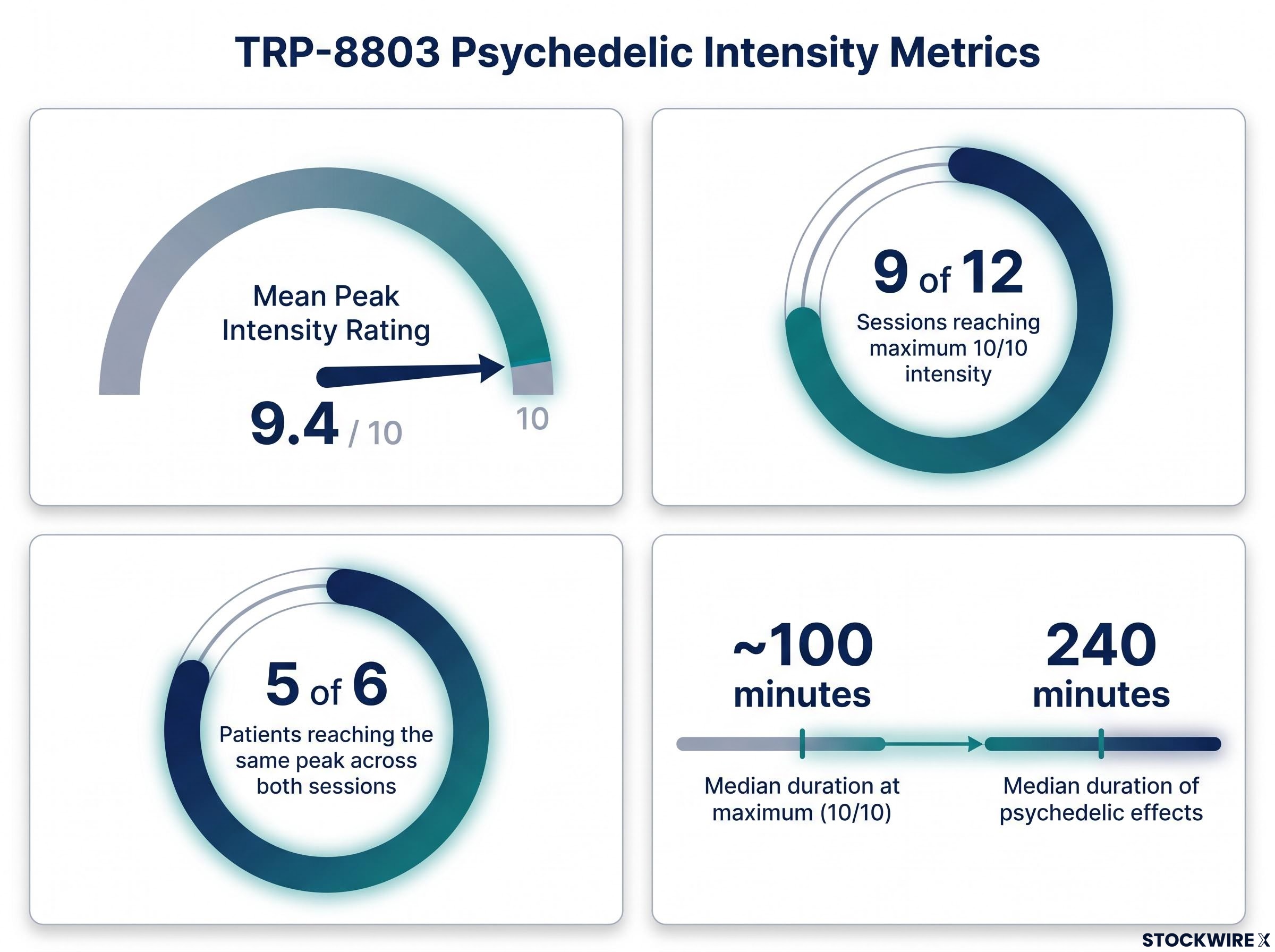
| Metric | Result | Why it matters |
|---|---|---|
| Sessions reaching peak intensity within 20 minutes | 7 of 12 | Indicates speed of onset |
| Mean peak intensity rating | 9.4/10 | Measures depth of the experience |
| Sessions reaching maximum intensity | 9 of 12 at 10/10 | Shows how often the maximum was reached |
| Patients reaching the same peak across both sessions | 5 of 6 | Points to consistency between sessions |
| Median duration at maximum (10/10) | ~100 minutes | Shows how long the peak state was maintained |
| Median duration of psychedelic effects from infusion commencement | 240 minutes | Describes total length of the experience |
For investors, predictability of onset and duration is central to the company’s case for IV dosing over oral psilocybin, which the poster describes as having unpredictable onset and duration.
Safety and tolerability profile
The poster reported “no serious Adverse Reactions, Suspected Unexpected Serious Adverse Reactions, Deaths or discontinuations/withdraws due to an Adverse Reaction.” All six participants (100%) experienced at least one adverse reaction.
The poster recorded 88 adverse reaction instances, of which 87 were Grade 1 to 2 and 1 was Grade 3. The Grade 3 event listed in the poster’s table was suicide ideation, reported in one participant (16.7%). The poster concluded that all but one adverse reaction was rated mild (Grade 1) or moderate (Grade 2).
The most commonly recorded events by instance were:
- Fatigue: 13 instances, across all 6 participants
- Headache: 8 instances, across 4 participants
- Nausea: 8 instances, across 4 participants
- Anxiety: 6 instances, across 4 participants
The study was a Phase 1, open-label, single-site trial in six adults aged 18 to 65 with BED. Each received two dosing sessions, two weeks apart, of 10 mg in total: a 5 mg loading dose over 20 minutes and a 5 mg maintenance dose over 120 minutes, or 140 minutes overall.
The sample is small, and the trial was designed to establish safety and tolerability first.
What is IV psilocin, and why does it matter for investors?
Psilocin is the active metabolite of psilocybin. According to the poster, oral psilocybin is constrained by variable bioavailability (the proportion of a drug that reaches the bloodstream), unpredictable onset and duration, and no capacity to pause or stop dosing in real time.
Intravenous administration bypasses gastrointestinal absorption entirely. The poster states this yields:
- More rapid onset
- More consistent and predictable plasma concentrations, by eliminating inter-individual variability in absorption
- Greater control over the dosing session, including the ability to pause or stop dosing in case of medical emergent events that do not respond to therapeutic support
BED is characterised by recurrent episodes of consuming large quantities of food in a short period, accompanied by a sense of loss of control and marked distress. The poster notes that despite available treatments, many individuals experience limited or incomplete remission.
The company describes TRP-8803 as having potential to reduce the overall duration of the intervention to a “commercially feasible timeframe.”
EEG findings give an objective brain-activity signal
The second poster, “Temporal mapping of EEG dynamics during intravenous psilocin administration in binge eating disorder,” presented an exploratory electroencephalography (EEG) analysis. EEG records electrical activity in the brain. This was a single-patient analysis, and its findings should not be read as representing the wider cohort.
Measurable changes in brain activity were observed approximately 11 minutes after infusion commencement. The changes developed during the acute dosing period and returned towards the patient’s pre-dose baseline at treatment conclusion.
The company described the findings as preliminary, providing an “early objective neurophysiological correlate” to the rapid subjective onset and reversible effects observed with TRP-8803. Broader analysis of EEG data across the clinical dataset is ongoing.
The poster listed these next steps:
- Expand EEG analyses
- Replicate analyses across the entire sample (N=12)
- Compare against subjective psychedelic intensity
- Test against oral dosing
Cohort 2 tests a 60-minute infusion
The ECNP findings provide further insight into the original 140-minute infusion protocol (Cohort 1). Entropy is now evaluating a shorter 60-minute regimen in Cohort 2 of its BED study, which is underway.
Cohort 2 is designed to evaluate whether the controlled psychedelic experience and clinical outcomes observed with the 140-minute regimen can be maintained within a 60-minute treatment regimen. If successful, the company said the shorter treatment duration could improve patient throughput and support future commercial scalability.
CEO Jason Carroll said the company will “build on this growing body of clinical evidence as we progress our BED program and advance the broader development of TRP-8803 across our basket-design study and additional programs.”
The Cohort 1 data presented covers safety and psychedelic intensity, not efficacy outcomes. The poster concluded that the results support progression to a Phase 2 efficacy trial of IV psilocin in BED.
The Cohort 1 efficacy results reported separately showed 50% complete remission and 100% clinically meaningful improvement, with weekly binge episodes falling 74% from baseline within four weeks of a single session.
Ready to Explore Entropy Neurodynamics’ TRP-8803 Program in Binge Eating Disorder?
Entropy Neurodynamics (ASX: ENP) has reported rapid, consistent psychedelic effects from intravenous psilocin, with a mean peak intensity of 9.4/10 and no serious adverse events across 12 dosing sessions. Cohort 2 is now testing a shorter 60-minute infusion that could support future commercial scalability.
Investors seeking a closer look at the pipeline can visit the Entropy Neurodynamics website to learn more about TRP-8803 and the company’s broader clinical programs. Explore the science and the next steps behind this precision-controlled approach.