
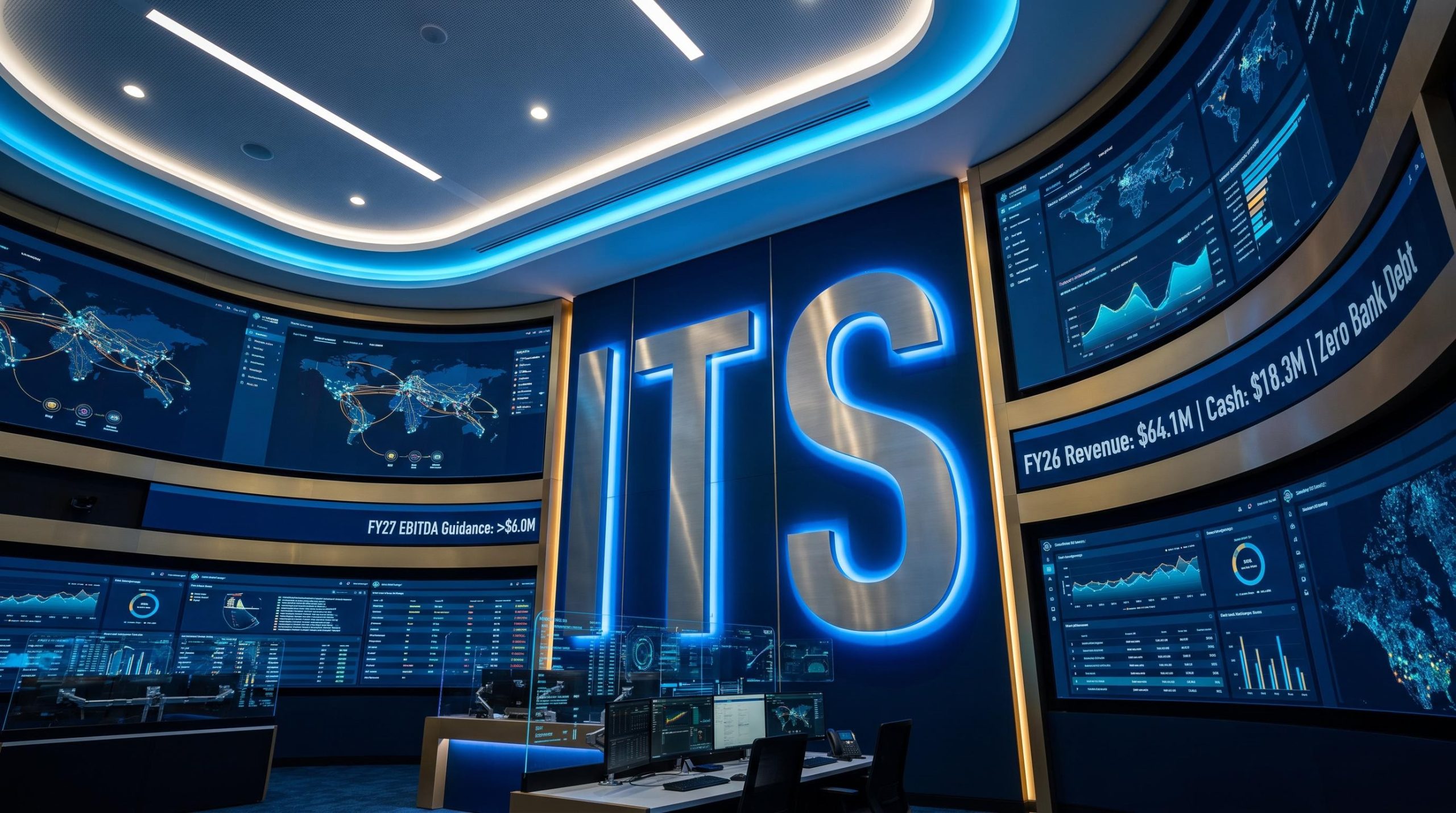
Infotrust completes cyber-first transformation with $18.3m cash and zero bank debt
In its FY26 full year results presentation, dated 31 August 2026, Infotrust (ASX: ITS) detailed the completion of its strategic reset into a focused, cyber-first business. Management outlined revenue growth of 9.8% to $64.1m, operating cash flow of $4.1m, cash of $18.3m and no bank debt.
The transformation involved divesting the NexGen cloud and communications business and acquiring Catalyst Cyber. Looking ahead, the company set FY27 underlying EBITDA guidance of >$6.0m.
When big ASX news breaks, our subscribers know first
FY26 financial results at a glance
The presentation set out the headline continuing-operations metrics, emphasising profitable revenue growth alongside a deliberate step-back in earnings as the company invested in Cyber Security capacity.
| Metric | FY26 | FY25 | % Change |
|---|---|---|---|
| Revenue | $64.1m | $58.3m | +9.8% |
| Underlying EBITDA | $2.7m | $3.4m | (20.3)% |
| Operating cash flow | $4.1m | ($2.2m) | +$6.3m |
| Cash position | $18.3m | $6.3m | +$11.9m |
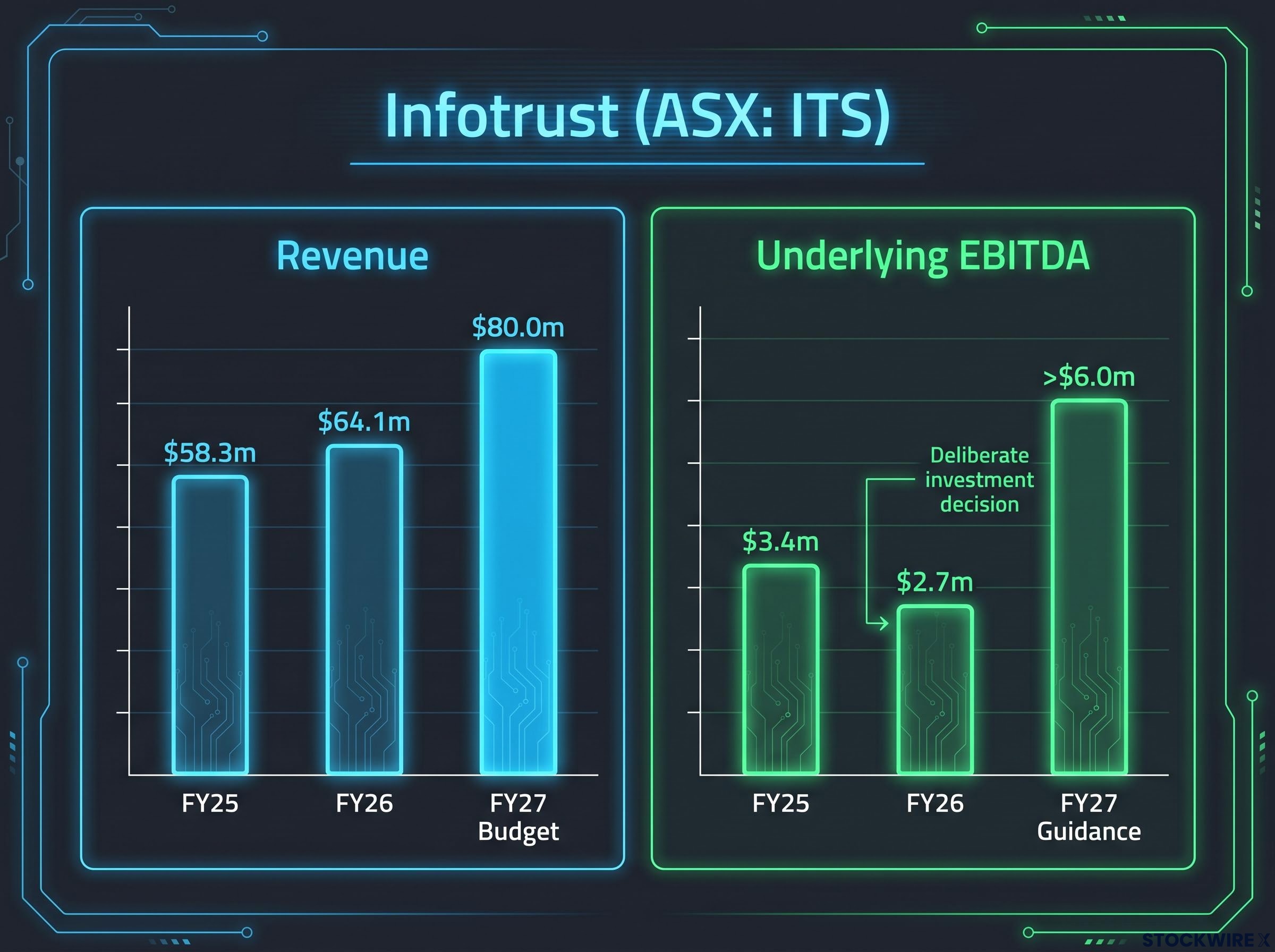
Management framed the 20.3% decline in underlying EBITDA as a deliberate investment decision rather than a deterioration in trading. According to the presentation, the company built Cyber Security capacity ahead of revenue, choosing to carry the cost of growth in FY26 so that FY27 earns the return.
Operating cash flow turned positive at $4.1m, a $6.3m improvement on the prior year’s $2.2m outflow. The company delivered this while self-funding its transformation, absorbing transformation and transaction costs across the period.
How the balance sheet was rebuilt for growth
The presentation detailed how cash almost tripled over the year, rising from $6.3m to $18.3m. The key movements in the FY26 statutory cash flow, which include continuing and discontinued operations, were:
-
NexGen divestment proceeds: $44.8m
-
Catalyst acquisition: ($5.4m)
-
Repayment of bank borrowings (full): ($27.0m)
-
Net cash from operating activities: $4.1m
Management noted the NexGen divestment proceeds were used to repay the senior bank debt in full, leaving the company bank debt free entering FY27. Net assets of $78.2m were lower than the prior year, a movement management attributed largely to non-cash NexGen disposal effects rather than a cash loss.
The Nexgen sale completion on 31 March 2026 delivered $44.1 million in upfront cash to Infotrust, with up to a further $5.9 million contingent on Nexgen meeting EBITDA targets in FY26 or FY27.
The presentation noted this is the strongest financial position the Company has held in recent years, and it funds FY27 without returning to the market.
The company also reported it was net cash positive for the first time in the Group’s recent history, after repaying the full $27.0m facility from divestment proceeds.
The Catalyst acquisition and NexGen divestment
The presentation clearly separated the two transactions that reshaped the balance sheet. Catalyst Cyber, the acquired business, contributed $2.1m in revenue and $0.52m in profit after tax from just ten weeks of ownership, with a full-year contribution expected in FY27. The business targets federal and regulated authorities’ markets.
The Catalyst Cyber acquisition announcement in March 2026 detailed the deal structure as approximately $3.5 million cash and $1.5 million in Infotrust shares, priced at a 5x EBIT multiple, with an uncapped earnout tied to incremental EBIT growth through FY28.
NexGen, the divested business, was sold for up to $50m in cash. Proceeds funded both the full repayment of bank debt and the Catalyst acquisition, consistent with the company’s strategy of targeted, earnings accretive acquisitions to accelerate its Cyber First strategy.
Why sovereign cyber security matters for investors
Infotrust provides sovereign capability while remaining Australian-owned, operated and ASX-listed. For regulated, government and defence-aligned customers, the presentation noted that sovereign capability has shifted from a preference to a procurement requirement.
The presentation outlined five structural demand thematics moving toward the markets Infotrust serves:
-
Tightening regulation across data protection, critical infrastructure and supply chain assurance
-
Cyber resilience treated as a board-level governance obligation, not an IT cost line
-
AI adoption widening both the attack surface and the governance burden
-
Identity and data emerging as the new control planes
-
Sovereignty shifting from preference to requirement
For investors, these drivers connect directly to the company’s growth runway. According to figures cited in the presentation, the Australian cyber security market is forecast to grow at a 10.7% CAGR, with cloud security forecast at 20% CAGR. As global technology groups continue to acquire Australian-owned cyber businesses, management positioned Infotrust as a differentiated sovereign, ASX-listed player.
FY27 priorities and profitable growth outlook
Management outlined its forward roadmap for FY27, led by underlying EBITDA guidance of >$6.0m, building on FY26’s 9.8% revenue growth and a materially strengthened balance sheet.
The presentation also referenced a Board-approved FY27 revenue budget of $80.0m, representing growth of 24.9%. This figure is a budget and target, incorporating a full year of Catalyst plus organic growth, rather than a reported result.
The company set out five priorities for FY27:
-
Profitable growth, scaling six high-growth practices
-
Grow recurring revenue through MDR, SOC and DFIR retainers
-
Improve operational leverage via a unified operating model and margin expansion
-
Lead in sovereign cyber, extending its Federal position through Catalyst
-
Allocate capital with discipline through selective earnings-accretive M&A
Management emphasised that this growth is to be funded from the balance sheet, with $18m+ cash and no bank debt, without returning to the market. As the presentation summarised, the strategy is set, the balance sheet is ready, and growth is next.
Get ASX Cyber Security News Before the Market Moves
Big News Blast delivers FREE breaking ASX announcements straight to your inbox within minutes of release, complete with in-depth analysis so the work is already done. Join 20,000+ subscribers who stay ahead of market-moving news across Tech, Healthcare, Finance and more. Click the “Free Alerts” button at Big News Blast to start receiving alerts today.