
Delorean turns the corner: EBITDA back in positive territory as BOO transition takes shape
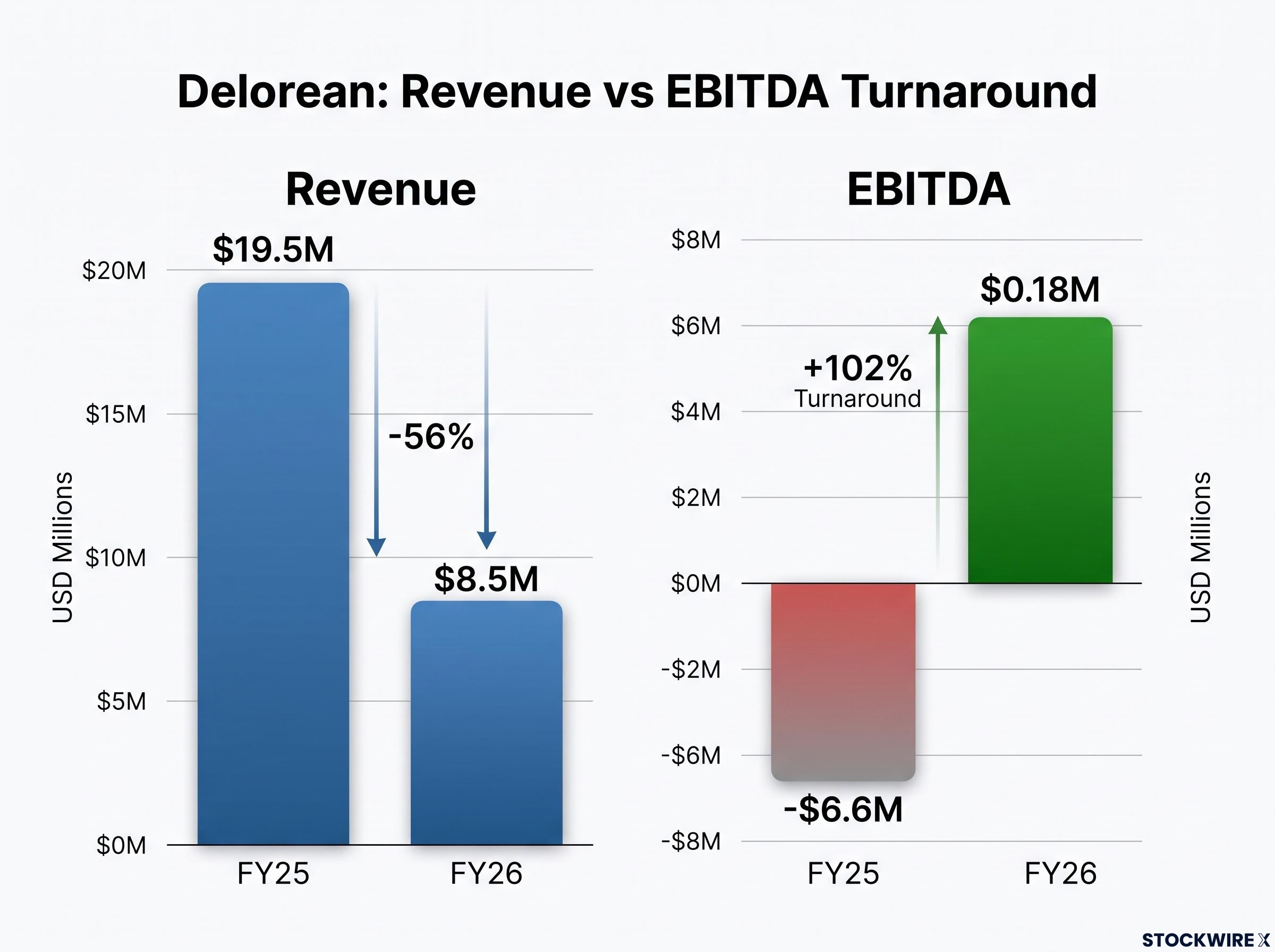
In its FY26 4E preliminary results presentation released in August 2026, Delorean Corporation (ASX: DEL) detailed a return to positive earnings, reporting FY26 EBITDA of $0.18M, up 103% from -$6.6M in FY25.
Management framed the year as a “foundational” period in the company’s transition from an Engineering, Procurement and Construction (EPC) contractor into a long-term infrastructure owner-operator under a Build-Own-Operate (BOO) model, with first BOO revenues expected in FY27.
Delorean was identified as the only ASX listed Build-Own-Operate (BOO) renewable biomethane developer in Australia. All financial figures presented are unaudited and preliminary.
When big ASX news breaks, our subscribers know first
FY26 financial results: a return to positive EBITDA
The presentation detailed a completed reporting period shaped by the structural shift underway across the business. Revenue declined to $8.5M from $19.5M in FY25, a fall the company attributed to planned transition rather than deterioration.
The decline followed practical completion of the approximately $53M Yarra Valley Water (YVW) main construction contract, after which the project moved into a recurring operations and maintenance (O&M) phase. Despite the lower top line, profitability improved markedly.
| Metric | FY26 | FY25 | Change |
|---|---|---|---|
| Revenue | $8.5M | $19.5M | Down 56% |
| Gross Loss | ($0.11M) | ($3.29M) | Down 97% |
| EBITDA | $0.18M | ($6.6M) | Up 103% |
| Net loss after tax | ($0.92M) | ($8.98M) | Down 90% |
| Total Assets | $63.0M | $46.4M | Up 36% |
| Cash Position | $5.6M | $7.8M | Down 28% |
The company outlined several drivers behind the improved result:
-
A $5.76M R&D tax refund relating to eligible FY25 expenditure boosted total income
-
Improved margins on the YVW contract narrowed the gross loss to ($0.11M)
-
Total assets rose 36%, driven largely by SA1 construction progress
-
Debt increased 62% to $48.3M, reflecting construction drawdowns to fund SA1 and the broader pipeline
Management reinforced that FY26 reflected the capital-intensive build phase ahead of operational revenue expected from FY27.
What is Build-Own-Operate bioenergy?
Delorean’s projects use anaerobic digestion, a mature technology in which organic waste diverted from landfill is broken down to produce biogas. That biogas is then upgraded into renewable biomethane, biogenic carbon dioxide (CO₂) and digestate.
Under the BOO model, rather than only building plants for third parties through EPC contracts, the company builds, owns and operates its own plants to capture long-term, contracted, annuity-style revenue.
The presentation set out three revenue pillars:
-
Engineering: EPC and O&M contract margins
-
Infrastructure: renewable natural gas, biogenic liquid CO₂ and gate fees
-
Energy Retail: trading of Australian Carbon Credit Units (ACCUs), Renewable Gas Guarantees of Origin (RGGOs) and Large-scale Generation Certificates (LGCs)
For investors, the significance lies in the earnings profile. Once assets are operational, revenue becomes predictable and recurring, with the company targeting 15%+ unlevered project IRRs.
Flagship projects driving the transition
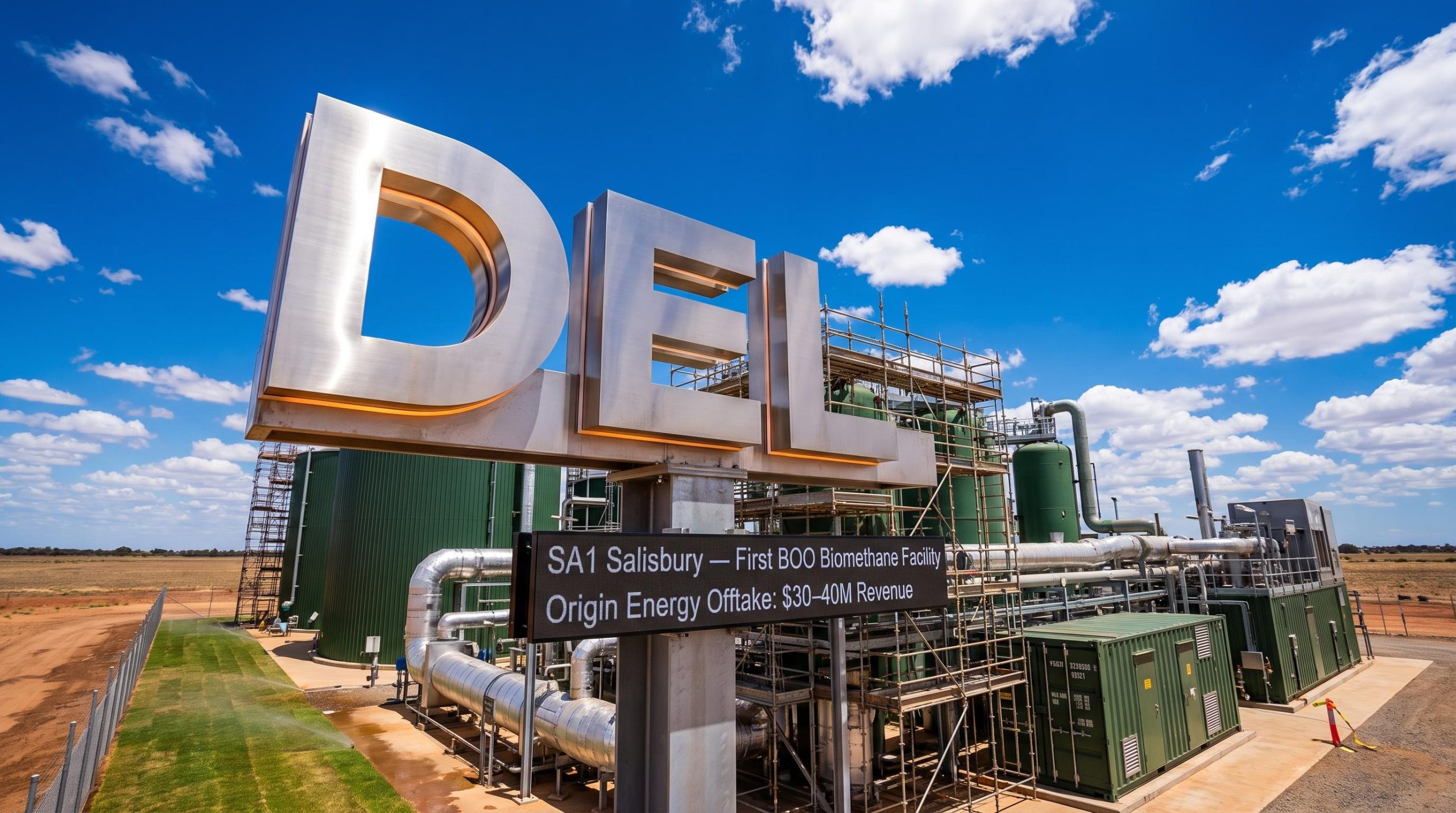
SA1 Salisbury — first BOO project nearing completion
Located within the northern Adelaide food park in South Australia, SA1 Salisbury advanced significantly during FY26. The company reported construction progressed to over 85% complete in its FY26 Achievements summary, though elsewhere in the presentation the project is described as “over 75% complete”.
The project secured a 10-year Origin Energy biomethane offtake agreement, locking in $30–40M in revenue over the term. Combined with a liquid biogenic CO₂ offtake agreement with Supagas, this brought approximately $55M of long-term contracted revenues with investment grade counterparties.
Financing progressed with a $14.5M NAB bank loan facility secured to support delivery, alongside a further $1.66M ARENA grant, bringing total ARENA payments received to $5.46M of $7.74M. The project also achieved GreenPower Renewable Gas certificate accreditation.
SA1 is described as the first bioenergy facility in Australia to produce mains-grade biomethane and biogenic CO₂. First waste and first gas are expected in CY2026, with revenues anticipated in FY27.
NSW1 Horsley Park — 100% DEL-owned, FID reached
The company reached a positive Final Investment Decision (FID) on its 100%-owned NSW1 Horsley Park facility in April 2026. The project secured $30.5M in grant funding, comprising $20M from the NSW Government and $10.5M from ARENA, subject to Financial Close.
The NSW1 Final Investment Decision, reached in April 2026, secured binding 25-year agreements with Brickworks and unlocked the $30.5M in government grants, with financial close required within six months to make all commitments unconditional.
NSW1 entered into a 25-year lease and renewable gas offtake agreement with Brickworks, and is expected to generate approximately $13M of revenue per year before CPI, subject to financial close. Construction is anticipated to commence in CY2026.
A $200M+ near-term portfolio and sector tailwinds
The presentation positioned the company’s development pipeline as its forward-looking investment thesis. Delorean detailed 5 near-term development projects worth $200M+, supported by a 9x long-term development portfolio valued at $500M+.
Key portfolio elements include:
-
VIC1 Stanhope: shovel-ready and 90% DEL owned
-
QLD1: a $5M Queensland Government grant approved in support of the project
-
Opal partnership: an up to $2M Opal-funded feasibility study at the Maryvale Paper Mill, with a potential 50/50 joint venture under which Delorean holds first right of refusal for 50% equity following a successful feasibility study
Management pointed to several sector tailwinds underpinning demand:
-
The Safeguard Mechanism, requiring more than 200 of Australia’s largest industrial facilities to reduce emissions
-
Australia’s Future Gas Strategy, which recognises the role of gas in the future energy mix
-
Biomethane as a commercially viable, drop-in renewable gas that can utilise existing infrastructure
The company also noted a strategic 9.97% shareholding by LMS Energy, established through a $2.2M placement, alongside a $0.75M Share Purchase Plan (SPP) that strengthened the register.
The LMS Energy strategic placement brought more than four decades of bioenergy operational expertise onto Delorean’s register, with LMS operating over 70 biogas projects across Australia, New Zealand, and the United States, a credential set that extends well beyond the $2.2M capital contribution.
The road to FY27
Delorean FY26 4E Results Presentation
“FY2026 represents a foundational period in Delorean’s transition from EPC contractor to infrastructure owner and operator.”
The presentation set out the company’s forward priorities heading into FY27:
-
Complete and commission SA1, delivering first BOO revenues in FY27
-
Progress NSW1 and VIC1 towards construction start
-
Optimise the capital structure and secure BOO funding
-
Conclude further government grant applications
-
Expand feedstock, offtake and industrial decarbonisation partnerships
Management framed the strategy as positioning Delorean to deliver recurring, infrastructure-backed earnings from FY27 onward, as its BOO assets move from construction into operation.
Don’t Miss the Next Utilities Sector Breakout
Big News Blast delivers FREE breaking ASX news straight to your inbox within minutes of release, complete with in-depth analysis already done for you. Join 20,000+ subscribers staying ahead of market-moving announcements across utilities and beyond. Click the “Free Alerts” button at Big News Blast to make sure you never miss the next major ASX development.