

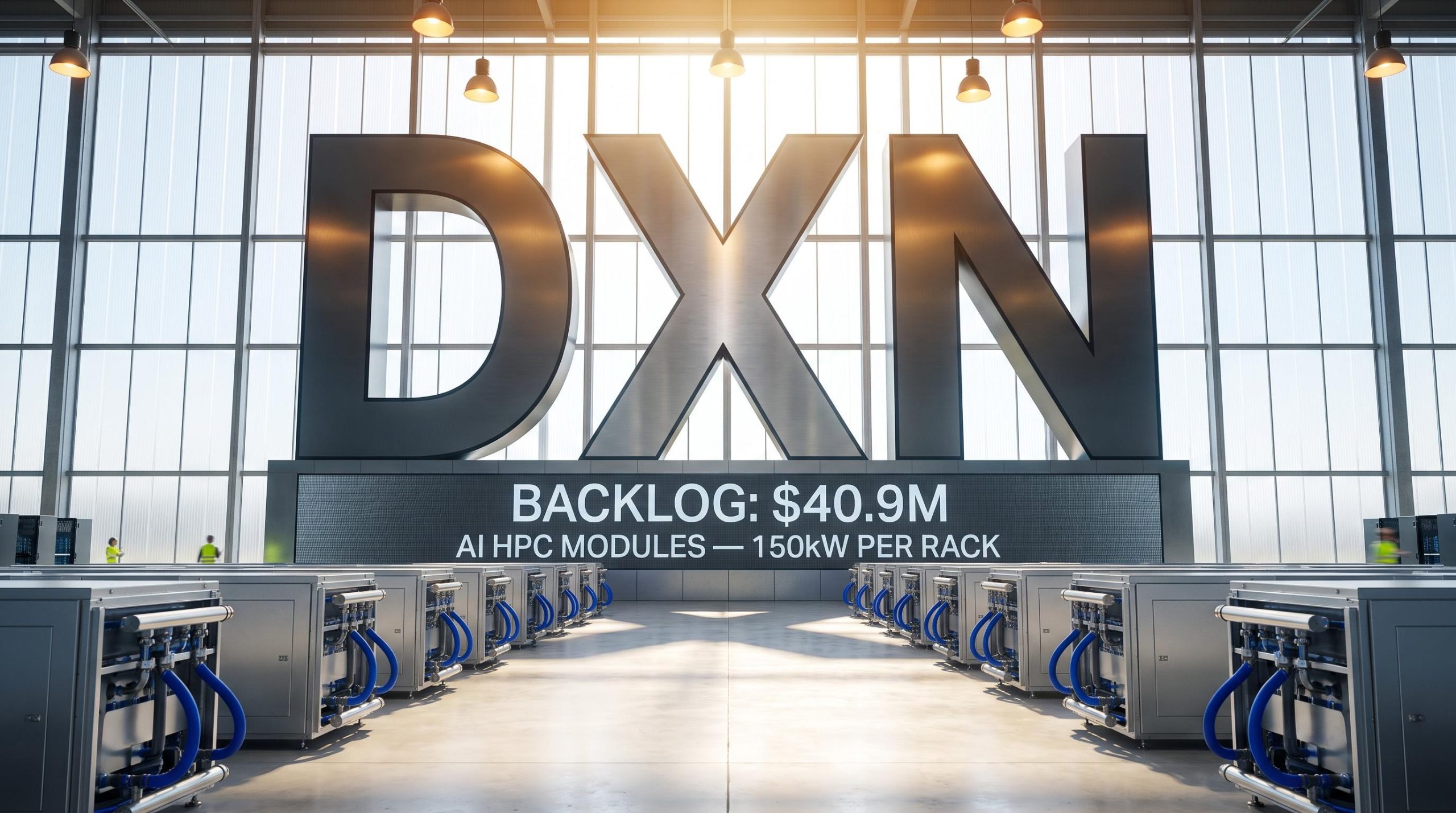
DXN details AI data centre pivot with record FY26 backlog of $23.5m
In its FY26 investor presentation, released 31 August 2026, DXN Limited outlined a strategic repositioning towards prefabricated modular data centres built for the artificial intelligence (AI) compute boom.
Management detailed a record contracted backlog of $23.5m as at 30 June 2026, which had grown to $40.9m by 30 August 2026 following multiple contract wins. The company signed its maiden AI high-performance computing (HPC) contract in June 2026 and completed a $7.0m institutional capital raise, lifting cash to $11.0m.
FY26 revenue declined, yet the presentation framed the narrative as forward-looking, anchored to a deepening pipeline, AI HPC modules, and manufacturing expansion. The update signalled DXN’s shift from a small modular projects business towards an AI infrastructure play.
When big ASX news breaks, our subscribers know first
The business at a glance and where revenue comes from
DXN describes itself as a vertically integrated manufacturer and operator of modular data centres, established in 2010 and prefabrication-focused since 2020, operating across the Asia-Pacific region. The company designs, engineers, manufactures, deploys, operates and maintains modular data centres across three core divisions.
Revenue for FY26 was split across those divisions as follows, calculated on revenue including the now-divested Hobart (TAS01) data centre.
| Division | FY26 Revenue Share | What it does |
|---|---|---|
| Modular Division | ~73% | Design, engineering, manufacturing and deployment of prefabricated data centres globally |
| Data Centre Operations | ~23% | Owns and operates 75-rack critical infrastructure in Darwin |
| DCaaS | ~4% | Capital-light facility-as-a-service model |
Why prefabricated modular data centres matter in the AI era
A prefabricated modular data centre is built in a factory as complete units, or modules, rather than constructed piece by piece on-site. The modules arrive tested and ready for service, which contrasts with traditional builds that require lengthy on-location construction.
Management pointed to several supply-side problems driving the shift. Customers face long lead times caused by skilled labour shortages, equipment shortages and permitting delays. DXN’s answer centres on speed to market (delivery in months rather than years), a product-agnostic design that adapts to new chip and cooling technology, custom build capability, and a decade-long track record.
The presentation introduced DXN’s AI HPC modules as factory-built, AI-ready units. They support up to 150kW per rack with 80-90% direct-to-chip liquid cooling, are available in 1MW and 2MW all-in-one configurations, scale in 10-20MW clusters, and are 95% factory-built.
Management set out the measurable benefits:
-
Parallel factory and site construction cuts delivery to 6 months for a 2MW module or 8 months for a 10MW cluster.
-
Shorter build duration lowers site overheads and improves cost predictability.
-
A 95% factory-built approach reduces on-site labour, rework and commissioning risk.
-
Phased cluster expansion reduces upfront capital commitment and demand risk for customers.
This productised approach is what positions DXN for hyperscalers and neocloud providers seeking AI capacity.
FY26 financial results in review
DXN recorded a 33% decline in revenue to $10.1m (FY25: $15.1m), reflecting customer-side project deferrals in the first half of FY26 that partly recovered as deferred work progressed through the second half.
Gross profit fell to $1.8m (FY25: $4.9m), with margin pressure attributed to under-utilised first-half capacity and elevated project costs for Globalstar. Loss after tax attributable to owners widened to $6.6m (FY25: $2.3m), including a $0.55m loss from the discontinued Hobart (TAS01) data centre.
Importantly, the maiden AI HPC contract signed in June 2026 is not yet reflected in FY26 revenue, framing the reported loss as a pre-inflection result.
The maiden AI HPC contract, signed with a publicly listed US neo-cloud operator, calls for a 1.36MW modular data centre built at DXN’s Welshpool facility and commissioned at the customer’s US mainland site within approximately six months, with direct liquid cooling supporting GPU rack densities that air-cooled systems cannot match.
On a non-IFRS, unaudited basis, Underlying EBITDA from continuing operations was -$3.7m (FY25: +$0.5m).
| Metric | FY26 ($m) | FY25 ($m) |
|---|---|---|
| Sales to customers | 10.1 | 15.1 |
| Gross profit | 1.8 | 4.9 |
| Loss after tax from continuing ops | (6.1) | (2.4) |
| Underlying EBITDA (non-IFRS) | (3.7) | 0.5 |
| Loss after tax attributable to owners | (6.6) | (2.3) |
Strengthened balance sheet
The presentation detailed a materially stronger capital position:
-
Cash rose to $11.0m (FY25: $3.1m), supported by the $7.0m institutional capital raise completed in June 2026.
-
Contract liabilities increased to $3.8m, reflecting customer deposits on new AI HPC and modular contracts, a forward-demand signal.
-
Inventories and work in progress nearly quadrupled to $2.0m on manufacturing progress.
-
Net assets improved to $5.4m (FY25: $4.9m).
Record backlog and a deepening pipeline
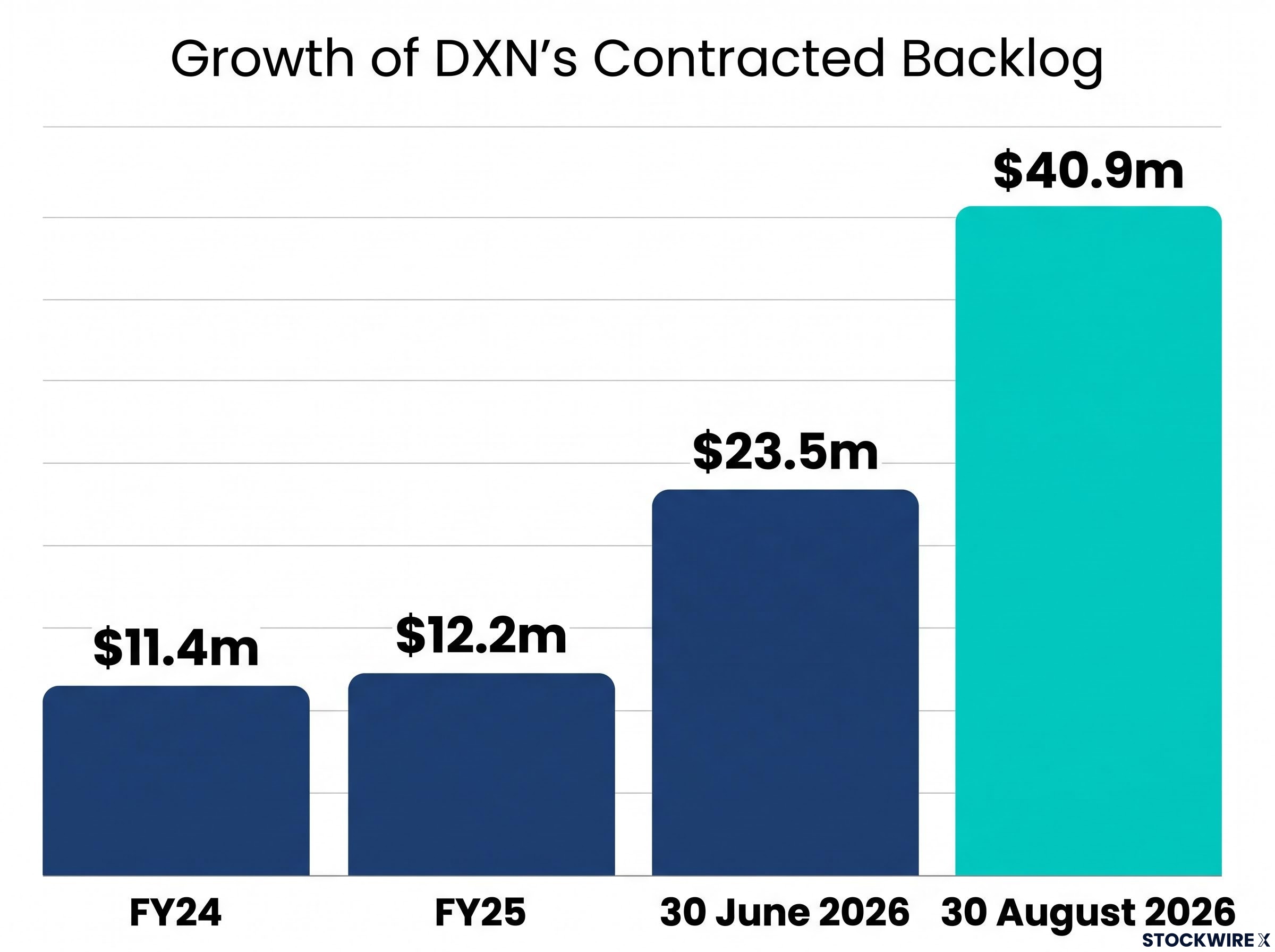
DXN reported its strongest backlog position to date. Contracted work not yet delivered grew from $11.4m in FY24 to $12.2m in FY25, then to $23.5m as at 30 June 2026. The backlog includes the initial $8.8m AI HPC contract.
Key backlog details from the presentation include:
-
Modular backlog of $19.0m, with 45% expected to be delivered in the first half of FY27.
-
Post year-end growth to $40.9m as at 30 August 2026, driven by multiple contract wins.
-
A second AI HPC contract valued at $12.2m, alongside projects including the Solomon Islands Submarine Cable Company (SISCC) and Melbourne Airport.
The second AI HPC contract, valued at A$12.2 million for a turnkey 2MW modular data centre, was awarded in part because conventional construction could not meet the customer’s deployment timeframe, reinforcing modular speed-to-market as the primary competitive differentiator in this segment.
On the pipeline, management identified 99 projects, of which 21% relate to global AI compute infrastructure customers. The identified pipeline funnel comprised:
-
Identified: 41 projects
-
Qualified: 16 projects
-
Proposal or RfP submitted: 27 projects
-
Final negotiations: 8 projects
-
Verbal win / Contracting: 7 projects
Backlog nearly doubling year-on-year, combined with post-period wins, points to demand-led momentum.
FY27 outlook and expansion roadmap
Management outlined its FY27 priorities, anchored to the delivery of the AI HPC pilot and continued Asia-Pacific expansion:
-
Successful delivery and commissioning of the AI HPC pilot, positioned as the key catalyst for converting an indicative US$200m+ follow-on opportunity into contracted work.
-
Commencement of production at the newly leased Malaysian manufacturing facility, currently expected in Q2 FY27.
-
Progress on a proposed east coast Australian facility, also targeted for Q2 FY27.
The presentation noted that expansion plans will be led by DXN’s newly appointed Chief Operating Officer, and that the reinforced capital position supports the company’s ability to capitalise on accelerating global demand for high-density AI compute infrastructure.
DXN FY27 positioning (presentation summary)
“DXN enters FY27 with a materially strengthened balance sheet and a foothold in the global AI HPC and neo-cloud market.”
For investors, the update presents a small-cap repositioning around AI infrastructure, funded and carrying a record backlog. Execution of the AI HPC pilot remains the pivotal near-term proof point, as it underpins both revenue conversion and the indicative follow-on opportunity that management has flagged.
Don’t Miss the Next ASX Tech Breakout
Big News Blast delivers FREE breaking ASX tech and AI news directly to your inbox within minutes of release, complete with in-depth analysis. Join 20,000+ subscribers already ahead of the market. Click the “Free Alerts” button at StockWire X to get the next market-moving announcement the moment it drops.