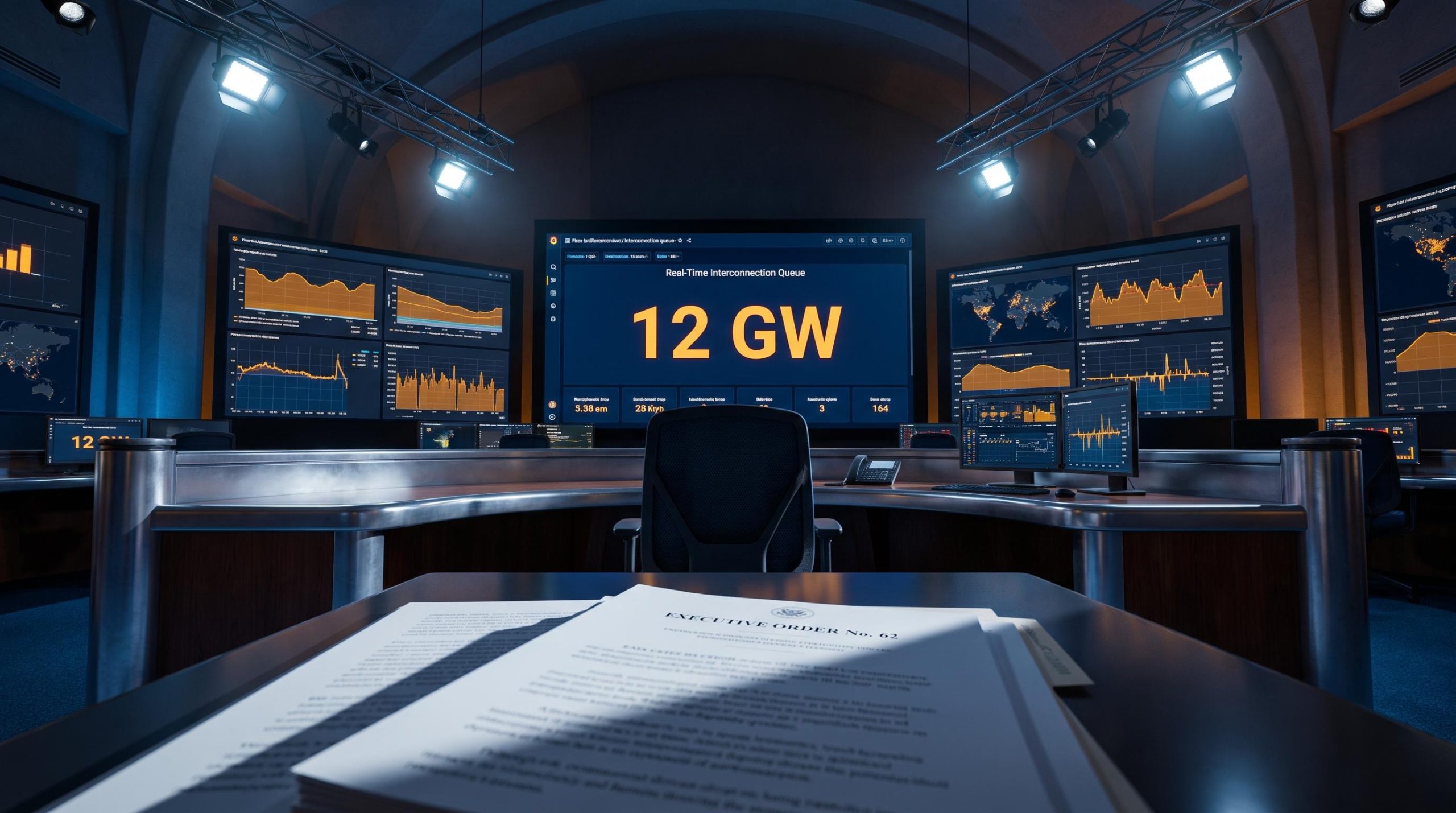
New York just imposed the first statewide moratorium on hyperscale data centre construction in American history. That sentence should land harder than it probably does, because until 14 July 2026, no US state had drawn a line this bright around AI infrastructure development. The assumption embedded in most AI-infrastructure investment models, that capital deployed into data centres faces engineering constraints but not political ones, is now testable against reality. It is being tested, and it is losing.
The timing matters. AI growth optimism is already priced into infrastructure plays across the sector. Capacity announcements from hyperscale operators have been absorbed by markets as forward revenue with relatively modest discounting for execution risk. Yet in the space of four months, one state has halted permitting outright, a second came within two legislative votes of doing the same, and a third has effectively frozen new grid interconnections under the weight of a queue that dwarfs available capacity.
Here is a framework for distinguishing temporary permitting friction from structural constraint, and for applying that distinction to how you evaluate current and prospective positions in AI infrastructure.
The first statewide moratorium sets a precedent that now travels
Governor Kathy Hochul signed Executive Order No. 62 on 14 July 2026, directing the New York Department of Environmental Conservation (DEC) to suspend all discretionary environmental permits for data centres consuming, or capable of consuming, 50 megawatts (MW) or more. Applications already deemed complete may proceed. Everything else waits.
The mechanism is a Generic Environmental Impact Statement (GEIS), to be conducted by the Department of Public Service (DPS). The order frames the GEIS as lasting “up to one year,” but critically, there is no statutory hard deadline for its completion. Key waypoints are expected in late 2026 and early 2027, but the process could extend beyond that window without violating the order’s terms. The GEIS will evaluate large data centres across six dimensions:
- Energy demand
- Water use
- Air quality
- Noise
- Disproportionate impacts on disadvantaged communities
- Grid reliability and ratepayer effects
Nearly 12 GW of data centre load requests are sitting in the NYISO interconnection queue, a figure that quantifies the demand pressure behind the order and explains why the political logic for a pause was difficult to resist.
The 12 GW figure sitting in the NYISO queue is a downstream symptom of a broader structural condition: AI energy demand has grown fast enough that grid infrastructure in major markets cannot absorb it on the timelines hyperscalers originally assumed.
That queue number is not incidental context. It is the reason the moratorium exists. 12 GW of requested load in a single state grid represents a resource claim large enough to reshape electricity pricing, water allocation, and community infrastructure planning for decades. The order is a direct response to documented strain, not a precautionary gesture.
What the order does not cover
The exemption structure narrows the moratorium’s scope to net-new hyperscale commercial development. Facilities primarily used for manufacturing, research, education, or medical care are exempt. Projects with already-complete permit applications are unaffected. This means the moratorium targets the precise category of development driving the interconnection queue: large-scale commercial AI and cloud computing facilities seeking first-time grid access.
For investors building capacity addition timelines around specific project announcements, the open-ended GEIS is the sharpest risk: a project stalled in New York is not facing a defined one-year delay but a process with no completion clock. Capital deployment schedules built on point-estimate timelines are structurally miscalibrated for this environment.
When big ASX news breaks, our subscribers know first
Maine’s near-ban reveals how close the legislative coalition came to tipping
New York acted through executive authority. Maine’s story is more instructive because it ran the full legislative gauntlet, and nearly made it through.
LD 307, titled “An Act to Establish the Maine Data Center Coordination Council and Place a Temporary Limitation on Certain Data Centers,” would have imposed an 18-month moratorium on data centres using more than 20 MW of power. That threshold is materially lower than New York’s 50 MW bar, which means LD 307 would have captured a broader category of facilities. The legislative sequence unfolded quickly:
- LD 307 was introduced and moved through committee
- The bill passed both chambers of the Maine Legislature
- Governor Janet Mills vetoed the bill on 24 April 2026
- The House attempted to override the veto on approximately 29 April 2026
- The override failed by two votes, sustaining the veto
The veto override failed by two votes. Maine was the first US state to pass data centre moratorium legislation through its legislature before it was blocked.
Two votes. That margin is the single most important political data point in this regulatory cycle, not because the moratorium passed (it did not) but because it nearly did, in a state that was not widely identified as a moratorium risk before LD 307 surfaced.
The policy implication is direct: gubernatorial veto power remains a check on statewide moratoriums, but the political coalition capable of passing one can be assembled in states beyond New York, and it can assemble faster than most industry participants expected. A two-vote margin is not a signal that the restriction movement is weak in Maine. It is a signal that one shifted election or one changed governor could convert a near-miss into law. If you are treating the veto as a durable resolution, you are reading the wrong signal.
Why restrictions push capacity into fewer places rather than stopping it
The restrictions documented above are not stopping planned capacity from being built. They are redirecting it. That sounds reassuring until you follow the displacement to its logical conclusion.
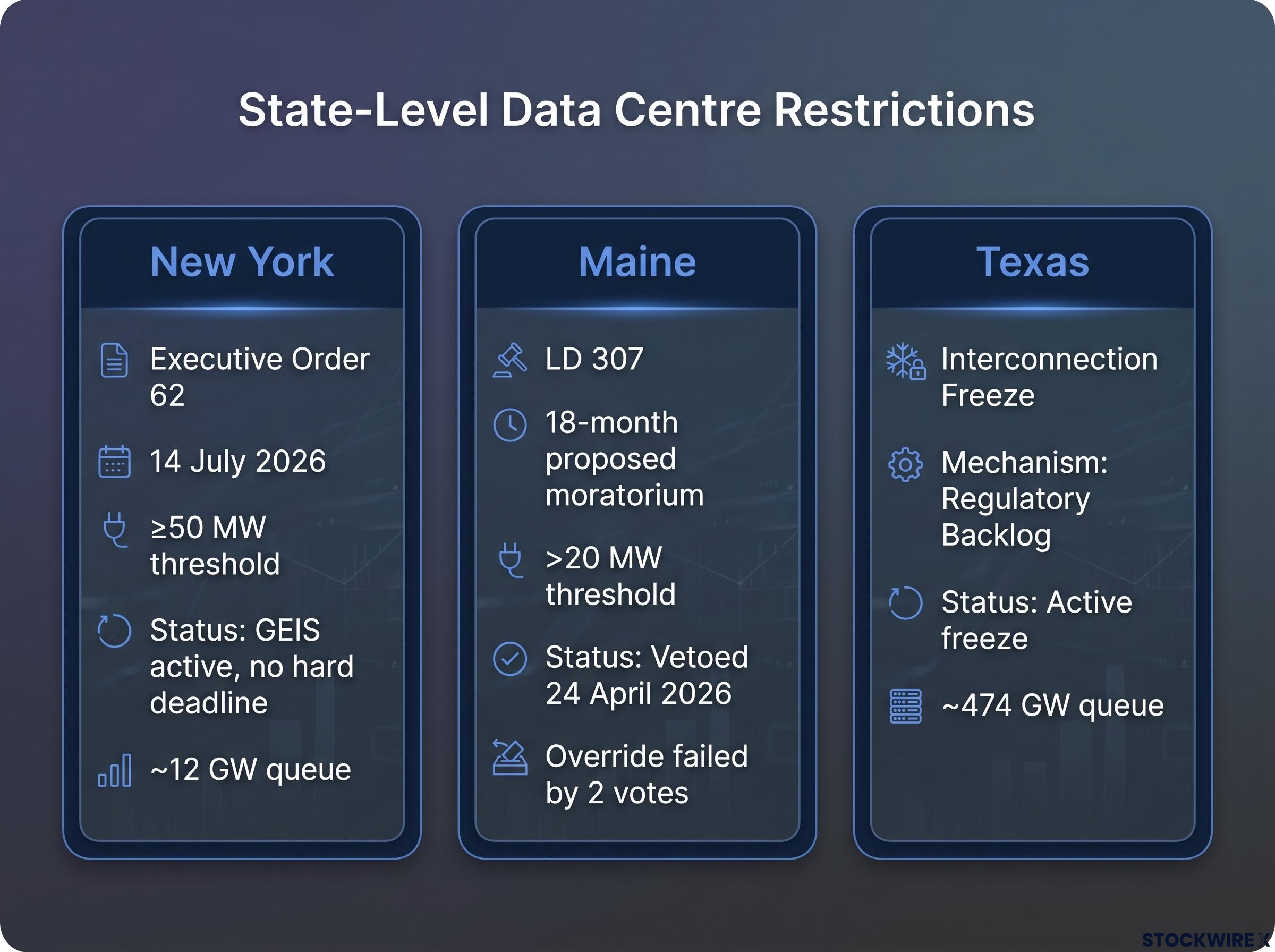
| State | Restriction mechanism | Threshold or trigger | Current status |
|---|---|---|---|
| New York | Executive order (EO 62), permitting moratorium | ≥50 MW facilities | Active; GEIS under way, no hard deadline |
| Maine | Legislative moratorium (LD 307), vetoed | >20 MW facilities | Vetoed; override failed by two votes |
| Texas | Grid interconnection freeze (regulatory backlog) | ~474 GW queue (majority data centres) | Effective freeze while regulators review |
Texas is the telling case. There is no formal legislative moratorium. Instead, the large-load interconnection queue has reached approximately 474 GW of requests (the majority involving data centres or similar infrastructure), creating an effective freeze on new grid connections while regulators work through the backlog. The constraint operates through a different mechanism, queue saturation rather than legislation, but the practical outcome for developers is similar: new projects cannot connect to the grid on the timelines their financial models assumed.
The pattern is clear. States tightening through legislation, executive action, or queue overload are pushing development toward jurisdictions with cheaper power, more available land, and fewer restrictions. That reallocation keeps aggregate planned capacity broadly intact. It also creates two problems that are harder to see.
Goldman Sachs revised data centre capacity forecasts upward sharply in July 2026, projecting 217 GW of global capacity by 2030 and identifying power availability as the primary binding constraint, a finding that makes the New York moratorium and Texas queue saturation look less like isolated events and more like early expressions of a system-level problem.
When the next permissive state runs out of runway
States absorbing displaced hyperscale development will experience growing grid strain, community opposition, and political attention as their own infrastructure encounters the same pressures that triggered restrictions in New York and Maine. This is not speculation. It is the documented pattern: local impacts from noise, water withdrawals, elevated utility costs, and grid strain generate community opposition, which translates into legislative and regulatory action.
The dynamic is a repeating cycle, not a one-time displacement. Projects sited in currently permissive locations for regulatory reasons may face higher operating costs through more expensive power, longer transmission distances, or more extensive grid upgrade requirements. Over assets designed to run at high utilisation for a decade or more, those cost differentials compound. The investor thesis that “capacity will be built somewhere” does not resolve the questions about where, at what cost, and under what future political conditions. It defers them.
Policy tracker data (which should be treated with appropriate qualification, as the specific figures have not been independently confirmed across all sources) suggests the number of state-level data centre measures tracked nationally rose from 46 to 68 by 24 August 2026. The direction of that number matters more than its precision.
What the regulatory landscape actually means for AI infrastructure investors
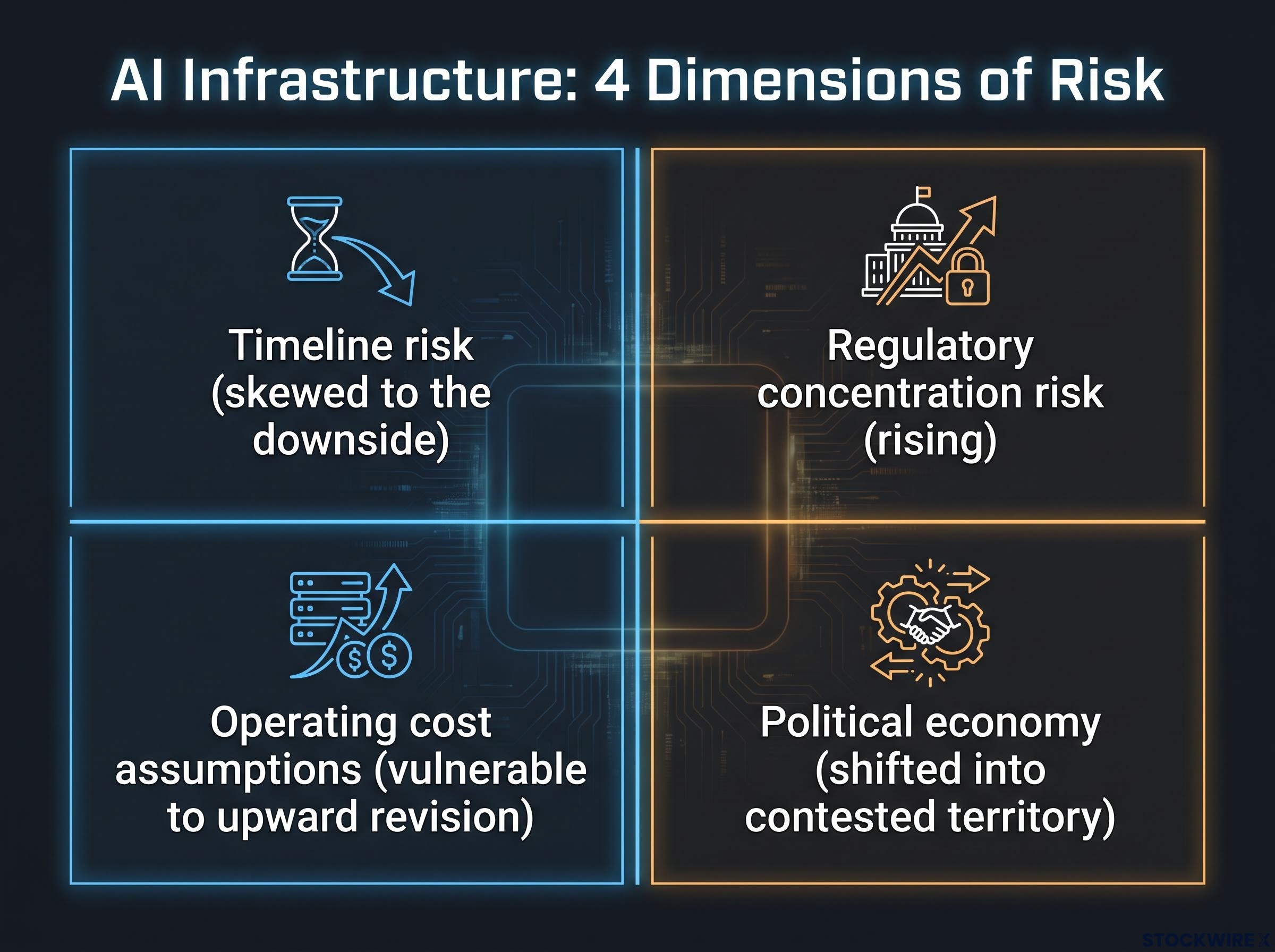
The analytical through-line across these developments translates into four specific risk dimensions. Each one is a portfolio-level question, not an abstract sector observation.
- Timeline risk (skewed to the downside). New York’s open-ended GEIS, with waypoints expected in late 2026 and early 2027 but no statutory completion clock, introduces potentially multi-year uncertainty for any new project requiring DEC permits above 50 MW. Maine’s near-moratorium shows similar timelines can be credibly proposed and passed in other states. Revenue and earnings models that assume linear capacity additions need to incorporate these probabilistic delays rather than treating them as low-impact edge cases.
- Regulatory concentration risk (rising). As restrictive states pause major projects, capacity shifts toward states viewed as friendlier, many of which are simultaneously tightening grid-connection scrutiny or considering their own measures. If one or two currently permissive hubs change course after significant buildout has already occurred, the resulting disruption could be sharper than a gradual spread of moderate restrictions.
- Operating cost assumptions (vulnerable to upward revision). Moratoriums and tighter permitting that prioritise grid reliability and ratepayer protection increase the likelihood that data centres will face efficiency mandates, load management requirements, or infrastructure contribution obligations that raise long-run costs relative to current assumptions. For displaced projects in suboptimal locations, cumulative effects on power costs and latency performance erode margins over the asset’s operating life.
Hyperscaler capex is now absorbing roughly 93-94% of operating cash flow at major AI infrastructure spenders, according to PIMCO estimates, which means the financial cushion available to absorb regulatory delays or cost escalation from suboptimal site selection is materially thinner than headline investment figures suggest.
- Political economy (shifted into contested territory). New York has imposed the first statewide moratorium. Maine’s legislature passed an 18-month ban before a narrow veto. State-level measures have proliferated. Data centres are now a recognisable political issue. Once an industrial activity is politicised at the state level, experience from other infrastructure sectors suggests opposition tends to intensify as the footprint grows, not subside as initial controversies age.
Fisher Investments has cautioned that a significant portion of AI growth optimism has already been priced into current valuations, meaning positive developments may struggle to meet elevated market expectations.
That observation is the most directly actionable data point in this analysis. It means that even a buildout proceeding broadly on plan may not deliver the returns implied by current prices, because meeting elevated expectations requires not just execution but outperformance. The regulatory headwinds documented here make outperformance harder, not easier.
Friction, or fault line? How to position when the answer is not yet clear
The honest answer is that the distinction between temporary friction and structural fault line has not been resolved. The restrictions documented here do not collapse the AI data centre buildout. They change its shape, cost structure, and geographic concentration in ways that materially affect long-run returns if left unincorporated in investment models.
The asymmetry is where the practical takeaway lives. The upside scenario, where restrictions ease and buildout accelerates, is visible and already largely priced in. The downside scenarios, where restrictions spread, concentration risk crystallises, and costs rise, are less priced in and deserve more explicit portfolio weight. If you are treating current regulatory developments as temporary noise, you may be systematically underweighting the scenarios most likely to disappoint elevated expectations.
Three specific monitoring variables give you a continuous read on which way this resolves:
Regulatory-driven supply-side constraints on AI infrastructure are not limited to grid permitting: the FCC’s proposed restrictions on Chinese optical transceivers could open a 12-24-month gap in the networking components that connect GPU clusters, adding a hardware availability risk that compounds the site-level delays the New York moratorium creates.
- GEIS completion milestones: Track the New York DPS process against the late 2026 and early 2027 waypoints. Slippage beyond those dates amplifies timeline risk for the entire sector, not just New York projects.
- Permissive-state pipeline pressure: Watch grid connection queues and community opposition dynamics in the states currently absorbing displaced development. These are the most likely venues for the next round of meaningful restrictions.
- National legislative tracker: The rise from 46 to 68 tracked state-level measures (as of 24 August 2026; this figure has not been independently confirmed across all sources) is the broadest leading indicator of political momentum. The trajectory matters more than any single bill.
The risk model supporting current AI infrastructure valuations is incomplete. Closing that gap is now a required step for anyone holding or considering positions in the sector, not an optional refinement for a later date.
This article is for informational purposes only and should not be considered financial advice. Investors should conduct their own research and consult with financial professionals before making investment decisions. These statements regarding future regulatory developments and their market implications are speculative and subject to change based on political, regulatory, and market conditions.