
Visionflex narrows loss and turns cash flow positive in 2H FY26
In its FY26 audited full year results for the 12 months ending 30 June 2026, Visionflex Group recorded a sharp reduction in losses and returned to positive operating cash flow in the second half. The virtual healthcare technology provider narrowed its statutory loss before tax by 84% to $0.6m (FY25: $3.7m), while its underlying EBITDA loss was cut 34% to $1.6m.
Net operating cash outflow improved 60% to $1.3m (FY25: $3.2m). Revenue of $4.2m was down 10%, though the Company attributed this to customer-requested deferral of hardware deliveries into FY27 rather than lost demand.
The figures reflect a business shifting toward higher-margin recurring revenue on a materially lower cost base.
When big ASX news breaks, our subscribers know first
FY26 financial results at a glance
The scorecard below summarises the key financial metrics against the prior corresponding period.
| Metric | FY26 | FY25 | Change | Significance |
|---|---|---|---|---|
| Total revenue | $4.2m | $4.7m | ▼ 10% | Hardware deferrals into FY27 |
| Gross margin | 86% | 78% | ▲ 8pts | Richer subscription mix |
| Underlying EBITDA | ($1.6m) | ($2.5m) | ▲ $0.8m | Cost discipline |
| Loss before tax | ($0.6m) | ($3.7m) | ▲ 84% | Material narrowing |
| Net operating cash outflow | ($1.3m) | ($3.2m) | ▲ 60% | Approaching breakeven |
Gross margin expansion to 86% was driven by the increasing mix of higher-margin subscription revenue alongside a higher-margin peripheral component within hardware sales. The reduced underlying loss reflected both a richer revenue mix and cost discipline, with a workforce restructuring completed in February 2026 now fully reflected in the run rate.
Management framing
Disciplined cost management and a higher-margin revenue mix drove a material reduction in the underlying loss and a return to positive operating cash flow in the second half.

Recurring revenue becomes the growth engine
The strategic shift toward subscription and recurring income sits at the centre of the FY26 result. This transition improves both the predictability and quality of the Company’s revenue base.
Key recurring revenue metrics for FY26 included:
-
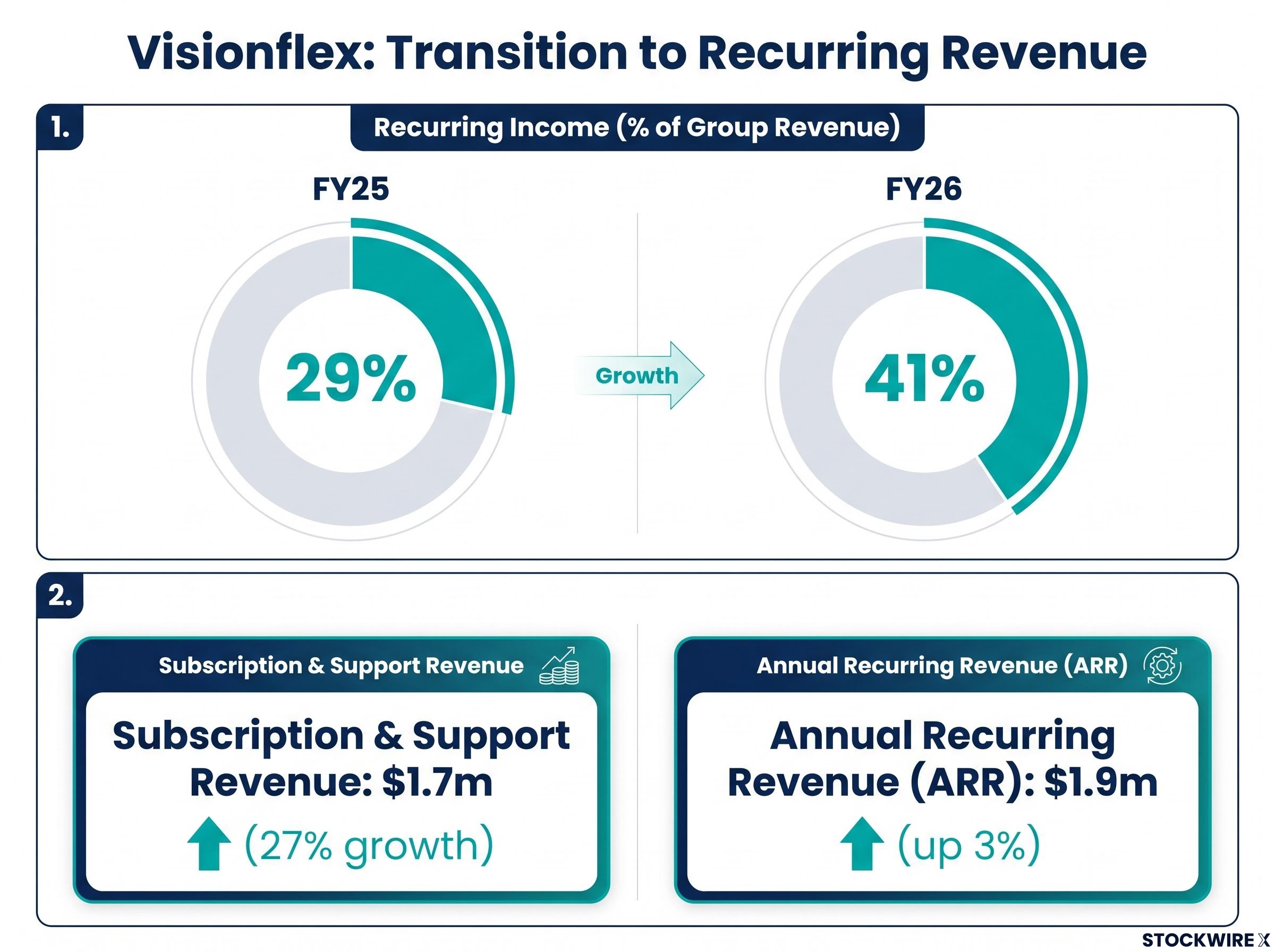
Subscription and support revenue grew 27% to $1.7m
-
Recurring income now represents 41% of Group revenue (FY25: 29%)
-
Annual Recurring Revenue (ARR) of $1.9m at 30 June 2026, up 3% on the prior corresponding period
Hardware serves as a foundational step that converts into long-term software subscriptions, with software licensing priced at approximately $5k per annum per unit.
What is Annual Recurring Revenue — and why it matters
Annual Recurring Revenue (ARR) measures the predictable subscription income a company expects to receive over a 12-month period. Unlike one-off hardware sales, which generate revenue only once, subscription revenue recurs each year for as long as the customer remains active.
Investors typically place greater value on recurring revenue for several reasons. It is more predictable, allowing clearer forecasting. It generally carries higher margins, because delivering software costs far less than manufacturing and shipping physical devices. And it tends to support stronger valuation quality, as steady, repeatable income streams reduce reliance on winning new one-off orders each year.
For Visionflex, this dynamic is visible in the numbers. As deployed hardware converts into ongoing subscriptions, the quality of revenue improves, evidenced by the 86% gross margin recorded in FY26. Each hardware installation effectively creates a platform for future recurring income, strengthening the long-term revenue base.
Enterprise and government contract wins broaden the base
Visionflex broadened its enterprise and government customer base across FY26, with several signed and expanded contracts tagged to Total Contract Value (TCV):
-
NSW Health — a statewide contract to supply clinical hardware for its Remote Patient Monitoring Digital Uplift initiative, TCV of ~$0.8m, signed and delivered in Q4 FY26
-
Amplar Health (Medibank) — residential aged care deployments grew from 10 to 30 facilities across the year, TCV of ~$0.6m
-
Royal Flying Doctor Service (SA/NT) — subscription upgrades across 12 facilities, expansion into a further 8, plus development of the new unattended access capability, TCV of ~$0.3m; network deployment begins Q1 FY27
-
Aspen Medical — secured contracts for the deployment of solutions with Origin Energy and the CSIRO, TCV of ~$0.1m
-
BlueCare Queensland — renewed 26 facilities, TCV of ~$0.1m
Beyond these, US expansion continued through distribution partners Avnet and ePlus (TCV ~$0.2m), alongside six new Aboriginal Community Controlled Health Organisation deployments and new contracts with Western NSW and North Coast Primary Health Networks.
New unattended access capability opens fresh markets
FY26 saw the introduction of a new product category, an unattended access capability that removes the requirement for a trained operator at the patient site. A clinician can lead a complete consultation and operate clinical examination devices remotely, with no operator required at the patient end.
The feature is designed to unlock deployment into unstaffed clinics, remote resources operations and after-hours aged care settings, where staffing a local operator has not previously been practical. Royal Flying Doctor Service (SA/NT) is the first customer for the capability, with network deployment forecast to begin in Q1 FY27.
A materially strengthened balance sheet
The Company’s balance sheet repair was a defining feature of the year. Key figures at 30 June 2026 included:
-
Net liabilities reduced from $1.8m to $0.015m
-
Borrowings reduced from $2.5m to $0.6m
-
Cash of $1.6m
-
Current ratio improved to 104%, up 16 percentage points
-
Net cash position of $1.0m
The improvement followed the conversion of $3.25m of convertible notes, plus accrued interest, into equity in November 2025, which generated a $1.6m non-cash fair value gain, alongside improved trading. Subsequent to year end, in July 2026, the Group repaid a further $75,000 of the Adcock Private Equity Debt Facility Agreement.
FY27 priorities and outlook
Visionflex entered FY27 with a materially lower cost base, improved cash generation and a growing pipeline of enterprise opportunities. The Company outlined the following growth priorities:
-
Grow recurring revenue within the installed base, expanding site counts with existing enterprise customers and converting deployed hardware into subscription and support arrangements
-
Convert the enterprise pipeline into executed contracts across aged care, Aboriginal community controlled health, public health, resources and defence, and extend international reach through channel partners in New Zealand and the United States
-
Scale the unattended access capability beyond its first deployment with RFDS SA/NT into additional remote, resources and after-hours aged care settings
-
Deepen integration of the platform with customers’ clinical and patient record systems
-
Maintain the cost discipline and operating cash generation achieved in the second half of FY26
On governance matters, the Company advised that its 2026 Annual General Meeting will be held on Thursday, 19 November 2026, with valid director nominations required to be lodged by 5:00pm (AEDT) on Thursday, 8 October 2026.
Don’t Miss the Next ASX Healthcare Breakout
Big News Blast delivers FREE breaking ASX healthcare news straight to your inbox within minutes of release, with in-depth analysis already done. Join 20,000+ investors who stay ahead of the market the moment announcements drop. Click the “Free Alerts” button to start receiving real-time coverage across ASX healthcare and beyond.