
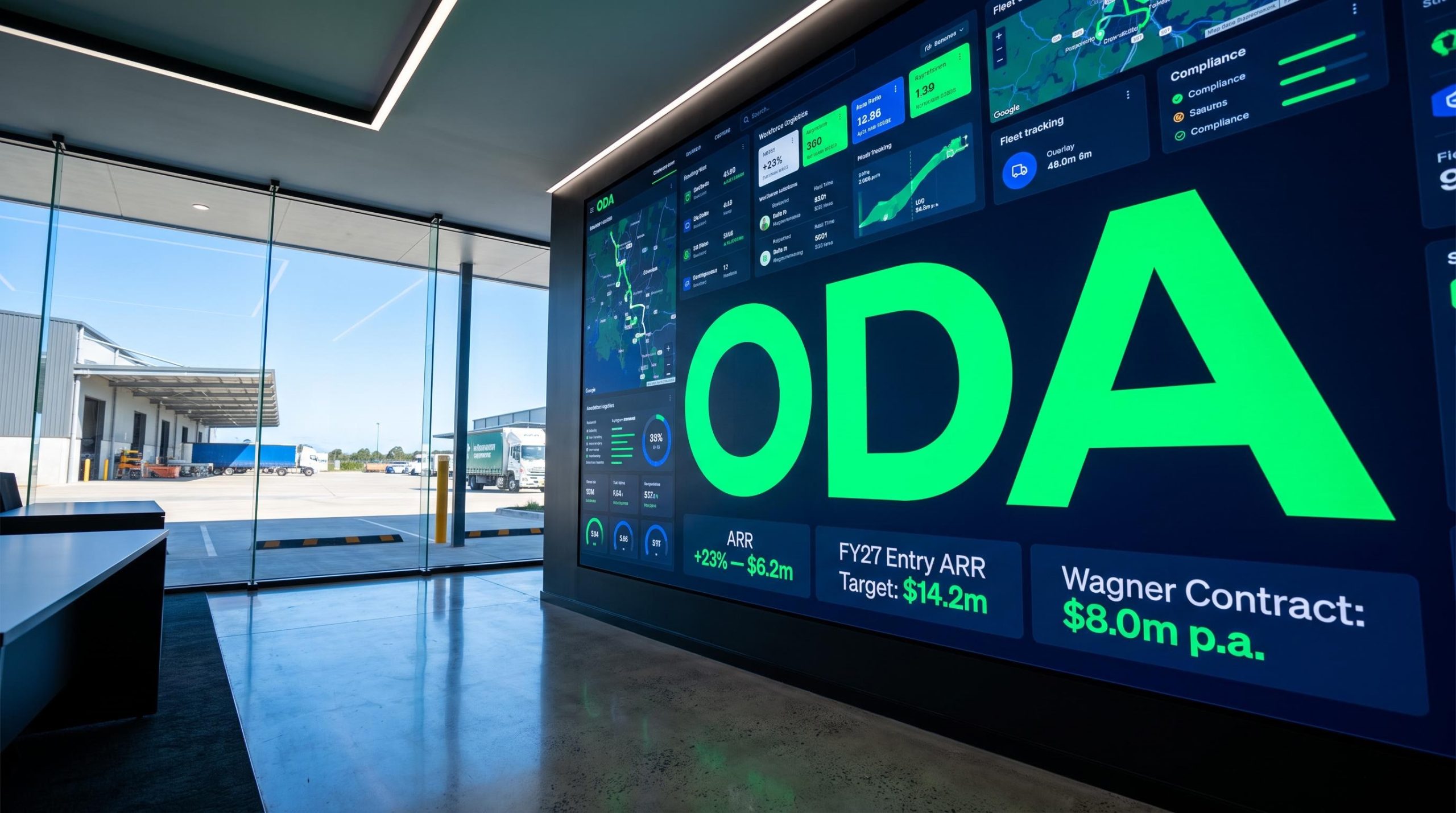
In its FY2026 results presentation delivered in August 2026, Orcoda (ASX:ODA) outlined a 23% lift in annual recurring revenue to $6.2m and set out a FY27 entry annual recurring revenue target of approximately $14.2m.
That figure represents a circa 180% step-change, driven largely by a newly commenced contract with Wagner Corporation. Orcoda is a software-led technology company built around its core 360 platforms, designed to optimise how organisations deploy people and fleets.
Management framed FY2026 as the foundation year, positioning FY27 as the acceleration phase for its transition toward scalable, higher-margin software revenue.
FY2026 results the company presented
The presentation detailed a FY2026 period in which profitability metrics improved despite broadly flat top-line revenue. Underlying EBITDA and net loss both narrowed by approximately 26%, while total revenue eased 3% year-on-year.
Importantly, both EBITDA and the net result remained in loss territory. The improvement reflected a narrowing of losses rather than a move into profitability, with management describing the period as building the runway for FY27.
The 130% EBITDA improvement recorded in the first half of FY2026 provided an early signal of the operating leverage building within the business, with both divisional units reaching EBITDA-positive territory before corporate overhead was applied.
| Metric | FY2026 | FY25 | Change |
|---|---|---|---|
| Annual Recurring Revenue | $6.2m | $5.04m | +23% |
| Underlying EBITDA | ($0.38m) | ($0.51m) | +26% |
| Total Revenue | $16.6m | $17.2m | -3% |
| Net Loss | ($1.84m) | ($2.50m) | +26% |
The presentation also included a corporate snapshot as at 26 August 2026:
-
Share price: A$0.07
-
Market capitalisation: A$13.1m
-
Shares on issue: 187.5m
-
Top 20 shareholders: approximately 67% of issued capital
When big ASX news breaks, our subscribers know first
The Wagner contract driving the FY27 step-change
The strategic centrepiece of the update was the Wagner Corporation contract, which management presented as validation of its Contractor360 platform. The contract is expected to contribute approximately $8m per annum across a 36-month term, having commenced on 1 July 2026.
Its scope covers workforce logistics and facilities management at Wellcamp Business Park in Toowoomba. Management stated the contract “validates the Contractor360 platform in a complex workforce environment” and provides a reference point for other large organisations facing similar challenges.
The Orcoda Wagner Corporation workforce contract, signed in June 2026, introduced a variable revenue structure where monthly fees are calculated based on actual workforce occupancy at Wellcamp, meaning realised income will track construction activity levels at the site rather than a fixed schedule.
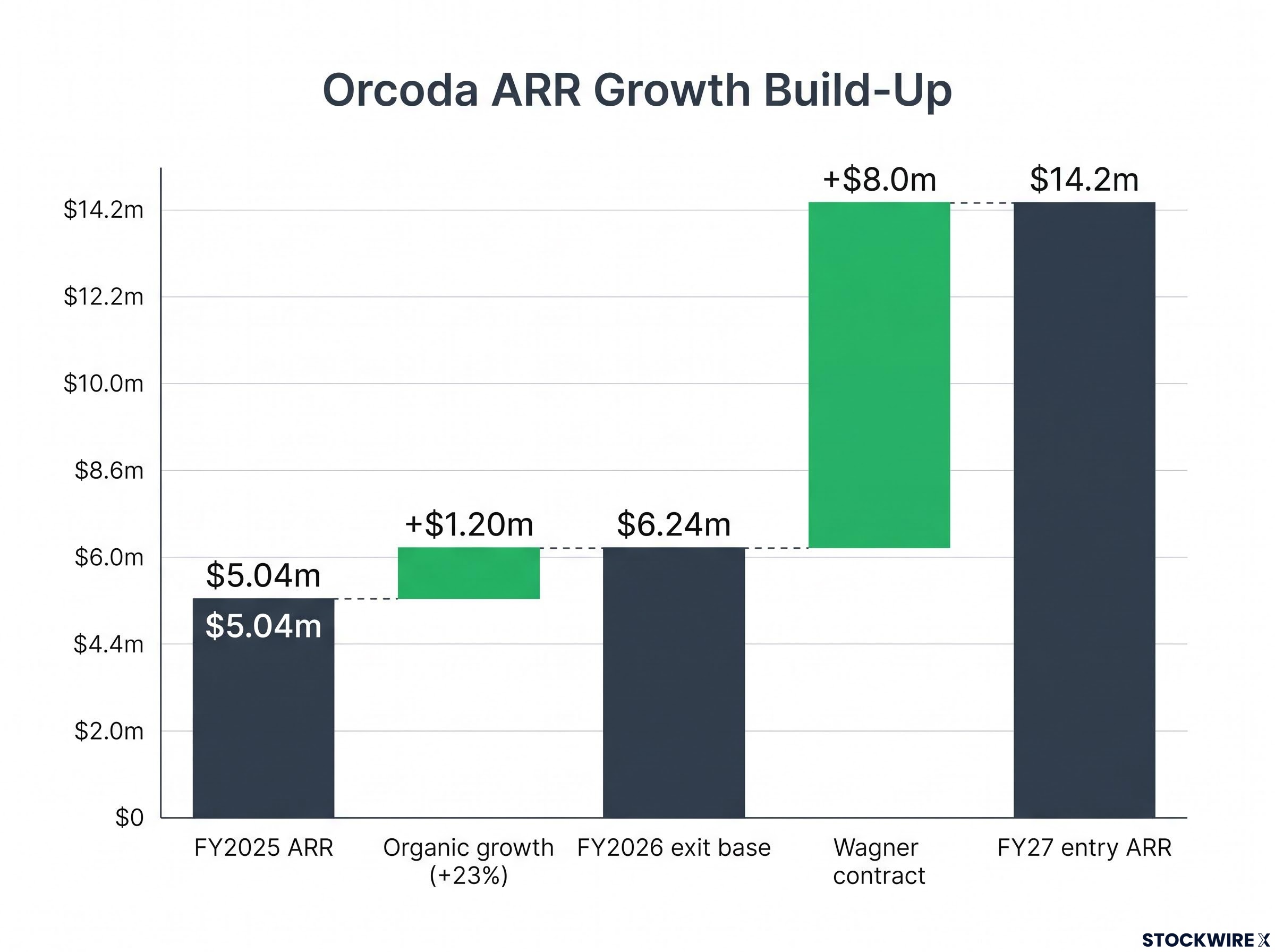
The company outlined how the FY27 entry annual recurring revenue is constructed:
-
FY2025 ARR: $5.04m
-
Organic growth (+23%): +$1.20m
-
FY2026 exit base: $6.24m
-
Wagner contract: +$8.0m
-
FY27 entry ARR: $14.2m
The $14.2m figure is a forward target rather than a reported result. Management noted its achievement is subject to contract timing, customer deployment schedules and other execution and market risks.
Patrick Bodegraven, Managing Director
“Our success with Wagner Corporation shows what the Contractor360 platform can deliver for a sophisticated organisation, managing people and operations across multiple locations.”
Understanding the SaaS model: why recurring revenue matters
Annual recurring revenue, or ARR, measures the predictable subscription-based income a software company expects to receive each year. Software-as-a-service (SaaS) businesses also benefit from operating leverage. In plain terms, the company noted that additional customers can be added to an established technology base without a corresponding increase in operating costs.
This is why the 23% ARR growth and the narrowing of losses matter to ODA investors. The thesis rests on building recurring, higher-margin software revenue that can scale without proportional cost increases, supporting margin expansion as the customer base grows.
The core platforms and supporting businesses
Orcoda’s business is anchored by two core SaaS platforms, supported by complementary revenue streams that management positions as cross-sell enablers.
-
Transport360 is an integrated transport management platform covering routing, scheduling, dispatch, compliance and fleet visibility. It serves trucking and logistics, healthcare and government, with the company claiming it can reduce fuel, labour and fleet costs by up to 20%.
-
Contractor360 is an integrated workforce logistics platform spanning mobilisation, travel, accommodation, onboarding and compliance, serving construction, mining, government and utilities.
-
Complementary businesses include Future Fleet (telematics, with deep integration into Transport360 and a competitive moat), TBG (electrical infrastructure contracting across rail, power and mining) and facilities management (remote FIFO camp services).
Management highlighted that Future Fleet and TBG function as cross-sell enablers, rather than operating solely as standalone segments.
The sales engine the company is industrialising
The presentation outlined a disciplined, repeatable eight-step sales funnel designed to scale recurring software revenue across the two core platforms. The process runs from identifying target verticals through demand generation, lead capture, qualification, product demonstration, ROI case development, pilot proof of value, and finally conversion and onboarding.
The funnel targets mining, transport, infrastructure and government markets. Management pointed to sales leaders Mark Austin for Contractor360 and Simon Anthonisz for Transport360 as part of a revitalised leadership team under CEO Patrick Bodegraven tasked with delivering on the strategy.
FY27 outlook: execution and scale
Management closed the presentation by setting out three strategic priorities for FY27, framed as the company’s roadmap.
-
Organic SaaS growth by accelerating the adoption and seat-count of the matured Transport360 and Contractor360 platforms.
-
Pipeline conversion by systematically converting targets in healthcare, mining and government through the eight-step funnel.
-
Margin expansion by extracting operating leverage from the fixed-cost software architecture as ARR scales toward and beyond the $14.2m baseline.
The overall tone was measured. Management positioned FY2026 as the year that built the foundation, with FY27 framed as the acceleration phase. The presentation reiterated that ARR targets remain subject to contract timing, customer deployment schedules and other execution and market risks.
Don’t Miss the Next ASX Tech Breakout
Big News Blast delivers FREE breaking ASX tech news directly to your inbox within minutes of release, complete with in-depth analysis already done for you. Join 20,000+ subscribers who stay ahead of the market the moment announcements drop. Click the “Free Alerts” button at Big News Blast to start receiving real-time coverage today.