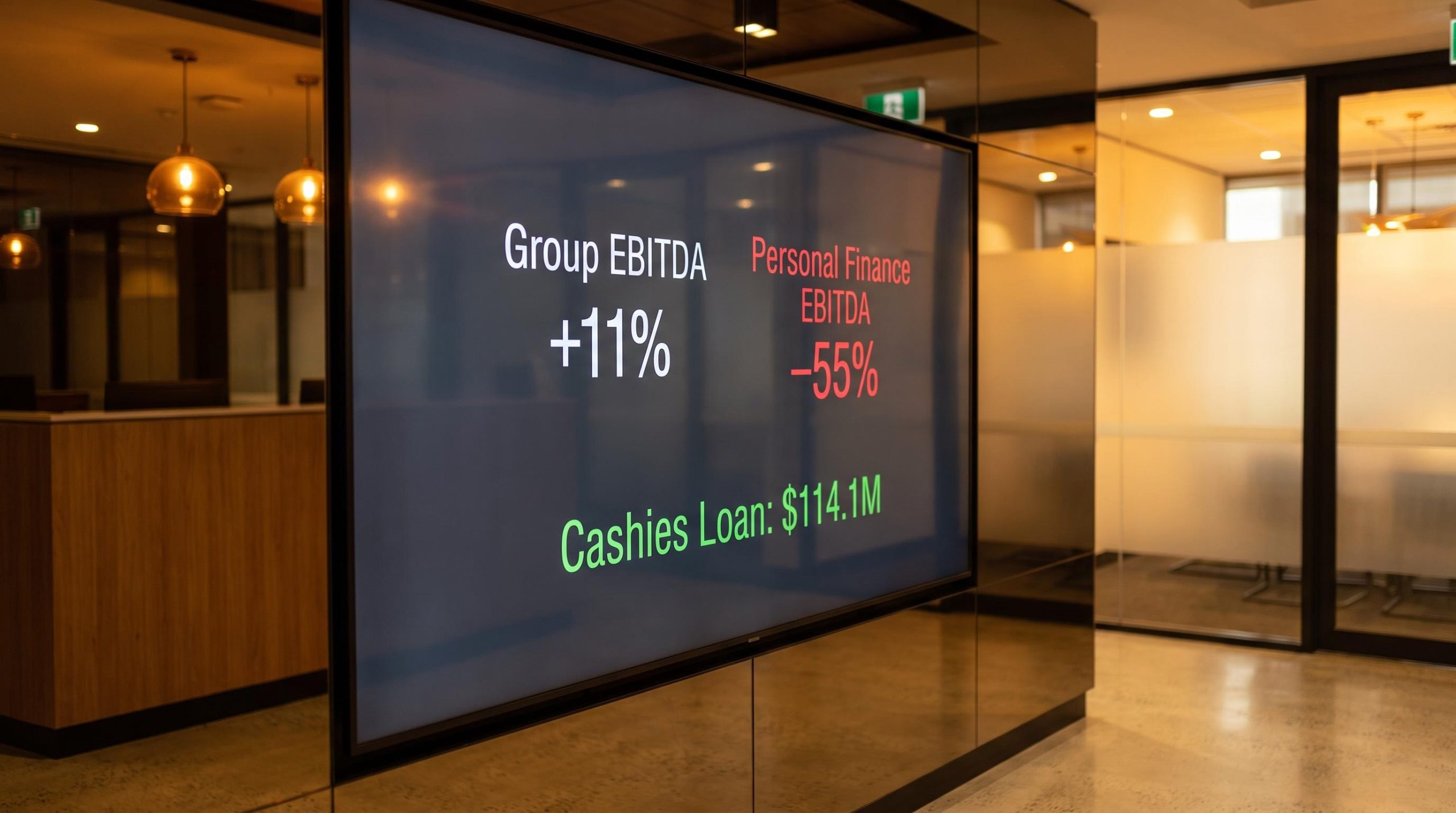
Cash Converters reported group EBITDA up 11% to $67 million in FY26. That number, on its own, reads like a business moving in the right direction. Then you look one level deeper: the personal finance segment, which historically generated the majority of group earnings, posted a 55% decline in operating EBITDA. The contradiction between those two figures is where the real story sits.
The market reads Cash Converters stock as a retail turnaround play. The “luxury pivot,” record retail revenue, and store expansion programme dominate management communication and analyst coverage. What sits underneath that framing is a lending business executing a multi-year product transition, one that is creating a temporary but measurable earnings gap in the segment numbers while the underlying loan book is being deliberately reshaped.
Investors who read the segment decline as business deterioration are looking at the wrong number. Here is the framework for reading CCV’s personal finance division correctly: the metrics that matter, the risks that are real, and the conditions under which the re-rating case becomes compelling.
The business inside the business: why the market is reading CCV wrong
Cash Converters operates two structurally distinct businesses under the same ASX ticker. They share a brand name and a store network. They share almost nothing else economically.
- Second-hand retail network: Revenue driven by store throughput and inventory turnover. Lower margin profile. Customer dynamic is transactional, one visit at a time.
- Personal finance lending division: Revenue driven by interest income on a loan book. Higher margin profile. Customer dynamic is recurring, with repeat borrowers generating compounding returns over time. Includes the Greenlight Money brand in Western Australia.
| Characteristic | Retail Division | Personal Finance Division |
|---|---|---|
| Primary revenue driver | Goods bought and resold through stores | Interest income on personal lending book |
| Margin profile | Lower; dependent on volume and inventory mix | Higher; driven by net interest margin on loans |
| Customer dynamic | Transactional; single-visit oriented | Recurring; repeat borrowers compound returns |
| How analysts currently frame it | Core business; retail pivot narrative | Legacy drag; segment in decline |
The historical earnings split makes the misperception concrete. By FY21, the personal finance segment already contributed more than half of group earnings.
FY21 personal finance EBITDA: approximately $49 million, up 27.6%. At that point, the lending division was not supplementing the retail business. It was carrying it.
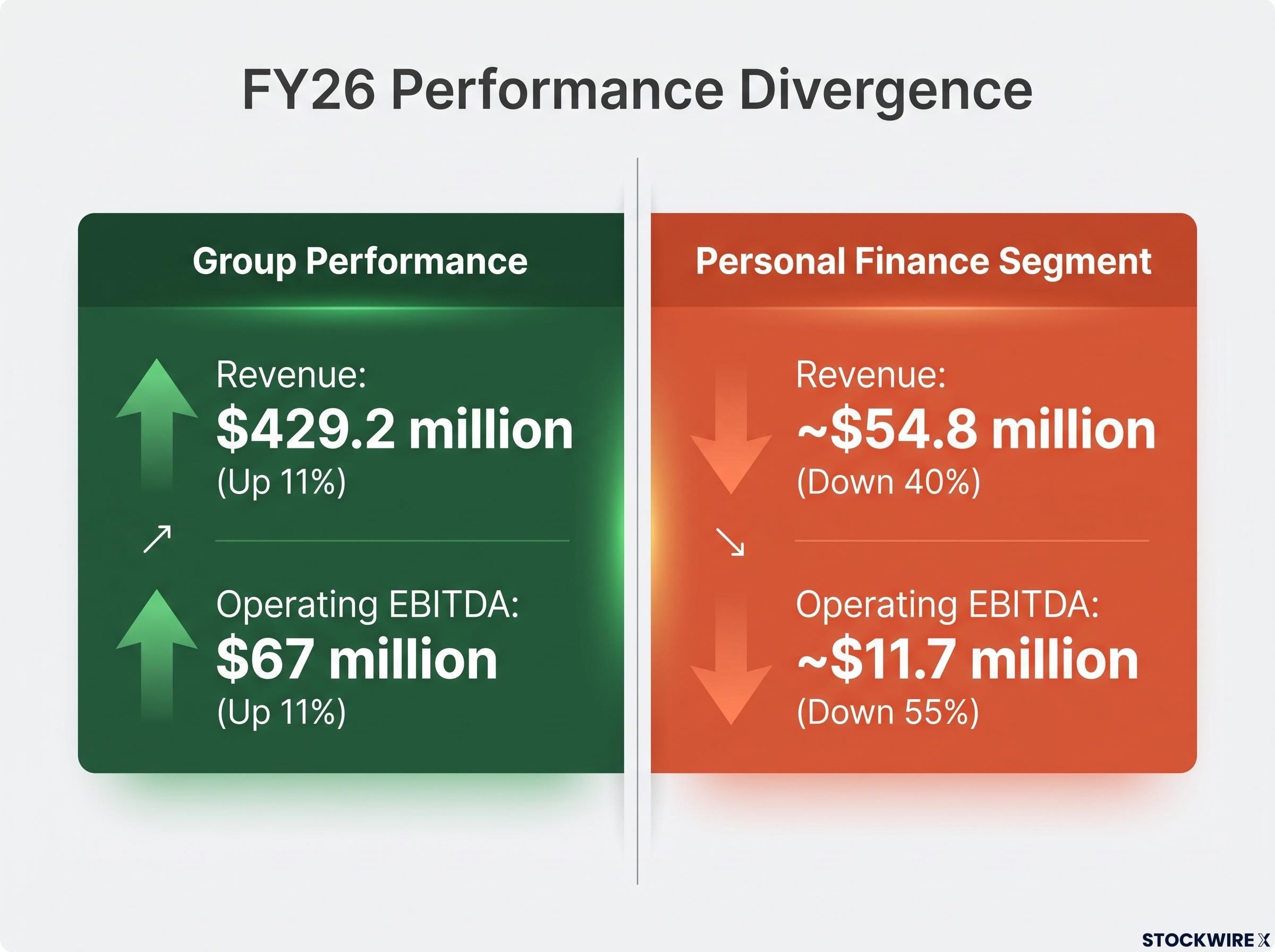
That trajectory continued. By FY24, management explicitly signalled an intention to “accelerate the growth of its personal finance products” and refinanced and upsized the company’s warehouse funding facility to provide capital specifically for lending growth. Group revenue in FY26 reached $429.2 million, up 11%, but the market’s interpretive frame remains anchored to the retail story.
The Cash Converters FY26 results, released 21 August 2026, show the Cashies Loan book surging 394% to $114.1 million while the net loss rate fell from 16.0% to 11.1%, giving investors a concrete baseline against which to track the personal finance segment’s recovery trajectory through FY27 and into FY28.
This is not a minor misread. It is a structural misclassification. The re-rating case does not depend on the finance division becoming dominant in the future. It already was. What it depends on is the segment’s reported numbers catching up with its underlying economics, which requires understanding exactly what is happening inside the loan book.
When big ASX news breaks, our subscribers know first
What the loan book numbers actually show
The headline figure looks like contraction. The gross loan book fell from approximately $288 million at FY24 to $236.6 million at FY26. Read in isolation, that is a business shrinking.
Read with product-level granularity, it is a business being deliberately reshaped. Three products are replacing the legacy lending operation:
- Medium-amount credit contracts (MACCs): Larger unsecured loans replacing the small-amount payday contracts that dominated the old book.
- Cashies Loan: The flagship new product, an unsecured personal loan that has scaled from a negligible base to $114.1 million in book value at FY26, up approximately fivefold year-on-year.
- Line of Credit: A revolving credit facility that closed FY24 at $14.6 million (up 108% in H2 FY24) and grew a further 29% to approximately $18.8 million by Q1 FY25.
Legacy payday loans now represent approximately 2.4% of the total gross loan book. The old book is almost gone. The new book is scaling rapidly. The total number went down because what left the book was larger than what entered it, but the quality and margin profile of what replaced it is structurally different.
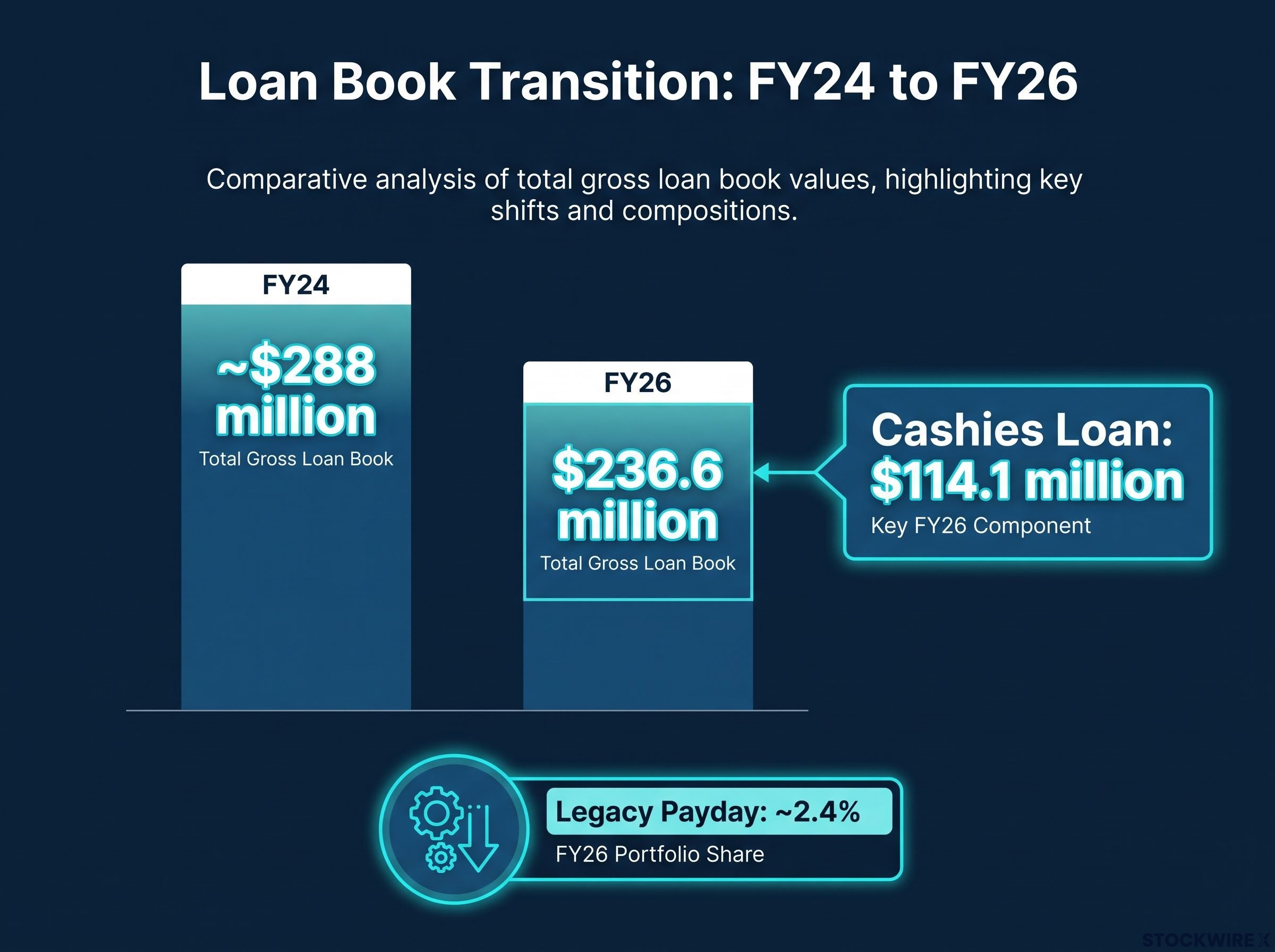
| Product | FY24 Book Value | FY26 Book Value | Direction |
|---|---|---|---|
| Cashies Loan | Negligible base | $114.1 million | Up ~5x year-on-year |
| Line of Credit | $14.6 million | ~$18.8 million (Q1 FY25) | Growing; +108% in H2 FY24 |
| Legacy Payday / Vehicle | Significant share of ~$288m | ~2.4% of $236.6m | Managed runoff; near completion |
| Total Gross Book | ~$288 million | $236.6 million | Down on headline; up on quality |
Application volumes confirm borrower demand is not the constraint. Over 390,000 credit applications came through in H1 FY24. In Q1 FY25 alone, the figure was over 236,000. Available funding capacity at FY26 end stood at $60.5 million, giving the company headroom to continue originating without an immediate capital raise.
The Cashies Loan growing fivefold in a single year tells you that origination capability and borrower demand are both present. The question is not whether the new products can scale. It is whether credit quality holds as they do.
The segment revenue decline is not what it appears
The FY26 personal finance segment numbers look alarming in isolation. Revenue fell approximately 40% to roughly $54.8 million. Operating EBITDA dropped approximately 55% to roughly $11.7 million.
These figures reflect legacy products being wound down before the new book has fully scaled. They are transition costs, not structural deterioration. The old products are exiting the book (payday is already at 2.4%) while the new products have not yet reached the scale required to replace the legacy earnings stream.
Group operating EBITDA still rose 11% to $67 million in FY26, confirming the segment drag is being absorbed at the group level. The group is not shrinking. One segment is mid-transition.
Is the credit quality holding through the transition?
A loan book that grows fivefold in a year invites an obvious question: is the credit getting worse as the book gets bigger? Early evidence suggests not, but the data is too young for certainty.
Q1 FY25 net loss rate: 3.7%, down from 4.8% in the prior comparable quarter. The company described this as “well within” the target range. It is the clearest available data point showing improved risk selection through the transition.
The group net loss rate in FY26 was 11.1%. Net loss rate measures the proportion of the loan book that is written off as unrecoverable, net of any recoveries. It is the primary credit quality indicator for a lender to non-prime borrowers.
Management has attributed the improving trajectory to machine-learning credit models and better risk selection processes. That framing positions the improvement as a structural capability, something embedded in the underwriting system rather than a temporary benefit of favourable economic conditions.
Non-prime lending profitability on the ASX has a recent comparable in MoneyMe, which achieved positive normalised NPAT in Q3 FY26 as its net credit loss rate fell from 3.7% to 2.6%, offering a sector reference point for the credit quality thresholds that underpin sustainable earnings at scale.
The honest read, however, requires acknowledging what the data does not yet show. The Cashies Loan book has grown fivefold in approximately one year and has not yet fully seasoned. A loan book needs 12-24 months of maturity before credit performance conclusions can be drawn with confidence. The 11.1% group net loss rate is the current benchmark; it needs to be watched across future quarterly updates as the book matures.
Repeat borrower dynamics are a conceptually sound thesis element, since a high repeat rate would imply lower acquisition cost and more predictable cash flows. However, specific retention metrics are not publicly disclosed, which means this angle cannot be quantified with the data currently available.
Three credit quality indicators to track each quarter:
- Group net loss rate: The headline figure reported in full-year results. Currently 11.1% at FY26.
- Quarterly net loss rate: Disclosed in quarterly trading updates. Provides a more granular, real-time view of credit performance. Currently 3.7% at Q1 FY25.
- Loan book composition by product: The proportion of Cashies Loans, Line of Credit, and legacy products. Tells you whether the book is seasoning in the right direction.
Credit quality is the single variable that can validate or break the entire re-rating thesis. Investors watching CCV should treat quarterly net loss rate disclosures as the most important data point in each update, not the headline loan book number.
What the re-rating requires, and when to look for it
The case for a specialty-lender re-rating is real. It is also conditional. Four things need to happen:
- Segment earnings recovery: As legacy runoff completes, personal finance segment EBITDA needs to rebound from its depressed FY26 base of approximately $11.7 million toward levels that reflect the economics of the new book. The reference point is FY21, when the segment produced approximately $49 million in EBITDA.
- Net loss rate stability: The group net loss rate of 11.1% in FY26 and the quarterly rate of 3.7% in Q1 FY25 need to hold or improve as the Cashies Loan book seasons over the next 12-24 months.
- Clearer segment reporting: Until the company separates legacy runoff from growth product economics in its reporting, the segment numbers will continue to understate the new book’s performance and overstate the impression of decline.
- Market reframing: The market needs to shift its interpretive lens from “retail pivot with legacy finance drag” to “specialty lender with a modernised loan book and strong retail distribution.”
| Metric to Watch | Current Reading (FY26) | What to Look For |
|---|---|---|
| Personal Finance operating EBITDA | ~$11.7 million | Recovery toward FY21 levels (~$49m) as new products scale |
| Group net loss rate | 11.1% | Stability or improvement as Cashies Loan book seasons |
| Legacy payday share of book | ~2.4% | Approaching zero; confirms runoff completion |
| Available funding capacity | $60.5 million | Sufficient headroom to support continued origination growth |
There is a specific risk that could prevent the re-rating regardless of the underlying economics. If management continues leading investor communication with the retail and luxury pivot narrative, the market may not reprice the finance division even as its fundamentals improve. Perception risk is as material as credit risk in this story.
The bear case has three distinct components:
- Execution risk: Replacing legacy short-term lending economics with newer products while keeping loss rates contained is operationally complex. Early data are encouraging, not conclusive.
- Regulatory risk: CCV exited payday lending partly in response to regulatory and reputational pressures on the SACC sector. Future regulatory changes affecting MACCs or unsecured personal lending more broadly remain an ongoing risk.
- Perception risk: If the company’s own narrative stays retail-first, the market has no reason to apply a lender multiple, even if the earnings architecture supports one.
ASIC’s responsible lending conduct guidance sets the compliance framework that governs MACCs and unsecured personal lending products, meaning any future regulatory tightening in how suitability assessments are conducted would directly affect CCV’s new book origination standards.
What changes, and what the timing looks like
The group-level numbers confirm that CCV is not a distressed business. Group revenue of $429.2 million and operating EBITDA of $67 million, both up 11% in FY26, demonstrate that the segment-level drag is being absorbed while the transition plays out.
The structural components of the transition are largely in place. Legacy payday is at approximately 2.4% of the book. The Cashies Loan has reached $114.1 million. Available funding capacity of $60.5 million provides origination headroom. FY26 results, released 21 August 2026, are now available for investors to benchmark against.
The market is pricing a retail pivot. The earnings architecture is pricing a lender transition. The gap between those two readings is where the re-rating opportunity sits, if the credit quality evidence continues to hold.
The broader pattern of contrarian entry points in ASX retail and consumer finance stocks follows a consistent logic: reported segment numbers disappoint before the underlying business has recovered, and the investors who act on the gap between perception and emerging fundamentals capture the bulk of the re-rating return.
Three data points to record from each quarterly trading update going forward:
- Group net loss rate (credit quality trajectory)
- Cashies Loan book size (new product scaling)
- Personal finance segment EBITDA (recovery tracking from the ~$11.7 million FY26 base)
The re-rating is not guaranteed. But the conditions for it are traceable, the transition timeline is shortening, and the most important early indicator, net loss rates, is moving in the right direction. Investors with a 12-24 month horizon and the patience to read quarterly updates against this framework are better placed than those reacting to segment headlines designed to disappoint before they recover.
This article is for informational purposes only and should not be considered financial advice. Investors should conduct their own research and consult with financial professionals before making investment decisions.
Past performance does not guarantee future results. Financial projections are subject to market conditions and various risk factors.