
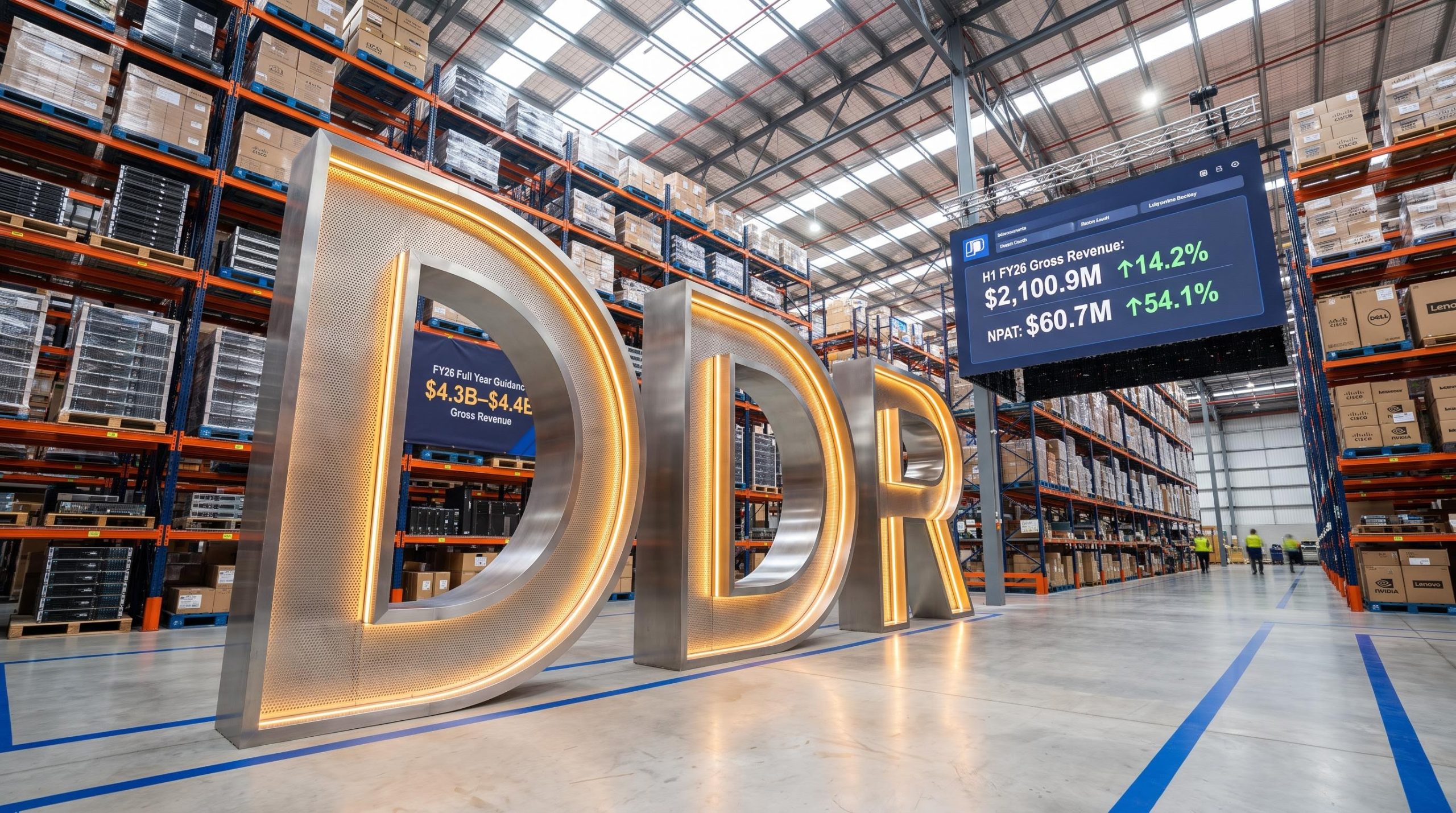
Dicker Data delivers double-digit growth across all key metrics in H1 FY26
In its H1 FY26 results presentation, Dicker Data reported gross revenue of $2,100.9m for the six months ended 30 June 2026, up 14.2% on the prior corresponding period, alongside net operating profit before tax of $86.4m, an increase of 50.1%. Management described the result as a strong start to FY26, with growth recorded across all key metrics.
The technology distributor also delivered earnings per share of 33.5c, up 53.5%, and net profit after tax of $60.7m, a lift of 54.1% on the comparable half.
| Metric | H1 FY26 | H1 FY25 | Change |
|---|---|---|---|
| Gross revenue | $2,100.9m | $1,840.4m | +14.2% |
| Gross profit | $205.6m | $167.1m | +23.0% |
| EBITDA | $103.5m | $75.4m | +37.3% |
| Profit before tax | $86.4m | $57.6m | +50.1% |
| NPAT | $60.7m | $39.4m | +54.1% |
| EPS | 33.5c | 21.8c | +53.5% |
When big ASX news breaks, our subscribers know first
What’s driving the numbers, margin expansion and operating leverage
The profit uplift was underpinned by both revenue growth and improved profitability. Gross margin expanded to 9.8% from 9.1% in the prior corresponding period, a benefit management attributed to strategic stock purchases and proactive sourcing during the half.
The Dicker Data FY25 results established the baseline for this performance, with the company posting $3.9 billion in gross revenue and $124.7 million in net operating profit before tax, both above the guidance provided in August 2025.
EBITDA rose 37.3% on the back of strong sales growth and improved margins. Total expenses, measured as a percentage of gross revenue, improved to 5.9% from 6.1%, reflecting lower finance costs and improved operating leverage. Profit before tax margin lifted to 4.1% from 3.1%.
Recurring gross software sales reached $600.0m, up 20.7%, while the company reported 10,000 active Australian partners and 2,300 active New Zealand partners.
Australia leads the charge
The Australian business recorded gross revenue of $1,831.5m, up 18.2%, driven by elevated end-point, software and data centre refresh demand. Profit before tax rose 55.9% to $82.5m, with the PBT margin finishing at 4.5%, which management noted exceeded internal expectations.
New Zealand held back by supply constraints
New Zealand gross revenue (in NZD) finalised at $323.0m, up 1.5%. Profit before tax decreased 12.7% to $4.8m, which management attributed to supply constraints across some hardware vendor portfolios and lower margins in the consumer retail business. The supply shortages are expected to ease in H2 FY26.
Segment performance, software and AI infrastructure lead demand
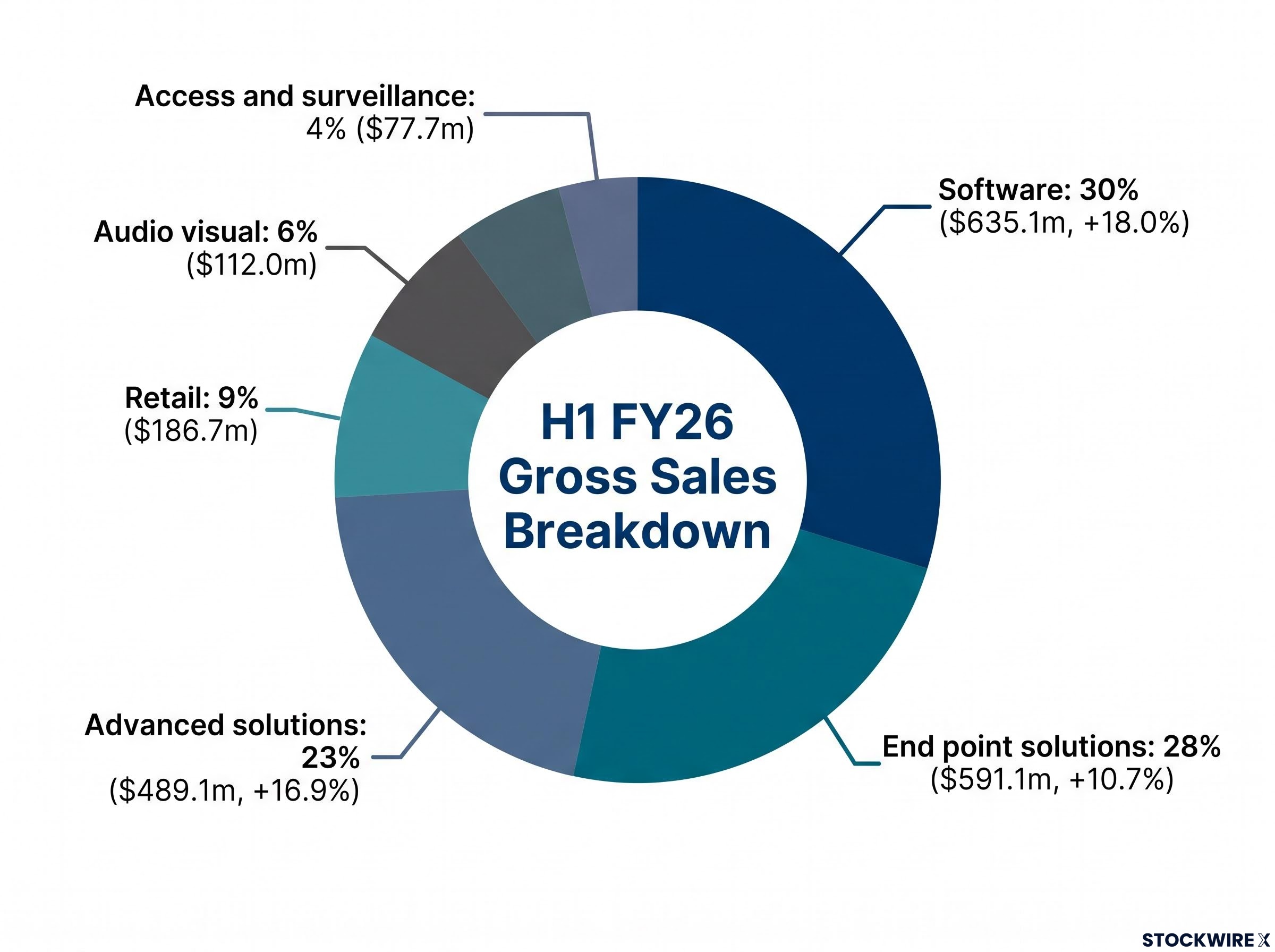
Growth was recorded across the portfolio, with software and advanced solutions among the strongest contributors. Software gross sales reached $635.1m (up 18.0%), advanced solutions $489.1m (up 16.9%), and access and surveillance $77.7m (up 22.9%). End point solutions rose 10.7% to $591.1m.
| Segment | H1 FY26 ($m) | H1 FY25 ($m) | Change | % of sales |
|---|---|---|---|---|
| Software | 635.1 | 538.1 | +18.0% | 30% |
| End point solutions | 591.1 | 534.0 | +10.7% | 28% |
| Advanced solutions | 489.1 | 418.4 | +16.9% | 23% |
| Retail | 186.7 | 173.1 | +7.9% | 9% |
| Audio visual | 112.0 | 106.7 | +5.0% | 6% |
| Access and surveillance | 77.7 | 63.2 | +22.9% | 4% |
| Services | 4.6 | 4.8 | -4.2% | — |
| Total gross sales | 2,096.3 | 1,838.3 | +14.0% | 100% |
The AI opportunity explained, why it matters for Dicker Data
The company achieved record AI-related sales in H1 FY26, with invoiced value exceeding $50m. Management outlined the launch of ‘AI Accelerate’ across Australia and New Zealand, bringing together Dell Technologies, HPE, Cisco, Lenovo, NVIDIA, Equinix, ResetData and other ecosystem partners to help resellers develop and commercialise practical AI solutions.
The presentation detailed that Dicker Data’s solution builds on historical investment with Dell Technologies to deploy an AI proof-of-concept hosted at an Equinix Sydney data centre. The company’s Cisco AI Pod also came online during the half. Dicker Data also launched ‘Solution ConX’, a partner-to-partner solutions marketplace enabling resellers to access specialist Microsoft cloud capabilities, and expanded its Telco and Unified Communications capability.
Management noted that AI now impacts almost all reporting segments of the company, positioning it across one of the fastest-growing categories of technology spend.
Structural tailwinds underpinning the growth story
Management outlined four strategic themes supporting the growth story:
-
Data Centre Refresh — ageing infrastructure and growing workload complexity are driving modernisation across networking, server, storage, power and cooling.
-
Artificial Intelligence — AI now impacts almost all reporting segments of the company.
-
Windows Refresh — as at August 2026, over 550,000 non-compliant devices remain in ANZ following Windows 10 end-of-support in October 2025.
-
Cybersecurity — identified as a top-three investment priority for both end customers and the company’s partner network.
On the broader market, Gartner forecasts Australian IT spending will reach A$172.3b in 2026, up 8.9%, with data centre systems expected to grow 22.5%. Gartner, as reported by Reseller News, expects New Zealand IT spending to reach $25.6b in 2026, up 10.4%.
Balance sheet, dividends and capital position
Net debt decreased $1.6m to $291.3m during the period, with the debt-to-equity ratio improving to 0.98x from 1.40x. Net tangible assets rose to $271.6m.
Inventory increased $107.0m as the company made strategic investments in stock to mitigate uncertainty in its supply chain, a deliberate positioning move ahead of anticipated supply pressures. The company also adopted a change in accounting policy, recognising land and buildings at valuation rather than cost, which added $107.9m to property, plant and equipment.
Dividends maintained and growing
Fully franked dividends of 23.0 cps were paid in H1 FY26, up 4.5% on the prior corresponding period. The second interim FY26 dividend was declared at 11.5 cps on 17 August 2026, payable on 1 September 2026. The dividend reinvestment plan (DRP) was retained for FY26 with a 1% discount.
H1 FY26 Guidance Snapshot
FY26 gross revenue guidance of $4.3 billion to $4.4 billion, reflecting full-year growth of 11% to 14% versus FY25, and net operating PBT of $162 million to $165 million.
FY26 outlook and guidance
Management noted that July and August to-date reflect a continuation of H1 performance, with sustained demand across multiple technology segments. Demand for data centre refresh, software and AI-related projects is expected to support growth in H2, while growth in end-point solutions is expected to moderate.
For the full year, Dicker Data provided the following guidance:
-
Gross revenue: between $4.3 billion and $4.4 billion, reflecting full-year growth of 11% to 14% versus FY25.
-
Net operating profit before tax: between $162 million and $165 million, reflecting a PBT margin of approximately 3.8%.
The company also disclosed several caveats to its outlook. AI-related revenues are anticipated to accelerate in H2 but reflect typically lower-margin business. Pricing impacts from component and supply chain constraints are expected to flow through in H2, resulting in higher inventory replenishment costs. While absolute revenue demand is expected to remain strong, the impact of higher prices is likely to begin materialising in H2, likely resulting in reduced unit demand.
The result reflects the structural demand tailwinds management highlighted across data centre modernisation, artificial intelligence, the Windows refresh cycle and cybersecurity, which are expected to continue supporting activity through the remainder of FY26.
Don’t Miss the Next ASX Tech Winner
Big News Blast delivers FREE breaking ASX tech news directly to your inbox within minutes of release, complete with in-depth analysis. Join 20,000+ investors already staying ahead of the market. Click the “Free Alerts” button at Big News Blast to start receiving alerts the moment market-moving announcements drop.