
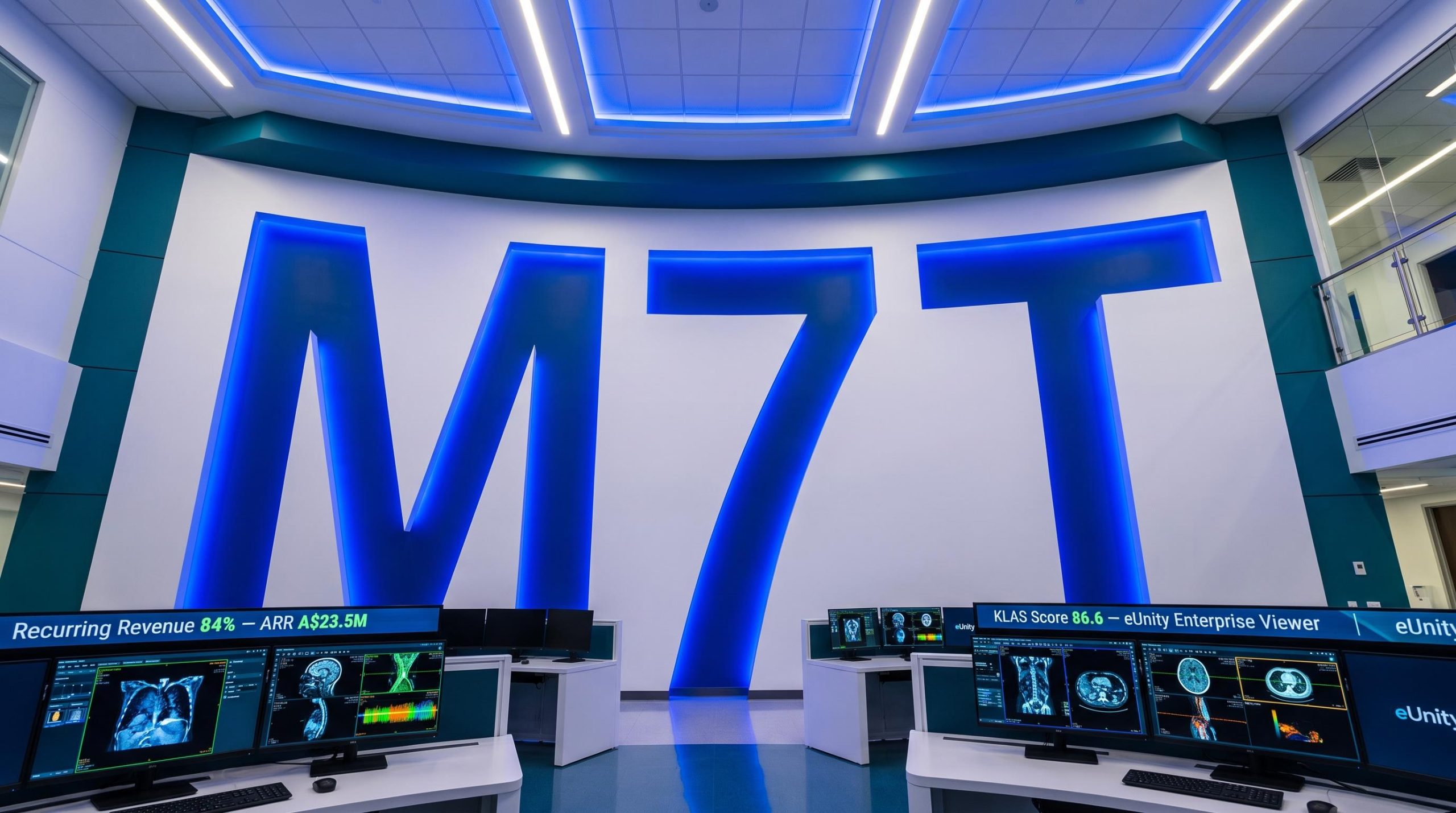
Mach7 delivers on FY26 guidance as reset year reshapes the business
In its FY26 results presentation released 28 August 2026, Mach7 Technologies (ASX: M7T) detailed a completed reset year for the period ended 30 June 2026. Management reported that the company met FY26 guidance, with recurring revenue now representing 84% of total revenue, operating expenses cut 16%, and closing cash of A$19.9M with no debt.
The presentation framed the period under the theme “From Archive to Architecture,” a deliberate restructure management described as beginning to pay off. For investors, the Mach7 Technologies FY26 results point to a business repositioning towards higher-quality, more predictable revenue.
When big ASX news breaks, our subscribers know first
FY26 financial results at a glance
Management presented the full-year numbers as reported, noting that revenue declines were driven by a deliberate shift away from lumpy capital licences and known headwinds rather than underlying weakness. Total revenue of A$27.9M was down 17% on the prior corresponding period (PCP), while recurring revenue reached A$23.4M, or 84% of revenue, up from 75%.
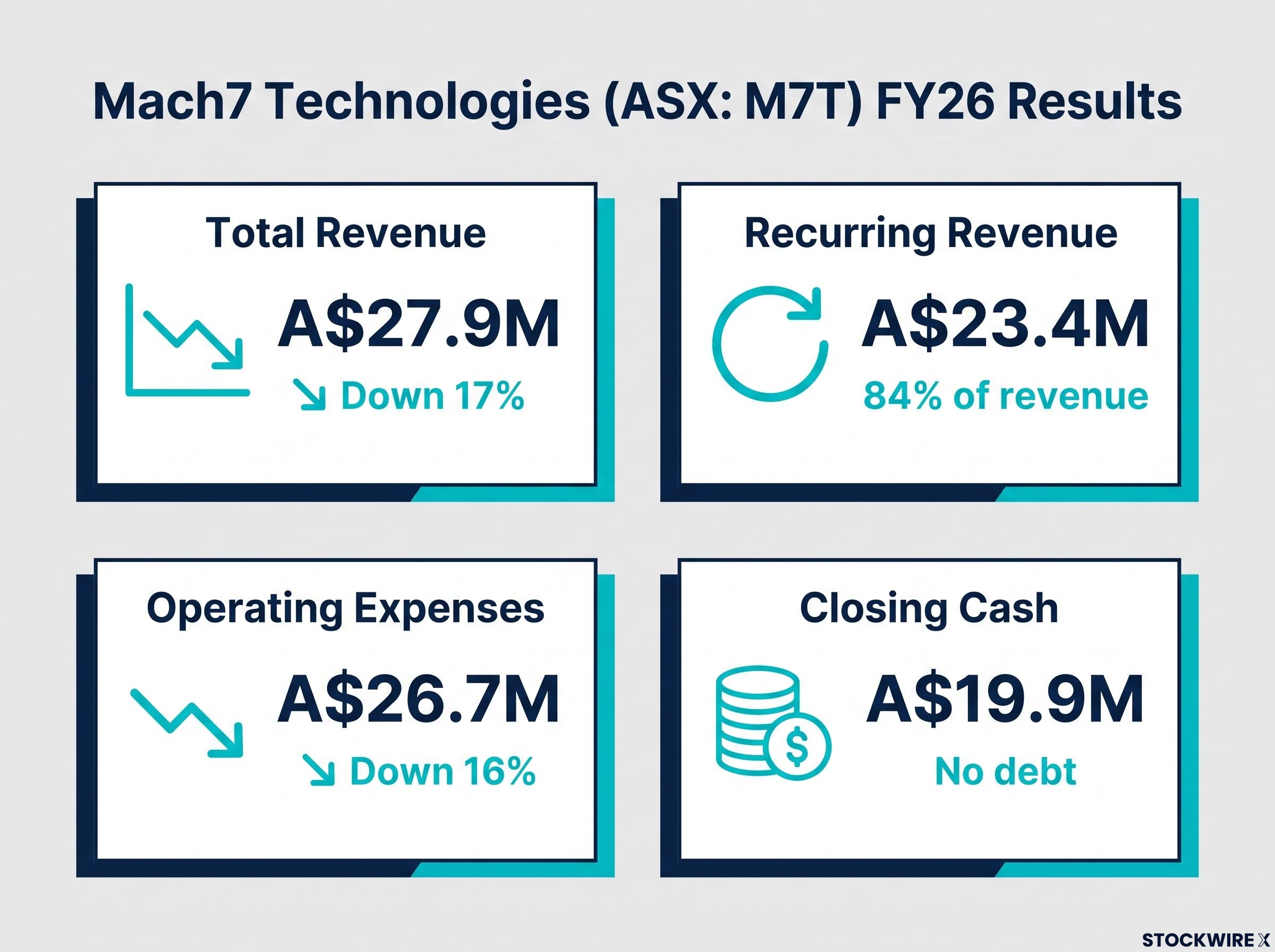
The ARR run rate recorded A$23.5M, up 8% in constant currency, with Contracted Annual Recurring Revenue (CARR) of A$25.5M. Operating expenses fell to A$26.7M, while adjusted EBITDA came in at −A$0.9M and NPAT at −A$8.9M.
| Metric | FY26 | FY25 (PCP) | Change | Note |
|---|---|---|---|---|
| Total revenue | A$27.9M | A$33.8M | −17% | Lower capital licences |
| Recurring revenue | A$23.4M | A$25.3M | −8% | 84% of revenue |
| ARR run rate | A$23.5M | A$23.5M | +8% | Constant currency |
| Operating expenses | A$26.7M | A$31.8M | −16% | Deliberate restructure |
| Adjusted EBITDA | −A$0.9M | −A$0.3M | −A$0.6M | Adjusted for FX and SBP |
| Closing cash | A$19.9M | A$23.1M | −A$3.2M | No debt |
Gross margin held at 93%, consistent with the platform’s efficiency, and three of four quarters delivered positive operating cash flow across the year.
What drove the revenue mix shift
The presentation detailed several factors behind the revenue composition change:
-
Capital licence revenue fell 70% to A$1.5M, reflecting timing, conversions to subscription, and lower expansion volumes.
-
Recurring revenue was impacted by the non-renewal of Trinity Health and the ceased Veteran’s Health Administration contract in H1 FY26.
-
H2 FY26 revenue of A$14.3M was ahead of H1 (A$13.7M) despite currency headwinds.
-
Product mix stood at 54% VNA and 46% eUnity viewer share of product revenue.
The takeaway management emphasised is a revenue base becoming more annuity-like and predictable.
The reset — four deliberate changes now paying off
Management outlined a four-part restructure taken during the year, with costs absorbed in FY26:
-
A new customer engagement model built on designated cross-functional teams per customer, executive account sponsorship, and AI-enablement.
-
A rebuilt leadership team, with seven senior leaders appointed within twelve months and product, support and engineering unified under new Chief Technology Officer Brian Wehrle.
-
A sharpened product strategy consolidating two overlapping product lines into one roadmap, with a next-generation containerised architecture enabling a “land-and-expand” approach.
-
A restructured cost base and revenue mix, favouring recurring revenue over one-off capital transactions, especially in North America.
Restructuring costs of A$1.9M were fully absorbed within FY26.
Independent validation and faster execution
Management cited KLAS scores, the industry’s most recognised independent benchmark of customer satisfaction in healthcare IT, as third-party proof of progress. The eUnity enterprise viewer scored 86.6, above the segment average, with “would buy again” sentiment above 90 against a KLAS market average of 83.1. The company’s VNA product improved from 68.7 to 73.6 across measurement periods.
Execution also accelerated. The first Flamingo customer went live and generating revenue in under half the time a typical implementation has taken. Separately, a teleradiology deployment recorded the fastest selection-to-live in company history, moving from selection to deployment in under 6 months.
The AMRADNET eUnity contract signed in May 2026 demonstrated that deployment compression in practice, with a 45-day first productive use timeline standing as the fastest selection-to-live in company history against a prior benchmark measured in months.
Imaging group customer
“We love you guys and we feel very connected to you. We wish all of our vendors and partners were like Mach7.” — Systems Engineer
Understanding the growth engine — why imaging orchestration matters
Medical imaging drives diagnosis and treatment across almost every specialty, yet the data often remains fragmented, duplicated, and locked inside proprietary systems. One health system customer reported finding “up to 18 separate copies of specific single images” across its systems. Mach7’s role is to unify that imaging data so it is accessible wherever care happens, integrated with the Electronic Health Record (EHR) and under the customer’s control.
The company’s architecture has three parts, each adopted a piece at a time:
-
Vendor Neutral Archive (VNA): consolidates and stores imaging natively or in DICOM, on-premise, cloud or hybrid, with no proprietary wrapping and no exit fees.
-
eUnity Enterprise Viewer: a zero-footprint diagnostic viewer with full image fidelity, described as the company’s highest-rated product.
-
Flamingo modules: rules-based routing, normalisation, anonymisation and lifecycle management across systems.
Management framed a strategic shift in where value sits, moving “from storage to orchestration.” As storing images commoditises, normalising, routing and governing them does not. Importantly, the company stated it is not a diagnostic AI company, but it can serve diagnostic AI results to users and make creating diagnostic AI easier.
The investment implication management drew is that as AI becomes a consumer of imaging data, owning the connected data layer beneath the algorithms becomes harder to remove and more valuable to own.
A large and growing addressable market
The presentation presented third-party market estimates focused on the imaging IT layer across four regions (United States, Canada, Asia-Pacific and Gulf Cooperation Council):
-
Total imaging market of US$5.7b growing to US$7.3b across FY27 to FY29, at a 12.5% compound growth rate.
-
The software and subscription layer available to the company sits at US$2.7b to US$3.4b.
-
The imaging intelligence layer, the company’s fastest-moving segment, is growing 20.7%, with US$514m addressable to Mach7 by FY29.
Management noted the new Flamingo modules launch at RSNA 2026, the industry’s largest imaging meeting, with named early-adopter customers.
The horizon — stabilise, prove, compound
Management outlined a three-phase roadmap. The first phase, to stabilise, is described as largely behind the company, having reset the cost base, protected the recurring revenue engine, and strengthened leadership. The second phase, to prove the growth engine, is the year in front, with the aim of showing operating leverage as revenue grows faster than operating expense. The third phase, to compound and lead, is framed as the ambition.
For investors, the framing signals that FY27 is the year the reset must convert into visible operating leverage.
What management said investors should watch in FY27
Management set out its stated FY27 focus areas and how it measures progress:
-
ARR growth: expanding and growing the recurring base.
-
New customer wins: increased demand converting into new customer contracts.
-
Module adoption: customers paying for new Flamingo modules.
-
OPEX discipline: disciplined spend focused on return on investment and a drive to profitability.
The company described the characteristics of a compounder: a predominantly recurring base at high gross margin, a reset cost base delivering operating leverage, positive operating cash flow, no debt, and disciplined investment funded from operations. Management also referenced a large enterprise imaging replacement cycle underway, with health systems reviewing infrastructure held in some cases for decades.
FY27 outlook
“We remain committed to financial discipline and efficient capital allocation, investing selectively in innovation and growth where the returns are visible and clear, to deliver against our strategy in FY27 and beyond.”
Don’t Miss the Next Healthcare Tech Winner on ASX
Big News Blast delivers FREE breaking ASX healthcare and tech news directly to your inbox within minutes of release, complete with in-depth analysis. Join 20,000+ subscribers already staying ahead of the market. Click the “Free Alerts” button at Big News Blast to get the next market-moving announcement the moment it drops.