
EUR/USD hit weekly lows on Thursday as a hotter-than-expected US inflation print revived dollar bulls. But every FX desk is holding its breath for one reason: in roughly twenty-four hours, a new Fed Chair delivers his first major keynote at Jackson Hole, and nobody knows what he will say.
The pair’s retreat from three-month highs above 1.1700 is not a routine pullback. It sits at the intersection of a stubborn inflation regime, a live September rate decision with a 36% implied probability of a hike, and the symbolic weight of Kevin Warsh’s inaugural set-piece address as Fed Chair. The speech lands nineteen days before the September 16 FOMC meeting, giving it direct capacity to move not just the euro-dollar pair but the broader Fed reaction function for the rest of 2026.
Here is what you need to understand before markets open Friday morning: the forces that put EUR/USD where it is now, what the technical picture says about how far this move can extend, and what three distinct Warsh speech outcomes would mean for the dollar in the sessions immediately after the address.
Why the PCE print mattered more than the September probability suggested
Wednesday’s Personal Consumption Expenditures (PCE) Price Index, the Fed’s preferred inflation gauge, came in hotter than forecast. The reaction was immediate. The dollar bid strengthened, EUR/USD retreated from above 1.1700, and the pair slid toward weekly lows.
The July PCE release confirmed that core held at 3.3% year over year for a second consecutive month, and the PCE breadth-of-disinflation gauges tracked by the Dallas and Cleveland Feds were both trending near 2%, a divergence from headline core that gives Warsh analytical cover to hold without signalling a pivot.
The PCE Price Index holds this status as the Fed’s preferred inflation gauge because it captures a broader basket of spending than the CPI and adjusts for substitution effects that consumers make when prices shift, giving policymakers a less distorted read of underlying price pressure.
The figure most traders turned to next was the CME Group FedWatch Tool’s market-implied probability of a September rate hike, which showed odds holding at roughly 36%. It barely moved. On the surface, that stability looked like the data did not matter much.
It did.
The tension between a steady probability number and genuine market repositioning is where the real story sits. Three forces were pulling in different directions simultaneously:
- The elevated PCE reading confirmed inflation persistence, giving hawks fresh ammunition and narrowing the Fed’s room to signal patience
- The September hike probability held near 36%, a level that reflects genuine uncertainty rather than conviction in either direction
- The nineteen-day window between Friday’s speech and the September 16 FOMC meeting compressed the entire forward guidance cycle into a single event
36% market-implied probability of a September rate hike (CME Group FedWatch Tool). In practical trading terms, a probability in this range means the market is not pricing a hike as its base case, but considers it a live possibility that a single data point or speech could tip decisively in either direction.
What the stable probability figure tells you is that markets have not panicked. What the EUR/USD move tells you is that they have quietly repriced the risk that Warsh will validate the hawks. That asymmetry, between a calm probability number and a repositioning currency pair, is what makes Friday’s speech so consequential. Traders are not betting on the hike itself. They are betting on whether Warsh gives them a reason to bet on the hike.
When big ASX news breaks, our subscribers know first
What the EUR/USD chart is actually telling you right now
The pair is caught between two competing forces, and the technical levels map them precisely.
“Caught between rate-differential USD support and event-risk uncertainty.”
EUR/USD is consolidating around 1.1666, a zone that has absorbed the post-PCE selling pressure without breaking decisively lower. The week’s price action tells a story of a pair that rallied hard, hit resistance, and is now waiting for a catalyst to resolve the standoff.
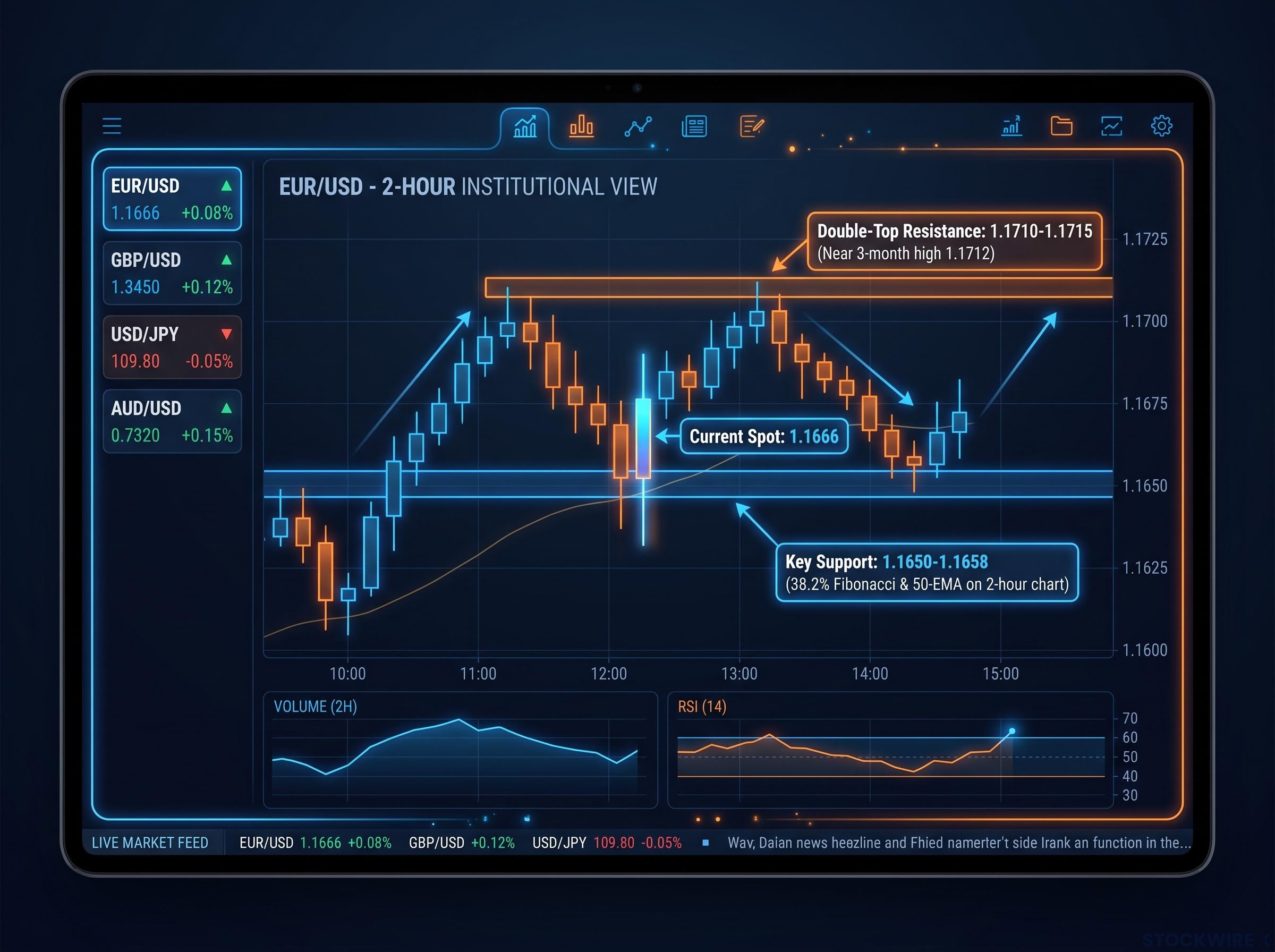
| Level Type | Price Zone | Technical Basis | Directional Implication |
|---|---|---|---|
| Current Spot | 1.1666 | Mid-range consolidation between support and resistance | Neutral; awaiting catalyst |
| Key Support | 1.1650-1.1658 | 38.2% Fibonacci retracement and 50-EMA on 2-hour chart | A clean break below signals corrective move becoming directional shift |
| Double-Top Resistance | 1.1710-1.1715 | Near three-month high of 1.1712 reached earlier this week | Confirmed break above signals renewed bullish momentum |
The support cluster at 1.1650-1.1658 carries particular weight. The 38.2% Fibonacci retracement, a level that measures how far a price has pulled back from a recent move, converges with the 50-EMA (exponential moving average, a smoothed average of recent prices that traders use to identify trend direction) on the 2-hour chart at precisely this zone. When two independent technical indicators align at the same price, it concentrates buying interest and makes any breach more significant.
Above, the double-top at 1.1710-1.1715 marks the ceiling. The pair touched 1.1712 earlier this week and reversed. A second failure at this level would confirm the double-top pattern, a bearish signal. A clean break through it would invalidate the pattern entirely and open room for further euro strength.
The broader August rally in EUR/USD has been characterised as a dollar-weakness-driven rally rather than a euro-strength-driven one, a distinction that matters because dollar-weakness moves are structurally more fragile and more vulnerable to a single hawkish catalyst reversing the entire advance.
The confluence at 1.1650-1.1658 means this is not an arbitrary support level. A clean break below it would be a technically meaningful signal that the week’s corrective move has become something more directional. Pre-speech caution is the reason the pair has not tested either boundary with conviction; Friday morning will resolve that.
Kevin Warsh’s first Jackson Hole keynote: what makes it structurally different from a routine Fed speech
This is not a standard policy update. Three factors elevate Kevin Warsh’s address into a genuinely different category of market event:
- Inaugural address with no prior baseline. This is Warsh’s first major set-piece speech as Fed Chair. Markets have no communication template for how he signals, hedges, or surprises. Every previous Fed Chair’s first Jackson Hole address generated outsized volatility precisely because traders had no pattern to anchor expectations against.
- No pre-released text amplifying genuine event risk. No embargoed copy of the remarks has circulated. The Kansas City Fed will post prepared remarks as they are delivered. In a normal speech cycle, desk strategists receive advance text and pre-position accordingly. That safety net does not exist here.
- Nineteen-day proximity to the September FOMC decision. The speech lands on Friday 28 August. The next FOMC meeting is 16 September. Nineteen days.
TD Securities strategists have argued that this deliberate speech construction, designed to avoid a September 16 FOMC rate signal, means investors positioned for a Powell-era rate preview carry the sharpest repricing risk entering Friday morning.
The calendar mechanics: nineteen days and the September decision
That nineteen-day window is tight enough that Warsh’s language will function as the de facto last major Fed communication before the September rate decision. Every hedged phrase, every qualifier, every deliberate omission will be parsed for hawkish or dovish lean.
The question hanging over the speech is whether Warsh addresses a dynamic several market participants have been watching: whether rising market rates are already performing part of the Fed’s tightening work. If long-term Treasury yields have climbed enough to slow credit growth and cool demand, Warsh may argue the Fed can afford patience. If he does not address it, markets will likely read the omission as tacit comfort with the possibility of further hikes.
For you, understanding the institutional mechanics around a new Chair’s first keynote means calibrating your post-speech interpretation more accurately than treating it as a standard policy update. There is no prior Warsh baseline. There is no advance text. There is a nineteen-day countdown to a live rate decision. That combination concentrates market-moving potential into a single hour on Friday morning.
Three scenarios for EUR/USD after the speech, and how to read each one
Rather than waiting for consensus commentary to form after the address, mapping the three most likely outcome paths against the technical levels gives you a framework for interpreting the speech in real time.
| Speech Outcome | Fed Signal | EUR/USD Direction | Key Level in Focus |
|---|---|---|---|
| Hawkish validation | Continued tightening bias; inflation persistence acknowledged as requiring action | Dollar strength; EUR/USD lower | 1.1650-1.1658 support under pressure |
| Dovish or patient tone | Comfort with current rate path; caution about overtightening | Dollar softens; EUR/USD recovery | 1.1710-1.1715 resistance tested |
| Deliberate ambiguity | Non-committal; no clear directional guidance | Whipsaw volatility in both directions | Both levels vulnerable to temporary breach |
A hawkish Warsh would validate the post-PCE repricing and likely push EUR/USD through the 1.1650-1.1658 support cluster. The 36% September hike probability would climb, and the dollar bid would broaden.
A dovish or patient Warsh would relieve the pressure. EUR/USD would likely recover toward and potentially through the double-top resistance at 1.1710-1.1715, and September hike odds would compress.
The ambiguity scenario is not the neutral option. For a pair already consolidating at a technically sensitive support level, an unclear speech can trigger sharper short-term moves than a clear hawkish or dovish signal, because it forces every participant to act on their own interpretation simultaneously. Both support and resistance become vulnerable to temporary breach before the market finds a new equilibrium.
That third scenario is the one most traders underestimate. It produces the widest intraday range and punishes directional positions in both directions before settling. If you are positioned in EUR/USD heading into Friday, the ambiguity path is the one that demands the most careful risk management.
What the next 48 hours actually change, and what they do not
The PCE data confirmed the inflation persistence that has been driving USD support. The technical picture shows a pair at a genuinely sensitive juncture. The speech is the near-term resolution event for the September rate question. Those three threads converge on Friday morning.
But it is worth separating what the speech can actually resolve from what it cannot.
What Friday may resolve:
- Near-term rate path clarity: whether the Fed is leaning toward a September hike or holding
- September hike probability direction: the 36% figure will move meaningfully in one direction
- Warsh’s communication style as a baseline: markets will finally have a template for how this Chair signals
What Friday does not resolve:
- The underlying inflation regime: one speech does not end a persistent inflation cycle
- The Fed-ECB rate differential: the structural gap between US and European rates remains the dominant medium-term force on EUR/USD
- Medium-term EUR/USD trend direction: the rate differential thesis requires watching the ECB’s forward guidance just as closely as the Fed’s
The key levels remain 1.1650-1.1658 on the downside and 1.1710-1.1715 on the upside. In the 48 hours after the speech, the pair will likely resolve to one side of that range.
One structural force complicating the dollar-strength thesis is the US Treasury buyback programme, which has been functioning as a yield curve cap on long-end rates, eroding the dollar’s rate premium independently of Fed policy and making hawkish rhetoric a less reliable dollar-strength signal than it would otherwise be.
Even a dovish Warsh is more likely to produce relief than a sustained EUR/USD trend reversal. The structural USD support from the rate differential does not disappear because one speech strikes a patient tone. For you, the speech resolves the near-term directional question; the medium-term structural one requires a different set of inputs entirely.
This article is for informational purposes only and should not be considered financial advice. Investors should conduct their own research and consult with financial professionals before making investment decisions. These statements are speculative and subject to change based on market developments and central bank decisions.