
AI-Media completes recurring-revenue transition as ARR reaches $36M
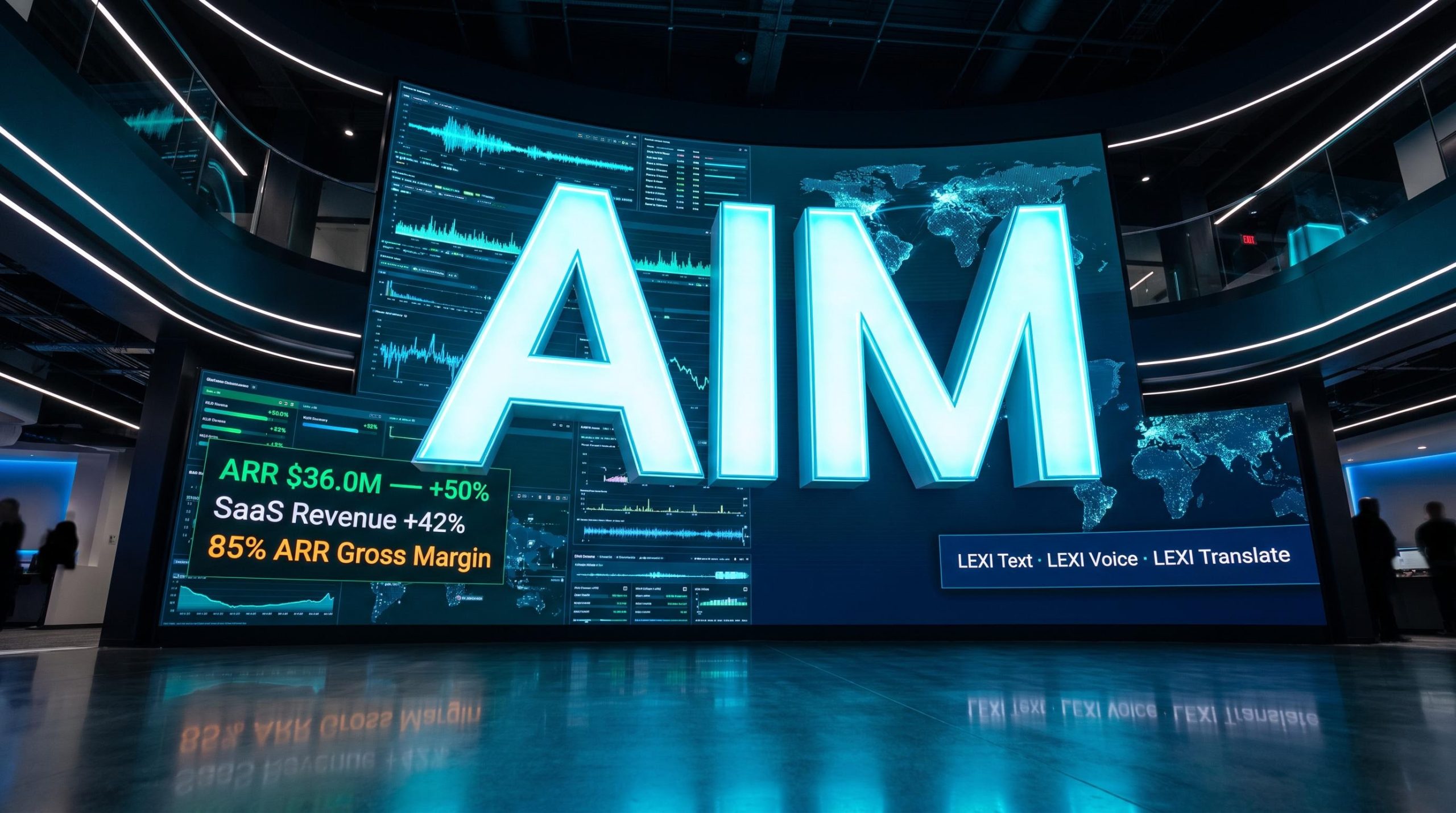
In its FY26 full-year results investor presentation, released 27 August 2026, AI-Media Technologies (ASX: AIM) reported that annual recurring revenue reached $36.0M on an exit run-rate basis, up 50% on FY25, at an 85% ARR gross margin. Management framed the result as the completion of the company’s transition to an AI-native recurring-revenue business.
The shift involved a deliberate trade-off. Total revenue declined 7% to $60.2M as Legacy Services was retired by design, while SaaS revenue grew 42% to $34.1M and total gross margin lifted to 73%. AI-Media, described in the presentation as the world’s leading provider of live broadcast captioning technology with a dominant position in North America, ended the period with $15.9M cash and no external debt.
When big ASX news breaks, our subscribers know first
FY26 headline results at a glance
The full-year scorecard highlights the divergence between scaling recurring SaaS and the planned exit of lower-margin Legacy Services.
| Metric | FY26 | FY25 | Change | Note |
|---|---|---|---|---|
| Total Revenue | $60.2M | $64.9M | -7% | Legacy exit as planned |
| ARR (exit run-rate) | $36.0M | $24.0M | +50% | 85% gross margin |
| SaaS Revenue | $34.1M | $24.0M | +42% | Majority LEXI Text |
| Legacy Services | $15.4M | $23.8M | -35% | Being retired |
| Total Gross Margin | 73% | 69% | +4pp | Tech-led |
| Adjusted EBITDA | $2.1M | $4.6M | -54% | H2 inflection |
| Cash Balance | $15.9M | $14.7M | +$1.2M | No external debt |
Key observations from the FY26 mix:
-
74% of FY26 revenue is now technology.
-
No hardware-as-a-service (HaaS) sales were recorded in FY26.
-
Hardware revenue declined $6.4M ahead of the new encoder refresh cycle, with next-generation units scheduled to ship in 1H27.
Why the revenue mix reset matters to investors
Headline revenue fell because the low-margin Legacy Services business was intentionally exited, while high-margin recurring SaaS scaled. The presentation positioned this as an improvement in the overall quality of earnings rather than a decline in the core business.
The second half showed an earnings inflection. 2H26 Adjusted EBITDA of $2.5M compared with a 1H26 loss of $(0.4)M, signalling operating leverage as product investment peaked. Management noted approximately $3M in annualised savings entering FY27.
Product and R&D of $7.7M was fully expensed in FY26, with none capitalised, reflecting peak investment now released.
The recurring-revenue engine
The ARR trajectory over four years illustrates the durability management is targeting:
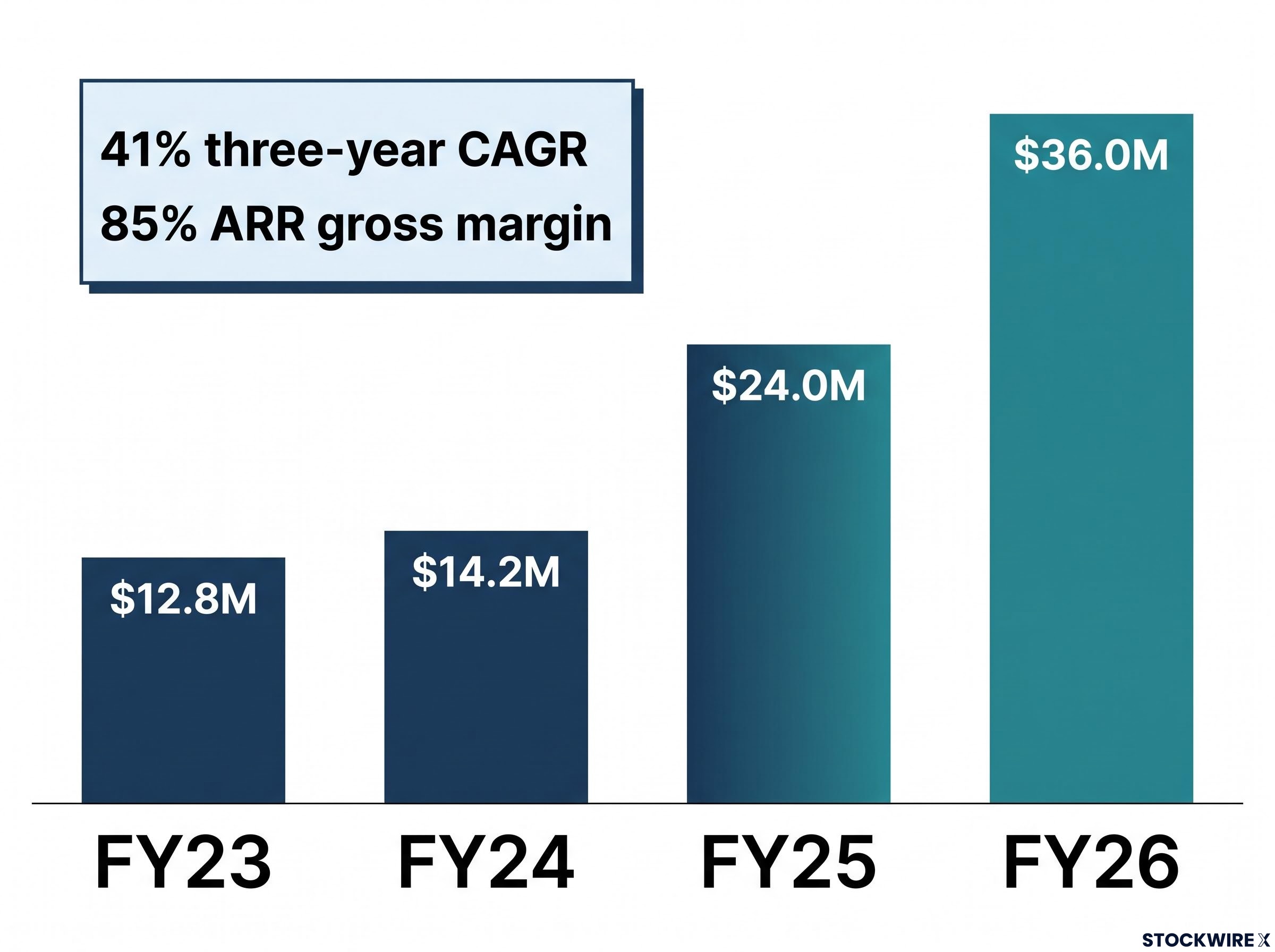
The LEXI ARR growth trajectory entering FY26 already showed the model working, with ARR reaching $30M at an 84% gross margin and zero churn recorded across the top 20 customers over five years.
-
FY23: $12.8M
-
FY24: $14.2M
-
FY25: $24.0M
-
FY26: $36.0M
That represents a 41% three-year CAGR at an 85% ARR gross margin. Usage data supports the growth. LEXI Text grew from 11% of iCap network usage in 1H21 to 68.5% in June 2026, and LEXI minutes recorded a 65% five-year CAGR. On the presentation’s framing, ARR growth is supported by rising customer consumption rather than pricing alone.
Tony Abrahams, Co-founder, CEO & Shareholder (18%)
FY26 completed AIM’s core business-model transition. FY27 focus is recurring revenue growth, leverage and cash generation.
Understanding the “language layer” and why the moat isn’t the AI model
At its core, AI-Media takes live video, adds broadcast-grade captions, translated text or translated voice, and delivers it back into broadcast and streaming workflows in real time. The company serves broadcasters, governments and enterprises across 46 countries.
A central investment point from the presentation is that AIM is model-agnostic. It plugs in best-fit AI models from providers including Google, DeepL, ElevenLabs and XL8, among others. As AI models commoditise, management argued, value shifts to the workflow infrastructure that integrates them securely.
The presentation outlined four moat pillars:
-
20+ years of workflow expertise and reliability.
-
Embedded installed infrastructure and integrations, spanning 8,000+ encoders across 46 countries.
-
Mission-critical reliability, compliance and auditability.
-
High switching costs from customer-specific workflows.
According to the company, each additional LEXI application deepens customer integration and expands the recurring platform opportunity.
The installed base becomes a FY27–FY28 growth lever
Management framed the encoder fleet as both embedded distribution and an upgrade opportunity:
-
8,000+ installed encoders globally.
-
2,200+ refreshable units more than five years old.
-
Three next-generation AI-native platforms: LEXI Direct, the UHD592 (new FY27) and the AIX-1 (new FY27).
-
Two commercial models, CapEx and HaaS, offering flexible adoption paths.
The next-generation encoders launched at the April 2026 NAB Conference and are anticipated to ship in 1H27, adding UHD support, modern security architecture and multilingual Voice. The AIX-1 supports up to 5 Voice and 6 Text channels. Management presented the aged fleet combined with new capability as a practical conversion pool for FY27 recurring revenue.
Four growth priorities set the FY27 agenda
The presentation detailed management’s stated FY27 strategy:
-
Scale LEXI Text — extend the US broadcast transition from human captioning, expand across EMEA and APAC, and enter Education.
-
Convert installed encoder base — upgrade the ageing fleet, ship UHD592 and AIX-1, and deploy software-based LEXI Direct.
-
Commercialise LEXI Voice — convert customer validation into contracted recurring revenue.
-
Extend LEXI platform — commercialise LEXI Recorded, AD and Insights on the same platform footprint.
Management described the approach as “replication not reinvention.” In FY26, one segment, AMER Broadcast, drove 55% of revenue via LEXI Text and Encoders. The remaining eight of nine segments (three regions across three industries) form the growth runway.
LEXI Voice: early commercial proof points
The presentation cited two validation deployments:
-
City of Sacramento — live English captions plus real-time Spanish voice translation across roughly 30 meetings per month at two City Hall locations, illustrating a repeatable Government workflow.
-
MNEWS Taiwan (partner: IDT) — English to Traditional Chinese translation plus real-time Mandarin dubbing, delivered live-to-air, demonstrating broadcast localisation.
A larger addressable opportunity
Management outlined a TAM expansion thesis extending AIM beyond its core captioning market:
-
Core Text/captioning market of approximately US$2bn.
-
Adjacent video, voice and localisation market of approximately US$4–6bn.
-
Broader language-services infrastructure market of approximately US$70bn.
On the company’s framing, the emerging LEXI Suite extends AIM from its core into materially larger adjacent markets.
What investors should watch in FY27
The presentation framed FY26 as the baseline against which FY27 progress can be measured, presenting five investment pillars as management’s own investor scorecard.
| Pillar | FY26 Evidence | FY27 Investor Indicator |
|---|---|---|
| Recurring growth engine | $36.0M ARR (+50%); $34.1M SaaS (+42%) | ARR + recurring revenue growth |
| High-quality revenue | 85% ARR margin; 74% tech mix | ARR margin + retention/net expansion |
| Durable workflow moat | Installed encoder estate; iCap network | Installed-base conversion + platform adoption |
| Multiple platform levers | Full LEXI Suite live | New-product revenue contribution |
| Funded operating leverage | $15.9M cash, no debt; $7.7M R&D expensed | Adjusted EBITDA + cash generation |
FY27 Outlook
FY26 proved the recurring model. FY27 must demonstrate that scale converts into durable earnings and broader platform revenue.
On the presentation’s framing, AIM enters FY27 as a higher-quality, funded, recurring-revenue business.
Don’t Miss the Next ASX Tech Breakout
Big News Blast delivers FREE breaking ASX tech news directly to your inbox within minutes of release, complete with in-depth analysis. Join 20,000+ subscribers already getting the edge on market-moving announcements the moment they drop. Click the “Free Alerts” button at Big News Blast to stay ahead of the market.