

Infratil-backed One NZ unveils mobile network sharing proposal with 2degrees
Infratil Limited has disclosed a proposed mobile network infrastructure sharing arrangement between One New Zealand and rival operator 2degrees, released to the market on 27 August 2026. The proposal would see both companies combine their mobile radio access network (RAN) infrastructure into a new, jointly-owned wholesale business under the holding name RANCo.
The arrangement remains a proposal subject to regulatory approvals, with the two parties targeting completion in the first half of 2027. The release was authorised by Infratil Chief Financial Officer Matthew Ross.
For the infrastructure investor, the proposal represents a potential shift in how One NZ deploys capital across its mobile network, with the stated aim of reducing duplication while maintaining competition between the two operators.
When big ASX news breaks, our subscribers know first
What the RANCo proposal actually involves
Under the proposal, One NZ and 2degrees would contribute their respective RAN assets into a jointly-owned commercial entity. That entity would own, manage and operate the shared RAN infrastructure, providing network services back to each company via separate wholesale agreements.
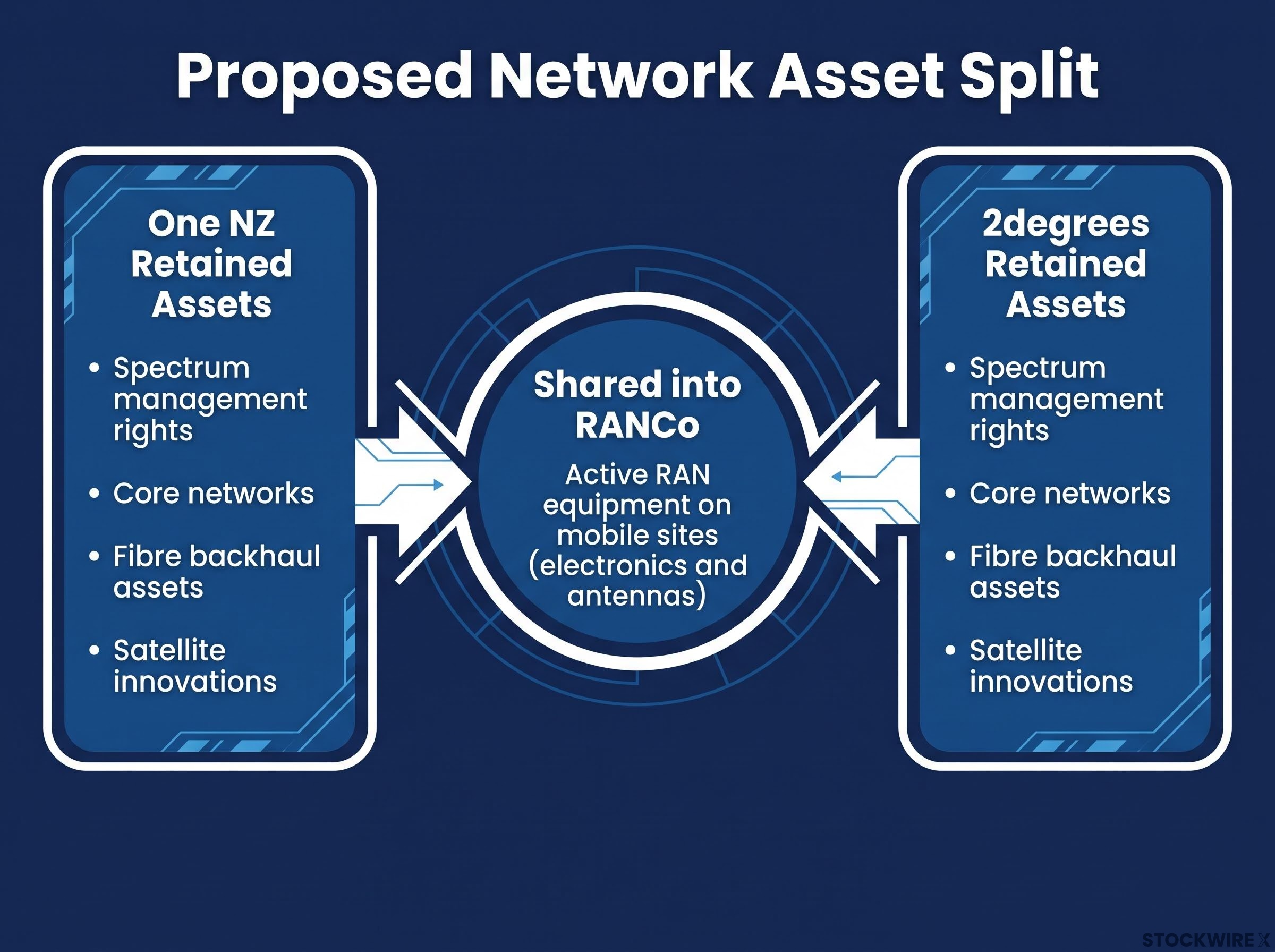
Importantly, each company would continue to separately own and invest in the assets that drive competition and differentiation. One NZ would retain ownership and control of its spectrum management rights, core networks, fibre backhaul assets and satellite innovations.
If approved, both companies would continue to operate as fully independent retail and wholesale businesses and continue to compete for consumer and business customers.
Here is a breakdown of what would be shared versus what stays independent:
-
Shared into RANCo: active RAN equipment on mobile sites (electronics and antennas)
-
Retained by each company: spectrum management rights, core networks, fibre backhaul assets, and satellite innovations
| Feature | Detail |
|---|---|
| New entity name | RANCo (holding name) |
| Assets contributed | RAN infrastructure (active equipment on mobile sites) |
| Ownership | Jointly-owned by One NZ and 2degrees |
| Service model | Separate wholesale agreements to each company |
| Target completion | First half of 2027 |
| Approvals required | NZ Commerce Commission, Overseas Investment Office |
Understanding RAN sharing and why it matters
RAN technology refers to the active equipment on mobile sites, such as the electronics and antennas that connect mobile devices to the wider network. Sharing this layer of infrastructure allows operators to make more efficient use of existing assets and reduce unnecessary duplication of equipment.
The concept is not new to the New Zealand market. One NZ and 2degrees already operate a smaller commercial RAN sharing arrangement covering a limited number of sites. Other examples of mobile infrastructure sharing in the country include the Rural Connectivity Group (RCG), and mobile tower companies Fortysouth and Connexa.
According to incoming One NZ CEO Nick Judd, RAN network sharing is already common in overseas markets and enables more efficient investment in mobile infrastructure.
For investors, the appeal of shared infrastructure lies in capital efficiency. By reducing spend on duplicated equipment, operators can redirect capital toward areas where they can differentiate and grow.
Strategic rationale and investment significance
For One NZ, the proposal is positioned to create a more efficient platform for long-term network investment. Nick Judd, Incoming One NZ CEO, stated the arrangement would allow capital to be directed to the areas where One NZ can deliver the greatest differentiation and value for customers, including product innovation, customer experience, core network capability and new connectivity services.
The RANCo proposal fits a broader pattern of capital recycling across its portfolio, with Infratil having unlocked approximately NZ$495 million earlier in 2026 through the sale of a Contact Energy stake to fund its next investment cycle.
The company outlined several potential customer and network benefits, including faster access to new technologies such as 6G, improved network resilience, and more future-proofed infrastructure. There is also a sustainability angle, with the proposal expected to reduce duplication of equipment and lower overall energy use over time.
Nick Judd, Incoming One NZ CEO
“This proposal would deliver real benefits for customers by enabling us to deliver better connectivity. This includes faster access to new technologies such as 6G and improving overall network resilience.”
What happens next: approvals and timeline
The proposal is conditional and not yet approved. Completion depends on securing the necessary regulatory clearances and completing several reorganisation steps before the shared entity can operate.
Both operators have stressed that competition would be maintained, with each continuing to compete strongly on value, products and innovation.
The path to completion involves the following steps:
-
NZ Commerce Commission approval
-
Overseas Investment Office approval
-
Some reorganisation steps
-
Targeted completion in the first half of 2027
The timing and structure of the arrangement remain subject to regulatory outcomes. No guaranteed completion date exists beyond the first half of 2027 target, and the proposal could be altered or delayed depending on the approvals process.
Should the proposal proceed as intended, more efficient infrastructure sharing could support One NZ’s long-term growth within the Infratil portfolio by freeing capital for network differentiation. For now, investors should treat the arrangement as a proposal, with its ultimate form and timing dependent on regulatory approval.
Stay Ahead on ASX Infrastructure and Telco News
Get FREE breaking ASX alerts delivered to your inbox within minutes of release, complete with in-depth analysis already done for you. Join 20,000+ subscribers who never miss a market-moving announcement. Click the “Free Alerts” button at StockWire X to start receiving real-time coverage the moment news breaks.