
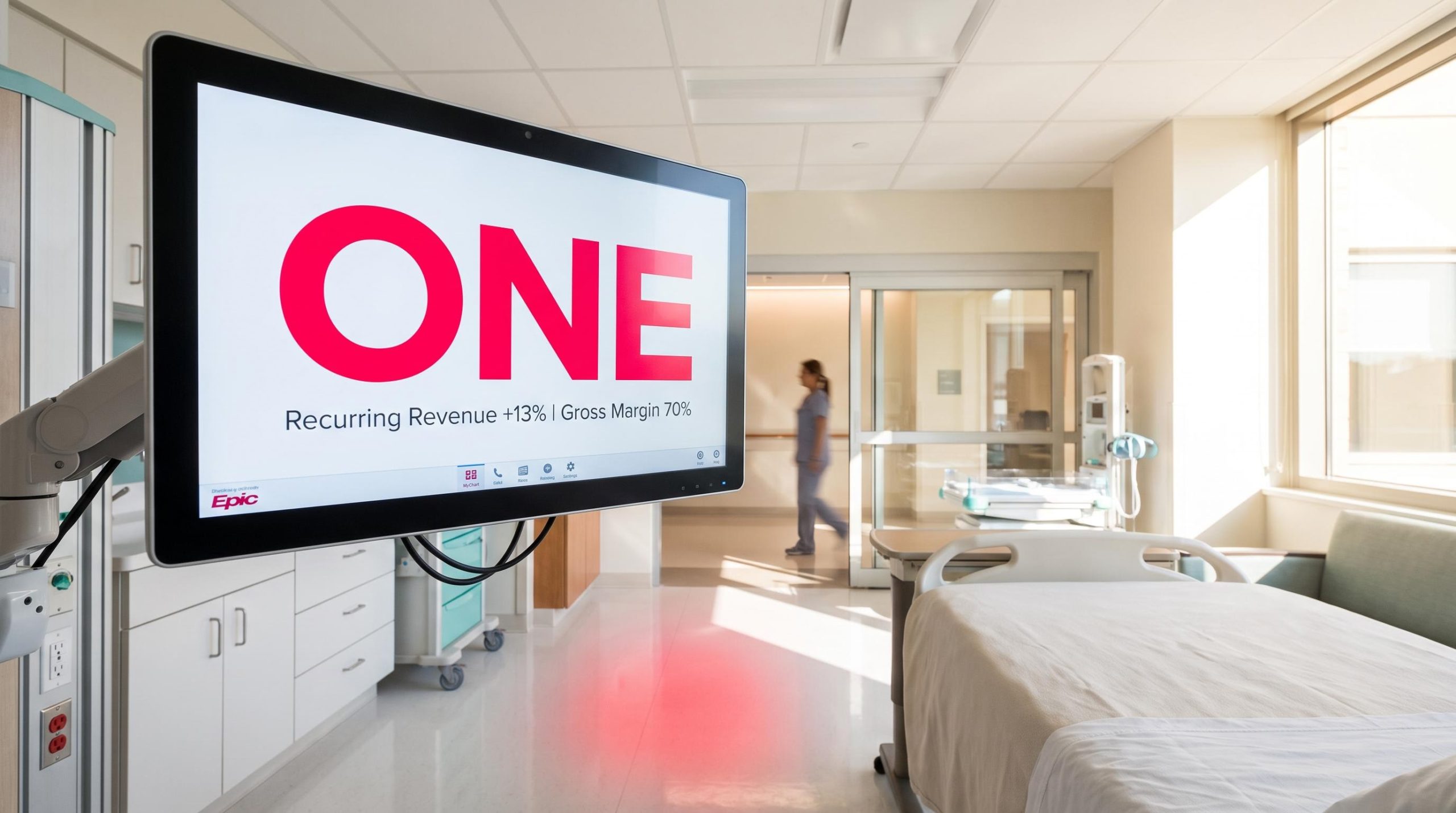
In its H1 2026 results presentation, delivered 27 August 2026 by Chief Executive Officer James Fitter and Chief Financial Officer Darragh Lyons, Oneview Healthcare (ASX) outlined a strategic shift toward what management framed as a “path to scalable growth.”
The headline story centred on recurring revenue climbing 13% to €4.3m, gross margin expanding to 70%, and the opening of a new Epic-certified revenue channel. Operating cash outflow fell 15% to €4.1m, while the company closed the half with cash of €7.2m (€11.4m pro forma for the second placement tranche).
H1 2026 financial performance at a glance
The financial picture management presented reflected a deliberate mix shift. Total revenue fell 14% to €5.5m, but this was driven by a lower non-recurring contribution as the company prioritised higher-margin recurring revenue. Notably, gross profit held flat at €3.8m despite €0.8m less revenue.
| Metric (€m) | H1 2026 | H1 2025 | Change |
|---|---|---|---|
| Recurring revenue | 4.3 | 3.8 | +13% |
| Non-recurring revenue | 1.2 | 2.5 | −54% |
| Total revenue | 5.5 | 6.3 | −14% |
| Gross profit | 3.8 | 3.8 | 0% |
| Gross margin | 70% | 61% | +9pts |
| Operating EBITDA loss | (4.0) | (4.5) | −11% |
Cash operating expenses fell 6% to €7.8m, sitting 10% below the H2 2024 peak as savings from the June 2025 restructuring flowed through the base. Combined with margin expansion, this cost discipline narrows the path to breakeven.
Capital position strengthened by the March placement
The balance sheet reflected proceeds from a two-tranche institutional placement raising A$19m (approximately €11.4m) in gross proceeds, secured in March 2026. Tranche 1 (A$12m) settled on 24 March, while Tranche 2 (A$7m / €4.2m) remains subject to shareholder approval at the AGM scheduled during Q4 2026.
The A$19m institutional placement secured in March 2026 was upsized from its original target due to strong demand from existing and new international investors, with proceeds earmarked for customer deployment acceleration, Ovie AI development, and balance sheet strengthening to meet US health system vendor requirements.
Cash of €7.2m at 30 June was up 56% on 31 December 2025, rising to €11.4m on a pro forma basis including the Tranche 2 proceeds. Net assets stood at €6.4m, up 73% since December.
When big ASX news breaks, our subscribers know first
Commercial momentum: Epic certification opens a new channel
The strategic heart of the presentation was the launch of Bedside Hub in May 2026, following certification by Epic. The product delivers Epic MyChart Bedside TV on Oneview healthcare-grade hardware with cloud-based device management, offering a lower-cost entry point into Epic-centric health systems.
The Bedside Hub launch in May 2026 came with an active pipeline already forming from pre-certification inquiries, including a named 1,100-bed opportunity already in contract negotiations at the time of certification.
The dual-market commercial model
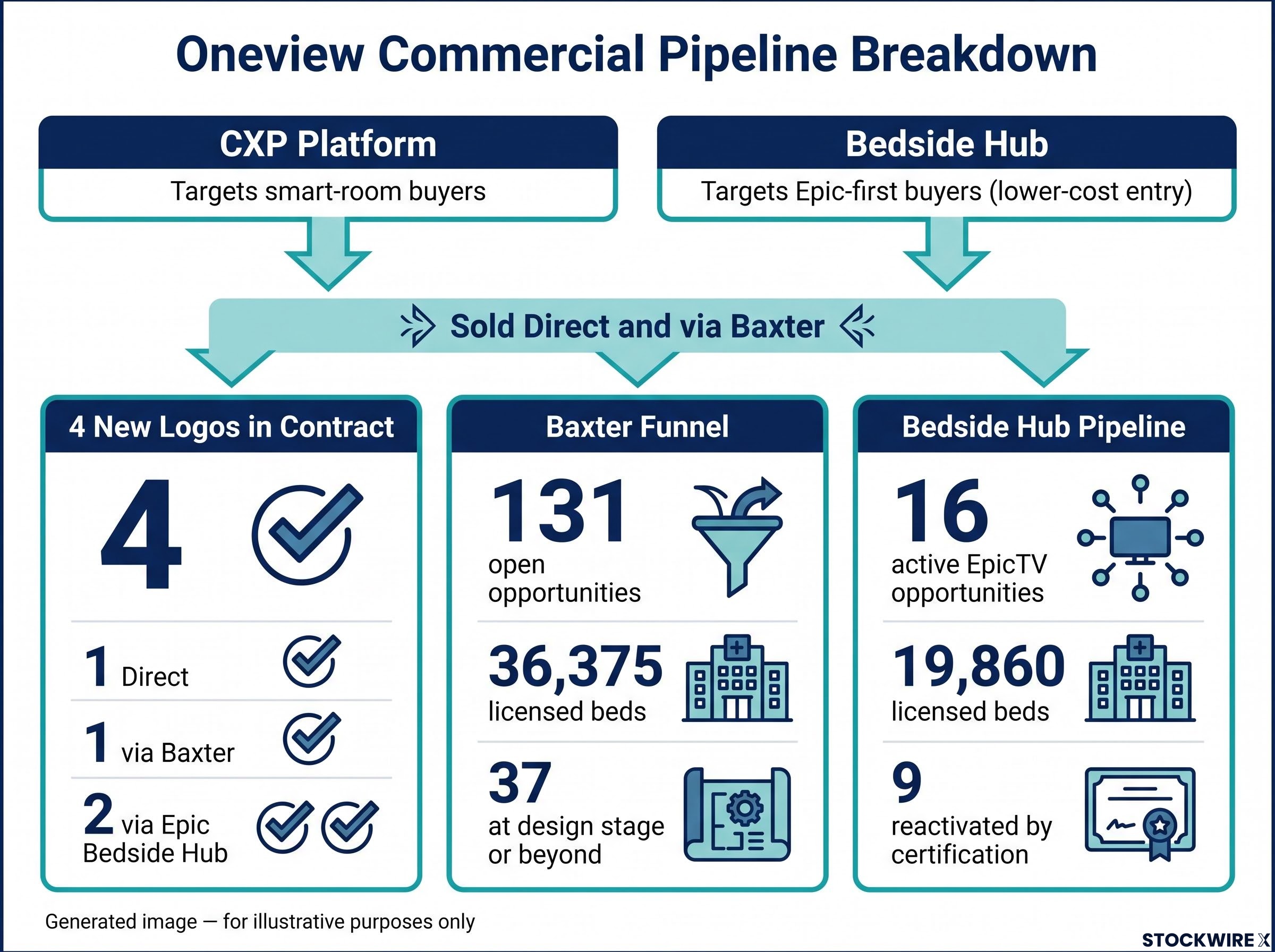
Management outlined two routes to market. The CXP platform targets smart-room buyers, delivering the full Care Experience Platform with deep integrations that management described as the commercial moat. Bedside Hub targets Epic-first buyers with a lower-cost entry point.
Both are sold Direct and through Baxter as value-added reseller. Management noted that 43.7% of US acute care hospitals run on Epic, representing 56.9% of beds in 2025.
Pipeline building across both channels
Commercial highlights presented across both channels included:
-
Four new logos in contract negotiation (1 Direct, 1 via Baxter, 2 via Epic Bedside Hub)
-
Addition to Baxter’s national care communication agreement with the group purchasing organisation of a top-10 US health system (85+ hospitals, 15k+ beds)
-
A Baxter funnel of 131 open opportunities representing 36,375 licensed beds, with 37 at design stage or beyond
-
A Bedside Hub pipeline of 16 active EpicTV opportunities representing 19,860 licensed beds, of which 9 were previously stalled and reactivated by certification
-
A first enterprise pilot: a 15-bed EpicTV pilot across three hospitals of a top-20 health system, commencing September
-
A first-ever invitation to Epic’s User Group Meeting in Madison, producing 50+ conversations and 10 demonstrations in the two weeks prior
Management indicated that certification is reactivating dormant pipeline and providing ecosystem credibility that Oneview could not otherwise acquire.
Installed base and market backdrop
The installed base grew to 15,092 live endpoints at 30 June, with 693 units deployed and 481 decommissioned in the half. Average recurring revenue per new endpoint was 59% higher than on those decommissioned.
In Australia and New Zealand, the sales pipeline has doubled, from 3 active bids in January to 8 today, with 4 of the 8 for hospitals under construction. Management noted that US procurement pressure, including EpicTV evaluations and tighter federal funding, is temporarily slowing full-platform decisions while increasing Bedside Hub’s relevance.

What is Bedside Hub and why does it matter?
Epic is the electronic health record (EHR) system used across 43.7% of acute hospitals. Certification means Epic validated Oneview to run its MyChart Bedside TV application on Oneview’s own healthcare-grade hardware.
For cost-conscious hospitals, a lower-priced entry point carries greater weight when capital budgets tighten. From an investment perspective, Bedside Hub provides a lower-cost entry point into Epic accounts and expands the addressable market.
Product innovation and the road to breakeven
Innovation delivered in H1
Management detailed four product deliveries during the half:
-
Bedside Hub — Epic-certified and launched May 2026
-
New front end — substantially complete, with first deployments scheduled from September
-
Ovie — evolving into an agentic intelligence layer designed to orchestrate patient and staff workflows, with initial pilots planned during 2026
-
Data and analytics — advanced utilisation dashboards shipped in H1
AI-enabled development
Management highlighted the integration of AI into the delivery model, supported by governance controls. Key metrics presented included approximately 85% of code written by AI agents (with human-in-the-loop review), 1.7x feature development, and around 5x faster bug root-cause investigation, underpinned by ISO 42001-aligned governance. Management indicated this shortens deployment timelines and improves operating leverage.
The US$50bn opportunity and competitive moat
The presentation positioned the US$50bn Rural Health Transformation Program (FY2026–FY2030) as policy alignment rather than guidance, explicitly noting that no allocations or revenue are assumed. The programme funds telehealth, remote monitoring, digital infrastructure and workforce productivity, capabilities management stated the platform already delivers.
On the competitive moat, management pointed to deep integrations, high switching costs from 15,092 embedded endpoints, 3 of the Top 25 US hospitals as customers, and ISO 27001, ISO 27701 and ISO 42001 certifications.
Management stated the strategic priority is continued progress to bridge to cash flow breakeven.
H2 2026 outlook and priorities
Management outlined the forward roadmap for H2 2026, grouped by theme:
-
Commercial: convert late-stage opportunities; target 3-4 new Bedside Hub logo wins; drive expansions across the existing base
-
Financial: sustain the strong ARR growth trajectory; continue optimising the operating cost base
-
Product: first deployments of the new front end from September; customer feedback from the Ovie pilots
-
Operations: first deployments of Bedside Hub; commence initial projects with the top-10 health system
The strategic through-line management presented was continued progress bridging to cash flow breakeven, underpinned by margin expansion, cost discipline and the new Epic channel.
Don’t Miss the Next Healthcare Breakout on the ASX
Big News Blast delivers FREE breaking ASX healthcare news directly to your inbox within minutes of release, complete with in-depth analysis already done. Join 20,000+ investors who stay ahead of the market the moment announcements hit. Click the “Free Alerts” button to start receiving real-time coverage today.