
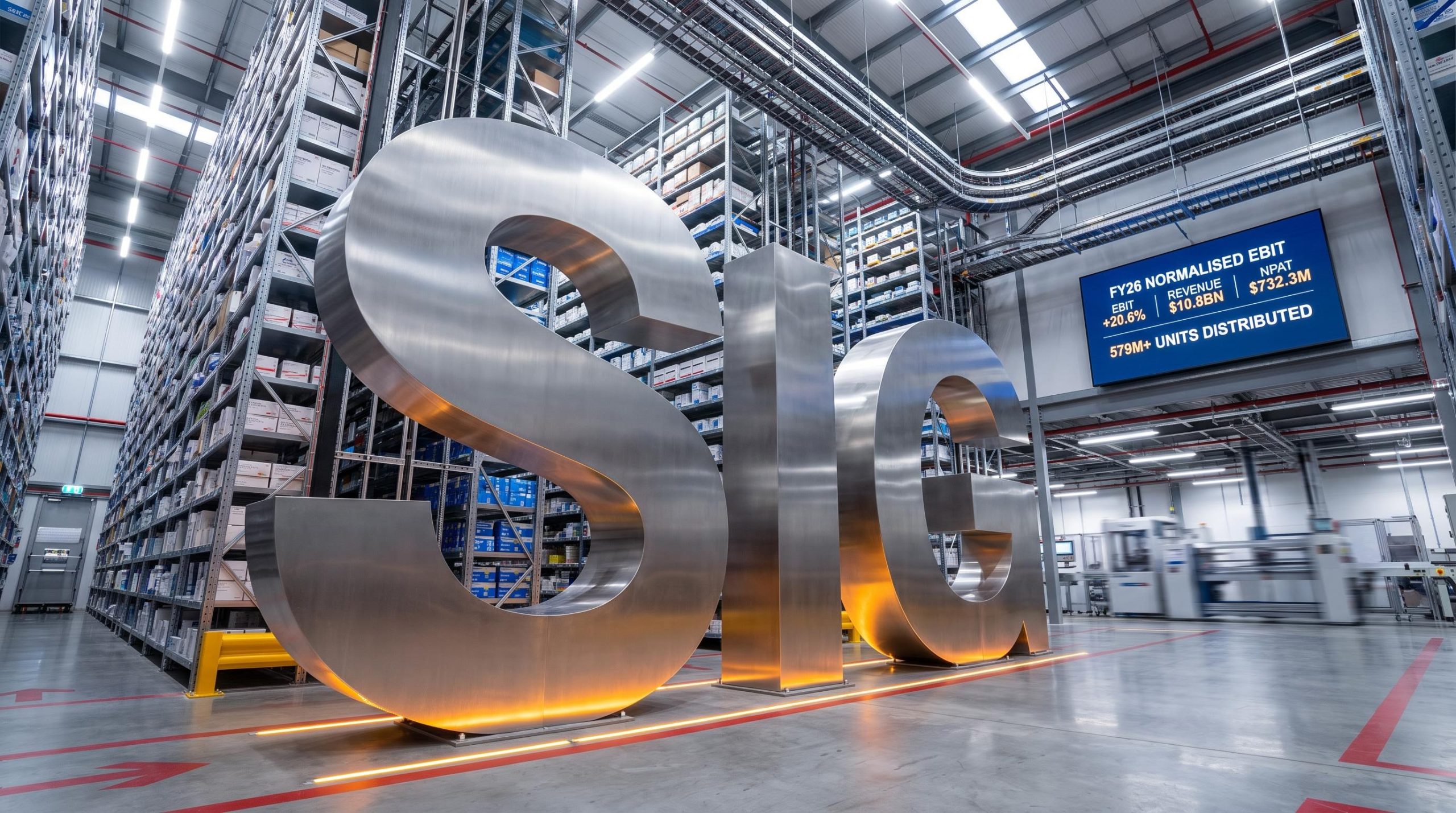
Sigma turns merger scale into faster earnings: FY26 normalised EBIT up 20.6%
In its FY26 results presentation, Sigma Healthcare detailed its first full 12 months operating as the merged Sigma/Chemist Warehouse group, converting revenue growth into faster earnings growth across the period to 30 June 2026.
Management highlighted normalised revenue of $10.8bn (+15.5%) and normalised EBIT of $1,090.0m (+20.6%) versus FY25 pro-forma, with NPAT reaching $732.3m (+22.3%) and normalised EPS of 6.4 cps (+21.5%). EBIT margin expanded 43 bps to 10.1%.
“Sigma is not simply larger after the merger – it is structurally stronger.”
Earnings growing faster than revenue points to genuine operating leverage rather than merger scale alone, a distinction management placed at the centre of the FY26 investment case.
When big ASX news breaks, our subscribers know first
FY26 financial results at a glance
The headline scorecard is presented on a normalised basis, with comparatives drawn from FY25 pro-forma (assuming Sigma and Chemist Warehouse Group were merged for the full year).
The H1 FY26 results established the trajectory that FY26 full-year performance has now confirmed, with the first merged half delivering normalised EBIT of $582.9 million on $5.5 billion revenue and a conservative 0.6x net debt to EBITDA position.
| Metric | Normalised FY26 | Normalised FY25 PF | Change % | Note |
|---|---|---|---|---|
| Revenue ($m) | 10,835.0 | 9,380.1 | +15.5% | Multiple revenue drivers |
| Gross profit ($m) | 1,956.9 | 1,698.6 | +15.2% | Margin 18.06%, -5 bps |
| EBITDA ($m) | 1,157.6 | 968.5 | +19.5% | Scale benefits |
| EBIT ($m) | 1,090.0 | 903.4 | +20.6% | Margin 10.06%, +43 bps |
| NPAT ($m) | 732.3 | 598.8 | +22.3% | |
| EPS (cps) | 6.4 | 5.2 | +21.5% |
Quality-of-earnings drivers detailed in the presentation included:
-
Gross margin held near 18.1% through product mix and strong category management.
-
CODB improved to 8.57% of sales, an improvement of 47 bps.
-
Scale efficiencies delivered in distribution and supplier arrangements.
On capital discipline, management noted:
-
Net debt of $663.2m, with net debt to normalised EBITDA of 0.57x (down from 0.85x).
-
Normalised ROIC of 19.3%.
-
Full-year dividends of 4.0 cps fully franked, representing a 63.0% DPR; the final 2.0 cps is payable 22 September 2026.
The four value-creation pillars driving growth
Management outlined four value-creation pillars underpinning the group’s growth: domestic network expansion, international expansion, growth in own and exclusive label product, and operating leverage.
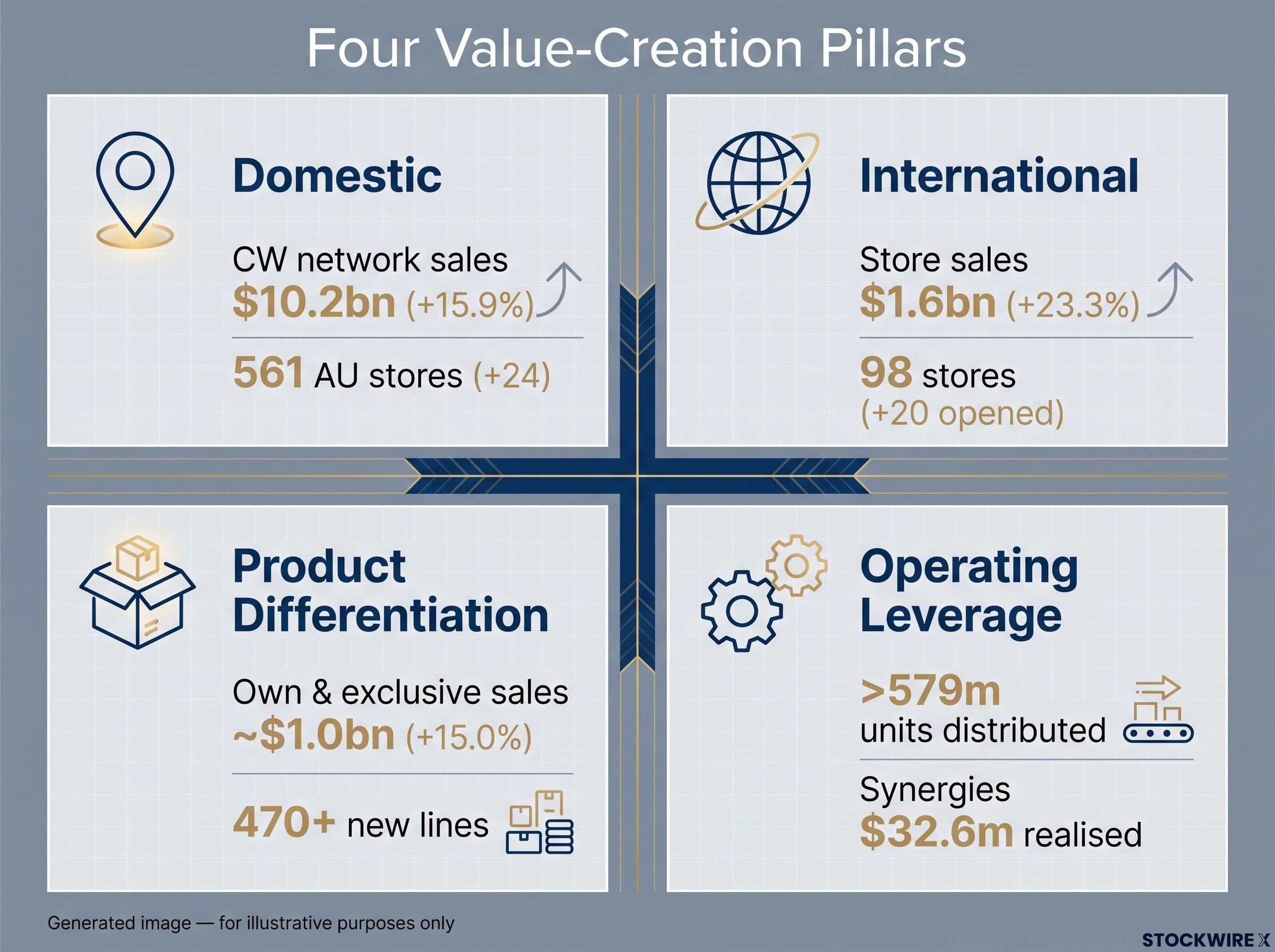
| Pillar | FY26 metric | Growth | Key detail |
|---|---|---|---|
| Domestic | CW branded network sales $10.2bn | +15.9% | 561 AU stores (+24), LFL +13.4% |
| International | Store sales $1.6bn | +23.3% | Network now 98 stores (+20 opened), LFL +12.2% |
| Product differentiation | Own and exclusive label sales ~$1.0bn | +15.0% | Approaching ~10% of CW network sales, 470+ new lines |
| Operating leverage | >579m units distributed | +6.5% | Synergies $32.6m realised in FY26 |
“Chemist Warehouse is and will remain a house of brands.”
Domestic: the core engine still compounding
The Australian segment recorded EBIT of $1,034.2m (+18.3%) with EBIT margin of 9.93% (+28 bps). Revenue growth of +14.9% outpaced CODB growth of +7.7%, driving operating leverage.
Management pointed to continued demand for GLP-1 medicines as a tailwind and noted Chemist Warehouse has delivered an 11.3% sales CAGR over the past 10 years. Reinvigoration of the Amcal and DDS brands is underway.
International: accelerating and now higher margin
International EBIT reached $55.8m (+91.3%) with EBIT margin of 13.23% (+403 bps). New Zealand sales grew +20.3% and Ireland grew +45.0%, with Ireland turning profitable for the first time.
The China store footprint is being wound down as the group refines its strategy toward a profitable online model.
What GLP-1 tailwinds and a capital-light pharmacy model mean for investors
GLP-1 medicines are a class of prescription treatments referenced by management as providing structural tailwinds for the group, which operates in a less-discretionary healthcare segment.
The group operates what management describes as a capital-light model in Australia. Sigma operates this capital-light business model in Australia, supporting the funding of both growth and dividends.
Operating leverage occurs when revenue grows faster than costs, expanding margins over time. FY26 illustrated this dynamic, with normalised EBIT rising 20.6% against 15.5% revenue growth. Together, these factors frame why management positions the group as “defensive and differentiated”, combining less-discretionary healthcare demand with structural volume tailwinds.
Balance sheet strength and the working capital opportunity
Management detailed a strengthened financial position, with net debt reduced to $663.2m at a conservative 0.57x net debt to normalised EBITDA. Debt facilities stood at $1.4bn with a weighted average maturity of 3.2 years, and net assets reached $4,989.5m.
Working capital was flagged as the key watch-item. The Cash Conversion Cycle rose from 46.9 days to 54.0 days, driven by higher inventory from own and exclusive label growth (including Wagner), the move of a direct-to-pharmacy supplier into the distribution centre network, and increased GLP-1 stock holdings.
Management estimated that each 1-day improvement in the Cash Conversion Cycle could release approximately $30m of cash, and noted plans are in place to capture this benefit.
Operating cash flow was $574.6m with free cash flow of $500.4m. Prior-period comparisons are not like-for-like, as FY25 cash flow included only 4.5 months of Sigma following the merger date of 12 February 2025.
Execution priorities and FY27 outlook
Management set out a forward roadmap for FY27, anchored on the following execution priorities:
-
Australian network expansion: 1H27 pipeline of 13 CW branded, 27 Amcal and 15 DDS stores, with 82 new Australian stores planned across FY27.
-
International expansion: 19 stores expected in 1H27, including first entry into the UK market.
UK market entry via partnership rather than acquisition reflects the same return-on-capital discipline management applied when exiting Boots acquisition talks in June 2026, a decision that underscored the group’s preference for self-funded, threshold-tested international growth.
-
Continued investment in own and exclusive label product to enhance margin.
-
Synergy programme tracking toward a $100m p.a. full run-rate, targeted for full realisation during FY29.
On guidance, management noted Australian CW branded LFL sales are continuing double-digit growth, with a trading update to be provided at the October AGM. Management anticipates delivering double-digit revenue and earnings growth in 1H27.
Long-term franchise network targets were reiterated: Chemist Warehouse ~900 stores, Amcal+ ~300, and Discount Drug Stores ~150.
Investment Case
“The investment case: a defensive and differentiated healthcare platform with a high growth earnings profile.”
Stay Ahead on Healthcare Sector News
Big News Blast delivers FREE breaking ASX healthcare news directly to your inbox within minutes of release, complete with in-depth analysis already done. Join 20,000+ subscribers who stay ahead of the market the moment announcements drop. Click the “Free Alerts” button at Big News Blast to start receiving real-time coverage today.