
Two FDA-approved drugs can slow the progression of Alzheimer’s disease. Most patients who qualify for them will never receive a single infusion.
That mismatch defines the Alzheimer’s drug market in mid-2026. Lecanemab earned its approval in 2023, donanemab in 2024, and both demonstrated the ability to modify beta-amyloid pathology rather than merely manage symptoms. Yet uptake has remained stubbornly narrow, constrained not by payer rejection or doubts about efficacy, but by the serial MRI monitoring their labels require to manage a class-specific safety risk. The gap between what is approved and what is accessible is now reshaping competitive dynamics across the entire space, creating a commercially significant opening for oral alternatives that sidestep the monitoring burden entirely.
Here is the framework for understanding why that bottleneck exists at a mechanistic level, what it means for the companies already approved, and how to evaluate any competitor, whether IV antibody or oral small molecule, positioning itself to capture the patients the current therapies cannot reach.
Two categories of Alzheimer’s treatment, and why only one is reaching patients at scale
The drugs most commonly prescribed for Alzheimer’s in 2026 are not the ones that modify the disease. Donepezil, rivastigmine, galantamine, and the rivastigmine patch remain the workhorses of community prescribing. They manage symptoms, improving day-to-day memory function without altering the underlying progression of the disease. They are widely used for one reason above all others: they carry no imaging surveillance requirements.
The second category is genuinely different. Lecanemab (Leqembi, FDA-approved 2023) and donanemab (Kisunla, FDA-approved 2024) are disease-modifying antibodies that target and clear beta-amyloid plaques from the brain. Their clinical trial results demonstrated something no prior Alzheimer’s therapy had achieved at the regulatory level: measurable slowing of cognitive decline tied to pathology reduction.
Those approvals did not translate into broad uptake. The constraint is a safety-monitoring burden embedded directly in the label. Per the August 2025 FDA Drug Safety Communication, patients on either therapy require a baseline MRI plus scans before the 3rd, 5th, 7th, and 14th infusions. That schedule is not optional. It is the price of prescribing a drug class that carries a specific risk of brain swelling and bleeding.
Alzamend Neuro CEO Stephan Jackman has noted that the monitoring burden associated with approved disease-modifying antibodies has limited their broader market adoption.
The result is a market where regulatory approval and commercial reach are two entirely different thresholds. If you are evaluating any Alzheimer’s-focused biotech, conflating “FDA approved” with “commercially penetrating” will lead you to systematically overestimate revenue potential for IV antibody programmes.
| Feature | Symptom-managing drugs | Disease-modifying antibodies |
|---|---|---|
| Mechanism | Improve neurotransmitter function; do not alter disease pathology | Target and clear beta-amyloid plaques from the brain |
| FDA status | Approved and widely prescribed for decades | Lecanemab approved 2023; donanemab approved 2024 |
| Monitoring required | No imaging surveillance | Baseline MRI plus scans before 3rd, 5th, 7th, and 14th infusions |
| Setting of care | Primary care, community neurology | Infusion centres with specialist oversight |
When big ASX news breaks, our subscribers know first
What ARIA is and why it makes MRI monitoring non-negotiable
ARIA stands for amyloid-related imaging abnormalities. It describes two forms of class-specific toxicity caused by anti-amyloid antibodies: brain oedema (ARIA-E, fluid accumulation in or around the brain) and microbleeds (ARIA-H, small areas of bleeding in brain tissue). Both can occur without any symptoms the patient notices, which is precisely what makes them dangerous and why imaging surveillance cannot be treated as optional.
Because ARIA can be clinically silent while still significant, regulators embedded serial MRI monitoring as a core safety requirement in the labels for both lecanemab and donanemab. Per the August 2025 FDA Drug Safety Communication, the mandated schedule is a baseline scan plus scans before the 3rd, 5th, 7th, and 14th infusions. This is not a guideline. It is a condition of prescribing.
The FDA Drug Safety Communication on MRI monitoring, issued in August 2025, standardised the surveillance schedule across both lecanemab and donanemab, cementing serial imaging as a non-negotiable condition of prescribing rather than a clinical recommendation open to physician discretion.
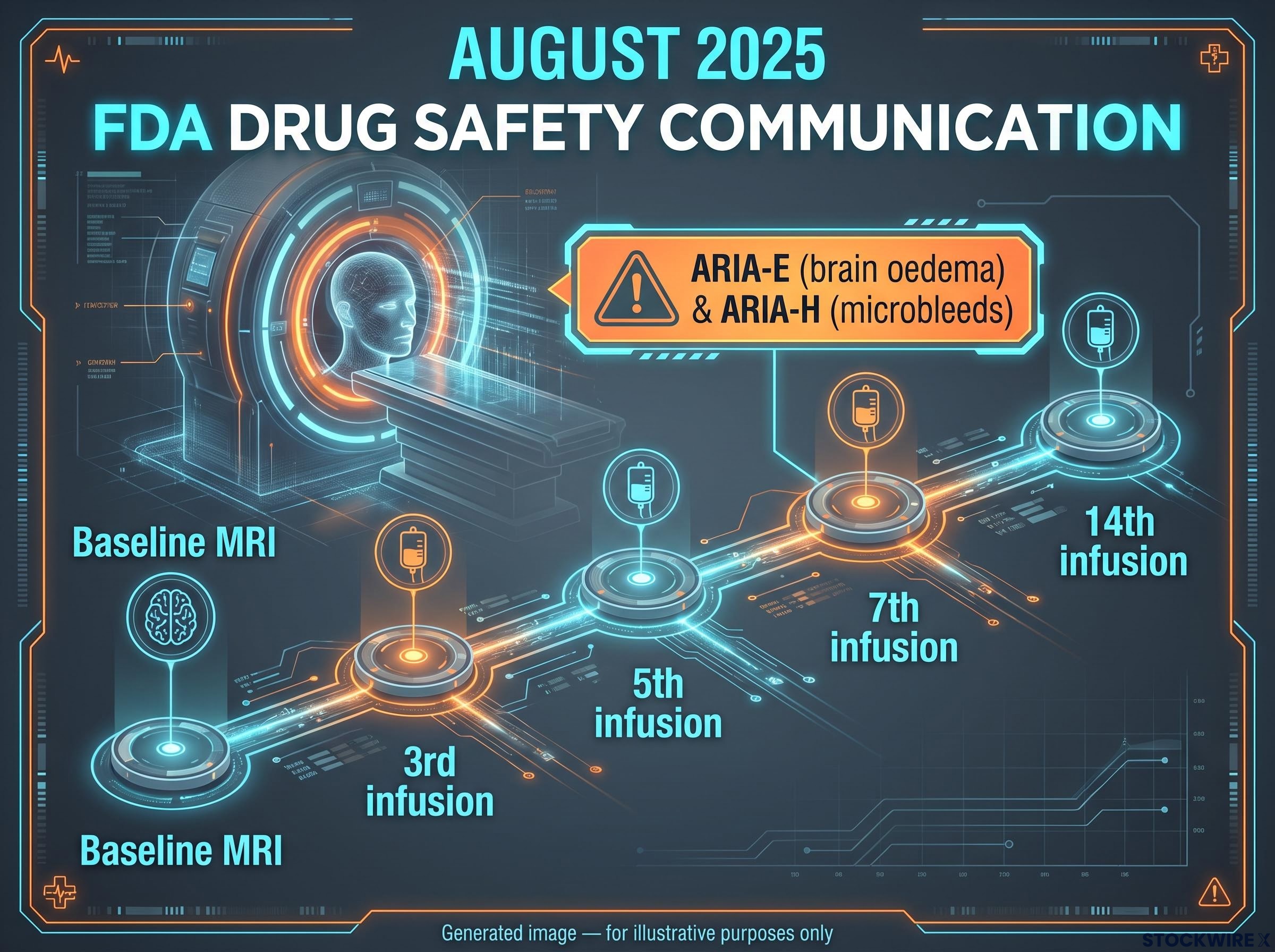
That schedule creates three structural frictions that collectively cap the reachable patient population:
- MRI capacity and cost: Scans are expensive, frequently backlogged, and geographically uneven. For cognitively impaired patients, coordinating multiple MRI appointments shifts a heavy logistical burden onto caregivers, many of whom are already stretched thin.
- Specialist and infrastructure requirements: Infusion centres with IV capabilities, neurologists trained to recognise ARIA on serial imaging, and radiologists comfortable managing findings are concentrated in academic and large urban settings. Most Alzheimer’s patients receive care in community neurology or primary-care practices that lack this infrastructure entirely.
- Caregiver and adherence constraints: Even motivated families face treatment fatigue from recurring infusions, repeated MRIs, travel time, and the anxiety of potential ARIA findings. Dropout risk is significant, and many otherwise-eligible patients never start therapy because the pathway looks too burdensome to sustain.
Together, these frictions create what researchers describe as a narrow “treatment corridor”: a concentration of infrastructure that caps uptake regardless of how large the headline addressable market appears. For you as an investor evaluating IV antibody revenue models, the three frictions mean the real, reachable patient population is structurally smaller than the total Alzheimer’s population, and that ceiling is unlikely to move until the pharmacology of the class itself changes.
Why the monitoring requirement is unlikely to ease without a pharmacological breakthrough
ARIA risk is not a logistics problem waiting for a scheduling fix. It is intrinsic to how anti-amyloid antibodies interact with amyloid-laden blood vessels in the brain. The mechanism that clears plaques from brain tissue is the same mechanism that causes vascular inflammation, oedema, and bleeding. You cannot separate the therapeutic action from the safety signal without fundamentally changing the drug’s pharmacology.
This means any future antibody in the same mechanistic class that does not clearly differentiate on ARIA risk will inherit exactly the same adoption headwinds. The monitoring requirement is not softening; the August 2025 FDA Drug Safety Communication reinforced and standardised it across both approved agents.
For investors, the implication is direct: revenue models for IV antibodies that assume broad community-setting penetration without solving the monitoring bottleneck are building on a foundation that does not currently exist.
Understanding the Alzheimer’s drug market opportunity for oral alternatives
The commercial logic for an oral, MRI-free Alzheimer’s therapy does not start with efficacy. It starts with access.
An oral drug that either modifies disease progression or delivers strong, reliable symptomatic benefit, without requiring serial MRI monitoring, would hold four structural advantages over the current IV antibody class:
- Prescriber accessibility: Primary-care physicians and general neurologists could prescribe it directly, without referring patients to specialist infusion centres. This alone expands the addressable prescriber base by orders of magnitude.
- Setting of care: No infusion centre required. The drug could be used in any care setting, including home administration, removing one of the largest bottlenecks in current treatment delivery.
- Administration burden: A pill taken at home eliminates the recurring infusion appointments, caregiver travel logistics, and treatment fatigue that drive dropout in antibody programmes.
- Payor-model compatibility: Oral therapies are easier to deploy across large, older populations in payor-driven care models. The per-patient infrastructure cost is a fraction of the IV-plus-MRI surveillance pathway.
The competitive insight is this: a slightly less impressive efficacy profile, paired with dramatically lower monitoring and logistical friction, could produce superior real-world adoption and revenue. The bottleneck for IV antibodies is delivery, not patient need. An oral therapy that clears even a moderate efficacy bar while removing the delivery constraints could capture the vast population that the current approvals cannot practically reach.
Among oral candidates, lithium is the most clinically evidenced small-molecule option in Alzheimer’s research. First approved by the FDA in 1970 for bipolar disorder, lithium carries a decades-long safety profile in psychiatric populations and, importantly, does not carry ARIA class risk.
Xanamem is one of the more advanced oral Alzheimer’s alternatives currently in late-stage testing, and its cortisol-reduction mechanism targets disease biology through a pathway entirely distinct from amyloid clearance, carrying no ARIA risk and requiring no serial MRI monitoring.
The LATTICE trial (NCT03185208), a randomised study of lithium in older adults with mild cognitive impairment (MCI), has completed with results supporting safety and preliminary signals in verbal memory, providing concrete human evidence that lithium may modulate cognitive decline in at-risk populations.
One longitudinal study in amnestic MCI patients treated with lithium over an extended period observed a measurable slowing of both cognitive and functional deterioration, alongside changes in Alzheimer’s-associated biomarkers. Research published in JAMA Neurology from a pilot randomised controlled trial demonstrated that low-dose lithium was well tolerated by older adults with MCI and yielded effect-size data to inform the powering of future studies. A Phase 1/2 feasibility investigation called LiO-AD is currently enrolling Alzheimer’s patients to assess how lithium orotate engages relevant biomarkers and affects clinical outcomes.
| Trial | Population | Design | Key finding |
|---|---|---|---|
| Long-term MCI trial | Amnestic MCI patients | Longitudinal lithium treatment | Attenuated cognitive and functional decline; altered Alzheimer’s biomarkers |
| JAMA Neurology pilot RCT | Older adults with MCI | Randomised, low-dose lithium | Confirmed safety, tolerability, and generated effect-size parameters for larger trials |
| LATTICE (NCT03185208) | Older adults with MCI | Randomised, two-year imaging and biomarker follow-up | Supported safety; preliminary verbal memory signals |
| LiO-AD | Alzheimer’s disease patients | Phase 1/2 feasibility | Ongoing; assessing biomarker engagement and clinical response |
What the evidence tells you is that lithium is not a speculative scientific hypothesis. It is grounded in human data suggesting measurable effects on Alzheimer’s biology at tolerable doses. But it also has not crossed the bar required for regulatory endorsement as a disease-modifying Alzheimer’s therapy. No oral, MRI-free therapy has. You are pricing a real but unconfirmed signal, and grasping that distinction is the conceptual tool you need to evaluate any oral Alzheimer’s programme, not just lithium-based ones.
GLP-1 receptor agonists represent a second mechanistic axis in oral Alzheimer’s development, distinct from both amyloid-targeting antibodies and lithium-based approaches, with early preclinical work suggesting neuroprotective effects that sit outside the established amyloid-tau paradigm.
How to evaluate companies competing in this space
Understanding the landscape is only useful if it sharpens how you evaluate individual companies. The framework differs materially depending on which treatment category a company operates in.
IV antibody programmes: the right questions to ask
For companies developing or commercialising anti-amyloid antibodies, three due diligence questions cut through headline narratives:
- What is the realistic addressable patient count after the MRI-monitoring discount? Headline figures for Alzheimer’s prevalence are not revenue projections. Discount to the population that can realistically navigate serial MRI surveillance, infusion access, and specialist availability. The gap between those two numbers is often significant.
- Do revenue models assume community-setting penetration, and if so, what solves the monitoring bottleneck? If the model assumes prescribing beyond academic and urban centres without a concrete plan to bring MRI capacity and specialist infrastructure to community settings, the assumptions are aggressive.
- Does the product differentiate on ARIA risk? Any new antibody entrant in the same mechanistic class that cannot demonstrate a meaningfully lower ARIA profile will inherit the same adoption ceiling as the currently approved agents.
Oral and small-molecule programmes: the right questions to ask
For oral, MRI-free programmes, a different set of questions applies, with Alzamend Neuro (NASDAQ: ALZN) serving as an illustrative case study:
- Is the trial design registrational-quality? Evaluate endpoints, biomarker strategies, and statistical powering. Early signals from small studies (such as the LATTICE trial’s preliminary verbal memory findings) are encouraging but not sufficient for a regulatory submission. The gap between early-signal data and a definitive disease-modifying label remains wide.
Biomarker-positive trial cohorts, selected using plasma pTau181 pre-screening, represent a meaningful methodological shift in Alzheimer’s programme design, compressing screening costs and ensuring enrolled populations carry confirmed pathological signals rather than clinically diagnosed but biomarker-ambiguous disease.
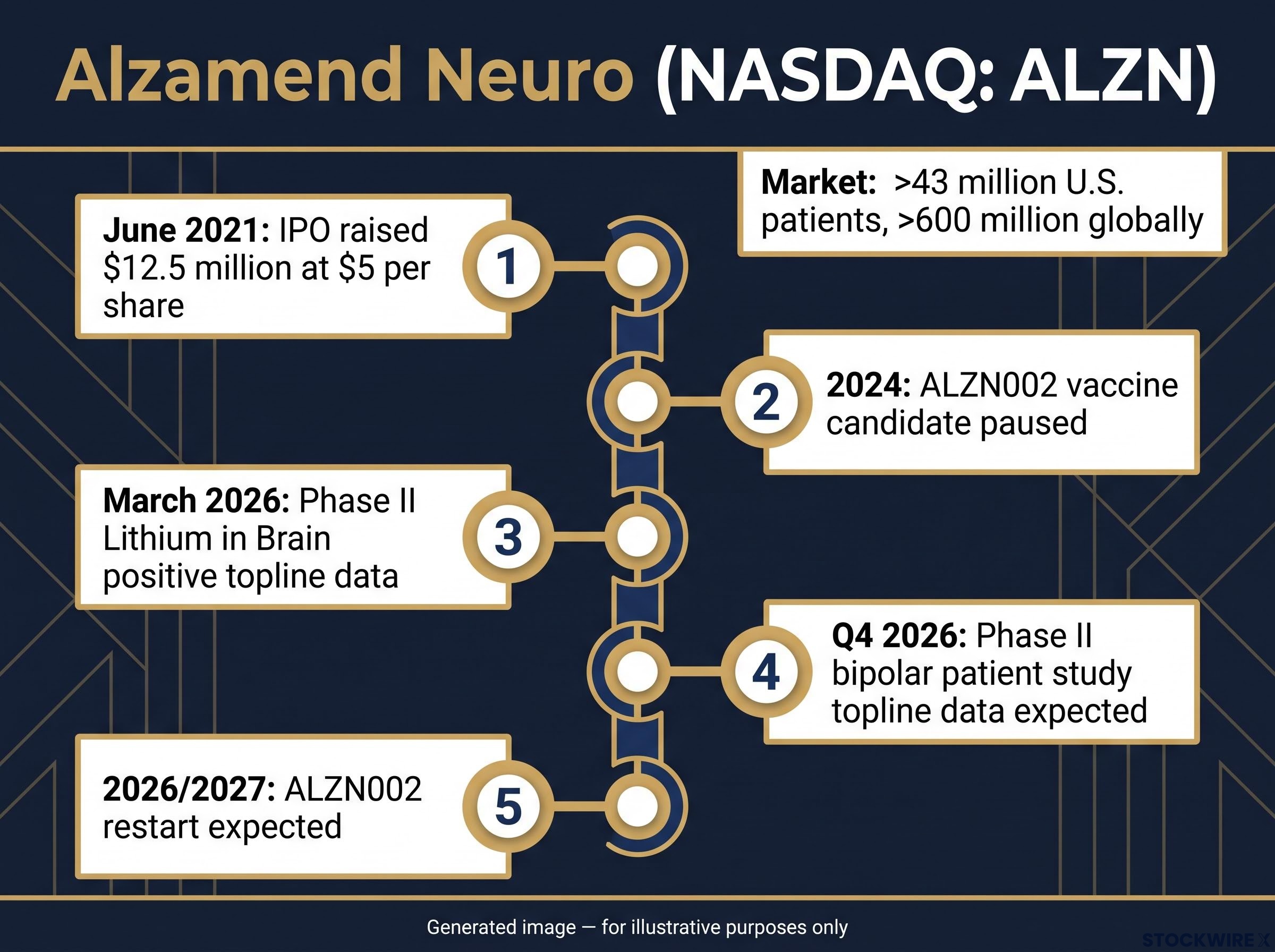
- What is the cash runway, and what does the financing path look like? Alzamend’s IPO in June 2021 raised $12.5 million at $5 per share, illustrating the capital constraints typical of this category. The company has reported positive topline data from its Phase II “Lithium in Brain” healthy-subject study (March 2026, showing bioequivalence and superior brain delivery for its AL001 ionic cocrystal lithium formulation) and initiated a Phase II bipolar patient study the same month, with topline data expected Q4 2026. Its ALZN002 vaccine candidate was paused after 2024, with a restart expected 2026 or early 2027. For micro-cap companies with binary data readouts, financing decisions are as important to track as clinical milestones.
- Can management execute a multi-indication strategy without over-extending? CEO Stephan Jackman has framed Alzamend’s addressable market as more than 43 million U.S. patients across Alzheimer’s and related psychiatric disorders, and more than 600 million globally across four target indications (Alzheimer’s, bipolar disorder, major depressive disorder, and PTSD). Multi-indication optionality is valuable, but only if the company can finance and execute across those programmes without stretching resources past the breaking point.
Alzamend’s profile illustrates the general template: real scientific signal, multi-indication optionality, and high binary risk around data readouts, with capital constraints that make every financing decision a material event. That template applies broadly across the micro-cap oral Alzheimer’s category.
Cognitive assessment infrastructure is a less-discussed but structurally important layer of the Alzheimer’s drug development ecosystem: proprietary patient data, validated testing platforms, and trial operations capacity are concentrated in a small number of specialist providers sitting outside the direct drug development stack.
This article is for informational purposes only and should not be considered financial advice. Investors should conduct their own research and consult with financial professionals before making investment decisions. These statements are speculative and subject to change based on market developments and company performance.
What the MRI bottleneck means for investors tracking the next phase of Alzheimer’s drug development
The Alzheimer’s drug market in 2026 is defined by a single structural reality: there is a gap between regulatory approval and commercial reach, and that gap is the primary commercial opportunity for the next generation of therapies.
For the current IV antibody class, that gap is unlikely to close without a pharmacological breakthrough on ARIA. The August 2025 FDA Drug Safety Communication reinforced and standardised MRI monitoring requirements rather than relaxing them. The monitoring bottleneck is a durable feature of the competitive environment, not a near-term problem to be optimised away through scheduling or logistics improvements.
What this tells you is that the Alzheimer’s drug market’s most important commercial contest over the next three to five years is not between the two approved antibodies. It is between the IV antibody category as a whole and whatever oral, MRI-free therapy crosses the clinical evidence threshold first. Oral programmes with rigorous trial designs, adequate financing, and credible regulatory pathways are the category to track, with your position sizing calibrated to match the stage of clinical evidence.
Near-term catalysts worth monitoring include topline data from ongoing oral programme trials, among them the AL001 bipolar patient study expected Q4 2026. Each data readout either narrows or widens the gap between early signal and definitive proof.
Past performance does not guarantee future results. Financial projections are subject to market conditions and various risk factors.