
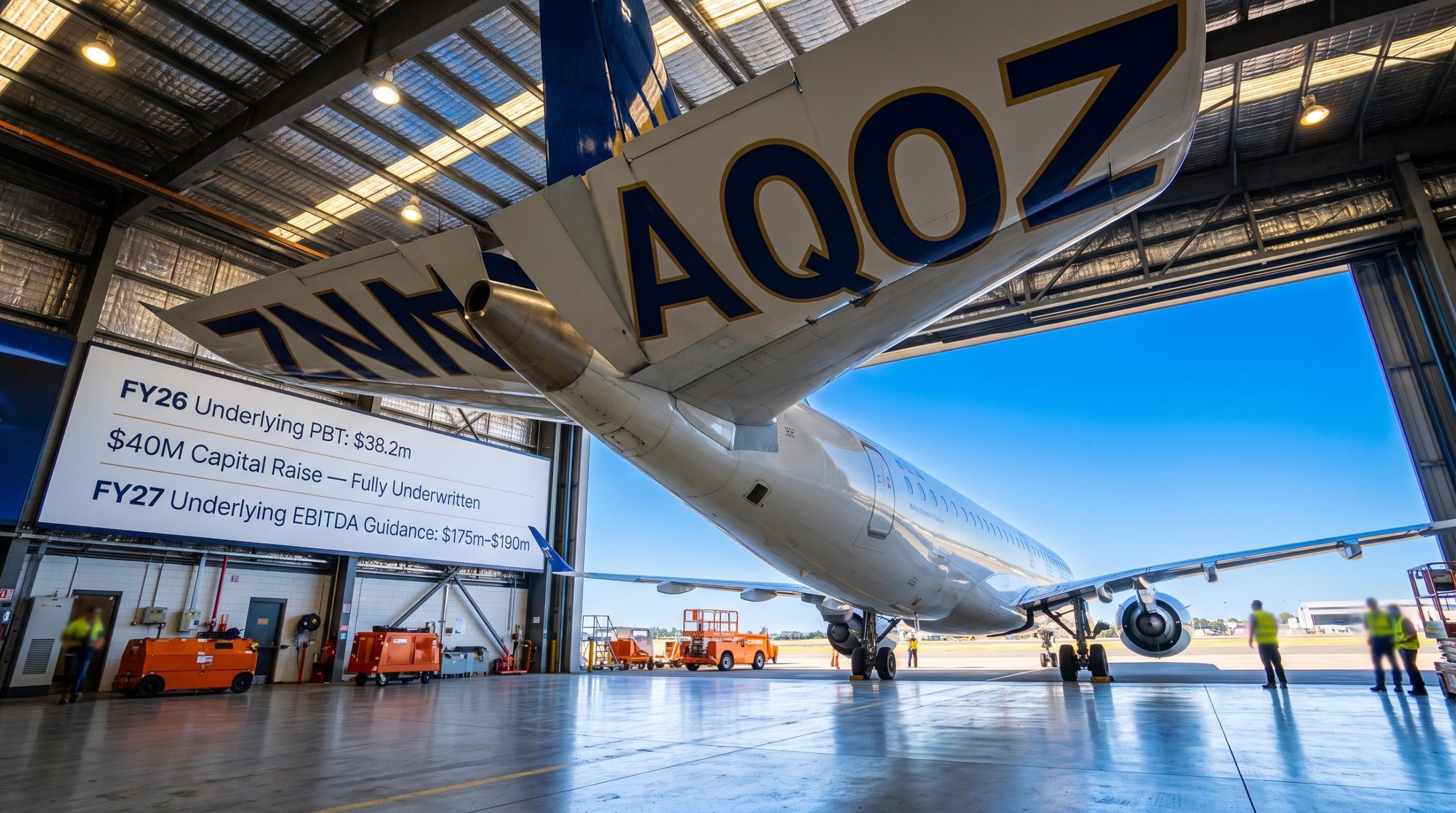
In its FY26 results and capital raising presentation dated 26 August 2026, Alliance Airlines outlined its full-year results, a strategic reset of its largest contract and a fully underwritten $40 million equity raising. Management reported $38.2m underlying profit before tax, landing within the $35–40m guidance range despite a year of operational challenges.
The presentation framed FY26 as a turning point, with a stronger second half, a revised Qantas wet lease and a balance sheet reset positioning the business for improved returns from FY27.
Central to the Alliance Airlines FY26 results is a deleveraging pathway funded by the capital raising and supported by targeted asset sales and a structural cost-out programme.
FY26 financial performance in review
The company recorded a statutory loss before tax of ($129.9m), driven principally by $151.9m in impairments, including a $144.6m write-down of Fokker aircraft. On an underlying basis, which management presented as the true operating picture, profit before tax was $38.2m.
Underlying revenue declined 7.4% to $712.6m, primarily reflecting the planned cessation of Aviation Trading and lower wet lease activity. FIFO contract revenue grew 7.0% to $319.2m, partially offsetting a modest decline in wet lease revenue.
The distinction between statutory and underlying figures was material. Statutory EBITDA was $9.4m after impairments, while underlying EBITDA was $177.5m.
| Metric | FY26 Underlying | FY25 | PCP Change |
|---|---|---|---|
| Underlying Revenue | $712.6m | $769.7m | (7.4%) |
| Underlying EBITDA | $177.5m | $207.3m | (14.4%) |
| Underlying PBT | $38.2m | $82.1m | (53.5%) |
| Underlying NPAT | $26.8m | $57.3m | (53.2%) |
| Basic EPS | 16.65c | 35.64c | (53.3%) |
H2 recovery signals turnaround momentum
Management highlighted a materially stronger second half, with underlying PBT rising 61% from $14.6m in H1 to $23.6m in H2. The presentation pointed to this recovery as evidence the operational reset is gaining traction ahead of the planned fleet transition.
Key H2 drivers included:
-
Contract revenue up $3.9m (net of fuel)
-
Repairs and maintenance costs down $4.9m
-
EBITDA margin improved from 24% (H1) to 26% (H2)
Cash management also strengthened in H2, supported by lower capital expenditure and reduced working capital requirements.
When big ASX news breaks, our subscribers know first
The Qantas wet lease reset explained
The revised wet lease terms with Qantas represent a central value driver in the reset. Management stated the changes strengthen the economic sustainability of Alliance’s largest wet lease arrangement.
The revised Qantas wet lease terms announced in early August 2026 introduced a pricing increase effective 1 July 2026 and a new annual escalation mechanism designed to track cost inflation more closely, with the fleet commitment stepping down from 30 to 23 aircraft across FY27.
Key improvements outlined include:
-
A meaningful pricing increase (contract rate uprate) commencing 1 July 2026
-
A revised annual price escalation mechanism to better reflect future cost increases
-
A staged fleet reduction from 30 to 23 aircraft over the course of FY27
The company noted that benefits are expected to be progressively realised across FY27, with the full-year benefit anticipated from FY28. Reduced fleet commitments lower capital intensity and free up aircraft for redeployment or monetisation, providing greater flexibility over capital allocation.
What is a wet lease and why it matters
Revising the terms matters because the wet lease directly affects Alliance’s margin, the capital tied up in aircraft and how efficiently those aircraft are utilised. Improved pricing and a smaller committed fleet can lift returns while reducing capital intensity.
For investors, the significance is scale. Wet lease revenue represented 45% of FY26 revenue, so improved economics on this contract flow directly through to profitability and cash flow.
The $40m capital raising and balance sheet reset
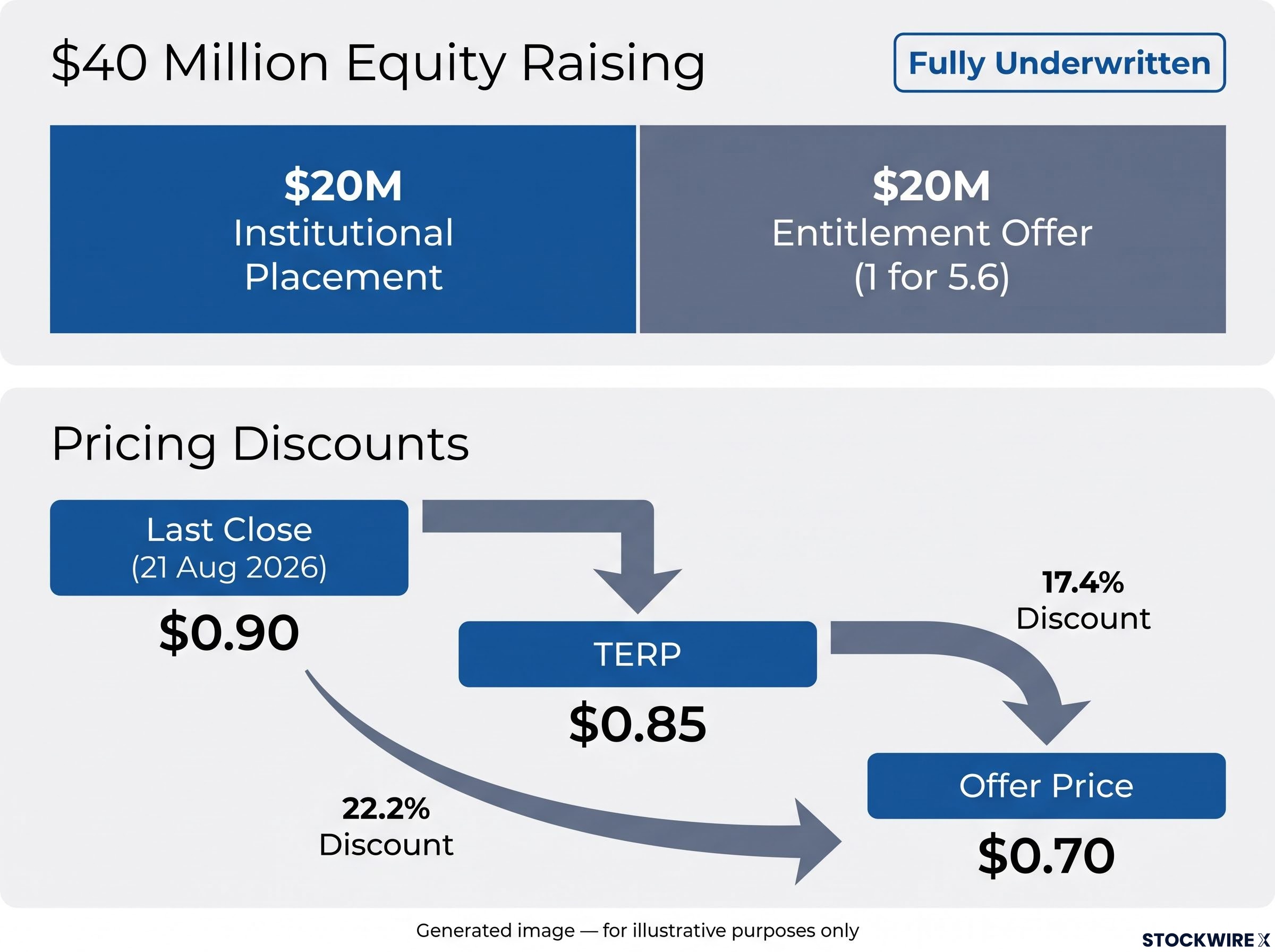
Alliance detailed a fully underwritten $40 million equity raising of new ordinary shares, structured across two components:
-
A 1 for 5.6 pro rata accelerated non-renounceable entitlement offer to raise approximately $20 million
-
An institutional placement to raise approximately $20 million
The Alliance Airlines capital raising is priced at $0.70 per New Share, representing a 17.4% discount to the theoretical ex-rights price (TERP) of $0.85 and a 22.2% discount to the last close of $0.90 as at Friday 21 August 2026. Approximately 57.2 million New Shares are to be issued, representing around 35.5% of existing shares on issue.
Management stated proceeds will be used to enhance liquidity and balance sheet flexibility. The raise is fully underwritten by Barrenjoey Markets Pty Limited, with Morgans Financial Limited and Ord Minnett Limited acting as Co-Managers.
The presentation highlighted shareholder support underpinning the raise:
-
Alliance’s major shareholder (19.7%) has committed to its pro-rata entitlement of approximately $8.1 million
-
Viburnum, the second largest institutional shareholder, has committed to its pro-rata entitlement of $4.1 million
-
The Directors intend to participate in the Entitlement Offer for some or all of their entitlement
Reset rationale
Management positioned the equity raising, revised wet lease and cost programme as a coordinated set of initiatives aimed at strengthening the balance sheet, reducing indebtedness and improving long-term shareholder returns.
Deleveraging pathway
Net debt stood at $459.8m at 30 June 2026, up from $378.0m at FY25, reflecting lower cash generation and ongoing fleet investment. The company noted it remains compliant with all banking covenants.
The raise reduces pro forma Net Debt/EBITDA from 2.7x to 2.5x, with management targeting approximately 2.1x by 30 June 2027. ANZ has extended expiring facilities through to September 2027, and the company is targeting $60–75m of asset sales in FY27 from surplus E190 and Fokker aircraft, Brisbane hangars and surplus engine cores.
| Metric | 30 Jun 2026 Reported | 30 Jun 2026 Pro Forma |
|---|---|---|
| Net Debt | $459.8m | $419.8m |
| Net Debt / Underlying EBITDA | 2.7x | 2.5x |
| Available liquidity | $29.2m | $69.2m |
Cost-out programme delivering results
Management outlined structural cost reductions delivered in 2H26:
-
Labour costs down 15.3%, versus a 14% reduction in overall block hours
-
Repairs and maintenance costs down 14.6% in H2
-
Procurement, rotables and heavy maintenance savings achieved through new tender and contract arrangements
In aggregate, the company expects these initiatives to deliver an annualised cost reduction of $38m from FY28, with $27m captured in FY27, supporting future margin expansion.
Leadership transition to the next phase
Stewart Tully is to step down as Managing Director and CEO after more than 11 years with Alliance, with Steven Greenway appointed CEO from 1 October 2026. Tully will support an orderly transition through October.
Greenway brings more than 25 years of international aviation leadership experience. Most recently as CEO of Flyadeal, he led a turnaround that doubled passenger numbers, expanded the network to more than 70 routes and achieved the world’s number one on-time performance ranking within 18 months. The board framed the transition as orderly and strategically timed, following completion of the strategic review and resolution of the Qantas wet lease contract.
Steven Greenway’s appointment was announced on 18 August 2026, with the board citing his track record at Flyadeal, including doubling passenger numbers and achieving a top-ranked on-time performance rating, as directly relevant to Alliance’s FIFO-focused growth phase.
FY27 outlook and what comes next
Management presented forward guidance reflecting expected improvements in earnings, cash generation and balance sheet strength:
-
Underlying EBITDA of $175m–$190m
-
Underlying EBITDA margin of 27–29%
-
Underlying PBT of $55m–$60m
-
FY27 underlying free cash flow of $10m–$20m
-
Planned asset sales of $60m–$75m
The company stated the guidance reflects improved wet lease economics, benefits from cost reduction initiatives and materially lower growth capital requirements. It remains subject to timing and execution risk, particularly on surplus asset sales. The guidance also incorporates an AerCap contract finalisation payment of $33m, which brings a major component of capex forward into 1H FY27.
Alliance at a glance
The presentation closed with a snapshot reinforcing the asset backing and recurring revenue base underpinning the turnaround:
-
80 aircraft (35 Fokker, 45 Embraer; 75 operational), 100% owned
-
Approximately 110,000 flight hours in FY26
-
95% on-time performance
-
25 major FIFO contracts; 91% contracted revenue
-
NTA of $2.32 per share
-
Diversified commodity exposure led by gold (30%) and iron ore (18%)
The combination of a 100% owned fleet, high contracted revenue and diversified commodity exposure provides asset backing and recurring revenue that anchor the investment case as the reset progresses through FY27.
Don’t Miss the Next ASX Industrials Move
Big News Blast delivers FREE breaking ASX announcements straight to your inbox within minutes of release, complete with in-depth analysis already done for you. Join 20,000+ investors who stay ahead of the market the moment news breaks. Click the “Free Alerts” button at Big News Blast to start receiving alerts today.