
A central bank announces a single number, and within minutes, currencies swing, gold reprices, and bond markets across three continents recalibrate. One number. Everything shifts. If that seems like an outsized amount of power for what is essentially an interest rate on overnight loans between banks, you are asking the right question.
The policy rate is not a number reserved for economists. It is the upstream variable that determines what you pay on a mortgage, what a business pays to expand, and what a government pays to service its debt. More than that, it reshapes the relative attractiveness of every asset class you hold, from bonds to equities to gold. Whether you recognise the mechanism or not, every portfolio you manage sits downstream of central bank decisions.
Here is the transmission chain you need to understand: how a single central bank meeting flows from a committee room into your currency exposure, your gold position, and your bond allocation. After this, you will be able to trace that chain yourself the next time a rate decision lands, rather than waiting for someone else to tell you what it means.
What a policy rate actually is (and why one number moves everything)
You probably encounter the policy rate as a headline: “Fed holds at 3.75%.” What that headline omits is the mechanical reality beneath it, and that reality is what makes the number so powerful.
At its core, the policy rate is the rate governing overnight reserve lending among commercial banks. It does not apply directly to your mortgage or business loan. The Federal Reserve expresses it as a target range rather than a single point (for example, 3.50%-3.75%), and it is the upper bound of that range that appears as the quoted figure in news coverage.
The Federal Open Market Committee (FOMC), the Fed’s policy-setting body, meets eight times per year to decide whether to raise, cut, or hold this target. Every other major central bank follows a similar calendar. Between meetings, the CME FedWatch tool gives market participants a real-time window into where rate expectations are sitting, making those expectations visible and tradeable well before an actual decision is announced.
Rate expectations are live. The CME FedWatch tool translates central bank communication and incoming economic data into probability-weighted forecasts of future rate moves. By the time a rate decision is announced, much of the market’s reaction has already happened.
Because the policy rate is a wholesale interbank rate rather than a retail rate, every mortgage, business loan, and deposit rate you encounter is downstream of it. Changes in policy ripple outward with a lag, not instantly, but the direction is set at the source.
How central banks keep the market rate on target
Central banks do not simply announce a target and hope the market complies. They enforce it through a three-tool corridor:
- Interest paid on reserves (floor): The central bank pays commercial banks interest on reserves held at the central bank. No bank will lend to another bank at a rate below what it can earn risk-free from the central bank itself.
- Standing lending facility (ceiling): If a bank needs reserves, it can borrow directly from the central bank at a rate above the target. This caps how high the overnight rate can drift.
- Open market operations: The central bank buys or sells securities to add or drain reserves from the system, fine-tuning the supply of overnight liquidity.
This floor-ceiling mechanism keeps the actual market rate trading within a narrow band around the target, giving the central bank precise control over the cost of money at its source.
When big ASX news breaks, our subscribers know first
Why 2%? The logic behind the inflation target
You have almost certainly heard that central banks target 2% inflation. What is less obvious is why that number and not 1% or 3%. The answer is not arbitrary; it is an engineering choice designed to prevent two distinct failure modes:
- Deflation risk: If the target were set too low (say, 0% or 1%), even a small negative shock could push inflation into negative territory. Deflation, where prices fall broadly, discourages spending (why buy today if it is cheaper tomorrow?), increases the real burden of debt, and is historically very difficult to reverse once entrenched.
- Excessive inflation: If the target were set too high, the ongoing erosion of purchasing power would compound year after year, punishing savers and distorting investment decisions.
2% threads the needle. It provides enough of a buffer above zero to absorb shocks without tipping into deflation, while keeping price growth slow enough that consumers and businesses can plan around it.
This is not a single country’s idiosyncrasy. It is a global convergence, widely adopted since the early 1990s:
| Central Bank | Policy Rate Instrument | Inflation Measure | Target |
|---|---|---|---|
| US Federal Reserve | Federal funds rate (target range) | PCE (Personal Consumption Expenditures) | 2% |
| European Central Bank | Main refinancing rate | HICP (Harmonised Index of Consumer Prices) | 2% (symmetric, medium-term) |
| Bank of Canada | Overnight rate target | CPI (Consumer Price Index) | 2% (midpoint of 1%-3% band) |
The symmetry matters for you as an investor. Central banks are as concerned about inflation falling persistently below 2% as they are about overshoots. Rate cuts are not reserved for crises; they are a routine tool deployed whenever inflation undershoots. That means the language in any central bank statement about “above target” or “below target” is a direct signal about the direction policy pressure is likely to build, and it is that direction that drives asset markets well before any actual decision.
From the policy meeting to your mortgage: how rates move through the economy
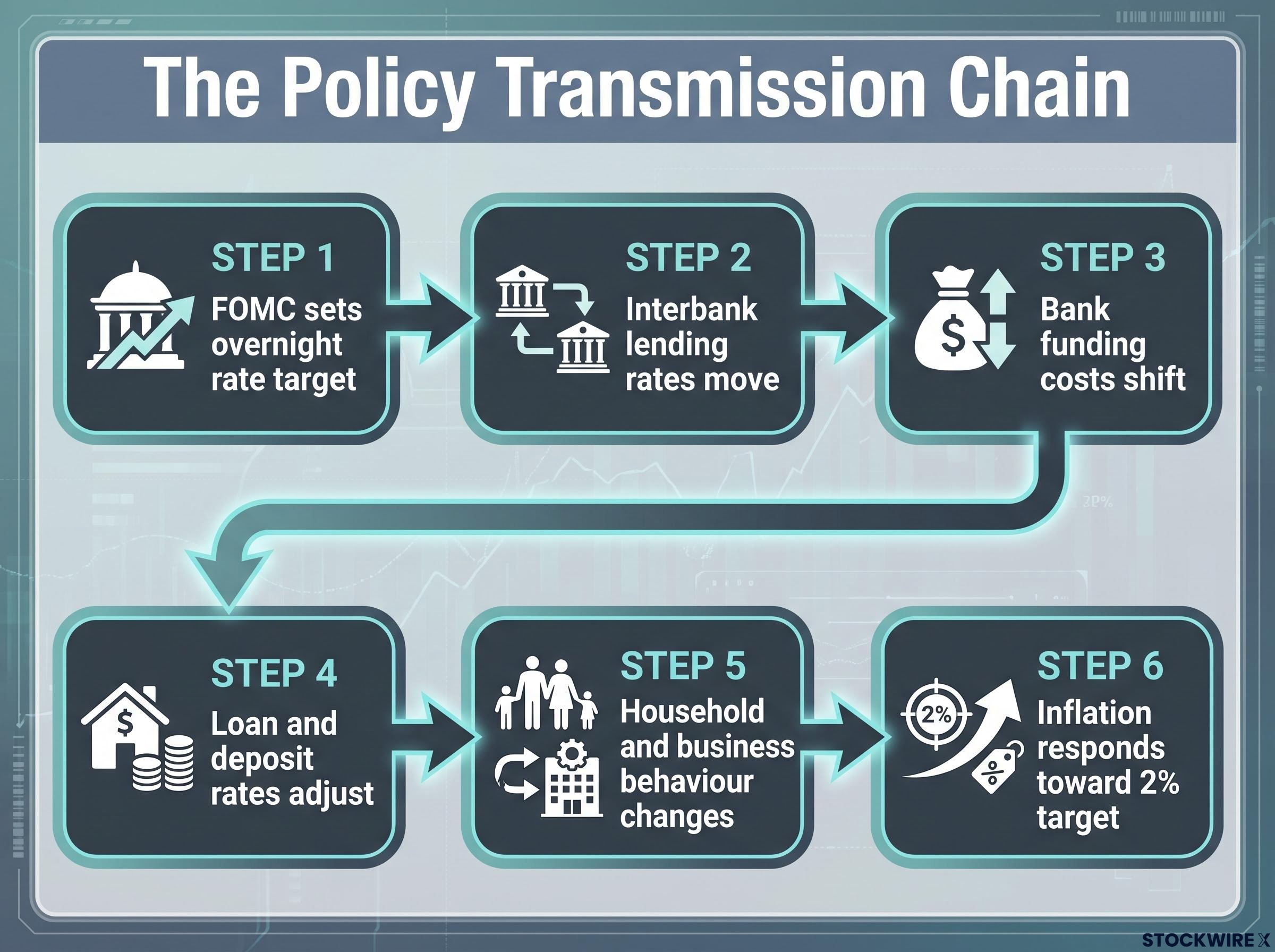
The distance between an FOMC decision and your loan statement is shorter and more direct than most investors assume. Here is the sequence:
- The FOMC sets or adjusts the overnight rate target.
- Interbank lending rates move accordingly. Banks borrow and lend reserves to one another daily to manage liquidity and meet regulatory requirements. When the target rises, interbank borrowing costs rise.
- Bank funding costs shift. The higher cost of wholesale funding feeds into what banks charge for new loans and what they offer on deposits.
- Loan and deposit rates adjust. Mortgage rates, business loan rates, and savings rates move in the same direction, though not always instantly or in equal proportion.
- Household and business behaviour changes. Higher borrowing costs slow credit growth and discretionary spending. Lower costs encourage it.
- Inflation responds. Reduced demand limits firms’ pricing power, pulling inflation back toward the 2% target. Increased demand does the reverse.
That is the direct transmission channel. But there is a second channel that often moves markets faster.
Why forward guidance moves markets before the rate does
Central banks do not operate in silence between meetings. The FOMC statement, the chair’s press conference, and the language used around economic conditions all function as forward guidance, signalling the likely future path of policy.
The CME FedWatch tool translates that communication, along with incoming inflation and employment data, into probability-weighted forecasts of future rate paths. What this creates is a live expectations market. By the time an actual rate change is announced, much of the move has already happened in the pricing of bonds, currencies, and equities.
It is deviations from expectations, not the decisions themselves, that move asset prices most sharply. A rate cut that was 90% priced in barely shifts markets. A hold when a cut was expected sends shockwaves.
This is why following central bank communication, not just the actual decisions, gives you an early read on where currencies, bonds, and gold are likely to move next.
How rate decisions move currencies and gold
Currencies and gold respond to rate decisions through the same upstream logic, which is why they belong together. The shared mechanism is yield differentials. The complication is that gold adds a second layer through the US dollar.
When a central bank raises rates, yields on that country’s money-market instruments and government bonds increase. Global capital seeking better returns flows toward those higher-yielding assets, and to access them, foreign investors must buy the local currency. That increased demand pushes the exchange rate higher.
The effect amplifies when central banks diverge. If one central bank is raising rates while another holds or cuts, the widening yield differential magnifies the currency move. This divergence dynamic is why currency markets react as strongly to one central bank’s inaction as to another’s action.
| Scenario | Currency Impact | Gold Impact |
|---|---|---|
| Rates rise | Currency strengthens (capital inflows seeking higher yields) | Gold weakens (higher opportunity cost; stronger dollar suppresses demand) |
| Rates fall | Currency weakens (capital outflows to higher-yielding markets) | Gold strengthens (lower opportunity cost; weaker dollar supports demand) |
Gold does not pay interest or dividends. Its sensitivity to rates runs through two channels. The first is opportunity cost: as real yields (interest rates adjusted for inflation) climb into positive territory, capital allocated to gold sacrifices the growing income available from interest-bearing alternatives. That trade-off weighs directly on gold’s relative attractiveness.
The opportunity cost principle: When real yields are positive and rising, holding gold means accepting zero income while alternatives offer a growing return. When real yields are low or negative, that trade-off inverts, and gold’s relative appeal rises.
Gold’s second sensitivity: the US dollar channel
Gold is denominated in US dollars on world markets, so a Fed-driven rise in the dollar compounds the pressure beyond opportunity cost alone. When the dollar appreciates, the dollar price of gold translates into a higher cost in local currencies, reducing purchasing power for buyers in major physical gold markets and pulling demand lower.
For you as a non-US investor, a Fed rate hike is therefore a double headwind for gold: higher real yields reduce its appeal directly, while a stronger dollar raises the local-currency price and suppresses global demand.
Geopolitical stress and financial-system concerns can override this logic temporarily, as gold also functions as a risk hedge. But absent those conditions, the rate-currency-gold chain is the dominant driver, and it explains why gold sometimes moves counterintuitively during a Fed announcement. If the decision was already priced into the dollar and yield curve, gold’s reaction is to the surprise, not to the rate level itself.
What rate cycles mean for bonds, equities, and portfolio construction
The transmission chain does not stop at currencies and gold. It runs through your entire portfolio.
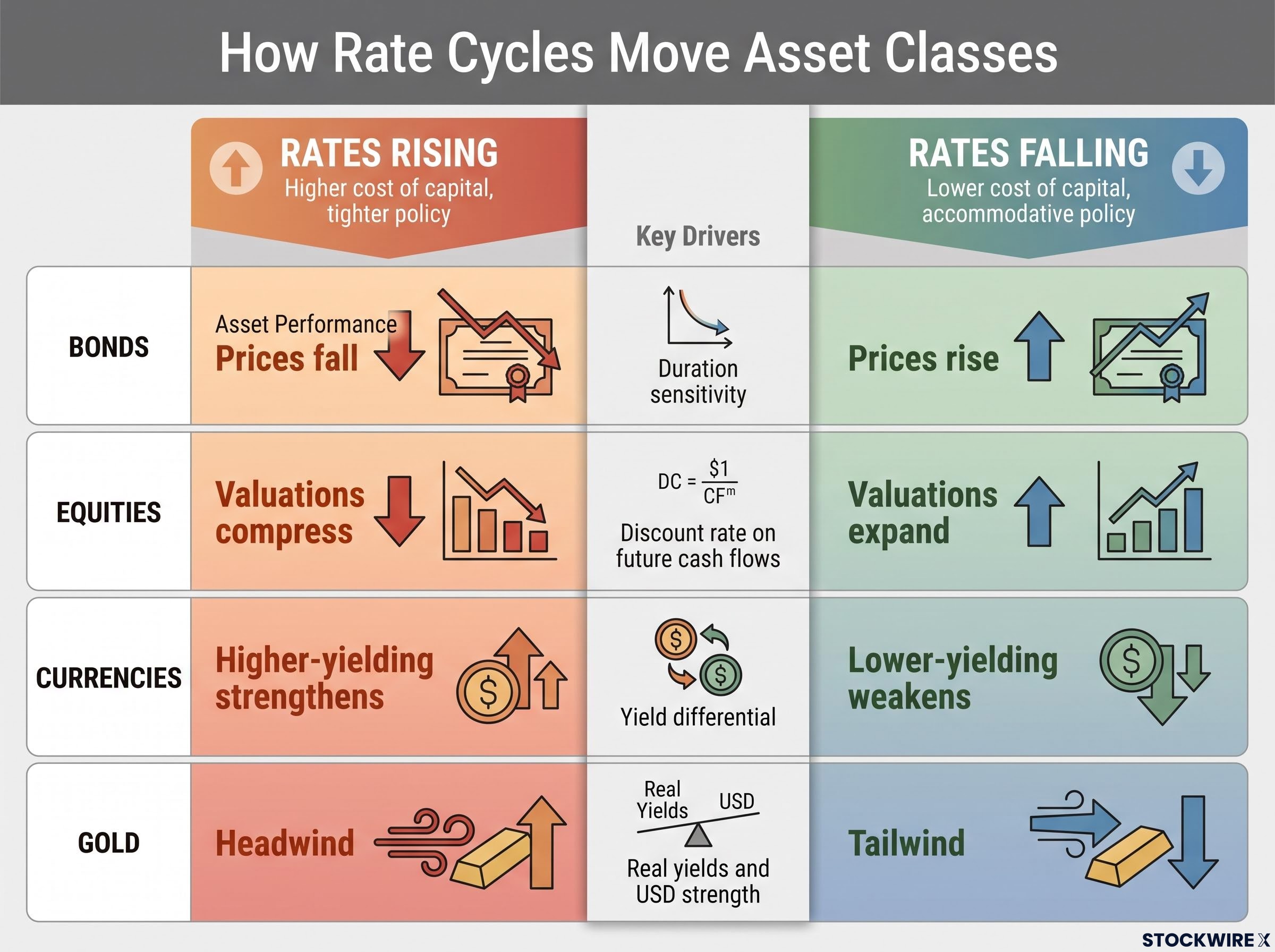
Bonds have an inverse relationship with rates. When rates rise, existing bonds (which pay a fixed coupon set at lower rates) lose value because new bonds offer better yields. The longer a bond’s duration, the larger this price impact. Duration, which measures a bond’s sensitivity to rate changes, is the single most important variable in fixed-income positioning during a rate cycle.
Equities respond through the discount rate. Higher rates raise the rate at which future earnings are discounted back to present value, compressing valuations. This hits growth stocks harder than value stocks because growth companies derive a larger share of their value from cash flows expected years into the future. Commodity producers and businesses with near-term earnings tend to hold up better because their cash flows are less affected by the discounting maths.
Gold within a portfolio follows the real yield logic described above: high, rising real yields are a headwind; low or negative real yields alongside a weaker dollar are tailwinds.
| Asset Class | Rates Rising | Rates Falling | Key Driver |
|---|---|---|---|
| Bonds | Prices fall (long duration hit hardest) | Prices rise (long duration benefits most) | Duration sensitivity |
| Equities | Valuations compress (growth stocks hit hardest) | Valuations expand (growth stocks benefit most) | Discount rate on future cash flows |
| Currencies | Higher-yielding currency strengthens | Lower-yielding currency weakens | Yield differential and capital flows |
| Gold | Headwind (opportunity cost rises; dollar strengthens) | Tailwind (opportunity cost falls; dollar weakens) | Real yields and USD strength |
The portfolio construction implication is straightforward but often underappreciated. Rate expectations create a chain of correlated exposures across bonds, equities, currencies, and gold simultaneously. A single central bank meeting can shift the attractiveness of multiple positions in your portfolio at once. Three implications follow:
- Duration management in bonds: Shorten duration when rates are rising to reduce price sensitivity. Extend duration when the cycle turns.
- Growth versus value tilt in equities: Rising rate environments favour near-term earners; falling rate environments support long-duration growth names.
- Gold’s real yield relationship: Monitor real yields, not just nominal rates, to gauge whether gold is positioned as a headwind or tailwind asset in your portfolio.
For a globally diversified portfolio, the rate cycle is the common factor running through currency exposure, equity valuations, and gold’s hedging role. Understanding its direction is the single highest-leverage input for multi-asset positioning.
Reading central banks with enough context to act, not just react
You now have the full chain: a policy committee sets an overnight interbank rate, that rate transmits through bank funding costs to household and business borrowing, and the resulting shift in economic activity feeds into currency valuations, gold pricing, and the relative attractiveness of every major asset class. One connected mechanism, end to end.
The practical edge this gives you lies in rate expectations, not rate levels. Markets price continuously around the expected path of future rates, which means three habits separate informed investors from reactive ones:
- Monitor central bank statements and press conference language. The words matter as much as the decision. Shifts in tone about inflation risks or employment conditions signal where policy pressure is building.
- Check futures-implied probabilities (CME FedWatch) ahead of meetings. These tell you whether an upcoming decision carries genuine uncertainty or whether the outcome is already priced in.
- Assess surprise potential. A decision that matches expectations moves markets modestly. A decision that deviates from expectations, even by a quarter of a percentage point, can reprice currencies, bonds, and gold sharply.
The closing principle: It is the gap between what was expected and what was delivered, not the rate level itself, that drives the sharpest moves in currencies, gold, and bonds.
The goal of understanding how central banks set rates is not to predict the future. It is to stop being surprised by the present. When the mechanism is clear, market reactions that previously seemed chaotic resolve into logical consequences of known relationships. The next time a major central bank meets, you have the vocabulary and the transmission logic to form your own view before the financial press has finished writing its headlines.
This article is for informational purposes only and should not be considered financial advice. Investors should conduct their own research and consult with financial professionals before making investment decisions.