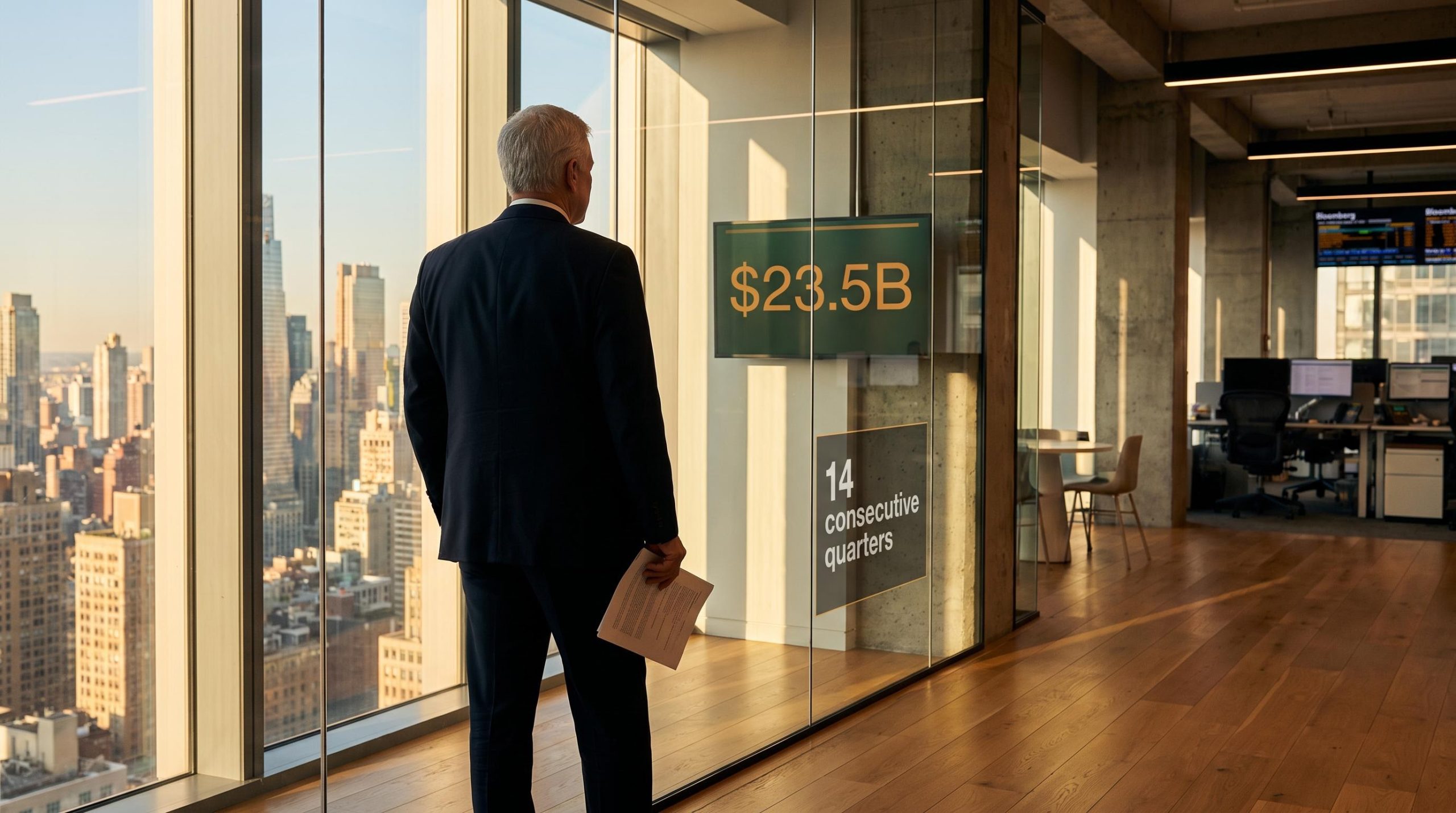
For three and a half years, Berkshire Hathaway steadily offloaded more stock than it bought, allowing its cash reserves to accumulate beyond $380 billion. In Q2 2026, that pattern reversed.
Berkshire Hathaway committed roughly $23.5 billion to marketable equities across the quarter, acquiring stakes in nine companies against disposals of just $3.7 billion. The result was the firm’s first quarter of net equity purchases in well over three years, and it coincided with a separately structured $6.8 billion all-cash acquisition. Even by Berkshire’s standards, where patience is doctrine, the length of that pause was extraordinary.
The timing matters beyond the dollar figure. This is the first major capital allocation cycle conducted under Greg Abel’s operational leadership as CEO, with Warren Buffett confirming a mutual-approval process on all investment decisions. The quarter is simultaneously a market call and a succession signal.
Here is what each bet tells you about the investment logic behind the reversal, and what the pattern of choices reveals about how Berkshire intends to allocate capital in the Abel era.
From cash fortress to conviction buyer: what broke the 14-quarter pattern
The streak itself deserves attention. For 14 consecutive quarters, Berkshire was a net seller of equities. The cash reserve crossed $380 billion. Coverage framed it as indecision, as Buffett sitting on his hands, as a verdict on valuations. The more accurate read is that Berkshire was preparing ammunition and waiting for a cluster of opportunities that met its threshold simultaneously.
Berkshire’s cash accumulation posture through early 2026 mirrored three prior historical episodes where prolonged reserve-building preceded large-scale deployment at depressed prices, a pattern that provides context for why the Q2 reversal carries more signal weight than a single quarter of net buying normally would.
That cluster arrived in Q2.
After more than three years of consistent net selling, Berkshire returned to net-buyer status in Q2 2026, deploying approximately $23.5 billion into equities while selling just $3.7 billion worth of stock.
The deployment spanned nine stocks across three distinct investment themes: AI infrastructure, U.S. housing supply, and resilient operators in consolidating industries. Separately, Berkshire agreed to acquire homebuilder Taylor Morrison in an all-cash deal at $72.50 per share, valuing the company at approximately $6.8 billion in equity and $8.5 billion in enterprise value. Taylor Morrison will be delisted and integrated with Clayton Properties Group.
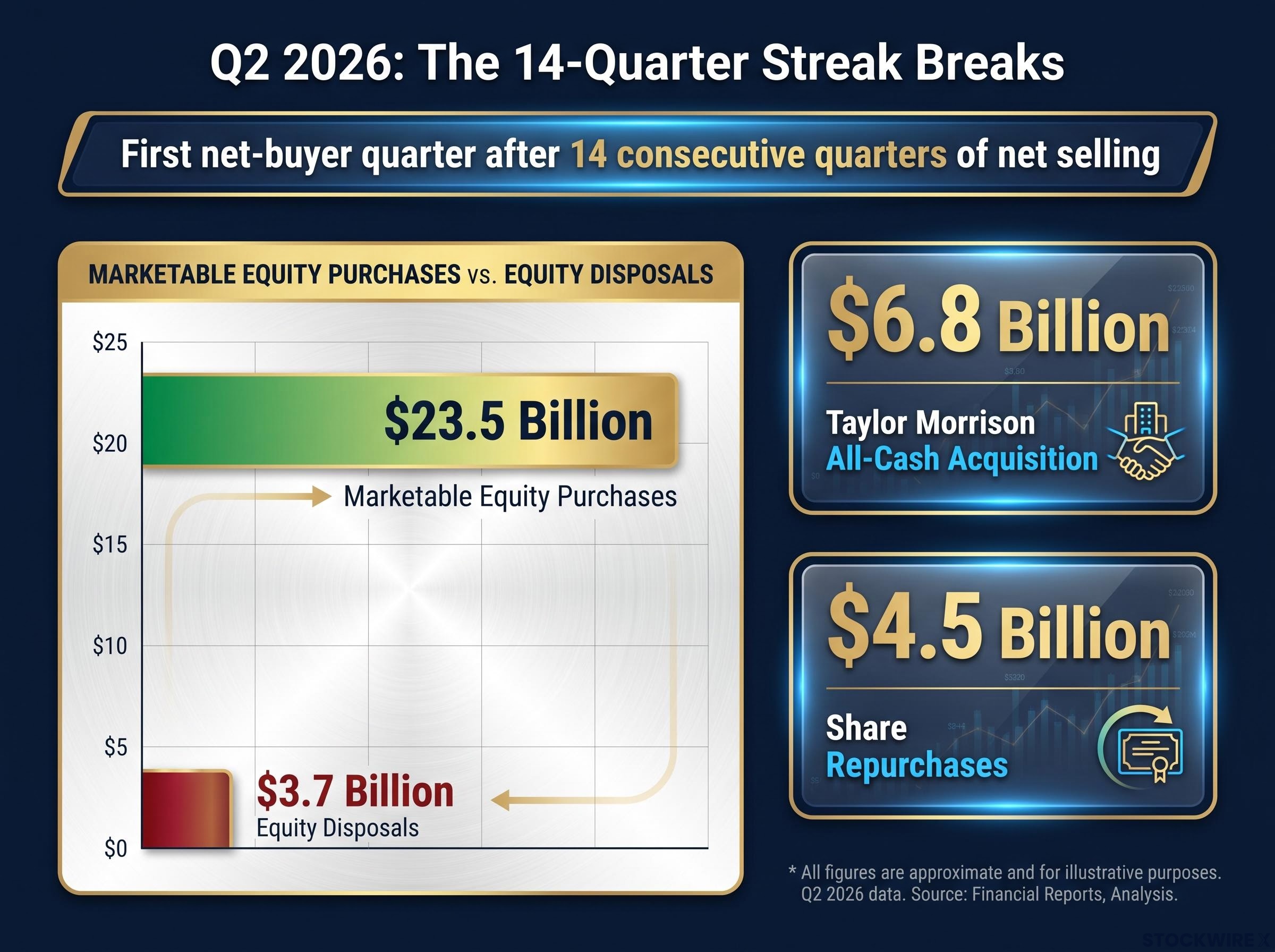
During the quarter, Berkshire also added approximately $4.5 billion worth of its own shares back through repurchases. (Both the buyback figure and the cash pile peak are sourced from Berkshire’s quarterly disclosures; cross-checking against the filed quarterly report is recommended for precision.)
The nine stocks purchased span the following sectors:
- Alphabet (technology/AI infrastructure)
- Delta Air Lines (aviation)
- Lennar and D.R. Horton (homebuilders)
- Macy’s (consumer retail)
- New York Times (media)
- Mitsubishi, Marubeni, and Sumitomo (Japanese trading houses)
The reversal’s significance is not simply that Berkshire spent money. It spent money on a thesis-driven basis across nine positions simultaneously, signalling that Abel and Buffett had identified a cluster of opportunities that cleared their combined threshold at roughly the same moment. The 14-quarter wait was not hesitation; it was calibration.
When big ASX news breaks, our subscribers know first
The Alphabet commitment and what it says about Berkshire’s AI thesis
Start with the structure, because the structure is where the conviction lives.
Berkshire built its Alphabet position through two channels. Approximately $10 billion came via a private placement, in which Alphabet sold Berkshire $5 billion of Class A stock at $351.81 per share and $5 billion of Class C stock at $348.20 per share. This private placement was part of Alphabet’s $80 billion capital raise to fund AI infrastructure. A private placement is a direct sale of shares between the company and the investor at negotiated terms, bypassing the open market.
The remainder of the roughly $17 billion in incremental Q2 deployment into Alphabet came through open-market purchases.
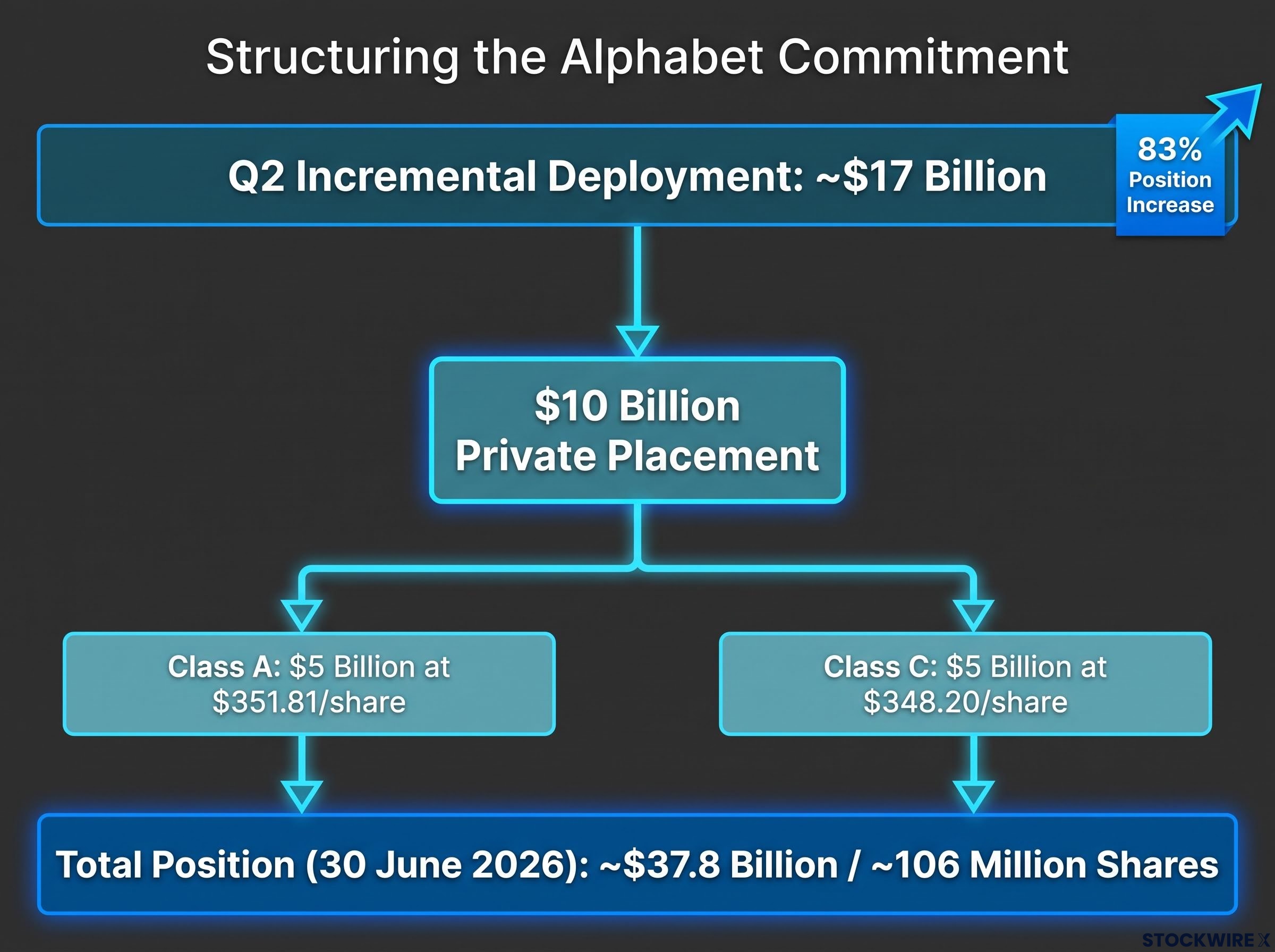
| Position metric | Figure |
|---|---|
| Q2 incremental deployment | Approximately $17 billion |
| Private placement (Class A) | $5 billion at $351.81/share |
| Private placement (Class C) | $5 billion at $348.20/share |
| Total shares held | Approximately 106 million |
| Total position value (30 June 2026) | Approximately $37.8 billion |
That $37.8 billion stake makes Alphabet Berkshire’s third-largest holding. The position increased by 83% during the quarter.
Warren Buffett confirmed initiating Berkshire’s Alphabet position in a CNBC interview, noting that he and Greg Abel operate with mutual approval on all investment decisions. Buffett remains active at Berkshire’s offices on a full-time basis.
Participating in a $10 billion private placement at negotiated pricing inside Alphabet’s AI infrastructure raise tells you that Berkshire is not buying a technology theme. It is buying a specific operator it believes will be a dominant capital allocator within AI, not merely a beneficiary of it. The distinction matters: Berkshire’s thesis is about Alphabet’s ability to deploy capital at scale into AI infrastructure and generate durable returns from that deployment, which is a compounding argument, not a momentum one.
Super investor 13F divergences on Alphabet were already visible in Q1 2026, when Berkshire tripled its position while Pershing Square fully exited the same stock, illustrating how the private placement structure and compounding thesis Berkshire ultimately expressed at scale in Q2 was building across multiple quarters.
Housing from every angle: how Berkshire built a multi-layer structural bet
Berkshire’s housing exposure after Q2 is not a single bet but an architecture: three distinct instruments expressing one thesis about structural undersupply in U.S. residential construction.
| Housing layer | Vehicle | Key detail |
|---|---|---|
| Take-private acquisition | Taylor Morrison | $72.50/share; $6.8B equity value; $8.5B enterprise value; delisted and integrated with Clayton Properties Group |
| Public market positions | Lennar and D.R. Horton | New positions added as part of the $23.5B in Q2 marketable equity purchases |
| Existing operating platform | Clayton Homes | Longstanding Berkshire subsidiary providing manufactured and site-built housing |
The Taylor Morrison deal is widely described as Abel’s first major multi-billion-dollar acquisition as CEO. Taking the company private and folding it into Clayton Properties Group creates a vertically integrated housing platform that spans manufactured housing, site-built homes, and land development.
The public homebuilder positions in Lennar and D.R. Horton add liquid, tradeable exposure to the same thesis. (A sourcing note: the original quarterly filings cited LGI Homes at approximately $4 billion and NVR as additional homebuilder positions, while subsequent research coverage highlighted Lennar and D.R. Horton. Direct 13F verification is recommended to confirm the precise names.)
The underlying investment logic rests on a structural supply deficit. The U.S. housing market faces an estimated shortfall of approximately 4.7 million units relative to current demand, according to industry estimates. (This figure is widely cited in housing research; precise attribution to a named source such as Freddie Mac or the National Association of Realtors should be confirmed before use.)
U.S. housing supply dynamics in early 2026 presented a contradictory picture: new single-family sales fell sharply while homebuilder equities remained positive year-to-date, a divergence that made the structural undersupply thesis Berkshire is expressing through Taylor Morrison, Lennar, and D.R. Horton more legible as a long-duration conviction rather than a near-term cyclical call.
What the layered structure tells you is that this is not a cyclical trade on near-term mortgage rates. It is a conviction hold on the multi-decade gap between U.S. housing supply and demographic demand, expressed through instruments that span private operations, M&A, and liquid public equities. For investors thinking about housing exposure, Berkshire’s approach offers a structural framework: rather than picking one instrument, layering across the supply chain distributes exposure while maintaining flexibility.
Delta, Macy’s, the Times, and the Japanese trading houses: Berkshire’s bet on resilient operators
Before naming the positions, consider the logic that connects them. Berkshire has a long history of betting that high-quality, cash-generating operators in cyclical and consolidating sectors compound value as weaker competitors exit. This quarter’s remaining positions follow that pattern precisely.
The sectoral groupings:
- Aviation: Delta Air Lines, approximately $1.6 billion invested. (This figure is sourced from Berkshire’s quarterly disclosures; cross-checking against the filed 13F is recommended for precision.) Delta was chosen for its operational durability, posting growth through a year that claimed a budget carrier rival to bankruptcy.
- Consumer and media: Macy’s and New York Times, new or enlarged positions in operators generating cash in categories where industry consolidation is accelerating.
- Global industrial and trading: Mitsubishi, Marubeni, and Sumitomo, expanding Berkshire’s existing conviction in Japanese trading houses.
Spirit Airlines collapsed into bankruptcy proceedings during a period of sustained fuel price pressure, becoming exactly the kind of weaker-competitor exit that Berkshire’s thesis depends on: when an industry sheds its marginal players, the disciplined survivors are positioned to absorb market share and widen margins without requiring any broader economic uplift.
The Macy’s and New York Times additions carry the same structural logic applied to different industries. Both operate in sectors where the weakest participants have been exiting for years. Berkshire’s bet is that the survivors with cash-generating durability will capture disproportionate value as the consolidation continues.
The Japan conviction continues
Berkshire’s Japanese trading house positions predate Q2 and represent a continuing conviction, not a new thesis. The additions to Mitsubishi, Marubeni, and Sumitomo are extensions rather than pivots.
These companies provide global commodity and infrastructure exposure that serves as a portfolio counterweight to the domestic U.S. focus of the housing and aviation positions. The diversified, globally active trading house model aligns with Berkshire’s preference for compounding businesses with multiple revenue streams and operational discipline across economic cycles.
The pattern across all these positions tells you that Berkshire is not chasing growth narratives. It is pricing durability: each name operates in a sector where the weakest participants are failing or exiting, creating conditions for surviving operators to take share without needing macro cooperation.
During the quarter, Berkshire also reduced positions in Capital One, Nucor Steel, Kroger, and Bank of America, indicating active portfolio shaping rather than passive accumulation.
What the quarter reveals about capital allocation under Abel
Step back from the individual positions and the aggregate picture sharpens. Three core investment convictions emerged this quarter:
- AI and durable moats: A $17 billion incremental commitment and a nearly $38 billion total stake in Alphabet, anchored by a $10 billion private placement tied to AI infrastructure spending.
- Structural housing supply: A take-private acquisition, public homebuilder positions, and an existing operating platform, all expressing conviction in multi-decade undersupply.
- Resilient operators in consolidating sectors: Delta, Macy’s, New York Times, and the Japanese trading houses, selected on the thesis that industry shakeouts reward operational discipline.
Buffett described the mutual-approval process with Abel on CNBC as genuine operational partnership, not ceremonial succession. Taylor Morrison, as Abel’s first major multi-billion-dollar acquisition, confirms that the transition carries real capital allocation authority.
With $23.5 billion directed into equities, Taylor Morrison taken private, and a $4.5 billion share repurchase completed, Berkshire still retains one of the world’s largest corporate cash reserves despite the scale of Q2 activity. The most practically significant takeaway is that Abel’s Berkshire has demonstrated it will deploy capital at scale when conditions meet its threshold. The prior multi-year patience was a holding pattern, not a permanent posture shift.
Whether Q2 was the opening of a sustained deployment cycle or a concentrated opportunistic episode remains the key question. The three forward-looking variables to watch:
- Whether the Alphabet position continues to grow as AI infrastructure spending accelerates
- Whether the housing thesis deepens through further M&A or additional public market positions
- The trajectory of Berkshire’s cash reserve in subsequent quarterly disclosures
How to track Berkshire’s next moves using 13F filings
Quarterly 13F disclosures must be submitted to the Securities and Exchange Commission (SEC) no later than 45 days after a quarter’s close. These filings, which cover all equity positions held, are publicly accessible through SEC EDGAR. For Q2 2026 (quarter ending 30 June 2026), the filing window has passed, and the data informing this analysis is drawn from that disclosure. The next quarterly filing will confirm whether the positions established this quarter were one-off allocations or the start of a sustained shift.
For readers wanting to monitor the valuation signals that shaped Berkshire’s multi-year holding pattern, our dedicated guide to the Buffett Indicator framework walks through the market-cap-to-GDP ratio, the equity risk premium calculation, and how investors can use those metrics alongside quarterly cash balance trends to detect when deployment conditions are shifting.
This article is for informational purposes only and should not be considered financial advice. Investors should conduct their own research and consult with financial professionals before making investment decisions. Past performance does not guarantee future results. Specific investment figures cited are sourced from quarterly filings and media reports; direct verification against Berkshire Hathaway’s SEC filings is recommended for precision.