
Citi’s European equity strategy team, led by Beata Manthey, has raised its top-down earnings-per-share (EPS) growth forecast for the STOXX Europe 600 to 12% for 2026 and published a mid-2027 index target of 700, implying roughly 11% upside from current levels. The move formally shifts the bank’s stance on European stocks from tactical to increasingly structural.
The upgrade arrives as European equities have already outpaced Wall Street over the past three months, the Eurozone’s fiscal stance has reversed from drag to contributor, and earnings revisions across the continent are defying the negative seasonal trend that typically sets in ahead of reporting season. For investors evaluating international allocation, the timing and the specific conditions behind Citi’s call matter as much as the headline number.
Here is what Citi’s numbers actually tell you about the European stocks outlook, which sectors and countries are positioned to benefit most, and the three conditions that must hold for the mid-2027 target to be realised.
European stocks have already outpaced the U.S., and Citi thinks the gap can widen
The scoreboard already favours Europe. During the past three months, the Euro Stoxx 50 posted a gain of approximately 8%, outpacing the S&P 500’s roughly 5% rise, with continental large-caps accounting for most of that margin. Citi’s published targets suggest the gap has room to widen further.
The contrarian European equity thesis built on depressed institutional positioning and a 31% forward earnings discount to the US produced measurable results in 2025, when European stocks outperformed the S&P 500 by 18.4% in dollar terms in a single quarter, the widest margin in over 30 years.
The bank’s formal numbers sit above the conservative 8% upside framing that circulated in initial coverage. Citi’s STOXX 600 end-2026 target is 640, with a mid-2027 target of 700, implying approximately 11% total upside. The FTSE 100 target is more aggressive still: 11,800 by mid-2027, implying roughly 15% upside.
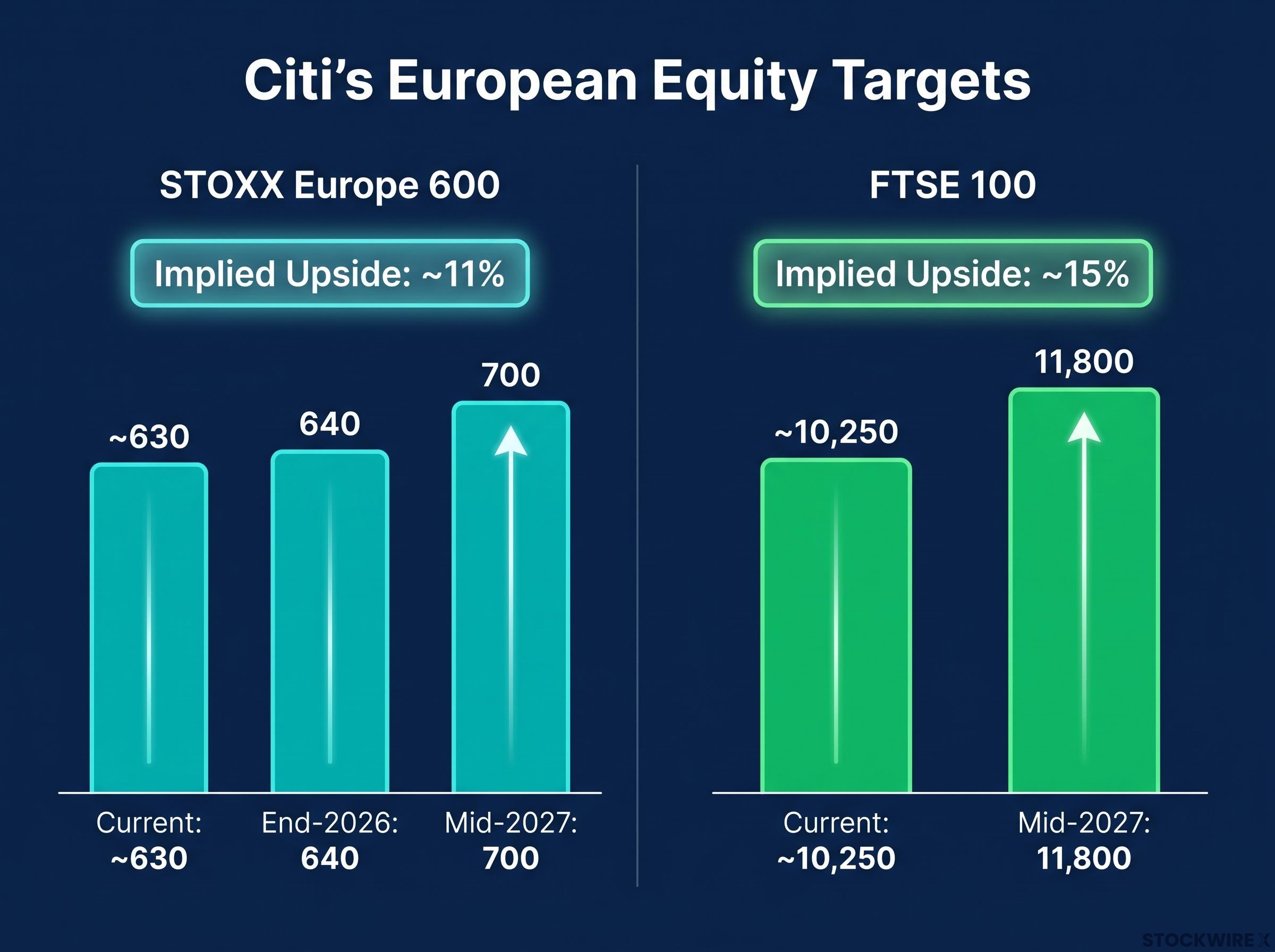
Citi’s STOXX 600 mid-2027 target of 700 implies approximately 11% upside from current levels, with the gains framed as earnings-driven rather than valuation re-rating.
What makes the call structurally interesting rather than merely optimistic is where valuations sit today. The STOXX 600 trades at approximately 14-15x forward earnings, near its long-term median. That tells you Citi’s upside case does not depend on investors paying a premium they have historically refused to sustain. The work has to be done by earnings, not sentiment, and that makes the thesis meaningfully less fragile than a momentum play.
Current STOXX 600 forward P/E data places the index at approximately 15.4x as of mid-2026, close to its long-term median and well below U.S. equity multiples, reinforcing Citi’s framing that the path to 700 is contingent on earnings delivery rather than investors paying a historically unusual valuation premium.
| Index | Current Level (approx.) | End-2026 Target | Mid-2027 Target | Implied Upside |
|---|---|---|---|---|
| STOXX Europe 600 | ~630 | 640 | 700 | ~11% |
| FTSE 100 | ~10,250 | — | 11,800 | ~15% |
When big ASX news breaks, our subscribers know first
The earnings engine behind the rally, and why breadth matters more than the headline number
Citi raised its top-down STOXX 600 EPS growth forecast for 2026 to 12%, up from a prior 8% estimate, although this still trails the bottom-up consensus of approximately 16%. The gap between the two numbers is worth noting: Citi’s own forecast is deliberately conservative, which means the bank’s index targets do not require a best-case earnings outcome to be achieved.
The 2027 EPS growth outlook of approximately 10% is broadly in line with consensus, providing a second consecutive year of double-digit earnings delivery as the structural foundation for the mid-2027 target.
What distinguishes this cycle from the usual European earnings story is the timing. Europe’s Earnings Revision Index, tracked by Citi, gained ground over the recent period despite this being a point in the calendar when such readings typically weaken ahead of the main reporting season.
Rather than following its usual downward path into reporting season, Citi’s Earnings Revision Index held firm and advanced, with net EPS upgrades recorded across most European sub-sectors, a breadth of positive revision momentum the bank regards as genuinely unusual for this time of year.
An earnings revision cycle running against the seasonal grain across most sub-sectors signals genuine economic improvement, not rotational repositioning. That is a sign the upgrade cycle has further to run rather than being late-stage.
Goldman Sachs’s parallel STOXX 600 upgrade illustrates the contrast: commodity-driven EPS revisions accounted for almost the entire doubling of Goldman’s 2026 growth forecast to 10%, leaving non-commodity margins tracking flat, a composition risk that makes Citi’s broader four-sector breadth case more significant by comparison.
From narrow rally to broad-based upgrade cycle
The breadth of the upgrades matters for portfolio construction. This is no longer a narrow rally led by a single sector or theme. Four key sectors are recording net EPS upgrades:
- Financials: Benefiting from improved economic activity and higher net interest margins across major European banks
- Industrials: Gaining from increased public investment commitments and strengthening order books
- Health Care: Recording upgrades driven by pipeline progress and resilient demand
- Information Technology: Supported by AI-linked structural drivers and broader enterprise spending
When gains are spread across these four sectors rather than concentrated in one theme, the path to the index target is less vulnerable to a single-sector reversal. Citi frames AI-linked structural drivers as a layer supporting the broadening, not a separate bet running parallel to it.
Germany’s fiscal reversal is the macro foundation the market needed
After acting as a net drag on Eurozone GDP throughout 2025, fiscal policy is expected to add around 30 basis points to growth in 2026, based on estimates from Citi economists referenced in the Manthey team’s strategy notes. That swing, from headwind to tailwind, is the policy backstop the earnings recovery needed.
The shift is primarily Germany’s doing. Berlin’s fiscal deficit is forecast to expand from around 2.7% of GDP in 2025 to close to 4.0% in 2026, a degree of budgetary loosening that would have been politically inconceivable in Germany until recently. For equity investors, 30 basis points of GDP impulse does not sound large in isolation, but arriving after a period of fiscal drag and coinciding with an earnings upgrade cycle, it is the policy floor that reduces the risk of the recovery stalling.
| Year | Fiscal Deficit (% GDP) | Direction of Fiscal Impulse |
|---|---|---|
| 2025 | ~2.7% | Net drag on GDP |
| 2026 (projected) | ~4.0% | Net contributor to GDP (~+30 bps) |
The structural layer sits above the German story. The EU’s planned long-term spending framework, totalling approximately $2 trillion across seven years, is in its concluding stages of negotiation.
Germany’s structural reform package, announced in July 2026 and including roughly 10 billion euros per year in income tax relief effective January 2027, adds a second fiscal channel beyond the deficit widening Citi quantifies, with BofA characterising the upgrade it prompted as pricing policy direction rather than verified GDP upside.
The EU’s proposed multi-year budget framework, valued at approximately $2 trillion over seven years, adds a structural, multi-year fiscal support layer beyond Germany’s near-term impulse.
Understanding that the fiscal shift is quantified and Germany-led, not vague policy optimism, allows investors to assess whether the macro foundation for Citi’s target is credible rather than contingent on political outcomes that remain uncertain.
What has to go right, and what could derail the mid-2027 target
Citi’s strategists have been explicit about what has to hold. The path to 700 on the STOXX 600 and 11,800 on the FTSE 100 depends on three specific, monitorable conditions:
- Earnings delivery: The STOXX 600 must achieve close to 12% EPS growth in 2026. This is strong but still below the bottom-up consensus of 16%, leaving margin for slight underdelivery. Failure looks like sub-8% EPS growth, which would leave index returns dependent on the multiple expansion Citi is explicitly not forecasting.
- Fiscal materialisation: Germany’s deficit widening and the broader Eurozone fiscal shift must proceed roughly as planned, without a sharp return to austerity or political disruptions that freeze spending commitments. Failure looks like coalition instability or EU budget framework delays that stall the fiscal impulse.
- Geopolitical containment: Geopolitical risks, including conflicts and trade frictions, must remain contained enough not to derail Europe’s recovery. Failure looks like an escalation severe enough to trigger a risk-off repricing in European equity markets or energy supply disruption.
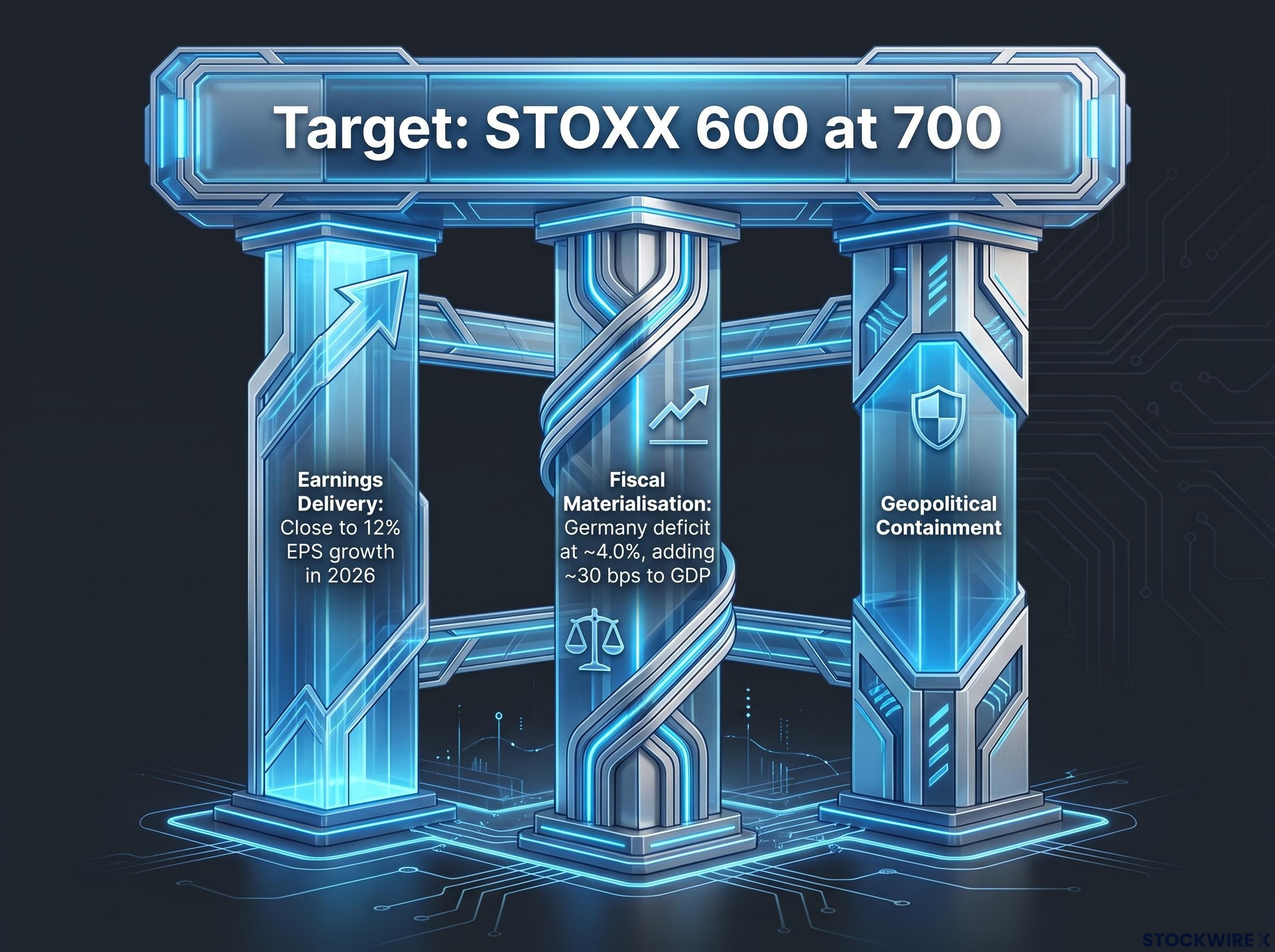
Citi frames its European equity outlook as earnings-driven and disciplined, not a call for a speculative melt-up or multiple re-rating. The STOXX 600’s forward P/E near 14-15x, close to its long-term median, confirms that valuation is not being asked to stretch.
The combination of a valuation-neutral thesis and three specific conditions means you can track whether the Citi thesis is on track in real time rather than waiting until mid-2027 to assess it. Investor positioning toward European equities has become more constructive, and Citi’s own strategy commentary cites “cracks in U.S. exceptionalism” as part of the relative case. That evolving positioning itself introduces a crowding risk if the macro conditions disappoint.
Citi’s commentary on ‘cracks in U.S. exceptionalism’ aligns with a broader positioning dynamic: the institutional underweight in European equities, documented in the June 2026 BofA Global Fund Manager Survey as the most extreme since December 2024, represents a large pool of latent demand that has not yet rotated into the market.
Within Europe, Citi’s sector emphasis translates into a clear allocation lean. Earnings momentum in Financials, Industrials, Health Care, and IT favours cyclical exposure over defensive or bond-proxy positioning:
- Financials: Strongest earnings revision momentum, supported by economic recovery and improved credit conditions
- Industrials: Direct beneficiaries of Germany-led fiscal expansion and infrastructure spending commitments
- Health Care: Defensive characteristics combined with genuine earnings upgrades, a rare combination in the current cycle
- Information Technology: AI-linked structural drivers providing a multi-year earnings layer beyond the cyclical recovery
Practical risk management remains relevant. Currency hedging on euro and sterling exposure is warranted given the uneven fiscal trajectory across member states, and country diversification within Europe reduces single-economy concentration risk.
This article is for informational purposes only and should not be considered financial advice. Investors should conduct their own research and consult with financial professionals before making investment decisions. These forward-looking statements are based on Citi’s published forecasts and are subject to change based on market developments and macroeconomic conditions.
European equities at an inflection point, not a peak
Beata Manthey’s team at Citi has built the European equity case on three pillars: anti-seasonal earnings revision breadth, a Germany-led fiscal reversal, and a valuation starting point near long-term medians that requires no speculative re-rating. The STOXX 600 target of 700 by mid-2027 and the FTSE 100 target of 11,800 represent a phased path, with approximately 3-4% accruing by end-2026 and the balance in the first half of 2027.
The three conditions Citi has named, EPS delivery at close to 12%, fiscal follow-through, and geopolitical containment, are visible and monitorable. That means investors do not need to take the thesis on faith. Whether a European overweight makes sense for your portfolio depends on whether your own macro view aligns with these conditions, and the data to test that alignment will arrive well before the mid-2027 deadline.