
Citi’s equity strategy team has identified a structural quirk in European markets that may be worth more to your portfolio right now than any directional bet on the region itself: Europe’s minimal technology sector weighting makes it a natural shock absorber when AI-driven equities sell off.
With many global portfolios now carrying heavy concentrations in U.S. AI-linked names, Citi strategist Beata Manthey and her team argue that adding selective European exposure is less about backing Europe to outperform and more about owning something that behaves differently when AI sentiment cracks. That distinction matters, because the bank’s own regional stance remains Neutral as of 24 August 2026, and the risks behind that rating are real.
Here is the logic behind Citi’s AI-hedge argument, the specific factors holding the bank back from a stronger call, and the five names that passed its multi-factor screen, so you can assess whether any of them belong in your own portfolio.
Why Europe’s sector mix becomes an asset when AI confidence wobbles
Europe’s largest indices look nothing like their U.S. counterparts. Where American benchmarks are weighted heavily toward semiconductors, cloud platforms, and AI infrastructure, European markets are dominated by a very different set of sectors:
- Financials (banks, insurers, asset managers)
- Industrials (engineering, aerospace, capital goods)
- Consumer staples (food, beverages, household goods)
- Energy (integrated oil majors, renewables)
- Healthcare (pharmaceuticals, medtech)
That composition has historically been framed as a growth deficit. Citi’s team, led by Beata Manthey, is reframing it as a correlation benefit.
The logic is straightforward. Because European indices carry so little exposure to the stocks that move when AI sentiment shifts, they tend to hold up better during AI-driven selloffs. When confidence in the AI trade cracks, whether from earnings disappointments, valuation compression, or regulatory pressure, the names dragging U.S. benchmarks lower simply are not present in European indices in meaningful size.
Citi’s strategists point to a consistent historical relationship in which European equities hold their ground and deliver relative gains precisely at the moments when enthusiasm for the AI trade fades.
For your portfolio, this reframes Europe entirely. It is not a place to chase returns. It is a position to hold alongside AI-heavy allocations that provides genuine protection when the AI story hits a rough patch. The lower correlation to the AI trade produces portfolio-level volatility dampening, and that is the mechanism Citi is telling you to exploit.
The problem Citi’s framework addresses is one that has become acute across institutional and retail portfolios alike: AI stock concentration risk has reached levels where a single earnings miss in one mega-cap name can simultaneously pressure a broad basket of holdings, as Marvell and NVIDIA demonstrated in June 2026 when Broadcom’s results cascaded across the sector.
What is holding Citi back from a full overweight call
If the hedge argument is real, the obvious question is why Citi has not gone further. The answer sits in two specific risk factors that keep the bank’s regional stance at Neutral.
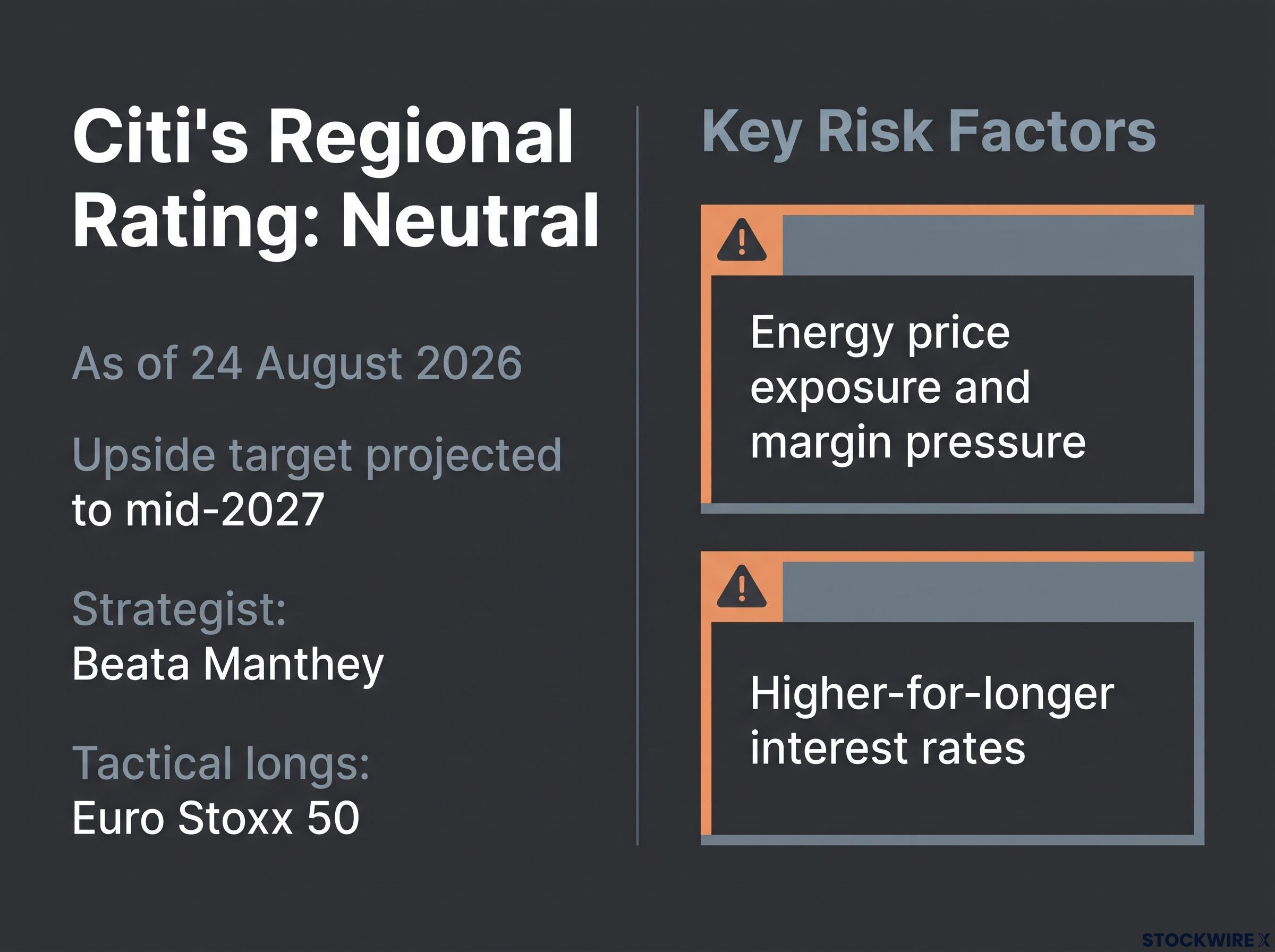
Citi’s regional rating on European equities: Neutral (as of 24 August 2026), with an upside target projected to mid-2027, according to Beata Manthey’s equity strategy team.
The two risks the bank flags are both structural rather than cyclical:
- Energy price exposure and margin pressure. Europe remains vulnerable to bouts of elevated energy costs, which compress margins across industrials and manufacturing, the very sectors that give European indices their diversification value.
- Higher-for-longer interest rates. If rates stay elevated beyond current market expectations, rate-sensitive sectors heavily represented in European indices, particularly financials and real estate, face persistent headwinds.
Citi has at times recommended tactical longs on benchmarks such as the Euro Stoxx 50, but those trades sit within an overall allocation that has not moved to overweight. The longer-term case is seen as improving, but the bank is not yet ready to issue a broad regional buy call.
That Neutral rating tells you something important about how to use this framework. Citi is flagging European stocks as a diversifying tool, not issuing a blanket endorsement. You should size any European allocation accordingly, treating it as a structural buffer rather than a directional trade.
JPMorgan’s European equities thesis offers a useful cross-check on Citi’s Neutral stance: where Citi holds back from a full overweight, JPMorgan has raised its STOXX 600 year-end target to 680 after the index delivered 13% in H1 2026, with European bank stocks gaining 45% in U.S. dollar terms representing the most concentrated validation of the rotation into European value cyclicals.
The five names Citi’s multi-factor screen surfaced and what each one offers
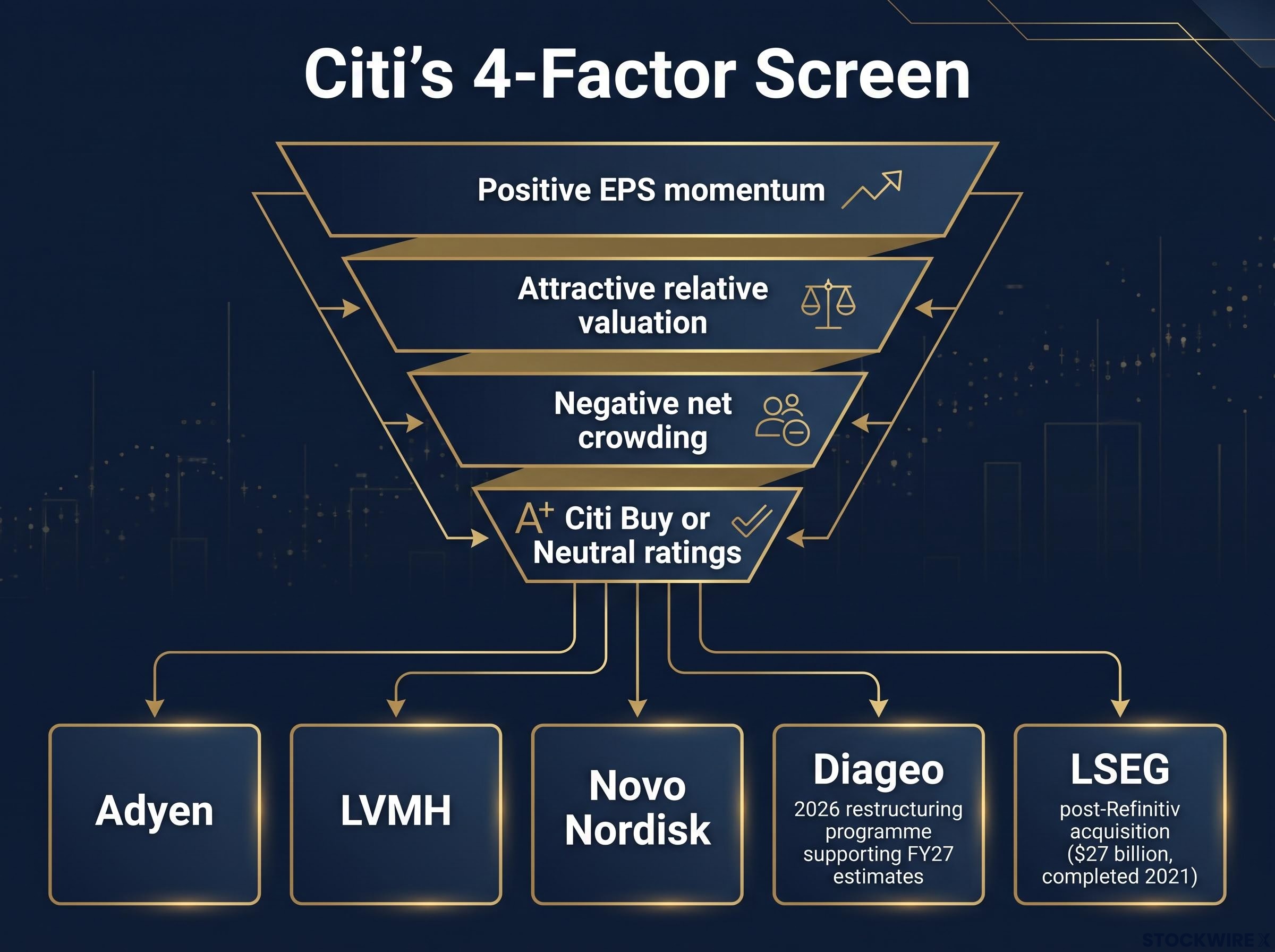
The macro thesis is only useful if it translates into specific positions. Citi’s team applies a four-factor screen to move from the regional argument to individual stocks:
- Positive EPS momentum: analyst earnings estimates trending higher, not being revised down.
- Attractive relative valuation: reasonable versus peers and earnings power.
- Negative net crowding: low institutional consensus positioning, which means these are not the trades everyone already owns.
- Citi Buy or Neutral ratings: internal consistency with the bank’s own fundamental coverage.
Five names passed. Citi has indicated additional European stocks also cleared the screen but were not disclosed in available reporting, so this is a representative rather than exhaustive list.
| Company | Sector | Key screen characteristic | AI-hedge role |
|---|---|---|---|
| Adyen | Fintech / Payments | Improving EPS momentum after prior share price correction | Fintech exposure with reasonable valuation, minimal AI-trade correlation |
| LVMH | Luxury goods | Strong pricing power with supportive earnings trends | Consumer demand driven, not AI-sentiment driven |
| Novo Nordisk | Pharmaceuticals | Durable GLP-1 earnings momentum despite share price volatility | Healthcare sector provides structural diversification from tech |
| Diageo | Spirits / Beverages | Earnings reset maturing; 2026 restructuring programme supporting FY27 estimates | Staples exposure behaves independently of AI cycles |
| LSEG | Financial infrastructure | Recurring revenue characteristics post-Refinitiv acquisition (approximately $27 billion, completed 2021) | Data and analytics revenue uncorrelated with AI hardware sentiment |
The low-crowding filter matters as much as the names themselves. Because institutional positioning in these stocks is not heavily consensus, a broad market de-risking event is less likely to trigger simultaneous selling pressure across the entire basket. That is a practical risk management benefit that a passive European index fund would not provide.
The institutional underweight in European equities adds a second dimension to Citi’s low-crowding filter: the June 2026 BofA Global Fund Manager Survey showed European equities at their most underweight since December 2024, a positioning gap that means a reallocation wave has not yet occurred and the screened names carry less crowding risk than their U.S. counterparts.
Citi’s framework suggests using these screened names as a targeted portfolio sleeve rather than buying broad European exposure. The construction logic works in three steps:
- Retain AI holdings as your core structural theme rather than timing an exit.
- Identify position size for a European diversifying sleeve, calibrated to dampen volatility rather than replace AI exposure.
- Populate the sleeve using multi-factor screened names rather than a broad index, so every position has passed a quality check on earnings direction, valuation, and institutional positioning.
The time horizon is mid-2027, consistent with Citi’s upside target. This is a medium-term structural positioning decision, not a short-term trade.
For investors ready to act on the sleeve construction logic, our dedicated guide to investing in European stocks walks through Switzerland, Spain, and Italy as three structurally distinct portfolio roles, covering the specific large-cap names, sector concentrations, and currency considerations that shape how each market behaves within a diversified allocation.
This article is for informational purposes only and should not be considered financial advice. Investors should conduct their own research and consult with financial professionals before making investment decisions. These views reflect Citi’s strategic framework as of 24 August 2026 and are subject to change based on market developments.