
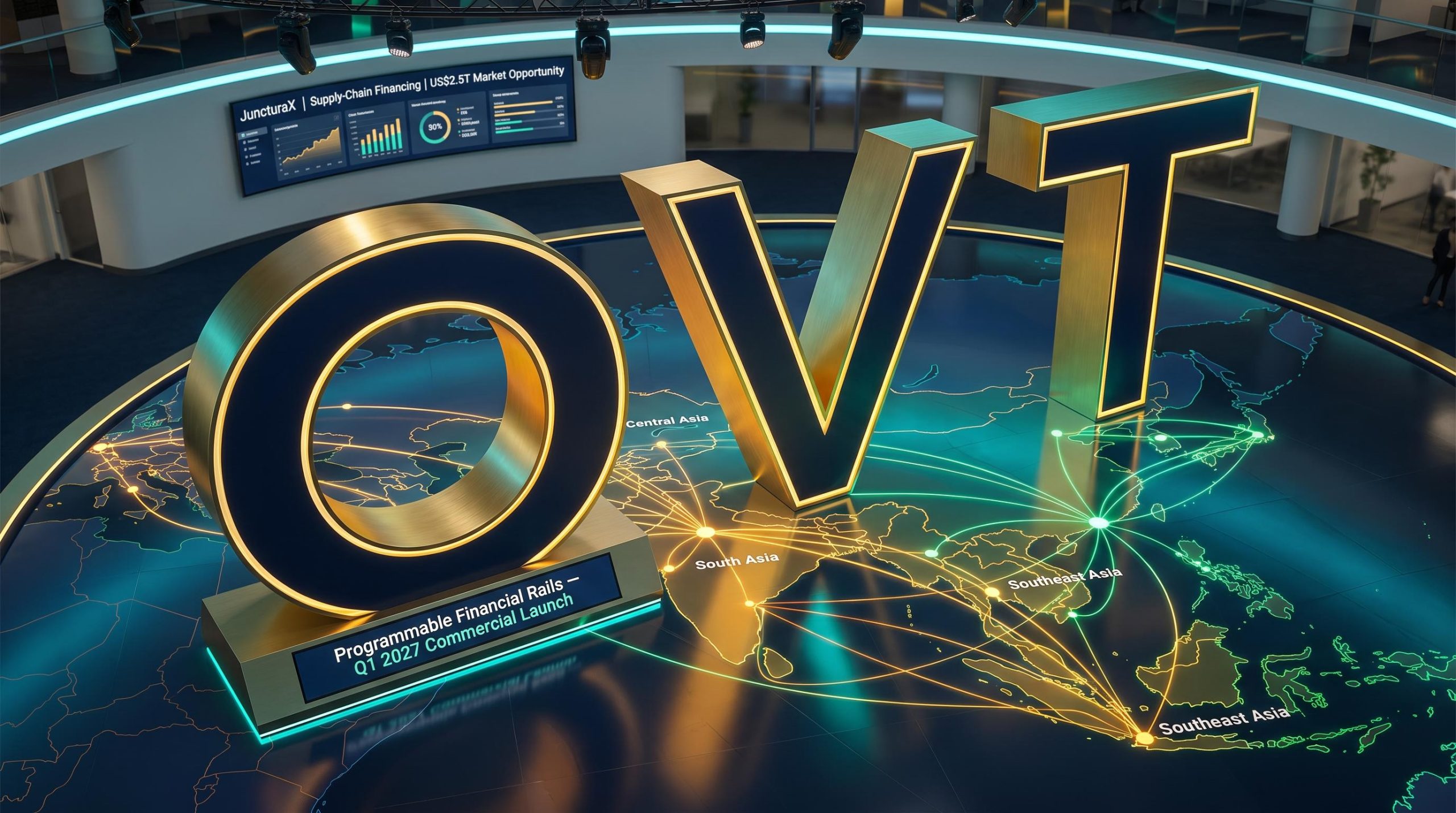
Ovanti maps out a three-region trade corridor strategy
In its August 2026 investor update, Ovanti Limited (ASX: OVT) set out a strategic vision to build a connected trade and remittance corridor spanning Southeast Asia, South Asia and Central Asia. The presentation framed the group’s core offering as “programmable financial rails for financial institutions”, covering remittance, cross-border settlement, payments, financing and digital-asset services.
Management outlined a unifying thesis. Every initiative detailed in the update, whether a licensed digital asset exchange, a digital bank pilot, a CBDC platform or a supply-chain financing product, sits under one group-wide programmable-rails strategy rather than functioning as a separate bet in each market.
These regions are bound together by some of the world’s largest labour-migration, remittance and trade corridors, yet remain served by fragmented and often informal financial rails. Ovanti described this as a leapfrog opportunity, where these markets can move straight to new financial infrastructure rather than retrofit legacy systems.
Underpinning the model is TEIZA, described as an institutional-grade blockchain protocol focused on developing sovereign financial networks for digital trade corridors. Ovanti is positioned as a strategic partner building its products on TEIZA’s infrastructure, not the owner of the protocol layer.
When big ASX news breaks, our subscribers know first
Status at a glance across three regions
The presentation detailed the current state of play region by region, with each market at a different stage of regulatory and commercial engagement.
Southeast Asia — Malaysia as the anchor
Malaysia anchors the group’s approach. JuncturaX, the deep-tiered supply-chain financing product, has been validated through a successful anchor-client proof-of-concept, with a targeted commercial launch in early Q1 2027. The eLabuan digital incorporation concept is progressing through engagement with the Labuan Financial Services Authority (LFSA) and Labuan Corp.
iSentric, Ovanti’s Malaysian subsidiary with more than 20 years serving the region’s top banks, is shifting toward project management and integration of the new programmable rails.
South Asia — Nepal leads
Nepal represents the group’s most advanced regulatory engagement. Central Bank of Nepal nominated its Payment Services Director as point of contact for a proposed training programme and CBDC proof-of-concept, with the team now working with the Central Bank’s Payment Systems Department.
Central Asia — remittance-first
The Central Asia strategy is remittance-led, entered through a Digital Asset Exchange (DAX) pilot starting with OTC-based institutional USD-to-USDT conversion. A neobank ambition is in active conversations with banks.
| Region | Anchor Market | Lead Initiative | Current Status |
|---|---|---|---|
| Southeast Asia | Malaysia | JuncturaX supply-chain financing | PoC validated; commercial launch targeted early Q1 2027 |
| South Asia | Nepal | CBDC proof-of-concept | Payment Services Director nominated as point of contact |
| Central Asia | Tajikistan | Digital Asset Exchange (OTC USD-to-USDT) | Pilot in development; banks in active conversation |
What programmable financial rails actually mean
For investors less familiar with the terminology, the strategy rests on several core concepts. Programmable financial rails refer to remittance, cross-border settlement, and the payment, financing, and digital-asset services built on top of them. Because many emerging Asian markets lack entrenched legacy banking systems, they can adopt this infrastructure without needing to unwind older technology, which is why the group argues blockchain’s value is proportionally higher in these regions.
Several terms recur throughout the update:
-
CBDC (Central Bank Digital Currency): A digital currency issued by a central bank, with Central Bank of Nepal progressing a proposed amendment to legally recognise CBDC as tender.
-
Tokenization: Representing assets such as trade receivables, real-world assets, and investment products on a blockchain protocol, so they can move across shared infrastructure.
-
Deep-tier financing: Extending credit further down a supply chain to smaller suppliers who are typically invisible to financiers due to thin credit histories and limited transaction data.
For investors, the model points toward recurring, scalable infrastructure revenue rather than one-off builds tied to a single product.
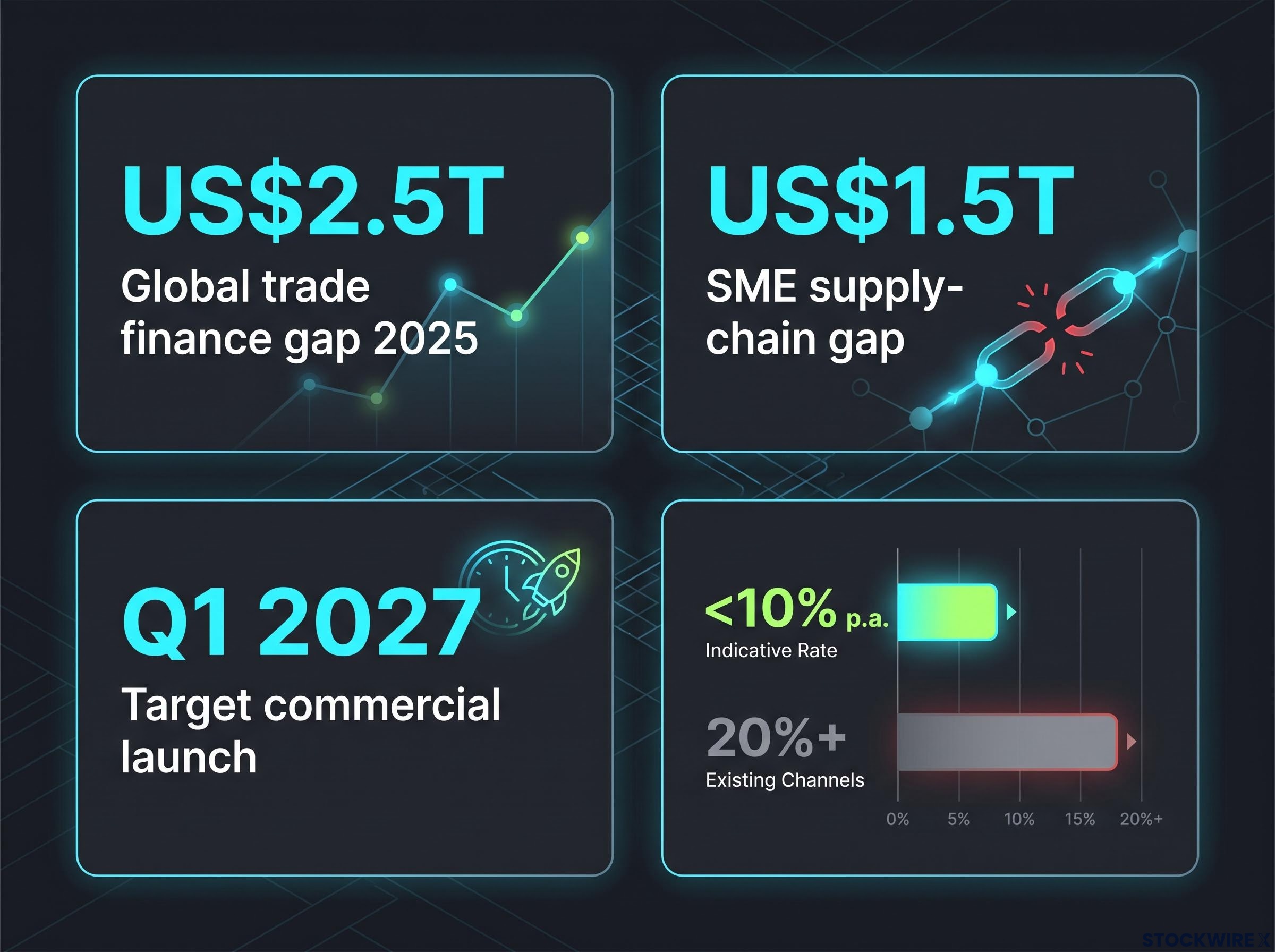
JuncturaX targets a US$2.5 trillion trade finance gap
The presentation positioned JuncturaX as the flagship revenue-generating pilot: a repeatable deep-tiered supply-chain financing product that scales anchor-client by anchor-client. It targets one of the largest structural gaps in global finance, where financing access deteriorates the further a supplier sits from a large anchor buyer.
In the Malaysia proof-of-concept, two licensed Malaysian financial institutions are exploring financing for the upstream suppliers of a major oil and gas anchor client. The proposed model is intended to support financing at indicative rates below 10% per annum, compared with rates reported by prospective participants as exceeding 20% through certain existing channels. Final rates would be determined by participating financial institutions and remain subject to credit approval and commercial terms.
The revenue model is recurring and subscription-based, scaling with each new anchor network brought onto the protocol. Ovanti noted it is searching for additional anchor clients, focused on listed oil and gas and real estate development groups.
| Metric | Figure | Detail |
|---|---|---|
| Global trade finance gap 2025 | US$2.5T | Roughly 10% of global trade |
| SME supply-chain gap | US$1.5T | Portion of the shortfall specific to SMEs |
| Target commercial launch | Q1 2027 | Full commercial rollout targeted |
| Indicative rate | <10% p.a. | Versus 20%+ reported through certain existing channels |
“The addressable opportunity scales with the number of anchor networks captured — not with the value of any individual contract.”
Nepal and the path to a CBDC platform
Nepal was framed as the group’s most advanced regulatory entry point in South Asia. Ovanti was invited to present at Central Bank of Nepal’s CBDC Stakeholder Consultation Workshop on 13 August 2026, addressing the Governor, senior officials, and the country’s banking and fintech community.
According to the update, the Governor responded positively and directed the Payment Services Director to liaise on a proposed training programme and proof-of-concept, with the Central Bank planning to allocate a budget covering both wholesale and retail CBDC.
The strategic prize is that this proof-of-concept becomes a template for a broader CBDC Management Platform ambition, repeatable across other regional central banks. Supporting market context includes Nepal’s remittance inflows, which grew nearly 38% year-on-year to roughly US$10.1 billion in the first eight months of FY2025/26, alongside a proposed amendment to legally recognise CBDC as tender.
Key milestones in the Nepal engagement include:
-
Meeting with Nepal’s Ministry of Finance, Central Bank Governor and institutional stakeholders in Kathmandu.
-
Invited presentation at the CBDC Stakeholder Consultation Workshop on 13 August 2026.
-
Payment Services Director nominated as point of contact for the proposed training programme and PoC.
-
A follow-up meeting with the Payment Systems Department being arranged to define next steps.
This positions Ovanti as a trusted technical partner on a stated central-bank priority.
Central Asia remittance play and the wider pipeline
The Central Asia strategy is remittance-first, with Tajikistan as the entry point given its position as the world’s most remittance-dependent economy. Inbound transfers to Tajikistan reached roughly US$5.8 billion in 2024.
Entry is through a licensed Digital Asset Exchange (DAX), starting with OTC-based institutional USD-to-USDT conversion, with a long-term ambition for a licensed digital bank. The presentation noted three regulated liquidity partners were evaluated across working sessions on 12 August, referencing a leading global digital-asset custodian, a leading B2B payments platform, and the NexStox Group.
The wider pipeline spans several markets:
-
Pakistan: An estimated 27.1 million active crypto users and interest in PVARA licensing.
-
Vietnam: Developing digital-asset legislation, with Ministry of Finance engagement underway.
-
Indonesia: Deep-tier financing plus Islamic finance and sukuk tokenization discussions.
-
Cambodia and Sri Lanka: Progressing from early exploration toward direct central-bank and government engagement.
“A template Ovanti can repeat across other high-remittance corridors.”
The investment case and what comes next
The synthesis presented is one connected corridor operating as a single ecosystem, with TEIZA as the coordination protocol linking Ominari, OmiCloud, JuncturaX and the CBDC Management Platform. iSentric provides an existing commercial engine and bank-facing distribution channel in Malaysia, complementing the proof-of-concept work.
Running in parallel to the programmable-rails rollout, Ovanti’s Asian BNPL relaunch is targeting Malaysia first, supported by two founding Afterpay executives appointed to the Advisory Board in July 2026, with broader regional expansion contingent on licensing, funding, and distribution milestones.
The corridor vision outlined in the August 2026 update is the commercial expression of a structural pivot Ovanti announced in March 2026, when the group revealed its Global Financial Super App strategy, retired the Flote brand, and wound down its legacy US operations to concentrate resources on Asian and European markets.
Near-term catalysts to watch include:
-
JuncturaX commercial launch, targeted for Q1 2027.
-
Progression of the Nepal CBDC proof-of-concept.
-
The Central Asia DAX pilot.
-
Planned MoU announcements on training partnerships.
Ovanti Limited (ASX: OVT) provides fintech and digital commerce software solutions serving leading banks in Malaysia and large telcos and corporates in Malaysia and Indonesia. Building on this platform, the group is developing programmable financial rails across Southeast Asia, South Asia and Central Asia, with the ambition of connecting these markets as a single digital trade and remittance corridor.
Don’t Miss the Next Fintech Breakout on the ASX
Get FREE breaking ASX fintech and finance news delivered to your inbox within minutes of release, complete with in-depth analysis already done for you. Join 20,000+ active subscribers who stay ahead of the market the moment announcements drop. Click the “Free Alerts” button at StockWire X to start receiving alerts today.