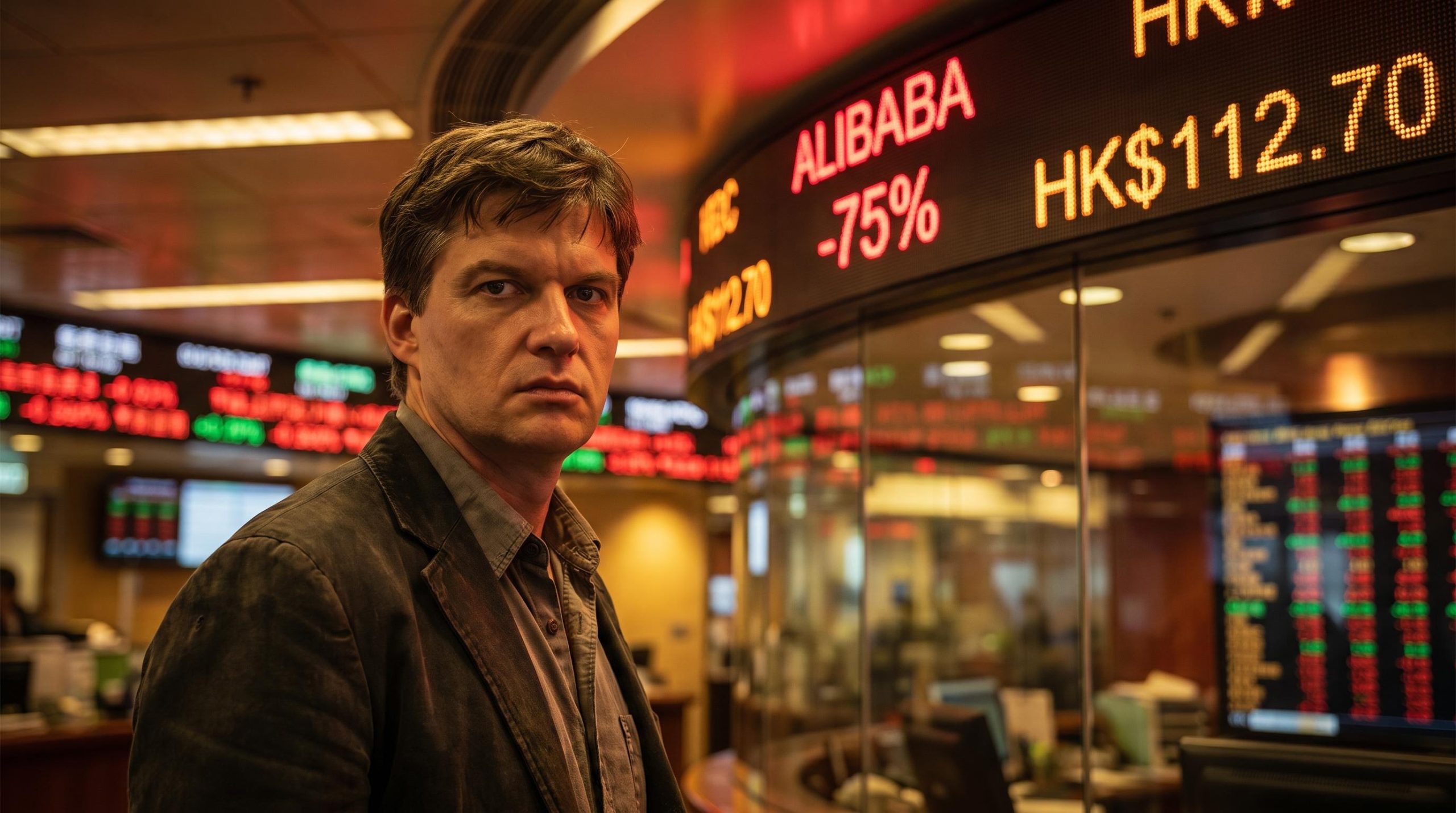
On 23 August 2026, the same day Alibaba Group Holding announced Hong Kong’s largest-ever follow-on share offering, Michael Burry closed his entire Alibaba position. He then stated via Substack that the shares would have to halve in price before he would give them a second look.
The timing was not coincidental. A 75% collapse in quarterly net profit, an HK$80 billion discounted share sale earmarked for artificial intelligence infrastructure, and a deteriorating return on invested capital gave Burry the three-part case he needed to exit. He did not retreat from Chinese e-commerce. He immediately redirected the capital into JD.com, which he described as a “large” position, signalling the call is company-specific rather than a macro exit from China.
Each element of Burry’s reasoning is laid out below so you can assess whether his logic applies to your own view of Alibaba, and what the rotation into JD.com signals about where disciplined capital is moving in Chinese tech right now.
What Burry did and when he did it
Burry first disclosed stakes in both Alibaba and JD.com in April 2026. Over the following months, he added to the JD.com position while holding Alibaba. Then, on 23 August 2026, two things happened within hours of each other: Alibaba announced an HK$80 billion share placement, and Burry published a Substack post confirming he had fully exited Alibaba and rotated the capital into JD.com.
The same-day timing matters. His original plan had been to put most of the Alibaba capital back to work in the same stock within a month or two. The share placement upended that intention. A fresh look at the valuation and growth outlook, now incorporating the discounted issuance, led him to a different conclusion and a clean exit.
He characterised his JD.com holding as “large” and identified it as one of his top equity positions. Substack, the platform he has used for previous high-conviction calls, was his vehicle for communicating the exit.
The key dates in sequence:
- April 2026: Initial disclosure of both Alibaba and JD.com positions
- 20 August 2026: Alibaba reports June-quarter results showing a 75% year-over-year net profit decline
- 23 August 2026: Alibaba announces HK$80 billion share placement; Burry publishes full exit and JD.com pivot via Substack
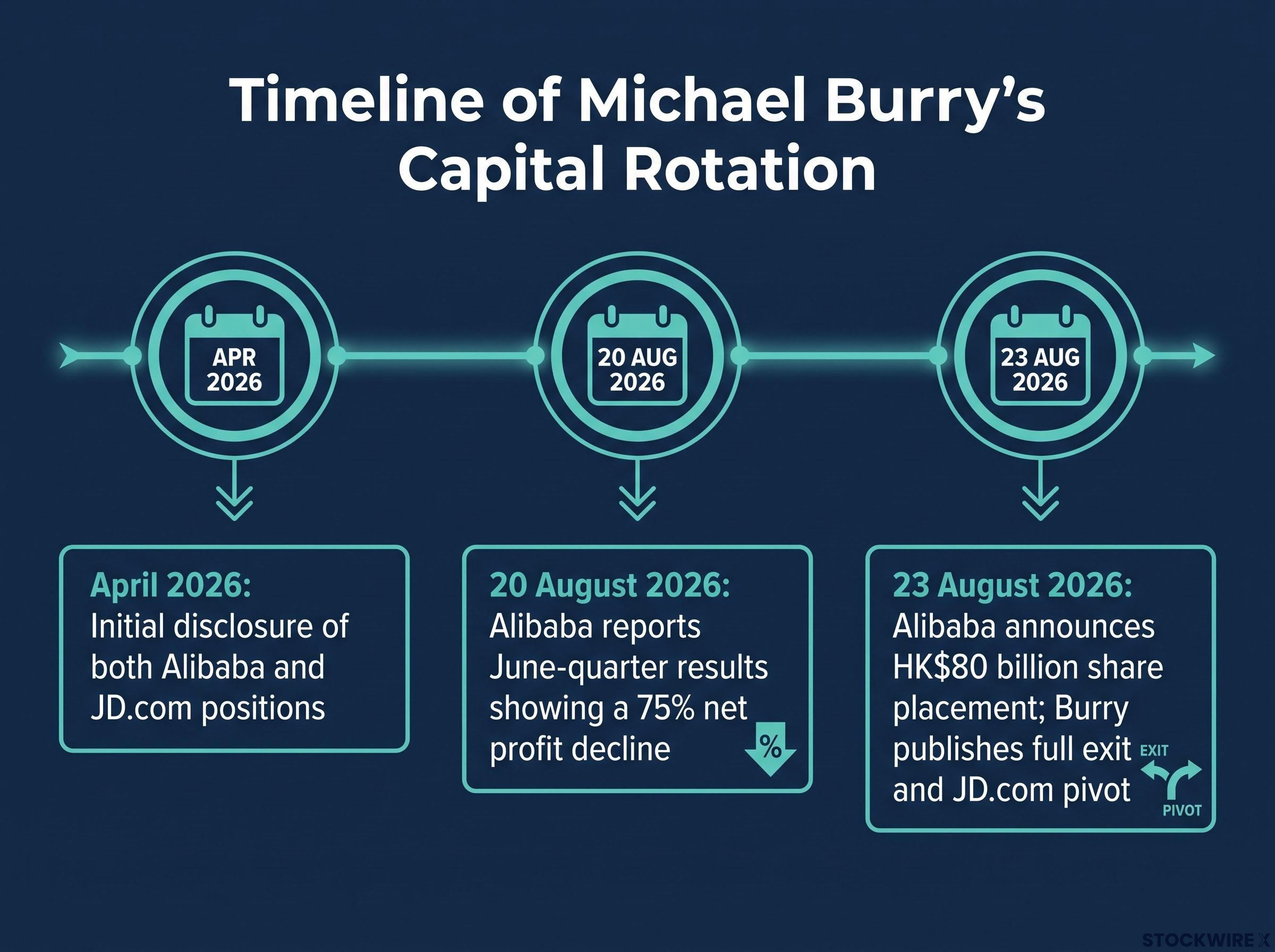
The placement was the proximate trigger, not the conclusion of a gradual reassessment. For anyone tracking institutional positioning in Chinese tech, that distinction carries different analytical weight than a generic portfolio rebalance.
Alibaba’s cloud infrastructure had attracted bullish analyst calls from Citi and Bank of America as recently as July 2026, when dual AI model launches pushed shares roughly 4% higher in premarket trading, making the August reversal all the more striking in its speed.
When big ASX news breaks, our subscribers know first
The three strikes that made Alibaba uninvestable to Burry
Start with the profit collapse. For the quarter ended 30 June 2026, reported on 20 August, Alibaba’s net profit fell 75% year over year. Revenue rose 9% to RMB 268.95 billion, beating consensus estimates. But the top-line growth masked a cost structure being reshaped by AI capital expenditure. Cloud revenue climbed 45% year over year, while capex surged 75% over the same period. Revenue expansion does not protect shareholders when the cost base expands faster.
BNN Bloomberg’s June-quarter results report confirms capital expenditure reached 67.68 billion yuan for the April-June period, a 75% year-over-year increase driven primarily by AI infrastructure commitments, providing the quantitative foundation for Burry’s ROIC deterioration argument.
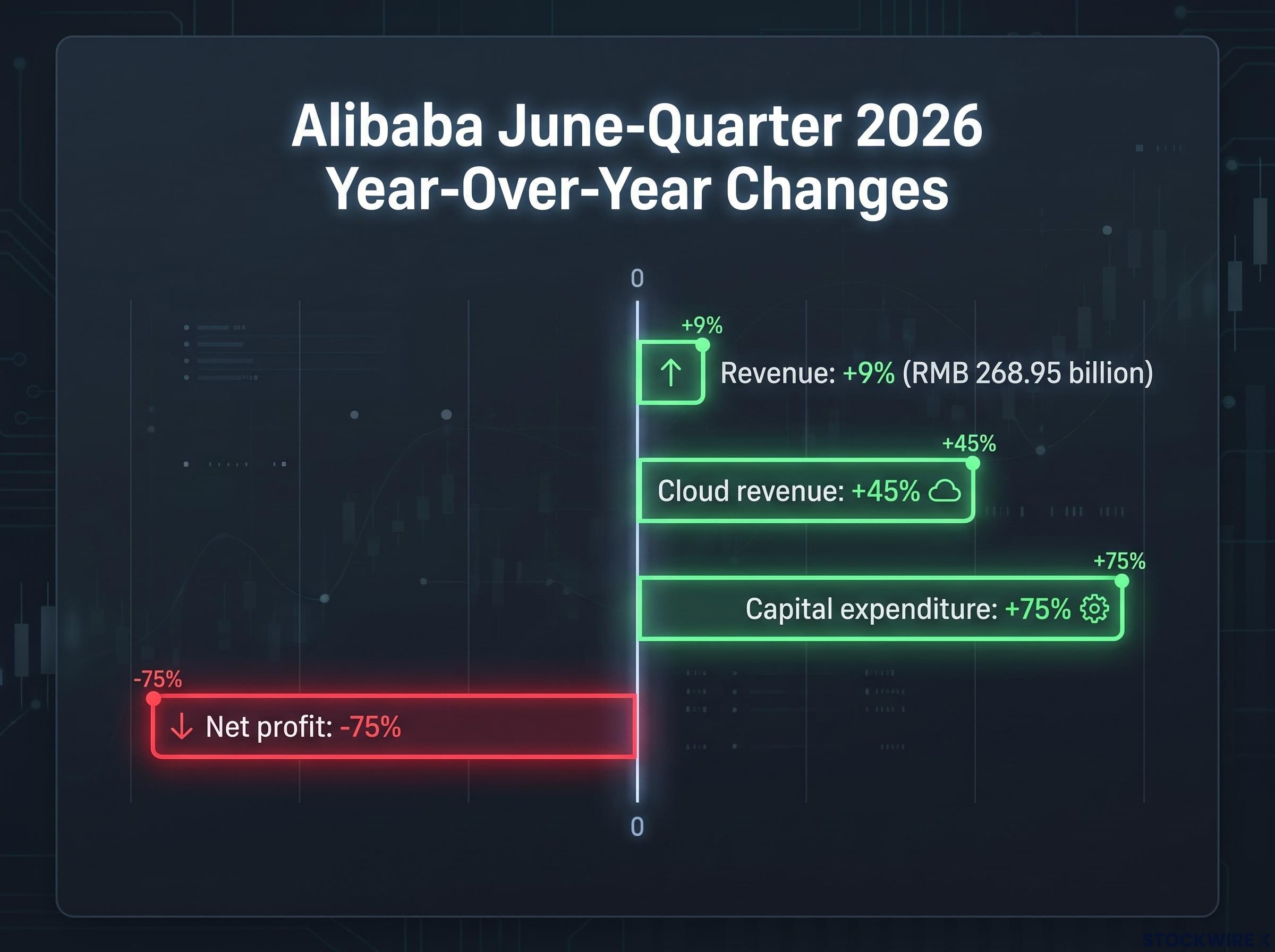
| Metric | Result | Year-over-year change |
|---|---|---|
| Revenue | RMB 268.95 billion | +9% |
| Net profit | Down sharply | -75% |
| Cloud revenue | Strong growth | +45% |
| Capital expenditure | Elevated | +75% |
Then came the second strike. On 23 August, Alibaba set the price for 710 million new shares at HK$112.70 apiece, a notable reduction from the HK$123 closing price in Hong Kong the previous Friday. The HK$80 billion (approximately $10.2 billion USD) raise was the largest follow-on equity offering Hong Kong had ever seen from a single company, with the funds directed at building out “full-stack” AI capabilities. Settlement is expected on 26 August 2026.
Burry stated via Substack that he “cannot bless share issuances” for AI spending with uncertain, long-dated payoffs.
How the share placement compounds the earnings problem
Dilution works simply: issuing 710 million new shares at a discount increases the total share count, reducing each existing holder’s percentage claim on future earnings. That dilution arrives precisely when near-term earnings power is already under severe pressure from AI capital expenditure. Existing investors face two simultaneous headwinds: earnings compression and ownership dilution.
The third strike is the long-term indictment. In Burry’s assessment, Alibaba’s return on invested capital (ROIC), which measures how effectively a company generates returns from the money it has deployed, is on a path of further erosion rather than recovery. Large, speculative AI capital expenditure can suppress ROIC for years if the returns materialise slowly or not at all. This is not a one-quarter concern. It is a structural capital allocation posture that depresses returns across multiple time horizons.
Burry’s Alibaba exit fits a broader pattern of scepticism toward AI capital cycles: his SOXX put options disclosed in May 2026 reflected a similar thesis that semiconductor valuations were pricing in AI returns far ahead of any demonstrated earnings foundation.
Why JD.com and not a China exit
Burry did not leave Chinese e-commerce. He moved from one Chinese platform to another, and the distinction matters.
His JD.com position is described as “large” and ranks among his top equity holdings. Earlier in 2026, he called it a “significant add” and cited prior weakness in JD.com’s share price as an attractive entry point. Both the Alibaba and JD.com positions were first disclosed in April 2026; he added to JD.com in subsequent months while holding Alibaba steady, before the August pivot.
The implied contrast between the two companies frames Burry’s reasoning:
Burry’s stated concerns about Alibaba:
- Dilutive share issuance to fund uncertain AI projects
- Deteriorating return on invested capital
- Overvaluation at current prices
The implied appeal of JD.com:
- Greater capital discipline
- More compelling valuation relative to growth prospects
- Prior share price weakness creating an attractive entry point
For anyone holding or watching Alibaba, the JD.com pivot clarifies something important: this exit is not a signal to abandon Chinese tech broadly. It is a specific valuation and capital-discipline verdict on Alibaba’s current management posture. The distinction between a macro China call and a company-specific call implies very different responses to the same news event for your own portfolio positioning.
The 50% threshold and what it tells you about Burry’s valuation framework
Burry has set a precise re-entry condition: Alibaba’s stock would need to shed roughly half its value before he would give it serious consideration again.
Burry described Alibaba as “pricey” and stated the stock would need to decline by roughly 50% before he would reconsider a position.
That threshold is not an arbitrary number. Burry, whose short against the U.S. housing market before the 2008 financial crisis made him famous, applies deep discount requirements when a company’s near-term earnings and ownership structure are both under simultaneous pressure. The 50% figure is his way of pricing in three compounding risk factors at once:
- Profit compression from AI capex: A 75% earnings decline with no near-term visibility on recovery
- Dilution from the share issuance: 710 million new shares reducing existing holders’ claims
- Long-dated, uncertain ROIC recovery: AI infrastructure spending that may take years to generate adequate returns, if it does at all
By 23 August 2026, Alibaba’s U.S.-listed American depositary receipts (ADRs) had accumulated a year-to-date decline of 18.6%, which included an 8.6% single-session fall the prior Friday. The Hong Kong-listed shares had shed 13.9% across the same period.
A 50% threshold from an investor who has already taken the time to own and study the stock is a more informative signal than a model-derived price target. It reflects the cost of specific risks he has identified through direct position experience, and it tells you that even after an 18.6% year-to-date decline, he considers the stock roughly twice as expensive as it would need to be to compensate for the risks ahead.
For investors tempted to express a bearish view on Alibaba by shorting the stock or its ADRs rather than simply avoiding the position, our full explainer on short selling risks covers why Burry himself has warned retail investors against replicating his directional trades through short positions.
What the correction has already priced in, and where the uncertainty sits
The year-to-date ADR decline of 18.6% and the single-day 8.6% drop are not trivial. A meaningful correction is already underway, and anyone assessing Alibaba’s risk profile needs to separate what the market has already absorbed from what remains unresolved.
| What the market has already priced | What remains unresolved |
|---|---|
| June-quarter profit collapse (-75% year over year) | Whether AI capex generates ROIC recovery fast enough to offset the dilution hit |
| Dilutive share placement at a discount (HK$112.70 vs HK$123 close) | How many additional funding rounds may be required for the “full-stack” AI programme |
| Initial market repricing (18.6% ADR decline, 13.9% HK decline year to date) | Whether the gap between cloud revenue growth (+45%) and capex growth (+75%) narrows or widens |
The central variable is whether Alibaba’s AI infrastructure spending generates returns fast enough to close the gap between cloud revenue growth at 45% and capex growth at 75%. That gap, visible in a single quarter’s data, is the empirical test of Burry’s ROIC thesis. The next two to three quarterly results will show whether it closes in Alibaba’s favour or confirms the deterioration Burry is betting on.
Margin compression in high-growth platforms is not unique to Chinese e-commerce: MercadoLibre reported a similar operating margin decline in Q1 2026, falling from 13% to roughly 7%, as it scaled logistics and credit infrastructure, raising analogous questions about whether investment-phase costs precede durable returns.
The offering is expected to settle on 26 August 2026. That settlement and the next quarterly reporting cycle are the first checkpoints.
Burry’s verdict on Alibaba is clear; the market’s is still being written
Burry has issued a precise, conditions-based verdict: exit, a 50% threshold for re-entry, and capital rotated to JD.com. His framework is internally consistent. The specific metrics to watch, cloud revenue growth versus capex trajectory and the ROIC trend over the next two to three quarters, are now identified.
The market is still processing the simultaneous arrival of a profit collapse, a record share offering, and an AI spending commitment with uncertain long-dated payoffs. The offering’s expected settlement on 26 August and the next quarterly result cycle will be the first empirical checkpoints against which Burry’s thesis can be tested.
This article is for informational purposes only and should not be considered financial advice. Investors should conduct their own research and consult with financial professionals before making investment decisions. Past performance does not guarantee future results. Financial projections are subject to market conditions and various risk factors.