
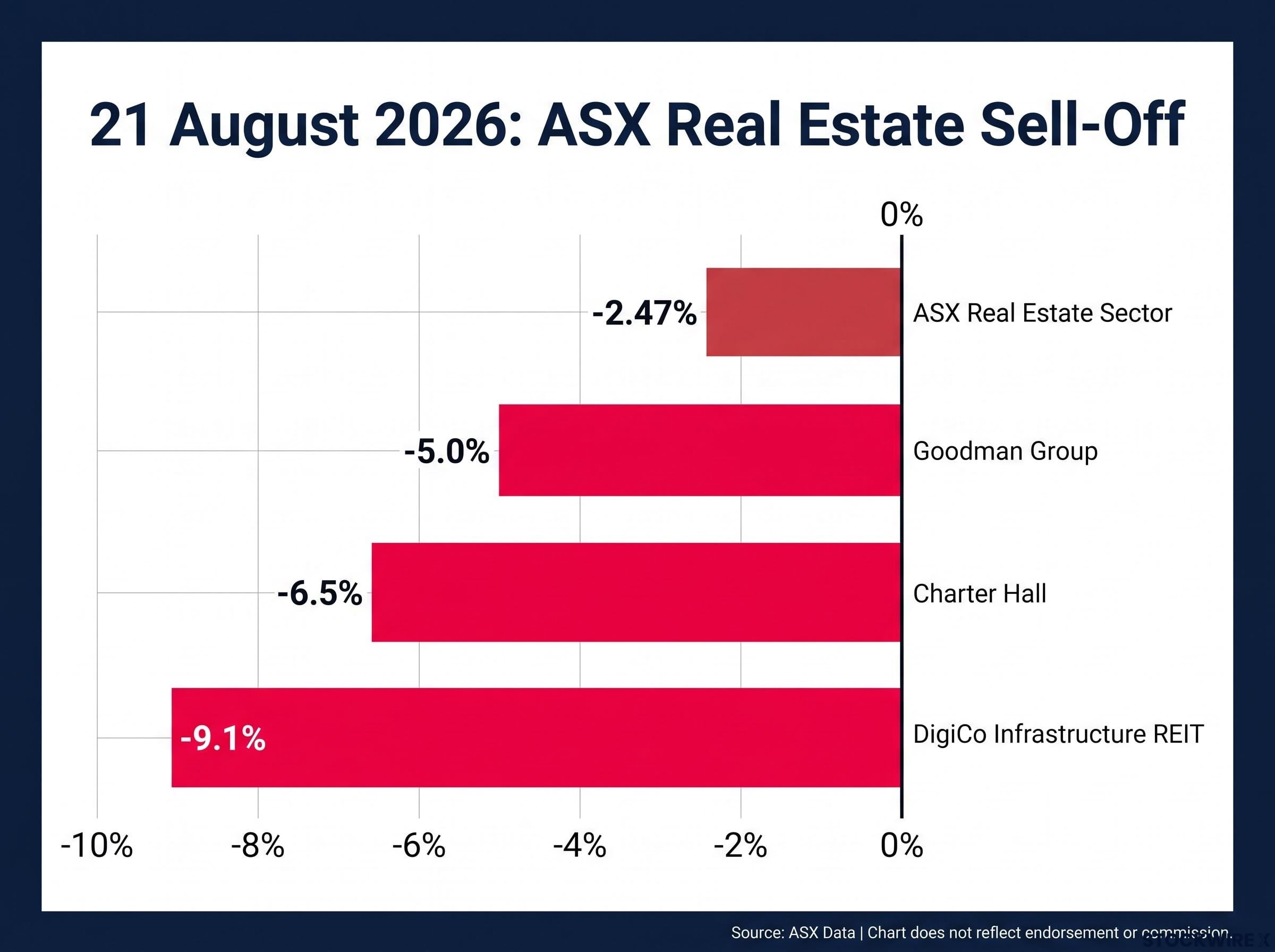
The ASX Real Estate sector fell 2.47% on Friday 21 August 2026, its worst single-session performance of the reporting season. It was not a property market collapse. It was not a macro-driven rotation. Three companies reported futures that looked dimmer than investors had priced in, and the market repriced them violently.
The sell-off was concentrated and earnings-driven, which makes its signal more durable than a broad risk-off day. Goodman Group, Charter Hall, and DigiCo Infrastructure REIT each triggered selling for related but distinct reasons, and each tells you something specific about how the market is now treating growth-oriented property trusts. Retail investors holding REIT exposure, or watching for entry points, need to understand the mechanics before deciding how to respond.
Here is a clear breakdown of each company’s numbers, what brokers did in response, and what this session tells you about how the market is pricing forward guidance across the listed property sector.
The day’s damage in numbers: what the ASX property rout looked like
The 2.47% sector decline on 21 August 2026 made Real Estate the weakest-performing sector on the ASX. Three names drove the damage, each representing a different flavour of REIT exposure but facing the same underlying problem: guidance that fell short of what was already priced in.
Goodman Group closed at $27.34 on Friday, having shed 5.0% on the day and accumulated a 10.5% loss across three sessions. Charter Hall fell 6.5% to $20.665. DigiCo Infrastructure REIT was the session’s most severe casualty, down 9.1% to $2.535.
| Company | ASX Code | 21 Aug Move | Closing Price | Trigger |
|---|---|---|---|---|
| Goodman Group | GMG | -5.0% (day); -10.5% (3 sessions) | $27.34 | Results released 20 Aug; guidance miss |
| Charter Hall | CHC | -6.5% | $20.665 | FY26 in line; FY27 guidance disappointed |
| DigiCo Infrastructure REIT | DGT | -9.1% | $2.535 | EBITDA guidance ~16% below estimates; distributions ~7% below |
The concentration of the damage in three names tells you this was an earnings-and-guidance event, not a macro-driven sector rout. The read-through to other REITs in your portfolio is more nuanced than the headline sector number suggests.
When big ASX news breaks, our subscribers know first
What Goodman Group’s result actually said, and why the market reacted so severely
Goodman Group published its results on Thursday 20 August 2026. By the time Friday’s session closed, the stock had settled at $27.34, representing a 5.0% single-day fall and a cumulative retreat of 10.5% across the prior three sessions.
That kind of multi-day, double-digit fall is consistent with a de-rating from a premium growth multiple, not panic selling on fundamentally broken assets. When a stock is priced for superior growth in logistics and digital infrastructure, the market is already paying for a future that needs to arrive on schedule. Even modest shortfalls in earnings or guidance direction can trigger outsized moves because the premium itself amplifies the disappointment.
Goodman’s data centre pipeline had already attracted scrutiny before the August results, with its $14.5 billion work-in-progress carrying no signed major leases as at March 2026, a deliberate departure from the pre-leasing thresholds used by global peers such as Digital Realty and Equinix.
The broker response captured the split in how to read the new price:
- Bell Potter downgraded Goodman to Hold from Buy, cutting the price target to $32.65 from $33.95.
- UBS retained its Buy rating but trimmed the price target to $33.66 from $34.09.
Bell Potter’s downgrade alongside UBS’s retained Buy, both with trimmed targets, tells you the broker community is divided on whether the sell-off has reset risk-reward to an attractive level. That split means investors need to form their own view on Goodman’s growth trajectory rather than outsourcing the decision to one house.
The broader lesson is structural. Goodman is the ASX’s most prominent premium-growth REIT. Its sell-off pattern is a case study in what it costs to hold high-multiple names through earnings: the upside is better long-term if growth is sustained, but the downside on a miss is steeper than for ordinary REITs.
Charter Hall and DigiCo: two different misses, one common lesson
When Charter Hall reported its FY26 numbers on 21 August 2026, the results themselves landed broadly where the market expected. Even so, the stock shed 6.5% to close at $20.665, because the FY27 earnings guidance that accompanied those figures read as soft and left investors wanting more.
DigiCo Infrastructure REIT was the session’s extreme case. Its FY27 underlying EBITDA (earnings before interest, taxes, depreciation, and amortisation) guidance range of $120-125 million fell roughly 16% short of what analysts had pencilled in. The accompanying distribution guidance of 15 cents per unit undershot consensus by around 7%, and the stock closed 9.1% lower at $2.535.
At approximately 16% below analyst estimates, DigiCo’s EBITDA guidance represented the session’s most significant single guidance shortfall and the result that most directly undermined the “predictable income” thesis that underpins REIT valuations.
The two companies are different businesses facing different challenges. But the common lesson is sharp: forward guidance is now the primary verdict the market delivers at results time. Rear-view numbers that merely meet expectations buy no protection if the outlook disappoints.
For DigiCo holders specifically, a 7% shortfall in expected distributions is not a rounding error for income-dependent investors. The 16% EBITDA miss raises a direct question about whether management’s growth assumptions were ever grounded in achievable execution.
Why data-centre and infrastructure REITs are not the defensive plays some investors assumed
The assumption is straightforward: REITs with digital infrastructure or data-centre exposure should offer bond-like income stability because demand for digital capacity is secular and structural. The thinking goes that tenants will always need more servers, more bandwidth, more storage, and the rent cheques follow.
DigiCo’s August result challenges that assumption directly. A 16% EBITDA guidance miss and a 7% distribution shortfall demonstrate that capex cycles, pricing risk, and execution risk apply to digital REITs just as they apply to conventional property trusts. The category label does not eliminate earnings risk.
Goodman’s sell-off reinforces the point from a different angle. Its digital infrastructure and logistics tilt underpinned the premium growth thesis that is now being repriced. Two “structural growth” stories recalibrated in the same session.
What investors assumed versus what the results revealed:
- Investors assumed digital infrastructure demand would translate to predictable, growing income. The results showed that capex timing, pricing, and execution risk can disrupt that translation.
- Investors assumed the “data centre” label provided defensive characteristics. The results showed that a thematic label is not a substitute for fundamental underwriting of each trust’s specific earnings mechanics.
- Investors assumed secular demand equalled low earnings volatility. The results showed that demand for digital capacity and the ability to convert it into reliable distributions are two different things.
If you have allocated to digital or infrastructure REITs specifically because you believed they carried lower earnings risk than conventional property, DigiCo’s August result is a direct signal to stress-test that assumption before the next reporting season.
What broker downgrades and price target cuts actually signal
The predominant broker pattern on 21 August was not alarm. It was calibration: price target trims on updated models, with selective rating cuts only where risk-reward had deteriorated materially.
The distinction matters. “Limited upside over 12-18 months on new information” is a fundamentally different call from “permanent asset impairment.” The broker moves reflect the former.
| Company | Broker | Action | New Price Target |
|---|---|---|---|
| Goodman Group | Bell Potter | Downgraded to Hold from Buy | $32.65 (from $33.95) |
| Goodman Group | UBS | Retained Buy | $33.66 (from $34.09) |
| Dexus | Macquarie | Retained Outperform | $6.71 (from $7.06) |
| Vicinity Centres | UBS | Downgraded to Neutral from Buy | $2.70 (from $2.65) |
| Dexus | UBS | Retained Neutral | $6.38 (from $6.12) |
Broker actions on the same day also included raised price targets for other names, reinforcing that this was a name-by-name reset, not a blanket sector call. UBS raised its Dexus target to $6.38 from $6.12 on the same day it downgraded Vicinity Centres.
The divergence between Bell Potter cutting Goodman to Hold and UBS retaining Buy on the same day is a reminder that broker ratings are inputs to your analysis, not verdicts. The most useful question to ask of any broker note is what assumptions underlie the target price, not just what the recommendation says.
What the session tells investors holding or watching ASX REITs right now
The 21 August session distils into three distinct takeaways depending on where you sit:
- Existing REIT holders: Re-underwrite each name on the new guidance rather than reacting to headline price moves. Goodman’s 10.5% three-session decline does not mean the long-term logistics and data-centre thesis is broken. It means the growth path has been revised and the price needs to reflect that revision. Focus on distribution sustainability and gearing, name by name.
- Prospective buyers watching for entry points: Distinguish between quality assets experiencing a one-off guidance shortfall and trusts where management has repeatedly over-promised. The first may be an opportunity. The second is a trap. Charter Hall’s “in-line results, soft guidance” pattern is the template for evaluating forward guidance credibility before committing capital.
A structured REIT valuation framework covering stress-tested NTA, yield spread, P/FFO versus peers, implied cap rate versus transaction evidence, and a balance-sheet filter provides the most systematic way to separate genuinely mispriced names from those simply anticipating writedowns, which is precisely the task the current sell-off requires.
- Income-focused investors: DigiCo’s 7% distribution shortfall demonstrates that “growthy” income from thematic trusts can be less reliable than diversified portfolios with long-dated leases and conservative payout ratios. If your portfolio depends on distributions arriving as forecast, predictability matters more than thematic excitement.
Arena REIT’s August result illustrated the contrast the article describes: conservative payout ratios and long-dated leases across a 307-asset fully occupied portfolio delivered 5.7% EPS growth even while management guided to a worst-case zero-income assumption for its defaulting Edge Early Learning exposure.
The three-session pattern in Goodman, the guidance miss in Charter Hall, and the distribution shortfall in DigiCo together tell you that the current reporting season rewards investors who read the fine print of guidance assumptions, not those who react to headline profit numbers.
This article is for informational purposes only and should not be considered financial advice. Investors should conduct their own research and consult with financial professionals before making investment decisions.
What needs to go right from here for the REIT sector to stabilise
Interest rates remain the primary macro swing factor. If rate expectations soften later in 2026 without a corresponding collapse in rental income, the current de-rating may prove to be an overshoot, creating long-term entry points for patient investors. If rates stay higher for longer, the repricing has further to run.
Interest rates remain the primary macro swing factor because four distinct rate transmission channels connect monetary policy to REIT valuations simultaneously: the economic outlook signal, the discount rate effect on future cash flows, the cost of debt financing, and yield competition with government bonds.
The RBA analysis of interest rate effects on property valuations identifies how rising rates compress the present value of future income streams and tighten borrowing conditions, the same transmission mechanism that continues to set the ceiling on how far REIT multiples can recover while rates remain elevated.
The reporting season is not over. REITs that merely “meet” expectations may still be sold if guidance reads as cautious. Volatility around reporting dates should be expected to continue through August.
The 2.47% sector decline was driven by three names. That concentration means sector-wide selling may have dragged down fundamentally sound, conservatively guided REITs to yields or discounts to NTA that are difficult to justify on long-term fundamentals. Identifying them requires name-by-name work rather than buying the sector.
Three indicators to watch from here:
- Distribution guidance: Are managements reaffirming or trimming forward distributions, and are the assumptions behind those numbers realistic?
- Payout ratios: Are trusts distributing from genuine operating cash flow, or stretching to maintain distributions that earnings no longer support?
- Balance sheet gearing: How much refinancing risk sits in the next 12-24 months, and at what cost?
If you are patient and selective, the correlation overshoot effect means there may be quality REITs now trading at levels that are difficult to justify on fundamentals. But finding them requires doing the work.
Reading the 21 August session as a signal, not just a shock
The common thread across Goodman, Charter Hall, and DigiCo is straightforward: earnings delivery and credible forward guidance are now prerequisites for REITs to hold their valuations, not bonuses. The market no longer gives credit for what a trust has done. It prices what the trust credibly says it will do next.
That regime shift is not going away when the reporting season ends. The rest of August will test more names against the same standard. Trusts that pass both the earnings scorecard and the guidance-credibility test will separate themselves from those that pass only one.
Past performance does not guarantee future results. These forward-looking observations are subject to change based on market developments and company performance. Readers should consult their own professional advisers before making any portfolio decisions.