
The official now overseeing the Treasury’s expanded buyback programme once criticised the previous administration for doing something structurally similar. Treasury Secretary Scott Bessent had spent years attacking Janet Yellen’s debt management choices, arguing she was artificially manipulating the yield curve through her issuance decisions. He now runs a programme built on precisely that compositional logic, buying back longer-dated debt and replacing it with short-end issuance, at twice the prior operational scale.
That political irony is worth noting not as a partisan observation but as a signal. When a policy approach survives the ideological objections of the person who ends up running it, the logic is durable. The question is whether the logic is sufficient.
The Treasury’s recent expansion, increasing maximum buyback sizes from $2 billion to at least $4 billion per operation effective September 2026, is, in structural terms, a replay of Operation Twist executed from the liability side of the sovereign balance sheet. The historical parallel is not nostalgia. It is a test: whether the original programme’s modest results were a function of the tool itself or the constraints placed around it. Here is a historically grounded framework for evaluating whether the current programme is a genuine yield stabiliser or a bounded tactic with a ceiling markets will eventually probe.
The original Operation Twist and what it actually moved
The 2011-2012 Maturity Extension Programme (MEP) is the closest controlled experiment available for assessing this type of intervention. The core mechanics:
- Launched September 2011 by the FOMC
- Initial tranche of $400 billion, extended to a total of $667 billion
- Sold Treasuries with remaining maturities of three years or less
- Bought equivalent amounts of six-to-thirty-year securities
- No net expansion of the Fed’s balance sheet; composition changed, size did not
Markets knew from the outset that the programme was finite. There was no mechanism to scale it beyond the announced envelope, and no language suggesting additional rounds were pre-committed. That constraint shaped pricing from day one.
The Federal Reserve’s Maturity Extension Program confirms the programme’s total operational scope at $667 billion, with the Fed selling shorter-term Treasuries and purchasing longer-term equivalents across the 2011-2012 period, establishing the benchmark mechanics against which the current Treasury buyback programme is being evaluated.
Empirical research on the episode estimates approximately 15 basis points of reduction in longer-term Treasury yields attributable to the programme’s announcements.
Fifteen basis points is not zero. It confirms that maturity composition tools can move yields through the portfolio-balance channel, where changing the supply of duration available to private investors forces repricing. But the number also tells you something about the ceiling. The policy rate was already at the zero lower bound. Long-term yields were already historically compressed. Conditions were as favourable as they were likely to get for a programme of this type, and the result was still modest. That ceiling was structural, not accidental. A bounded tool, operating without the credibility of an open-ended commitment, produced a real but limited effect.
When big ASX news breaks, our subscribers know first
Why open-ended QE moved markets further and faster
Operation Twist was followed by multiple additional rounds of quantitative easing. That sequence is the strongest evidence that the programme was insufficient on its own terms: policymakers would not have returned with successive follow-up rounds had the initial intervention delivered the yield compression they were seeking.
The iterative pattern looked like this. The Fed announced a capped programme, markets priced in its effects, yields stabilised rather than continued falling, and policymakers returned with a larger follow-up. Every subsequent round reflected the reality that the previous programme’s fixed ceiling had limited what it could achieve.
The market reaction on 19 August 2026 confirmed that the Treasury buyback signal carried more weight than the raw dollar volume: a 9-14 basis point single-session drop in the 30-year yield, alongside a 3% gold rally and a weaker dollar, reflected positioning dynamics driven by expectations rather than mechanical absorption of supply.
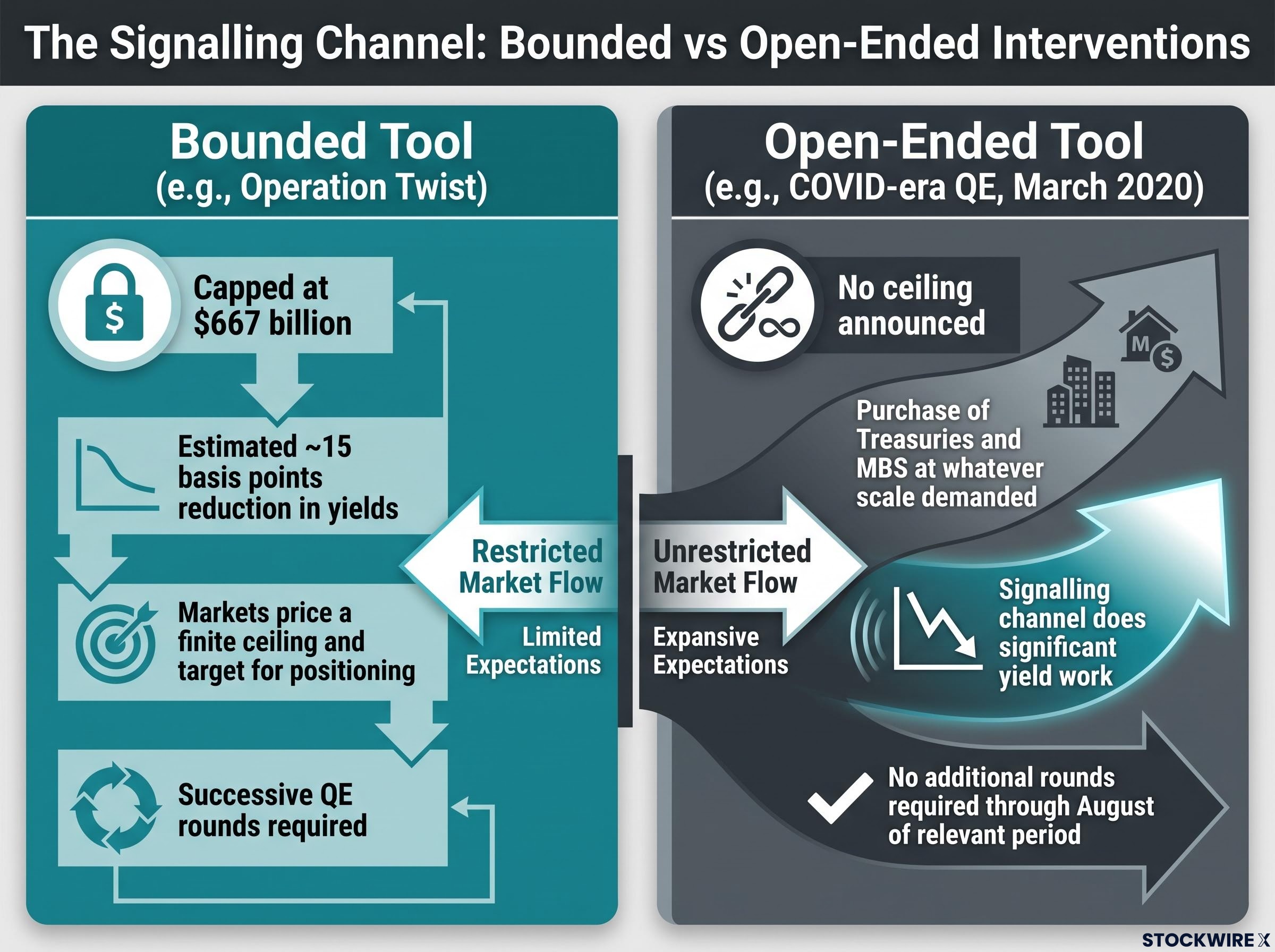
- Operation Twist: Capped at $667 billion, no balance-sheet expansion, with successive QE rounds required thereafter
- COVID-era QE (March 2020): Open-ended commitment to purchase Treasuries and MBS at whatever scale conditions demanded, no ceiling announced, no additional rounds required through August of the relevant period
The mechanism behind the signalling channel
The distinction between bounded and open-ended is not simply about size. It is about what markets can do with a number.
When a programme announces a specific dollar ceiling, traders can calculate how much duration supply will be absorbed and estimate the programme’s endpoint, positioning for it accordingly. The programme’s effect is fully priced before it finishes executing.
When the ceiling is removed, that calculation breaks down. Markets shift from pricing a finite intervention to pricing a standing backstop, one that will absorb whatever supply is necessary until the objective is met. That expectation does significant yield work before a single additional security changes hands. The signalling channel, in other words, is not a secondary benefit. It is the primary mechanism through which open-ended programmes outperform bounded ones.
What this tells you about any future policy announcement is straightforward: the framing of a programme as capped versus scalable is not rhetorical packaging. It is the primary determinant of how much of the work gets done through expectations versus actual operations.
How the current Treasury buyback programme replicates the Twist logic
The structural parallel between the original Operation Twist and the current buyback programme is not a metaphor. It is a mechanical analogy.
The Fed’s 2011-2012 programme worked through the asset side of its balance sheet, altering the mix of what it held while keeping the total unchanged. The Treasury’s programme works through the liability side, altering the mix of what it owes. The directional effect is equivalent: duration is withdrawn from private hands and replaced with shorter-dated obligations, compressing the term structure through supply management rather than rate-setting.
The Treasury has increased maximum buyback sizes for longer-dated nominal securities from $2 billion to at least $4 billion per operation, effective September 2026.
Each operation involves buying back seasoned, less liquid longer-dated issues and funding those purchases through fresh short-end issuance, which compresses the average maturity of the outstanding debt stock. The Treasury’s total borrowing does not increase; only the shape of its maturity schedule changes.
Bessent’s prior criticism of Yellen’s approach rested on the claim that she was manipulating the curve by tilting issuance toward the short end. In practice, Yellen’s strategy was about managing interest payment burdens by reducing average maturities, not an active programme of longer-end market intervention. What the current buyback programme does is formalise that same compositional shift at greater operational scale, using active repurchases rather than passive issuance decisions. That the official who led the attack on that approach now directs its more aggressive successor points to a policy rationale that outlasts the politics surrounding it.
| Attribute | Operation Twist (2011-2012) | Current Treasury buyback programme |
|---|---|---|
| Executing entity | Federal Reserve | US Treasury |
| Mechanism | Sold short-dated Treasuries, bought long-dated equivalents | Repurchases illiquid longer-dated issues, finances with new short-end issuance |
| Balance-sheet impact | None (composition change only) | None (maturity profile change only) |
| Announced scale | $667 billion total | Up to $4 billion per operation (from $2 billion), effective September 2026 |
Three structural reasons the current programme may underdeliver
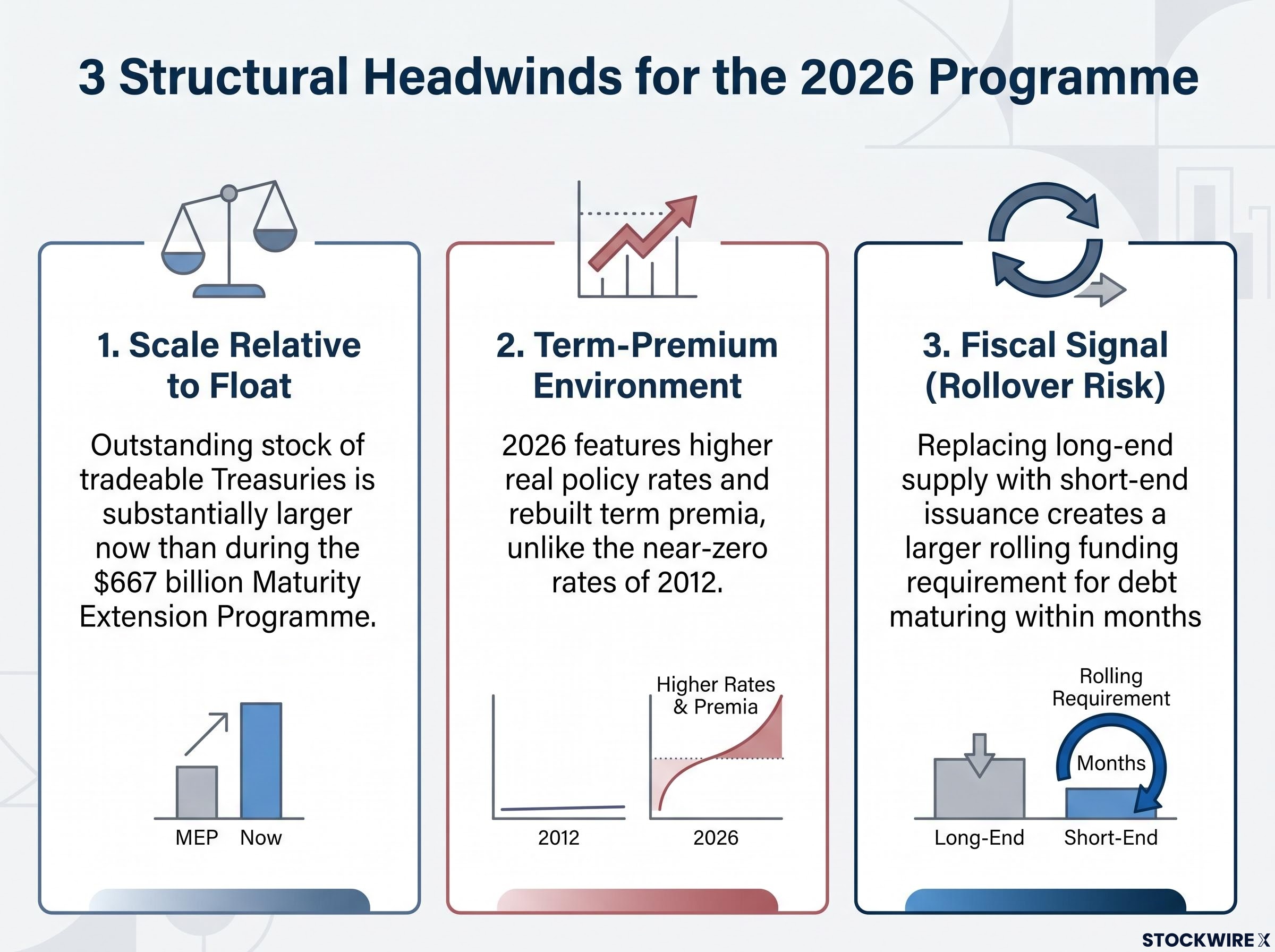
- Scale relative to the float has shrunk. The $667 billion Maturity Extension Programme operated against a considerably smaller Treasury market and still produced only around 15 basis points of yield reduction. The outstanding stock of tradeable Treasuries is now substantially larger, meaning the same nominal intervention size represents a proportionally smaller footprint. Without a mechanism for scaling operations in response to market conditions, the proportional impact is likely to be even more modest than the historical baseline suggests.
- The term-premium environment is working against the programme. Operation Twist operated in a world of already-compressed term premia and near-zero short-term rates. The current environment involves rebuilt term premia and higher real policy rates, which means the Treasury is working against a steeper structural slope. The same quantity of maturity swapping covers less distance in yield space when underlying risk compensation and inflation uncertainty are elevated. A programme that might have moved yields meaningfully in 2012 faces a harder environment in 2026.
The term-premium headwind the programme faces is compounded by an ongoing institutional selloff of long-dated Treasuries: PIMCO, BlackRock, and Schroders had been actively reducing 30-year exposure even as yields reached 5.21%, treating the supply-demand imbalance as structural rather than cyclical and signalling that compositional buybacks alone may not be sufficient to restore demand.
- Short-end concentration sends its own fiscal signal. Issuing more short-dated paper to finance buybacks creates a growing stock of obligations that must be rolled over frequently. In a market already focused on rollover risk and debt sustainability, concentrating issuance at the short end can raise questions about near-term funding pressure even as it improves liquidity at the long end.
The fiscal signal embedded in short-end concentration
This third point is the most counterintuitive. The buyback programme’s mechanics require increasing short-end supply to retire long-end supply. That achieves the maturity-shortening objective. But it simultaneously increases the proportion of outstanding debt that matures within months rather than years, creating a larger rolling funding requirement.
If markets begin pricing that rollover risk into short-end yields, the cost of funding the buyback operations themselves rises. The programme’s intended yield benefit at the long end can be partially offset by the fiscal signal it sends at the short end. Each of these three conditions has existed individually during past episodes. Their simultaneous presence in the current environment means the headwinds compound rather than simply add together.
Rollover risk is not merely a theoretical concern: Piper Sandler’s May 2026 analysis documented that US federal net interest payments had already reached $659 billion annually, with the CBO projecting they would surpass defence spending as a share of GDP by 2034, a trajectory that makes the short-end concentration embedded in the buyback programme’s mechanics a fiscal signal markets are primed to read.
The three questions that tell you whether any maturity swap programme is large enough to matter
These questions give you a portable framework for evaluating not just the current programme but any future maturity-management announcement:
- Is the programme credibly open-ended? A standing, scalable tool creates expectations of a backstop. A fixed-size initiative with a defined endpoint gives markets a finite ceiling to price and position against. The difference between those two framings determines whether the signalling channel amplifies or constrains the programme’s impact.
- What share of the targeted float is being retired? The headline dollar figure is less informative than the percentage of outstanding supply in the specific maturity buckets being repurchased or swapped. Given the growth of the overall Treasury market, the same nominal figure represents a smaller proportional intervention than it would have a decade ago.
- Where does the offsetting short-end supply land? Is new issuance flowing into already-saturated T-bill markets or into segments with absorptive capacity? How does that interact with money-market fund dynamics, bank demand, and changes in overnight reverse repo (ON RRP) usage or Fed reserve management? The destination of the offsetting supply shapes the net effect as much as the buyback itself.
Once markets identify a firm programme ceiling, it functions as a target for positioning rather than as a foundation of support.
Whether history’s lesson has been learned this time
The record on bounded maturity swaps points in one direction. The Maturity Extension Programme achieved around 15 basis points of yield reduction. Subsequent open-ended QE rounds achieved results of greater magnitude and speed. The fact that policymakers returned with multiple successive rounds confirmed what the initial effort’s modest outcome implied: a capped commitment had delivered less than conditions required.
Bounded compositional tools tend to produce genuine but limited effects, while open-ended commitments have historically moved markets by a different order of magnitude. Whether the current programme falls into the first or second category will be determined by how its framing develops over time.
That asymmetry is the single most important lens for evaluating what happens next. The current Treasury buyback programme has expanded its per-operation size, and the structural mechanics are sound. What it has not yet done is establish credible scalability, the signal that operations will grow if initial effects prove inadequate.
The specific variable to watch is not the current headline size. It is whether the programme is subsequently framed as a standing tool or treated as a completed, fixed-size intervention. If markets perceive a hard ceiling, they will price the programme’s effects as finite and begin positioning for its expiry. If the framing evolves toward open-ended conditionality, the signalling channel does much of the work before operations ramp up.
The history is clear. Whether its lesson has been absorbed is the open question. For investors calibrating expectations around long-end yield compression, the honest read is not pessimism about the programme. It is informed scepticism about whether a bounded announcement, however well-designed, can deliver what only an open-ended commitment has historically achieved.
For investors calibrating fixed income positioning around the programme’s uncertain yield impact, our dedicated guide to bond portfolio duration management covers how institutional managers including BlackRock, PIMCO, and Vanguard are positioning along the curve in a normalised rate environment.
This article is for informational purposes only and should not be considered financial advice. Investors should conduct their own research and consult with financial professionals before making investment decisions. Past performance does not guarantee future results, and the effects of policy programmes are subject to market conditions and various risk factors.