
MAAS Group delivers record FY26 result with $300.3m underlying EBITDA
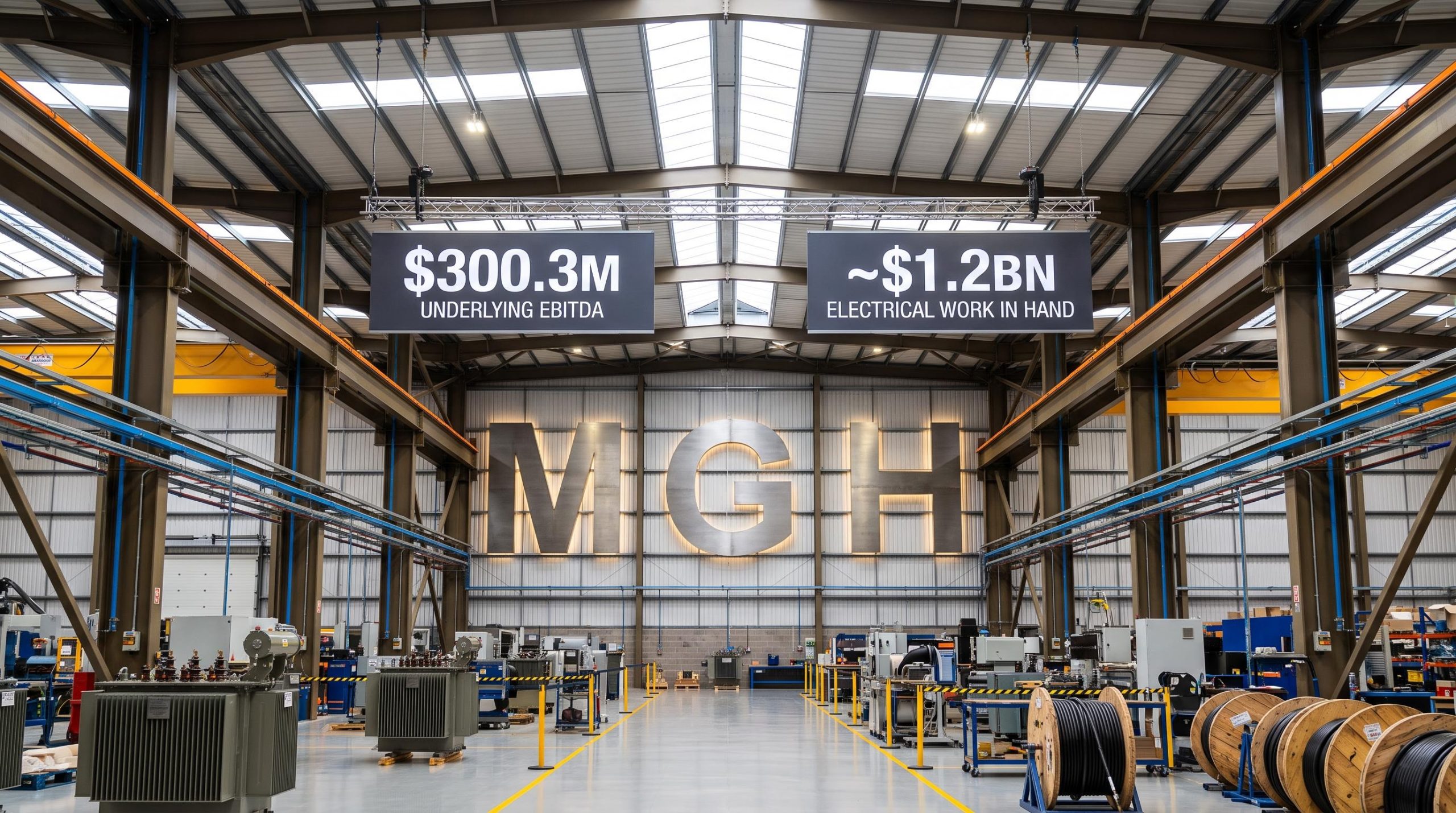
In its FY26 results presentation, MAAS Group Holdings (ASX: MGH) detailed a record full-year performance headlined by $300.3m underlying EBITDA, up 37% on the prior corresponding period and in line with guidance.
Three developments stood out for investors. The company reported record earnings, confirmed that its $1.703bn Construction Materials portfolio sale to Heidelberg Materials Australia (HMA) has now received ACCC approval, and highlighted ~$1.2bn of electrical manufacturing work in hand.
Management also outlined a new capital management framework, including an expanded on-market share buyback program. The presentation framed FY26 as the year MGH transitions to its “next phase” of growth, pivoting toward electrical infrastructure.
When big ASX news breaks, our subscribers know first
FY26 financial highlights at a glance
The presentation detailed a broad-based lift across earnings and profitability metrics, with management reporting results either in line with, or above, prior guidance ranges. Underlying earnings per share (EPS) rose sharply, supported by record underlying net profit after tax (NPAT).
| Metric | FY26 | Movement vs FY25 | Note |
|---|---|---|---|
| Underlying EBITDA | $300.3m | +37% | In line with guidance |
| Continuing ops EBITDA ex investment uplift | $143.3m | +37% | Above $130m–$135m guidance |
| Underlying EPS | 34.2c | +51% | Record underlying NPAT |
| Statutory NPAT (owners of MGH) | $136.1m | +89% | — |
| Cashflow conversion | 93% | — | Within target range |
| Leverage ratio | 2.6x | — | Within 2–3x target |
Additional context from the presentation:
-
Revenue of $1,263.8m, up 27% on FY25.
-
$99.3m of capital recycled, crystallising ~$26.1m of historical fair value gains.
-
Safety lost time injury frequency rate (LTIFR) rose to 5.6 (FY25: 4.7), with management flagging safety performance improvement as a key priority.
The Heidelberg transaction: crystallising premium value
The strategic centrepiece of the presentation was the sale of MGH’s Construction Materials portfolio to Heidelberg Materials Australia (HMA). Gross proceeds of $1.703bn include $120.0m of contingent consideration, with net proceeds after tax, minority interests and debt transfer expected to be ~$1.3bn.
The transaction has been approved by the ACCC and is expected to complete in October 2026, subject to FIRB and MGH shareholder approval. Around 1,140 employees are expected to transition, while MGH retains selected freehold land leased to HMA under long-term commercial arrangements.
The initial $1.7 billion divestment announcement in February 2026 framed the sale as a premium exit from Construction Materials, with proceeds earmarked for balance sheet repair and redeployment into digital infrastructure and electrification opportunities.
Management emphasised the return discipline behind the divestment. The presentation noted that Construction Materials has delivered approximately 50% per annum return on capital employed (ROCE) since listing, incorporating the pre-tax gain on sale and assuming full proceeds are realised, with MGH group ROCE of ~27% per annum over the same period.
The presentation’s Key Messages slide highlighted that the sale of the CM portfolio to Heidelberg crystallises premium value demonstrating disciplined ROCE focus, and the MGH Evolution slide noted that 2026 marks the transition to the next phase of growth.
Understanding the pivot to electrical infrastructure
For investors less familiar with the terminology, “electrical manufacturing work in hand” refers to contracted future work that has not yet been delivered. It represents a forward earnings pipeline, giving the company visibility over revenue it expects to recognise in coming periods.
The shift toward electrical reflects structural tailwinds. Management pointed to demand from digital and data centre infrastructure, alongside grid and transmission investment, as drivers underpinning the segment.
MGH reported ~$1.2bn of electrical manufacturing work in hand, expected to be executed over the next 18 months. The presentation also highlighted a ~$855m Firmus electrical manufacturing order expected to benefit FY27 and beyond.
The $855m Firmus purchase order, secured by JLE Group for modular electrical infrastructure delivery over 18 months, was the event that pushed total work in hand past $1.2 billion and triggered the subsequent guidance upgrade to $300m-$310m EBITDA ahead of the final result.
From FY27, the company will rename the Civil Construction & Hire segment to Electrical, led by electrical manufacturing, and add a new MGH Investments segment. Management positioned this pipeline as supporting continuing business earnings growth for FY27, reducing reliance on the divested materials business.
Segment performance across the group
The presentation detailed a mixed but broadly positive picture across the group’s operating segments, with strong growth from Civil Construction & Hire and Residential Real Estate.
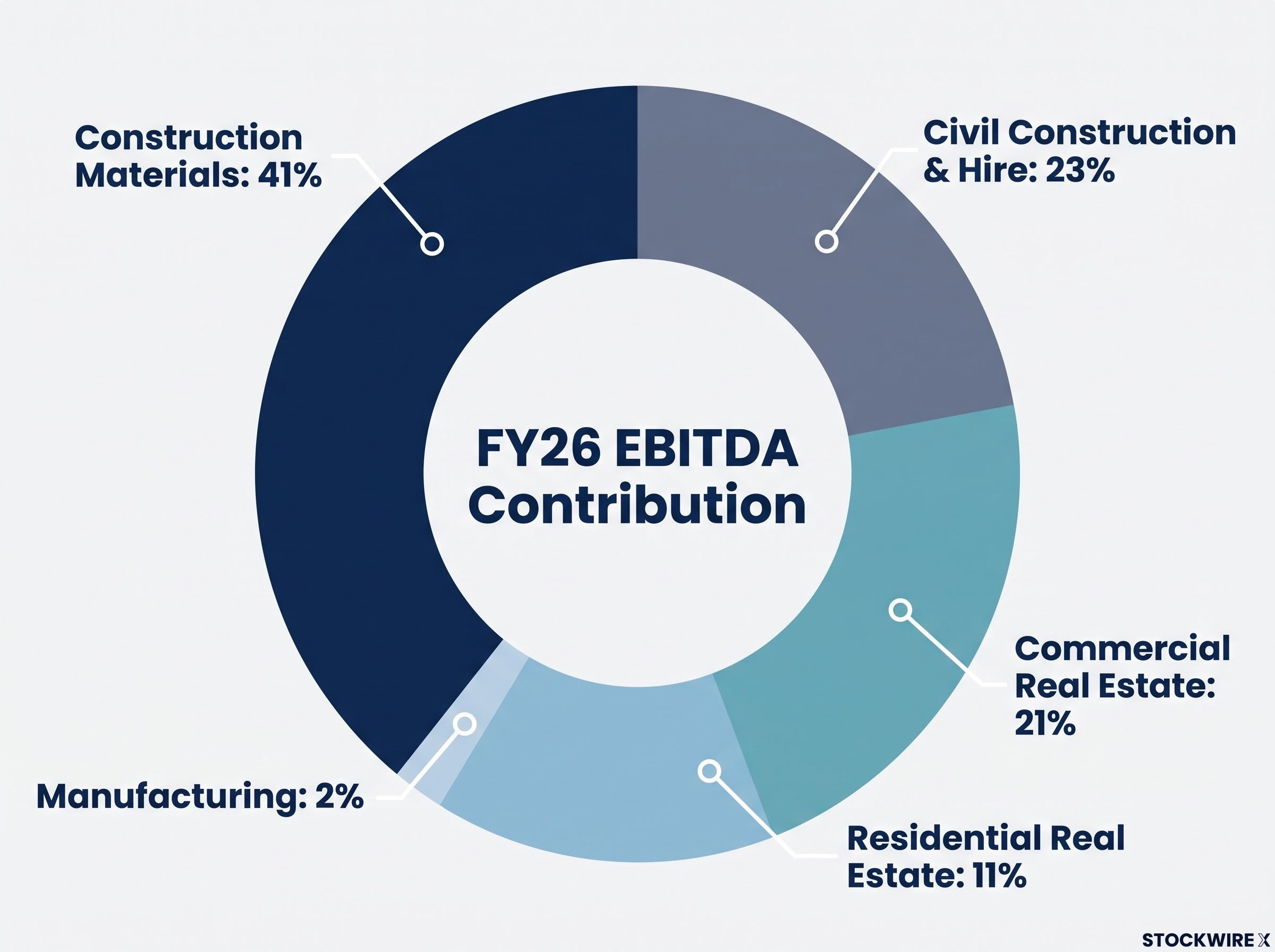
| Segment | FY26 EBITDA | Movement | EBITDA contribution |
|---|---|---|---|
| Construction Materials | $115.4m | 0% | 41% |
| Civil Construction & Hire | $65.1m | +64% | 23% |
| Commercial Real Estate | $59.4m | +20% | 21% |
| Residential Real Estate | $31.8m | +44% | 11% |
| Manufacturing | $6.4m | — | 2% |
Civil Construction & Hire was the standout, with EBITDA up 64%, driven by a strong contribution from Electrical and increased plant utilisation. Residential Real Estate settled 264 lots (FY25: 201), with a strong FY27 carry-in of 200 lots already secured.
Construction Materials EBITDA was flat, with margins compressed by fuel cost inflation and softer quarry and concrete demand. Management regards these pressures as short term.
Balance sheet strength and capital allocation
The presentation detailed a balance sheet positioned for redeployment. The leverage ratio ended the period at 2.6x (target 2–3x), interest cover was 5.6x, and liquidity stood at $479.0m at 30 June 2026.
Since February 2026, $55.1m has been allocated to share buybacks at a discount to the group’s intrinsic value. MGH intends to seek shareholder approval to expand the on-market share buyback program to 20% of issued capital over a 12-month period. No final dividend was declared, in line with the enhanced framework.
Management outlined the priorities of its new capital management framework:
-
Organic growth investments (capex above the hurdle rate)
-
Strategic acquisitions into industries with macro tailwinds
-
Share buybacks (below intrinsic value)
-
Debt reduction
-
Recycle capital once value is maximised
The framework signals a disciplined, ROCE-led approach to redeploying the HMA proceeds.
FY27 outlook and what comes next
Management indicated an expectation of strong revenue and profit growth to continuing operations in FY27, framed as an expectation rather than a guarantee. Several disclosed drivers underpin this outlook:
-
Record electrical work in hand of ~$1.2bn, with electrical manufacturing expected to become the dominant revenue and earnings driver of the segment.
-
Carry-in of 200 residential land lot settlements already secured.
-
$158.3m of property sales under contract at year end, expected to settle over the next 18 months, supporting the capital recycling outlook.
-
A strong balance sheet bolstered by the Construction Materials sale, supporting anticipated earnings-accretive capital redeployment in Q2 FY27.
The presentation also detailed MGH’s exposure to the Western Sydney Aerotropolis precinct. The company is to lend up to A$625m ($375m drawn at 30 June) to Bull Capital, funded back-to-back by a limited-recourse Metrics facility, providing a capital-light position in the precinct.
Management closed on a consistent message: a proven operating model aligned to powerful structural tailwinds, with FY26 marking the transition to its next phase of growth.
Don’t Miss the Next ASX Industrials Breakout
Big News Blast delivers FREE breaking ASX announcements straight to your inbox within minutes of release, complete with in-depth analysis already done for you. Join 20,000+ investors who stay ahead of the market the moment news breaks. Click the “Free Alerts” button at Big News Blast to start receiving alerts today.