
Pepper Money delivers 40% originations surge and 15% profit lift in 1H 2026
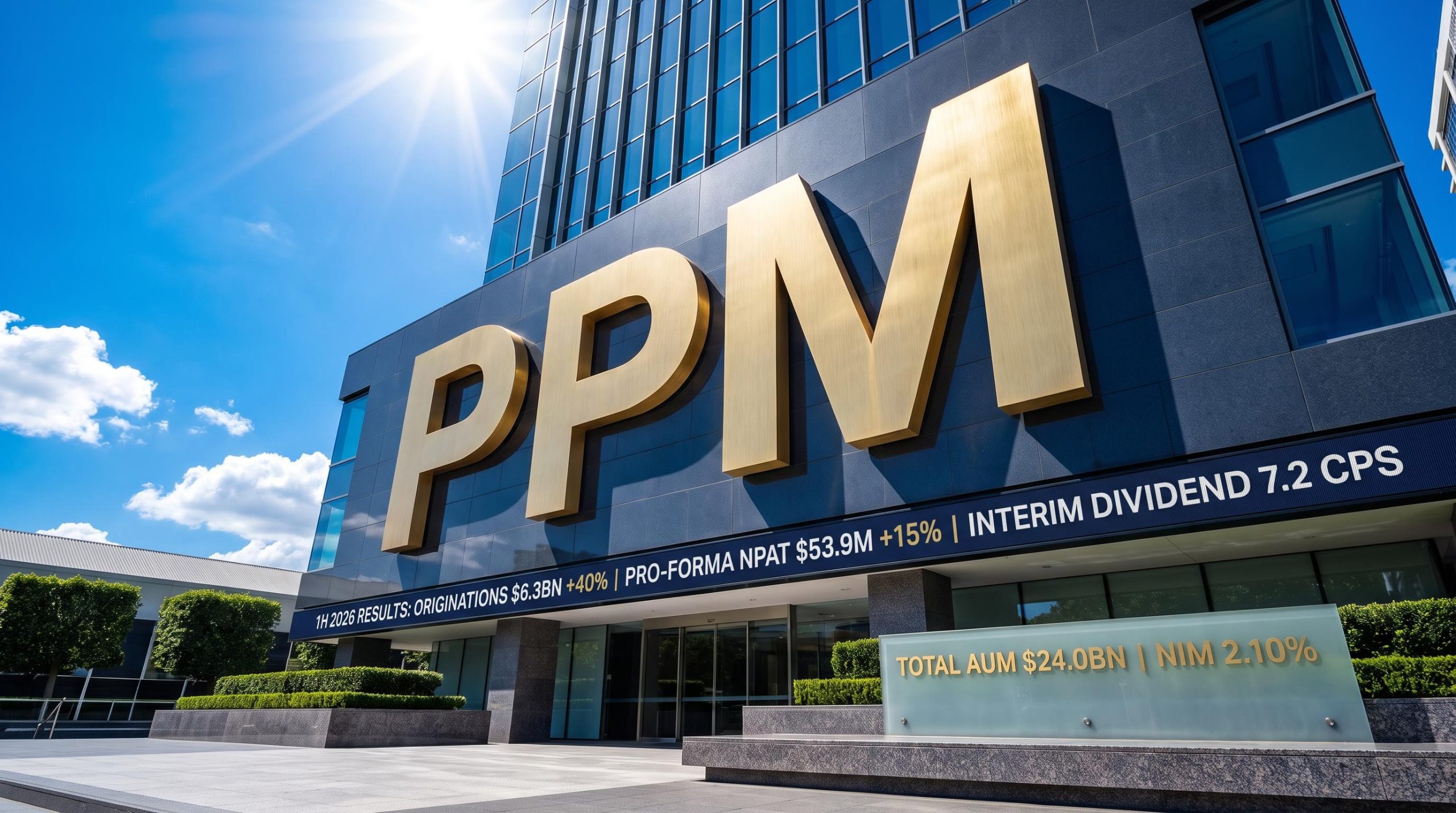
In its 2026 half year results presentation, released 20 August 2026, Pepper Money reported total originations of $6.3bn for the first half of 2026, up 40% versus the prior comparative period (PCP), alongside Pro-forma Net Profit After Tax (NPAT) of $53.9m, a 15% lift.
The results cover the period 1 January to 30 June 2026, with PCP referring to 1H 2025. The company declared a fully franked interim dividend of 7.2 cents per share (cps), up 12% on the 2025 interim.
Management framed the outcome around a diversified lending model paired with a capital-light servicing engine, driving growth well above system across both core segments.
| Metric | 1H 2026 | vs PCP |
|---|---|---|
| Total Originations | $6.3bn | +40% |
| Pro-forma NPAT | $53.9m | +15% |
| Profit pre-Tax & Loan Loss Expense | $127.8m | +17% |
| Total AUM | $24.0bn | +20% |
| Total NIM | 2.10% | +12bps |
| Cost to Income | 49.4% | improved 2% |
| Interim Dividend | 7.2cps | +12% |
When big ASX news breaks, our subscribers know first
Mortgages lead the charge as originations climb 63%
Mortgages was the standout growth engine in the half. The company reported mortgage originations of $4.5bn, up 63% on PCP, with Prime lending the primary driver at +83%. Mortgage Assets Under Management (AUM) reached $12.5bn (+32% PCP), while Mortgage Net Interest Margin (NIM) expanded to 1.64% (+13bps).
The origination and channel split for the half was as follows:
-
Prime $3.6bn, Near Prime $0.9bn, Specialist $0.1bn
-
Retail +79%, White Label +55%, Direct +50%
Asset Finance took a more measured path. Originations held at $1.7bn (+2% PCP) with AUM of $6.0bn (-4%) and NIM of 2.87% (+14bps), reflecting a disciplined, Tier-A weighted stance. The combined picture points to growth being won at improving margins rather than through discounting.
Above-system growth: 7x in mortgages, 9x in asset finance
The presentation detailed how Pepper’s growth compared against broader market, or “system”, growth. In mortgages, the company grew AUM at approximately 7x system, while Asset Finance expanded at around 9x system.
That gap widened even as overall market demand softened. Total Australian mortgage enquiries in-market fell 20% versus the three months to July 2025. Over the same period, Pepper Money enquiries rose 42%, which management flagged as evidence of share gains in a cooling market.
The contrast suggests counter-cyclical demand supported by the group’s brand and distribution reach, a point management returned to in its outlook messaging.
Understanding Pepper’s capital-light servicing engine
A growing part of the business is Loan & Other Servicing. This involves managing and administering loan portfolios, including through Whole Loan Sale arrangements and third-party portfolios, in exchange for a fee, without Pepper holding the underlying credit risk.
Why it matters to investors
Servicing is capital-light and carries no credit losses. It is accretive to the Cost to Income (CTI) ratio and generates annuity-style earnings that can hold up across the credit cycle, adding a defensive layer to the group’s income.
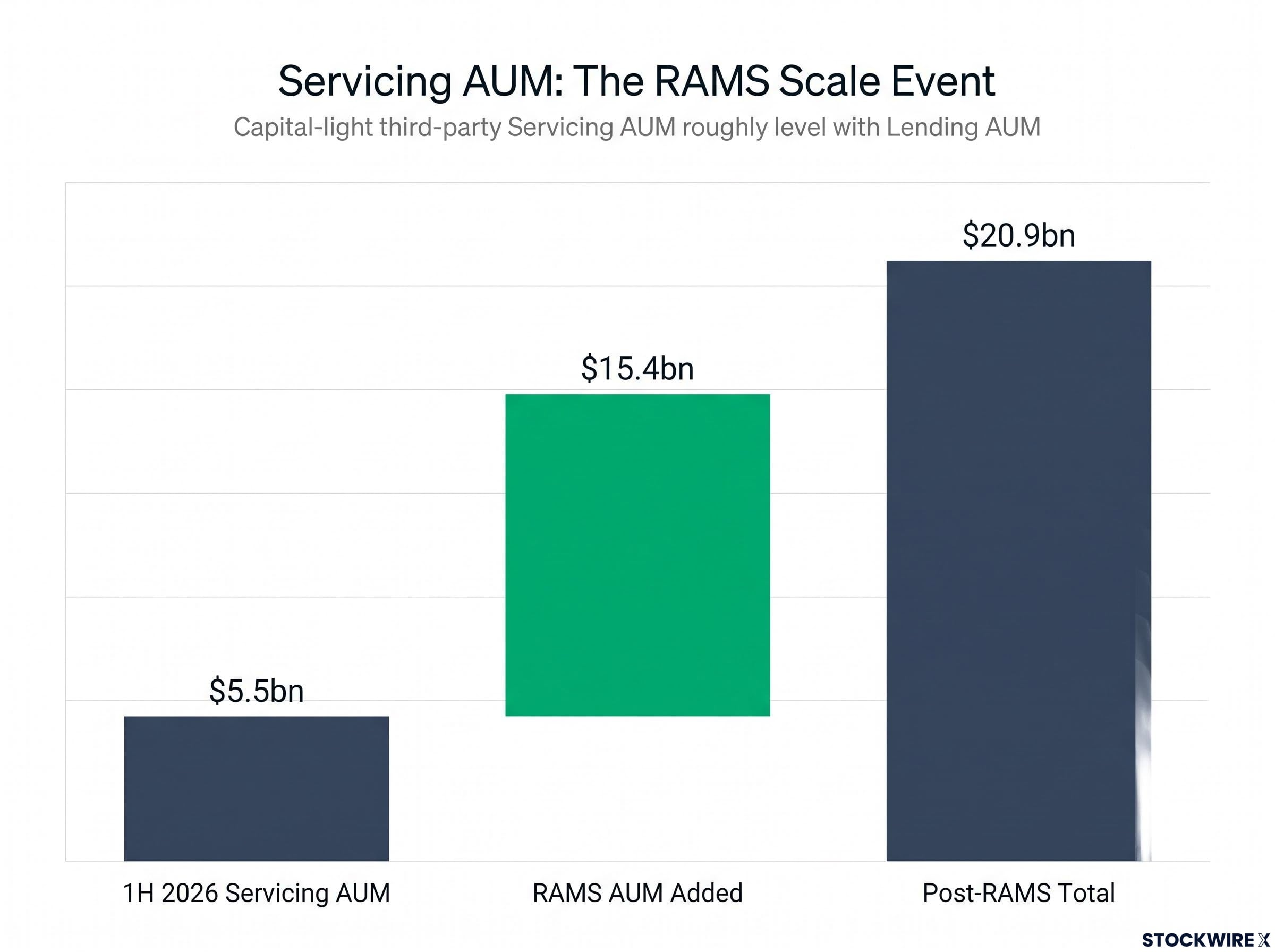
The numbers underline the momentum. Servicing AUM reached $5.5bn (+26% PCP), with servicing operating income of $10.9m (+30% PCP), representing roughly a 55% compound annual growth rate (CAGR) since June 2024.
RAMS transition adds scale to the servicing platform
Management highlighted the RAMS transition as a major scale event for the servicing platform, completed on 1 August 2026, after the reporting period. The transition saw 44,778 accounts transitioned and 41 FTE join the business, bringing across RAMS AUM of $15.4bn.
That takes Post-RAMS Total Servicing AUM to $20.9bn. On this basis, capital-light third-party Servicing AUM now sits roughly level with Lending AUM, which the company presented as a genuine diversification milestone.
The RAMS book is funded through the Cashmere Funding Trust 2026-1, a $15.4bn fund that settled 31 July 2026, funded by a consortium with members including Pepper Money and KKR.
The RAMS portfolio deal completed on 1 August 2026, with the $15.4 billion residential mortgage book acquired by a consortium including KKR-managed credit funds and PIMCO-managed funds, positioning Pepper Money as servicer without carrying the underlying credit risk on its own balance sheet.
Margins expand while costs stay disciplined
Total NIM rose to 2.10% (+12bps PCP), driven primarily by improved funding margins as swap rates and BBSW stabilised. The Cost to Income ratio came in at 49.4%, or 48.0% excluding $3.5m of non-recurring transaction costs. Total Operating Income reached $204.0m (+10% PCP).
Notably, Pro-forma expenses increased 7% versus PCP alongside the sharp lift in volumes, while mortgage originations per settlement FTE rose 37% over the half, reflecting scale and technology efficiency gains.
Mario Rehayem, Chief Executive Officer
Management’s outlook centred on the company’s ability to manage through all cycles, with a diversified model and disciplined approach to growth continuing to deliver for shareholders.
Credit quality holds firm as provisions build for growth
Credit metrics remained steady across the portfolio. The Total Coverage Ratio held at 0.79%, flat on PCP. Mortgage 90+ day arrears (excluding Whole Loan Sale) improved to 1.66% from 1.89%, while Asset Finance arrears were broadly steady at 0.30%.
Total provisions rose to $147.2m, with collective provisions increasing due to revised macro-economic assumptions and AUM growth across the period. The company framed this as conservative positioning rather than a sign of deterioration.
Consistent with that stance, the downside weighting in its macro-economic scenarios increased, with a base case of 60% and downside case of 35% at June 2026.
Capital position, dividend and funding strength
Shareholder returns stepped up over the half. Key dividend and yield figures were:
-
Interim dividend of 7.2 cps, fully franked, at a payout ratio of 60.0%
-
Cash returned to shareholders of $32.3m, up 14%
-
Annualised yield of 9.5%, up from 7.1% at the 2025 interim
-
Record date of 9 September 2026, with payment on 8 October 2026
On funding, the company reported $15.1bn in warehouse capacity across 25 funders, up 13% versus December 2025. A new $275.0m Corporate Debt Facility was completed in July 2026, with $120.0m drawn, while a $50.0m Medium-Term Note was retired. Closing cash at 30 June 2026 stood at $79.4m.
Outlook: diversified model built for an uncertain macro
Management’s outlook centred on a model built to navigate a mixed macro backdrop. The presentation pointed to a strong new product pipeline, including extended Mortgage products and Guaranteed Future Value in Asset Finance launched over June and July, alongside approximately $2.5bn in post-June public securitisations, a growing distribution footprint, and AI and technology supporting scale.
On the macro picture, management identified inflation as the key risk, with interest rates expected to stay “higher for longer” and the labour market gradually softening. Against this, Pepper positioned itself counter-cyclically.
The closing thesis tied the results together: a capital-light servicing platform now scaled to match lending, above-system growth across both segments, expanding margins and a lifting dividend, underpinning the company’s stated ability to manage through all cycles.
Investors wanting to understand the full corporate backdrop to these results can find our full explainer on the Challenger takeover bid timeline, which covers the progression from Challenger’s original $2.60 per share proposal through the 13.5% cut to $2.25 and the board’s ultimate rejection on execution grounds.
Stay Ahead on ASX Finance and Fintech News
Get FREE breaking ASX announcements delivered to your inbox within minutes, complete with in-depth analysis already done. Join 20,000+ subscribers who never miss a market-moving update across Finance, Fintech, and beyond. Click the “Free Alerts” button at StockWire X to start receiving real-time alerts the moment news breaks.