
Pioneer Credit delivers record FY2026 result with NPAT up 245%
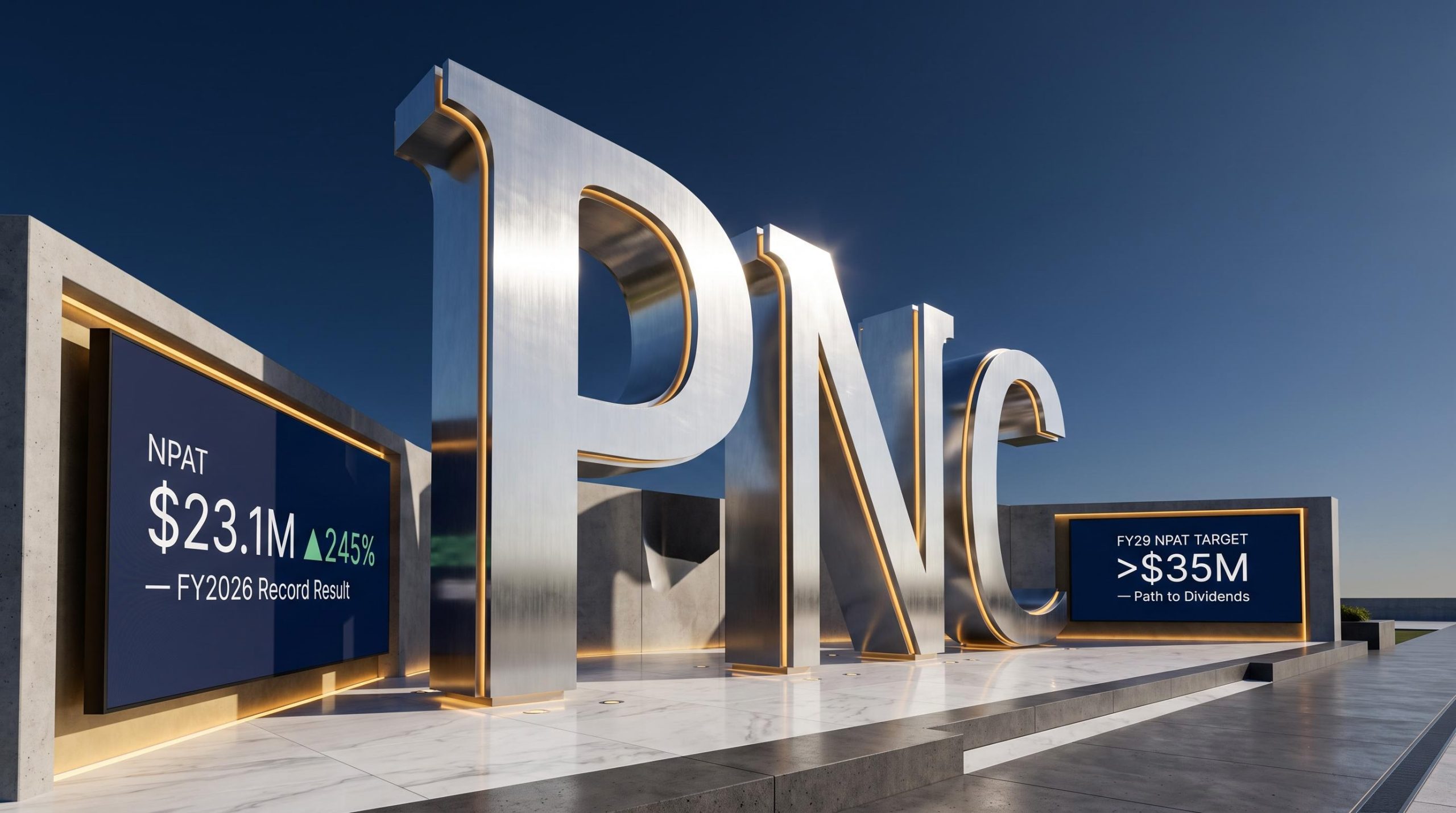
In its FY2026 results presentation delivered in August 2026 by Managing Director Keith John and Chief Financial Officer Barry Hartnett, Pioneer Credit detailed a record year, headlined by net profit after tax (NPAT) of $23.1m, up 245% on FY25.
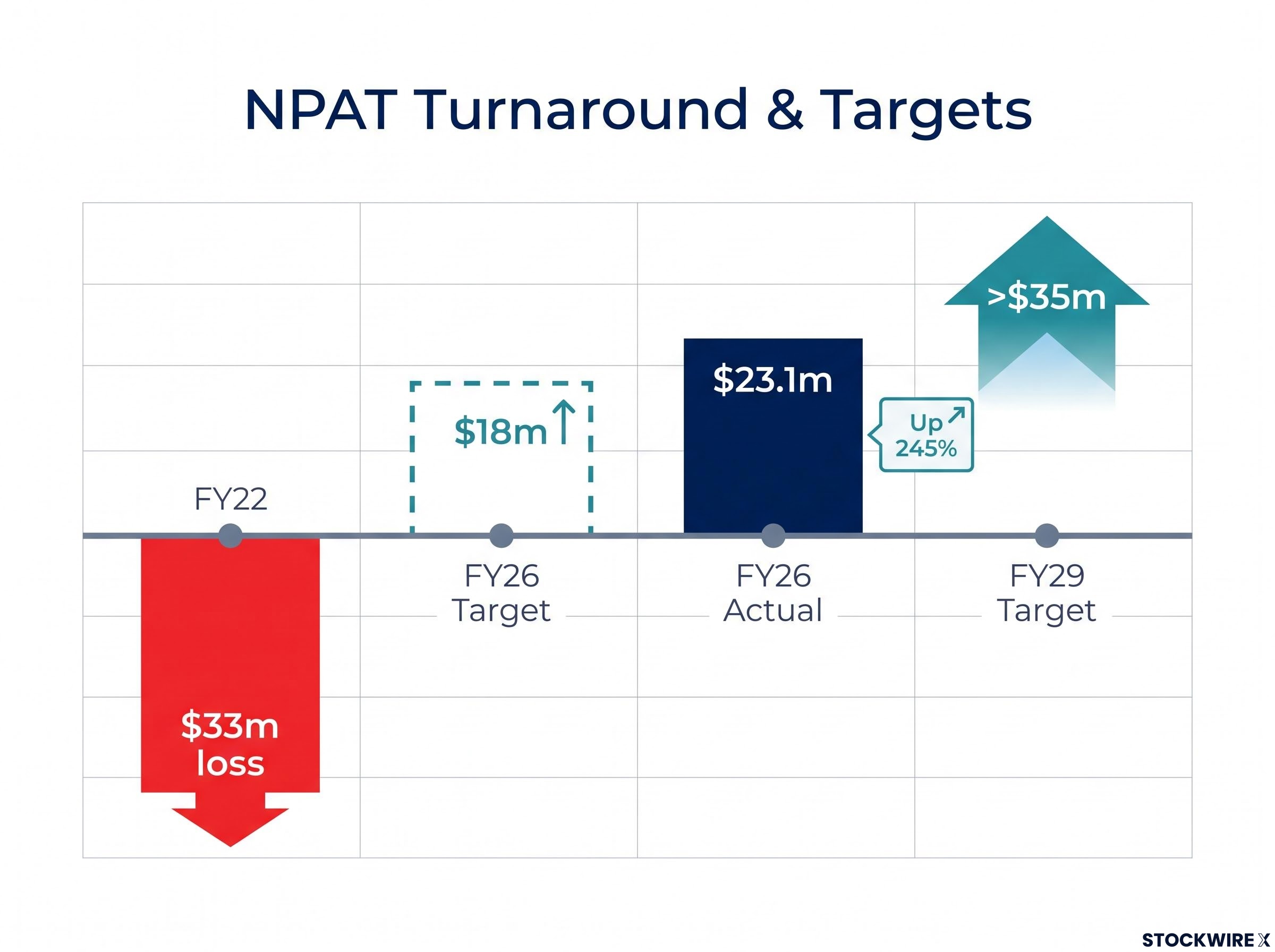
The company reported EBIT of $55.8m (▲35%), EBITDA of $105.9m (▲13%), and cash collections of $147.6m (▲4%). Management framed the year as the culmination of a multi-year turnaround, moving from a $33m loss in FY22 to record profitability.
When big ASX news breaks, our subscribers know first
FY2026 financial performance at a glance
The presentation opened with a headline scorecard summarising the group’s progress across the completed reporting period.
| Metric | FY25 | FY26 | Change |
|---|---|---|---|
| Cash Collections | $142.2m | $147.6m | ▲ 4% |
| EBITDA | $94.0m | $105.9m | ▲ 13% |
| EBIT | $41.3m | $55.8m | ▲ 35% |
| NPAT | $6.7m | $23.1m | ▲ 245% |
| Net Assets | $60.6m | $83.7m | ▲ 38% |
What drove the profit surge
Management attributed the earnings step-up to several income-statement drivers outlined in the presentation:
- Interest income rose 16% to $102.5m on a growing asset base
- Employee costs declined to $31.7m (from $33.0m) despite growth in managed assets, reflecting operating leverage
- Senior Facility and Medium Term Note (MTN) refinancing delivered a $7.7m benefit, cutting finance expenses to $26.9m (from $38.3m)
- NPAT met upgraded guidance
The MTN repricing completed earlier in FY26 locked in 315 basis points of margin reduction across the $55.5m Medium Term Notes facility, converting a structural funding cost into a direct bottom-line tailwind that flowed through to the full-year result.
The presentation positioned the growth as structural, driven by cost discipline and cheaper funding rather than one-off items.
What is a Purchased Debt Portfolio?
Pioneer’s business centres on acquiring Purchased Debt Portfolios (‘PDPs’), which are books of overdue consumer accounts bought primarily from major banks and financial institutions. The company then services those accounts, working with customers to recover the debt over time.
Key context points from the presentation include:
- A top-two player in the Australian market, buying mainly from major banks and non-bank financial institutions (NBFIs)
- Since 2008, invested ~$900m across ~947,000 customer accounts
- An active portfolio of ~234,000 customers with ~$1.9b outstanding, of which ~$406m sits under ~36,000 sustainable payment arrangements
Management emphasised a compliance-led, customer-centric servicing model, supported by a high net promoter score (NPS), which the presentation described as a barrier to entry. Because PDP investment made today drives collections and earnings in later periods, the record FY26 investment is relevant to future profitability.
Record PDP investment fuels the growth engine
The presentation detailed PDP investment of $105.1m (▲52%), a record, lifting PDP assets to $400.4m (▲17%). Estimated Remaining Collections (ERC) grew 14% to $796.8m.
Operating cash flow rose 35% to $70.8m, with the company ending the period with closing cash of $7.9m. Management explained that the accelerated investment aimed to capture favourable supply tailwinds as market competition eases and Pioneer remains a preferred partner for existing relationships.
For investors exploring the capital raise alongside the FY26 result, our detailed coverage of the $17m institutional placement walks through the pricing, the oversubscription dynamics, and how proceeds are earmarked to accelerate PDP investment heading into FY27.
A strengthening balance sheet
The presentation outlined a deleveraging trajectory alongside profit growth:
- Net assets grew 38% to $83.7m
- Group loan-to-value ratio (LVR) improved to 84% (Mar-26), and to 77% post-raise
- Interest Cover Ratio of 4.1x
Management noted that deleveraging, combined with stronger interest cover, expands funding capacity for further PDP investment.
The Pioneer advantage and shareholder alignment
The presentation set out the company’s competitive position through several moat characteristics:
- High-quality bank and NBFI origination, with no exposure to payday loans or SACC (Small Amount Credit Contracts)
- 17 years of proprietary performance data
- Regulatory trust and a strong compliance record
- $50m of available debt funding
- Aligned management with significant personal shareholdings
On alignment, the presentation disclosed that Keith John Entities hold 20.9m shares (10.9%), with Board and Management holding a subtotal of 28.1m shares (14.7%). Samuel Terry Asset Management holds 18.4%.
Management highlighted that incentives are structured only over the long term, via a minimum three-year earnout. Prior incentives, set in 2022, were based solely on NPAT above $18m, a target the company has now delivered.
Management commentary (paraphrased from presentation)
Management, led by Managing Director Keith John, framed the FY2026 result as delivery on a multi-year commitment, having moved the company from a $33m loss in FY22 to record profitability, with incentives aligned entirely to that outcome.
Outlook: a path to dividends and a FY29 NPAT target above $35m
Management outlined a forward roadmap anchored on continued disciplined investment and a return to profitability milestones.
Key guidance points from the presentation include:
- FY27 PDP investment of $100m–$110m ($77m projected under forward flow)
- FY27 cash collections of $170m–$180m, underwritten by the $406m payment arrangements portfolio
- FY27 expected to deliver material earnings growth
- A path set for return to dividends on achievement of FY27 results
- A FY29 NPAT target of >$35m
- An ambition to grow into Australia’s #1 PDP buyer, which the presentation forecast to be fully funded
The presentation noted a new balanced-scorecard incentive, spanning compliance outcomes, cash collections, return on investment, and strategy delivery, tying management to the FY29 target.
Management reinforced its track record: an ambitious FY26 NPAT target of $18m was set, $23.1m was delivered, and the company is now targeting more than $35m by FY29.
Stay Ahead on ASX Finance and Fintech News
Get FREE breaking ASX finance and fintech alerts delivered to your inbox within minutes of release, complete with in-depth analysis. Over 20,000 subscribers already rely on Big News Blast to stay ahead of the market. Click the “Free Alerts” button to start receiving alerts the moment market-moving news breaks.