A Reuters poll of 64 economists, conducted 13-18 August 2026, finds close to nine in ten expecting the Bank of England to keep its benchmark rate at 3.75% through the end of 2026. The survey results leave virtually no room for a move at September’s meeting, with every respondent in agreement that the MPC will stand pat. That is about as close to certainty as a Bank of England interest rate forecast ever gets.
The weekly calendar brings Wednesday’s July UK inflation reading into focus, with forecasters projecting that headline CPI will tick up to 2.9% while core measures continue their gradual descent. That combination, rising headline driven by energy costs rather than broad underlying pressure, is precisely the environment in which the Monetary Policy Committee (MPC) has chosen patience over action.
Here is what the consensus actually tells you, and what it leaves unresolved: the logic behind the hold, the inflation data that will test it this week, and what an extended pause through 2026 and into a potential 2027 easing cycle means for gilts, sterling, and rate-sensitive UK equities. By the end, you will know which variables to watch, not just what economists currently think.
How quickly the hold consensus has hardened
The 90% figure did not appear from nowhere. It is the sharpest point on a trend line that has been steepening all year.
In earlier 2026 polls, the picture was more divided. A notable minority of respondents were still pencilling in at least one hike or cut. The previous month’s survey showed around 83% of respondents expecting Bank Rate to remain at 3.75% until December. The latest poll puts that figure at 56 of 64 economists, or approximately 90%.
The acceleration from 83% to 90% in a single monthly cycle tells you that fresh data is closing off alternative scenarios faster than many expected. And the near-term signal is even stronger.
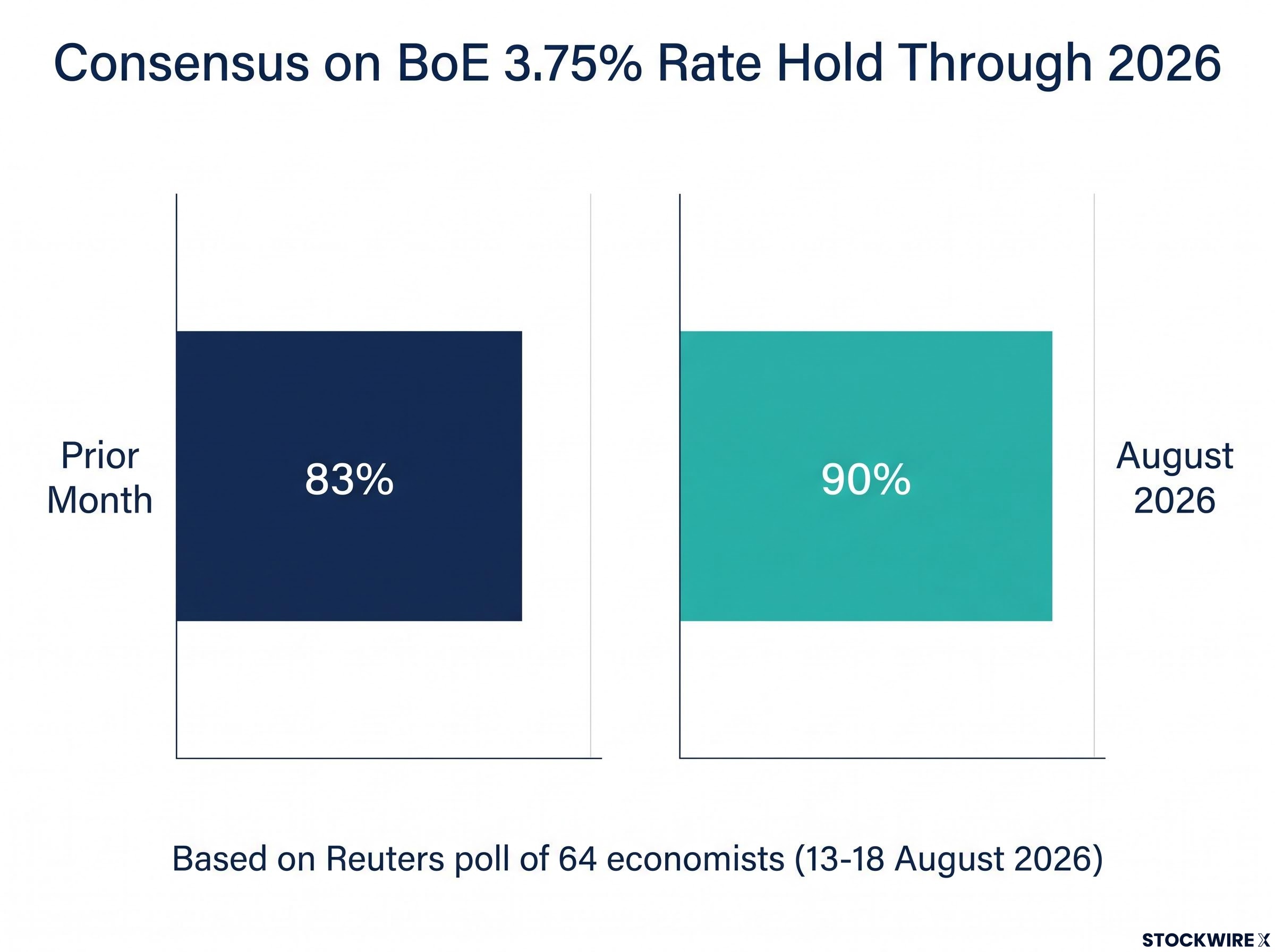
- Prior month consensus: Approximately 83% projected a hold through end-2026
- August 2026 consensus: 56 of 64 respondents (approximately 90%) project a hold through end-2026
All 64 economists polled expect no change at the September MPC meeting.
That unanimity makes September about as certain as an MPC outcome ever gets. The question for anyone pricing UK rate-sensitive decisions, from mortgage timing to gilt positioning, shifts from “will they hold?” to “how long will the hold last?”
When big ASX news breaks, our subscribers know first
What is keeping the BoE on hold despite above-target inflation
The hold is not inertia. It is a calibrated choice, and the logic matters because it tells you what would have to change before the MPC moves in either direction.
On one side of the ledger, CPI remains above the 2% target. On the other, the UK economy is subdued, and premature tightening into a fragile expansion carries its own risks. The MPC is threading a gap between inflation that is still too high on paper and growth that is too weak to absorb a further squeeze.
The result is deliberate patience: neither a hike nor a cut is clearly justified by the data, so the Committee is choosing stability over action. That posture only shifts if the balance of risks changes materially.
The inflation breakdown the MPC is watching
The distinction between headline and core inflation is doing the real work here. Headline CPI is being pushed higher by the Ofgem energy price cap reset, a mechanical uplift rather than evidence of broad demand pressure. Core CPI, which strips out volatile energy and food prices, is actually edging lower.
- Headline CPI trajectory: Rising, driven by energy price cap effects and base effects
- Core CPI trajectory: Easing modestly, suggesting underlying price pressures are not re-accelerating
That divergence matters. The BoE is not responding to a wage-price spiral or demand overheating, which would warrant a very different policy response. It is watching energy-driven noise sit on top of a gradually cooling core. The geopolitical wildcard: Iran-related developments and elevated oil prices remain the primary upside risk to inflation that could shift the MPC’s calculus.
Indirect energy transmission through logistics, agriculture, and manufacturing supply chains operates on a 6-12 month lag, meaning the second-round effects of sustained elevated oil prices have not yet fully appeared in core CPI data and represent the inflation channel most capable of closing the headline-versus-core divergence the MPC is currently relying on.
The UK inflation picture this week and what it changes
Wednesday’s July CPI release is the first live test of whether the consensus narrative holds. The numbers are expected to confirm the divergence pattern the MPC is banking on, but confirmation is not guaranteed.
The forecast: headline CPI is expected to reach 2.9% year-on-year, rising from 2.6% in June, with the Ofgem energy price cap reset (the regulator’s quarterly adjustment to the maximum price suppliers can charge households for gas and electricity) identified as the principal driver. Core CPI, by contrast, is anticipated to slip to 2.5% from its prior reading of 2.6%.
The July CPI breakdown confirms what the MPC has been signalling for months: a 13% energy price cap increase is mechanically lifting the headline figure while core and services measures continue their gradual descent, a pattern the committee explicitly cited when voting 6-3 to hold at 3.75%.
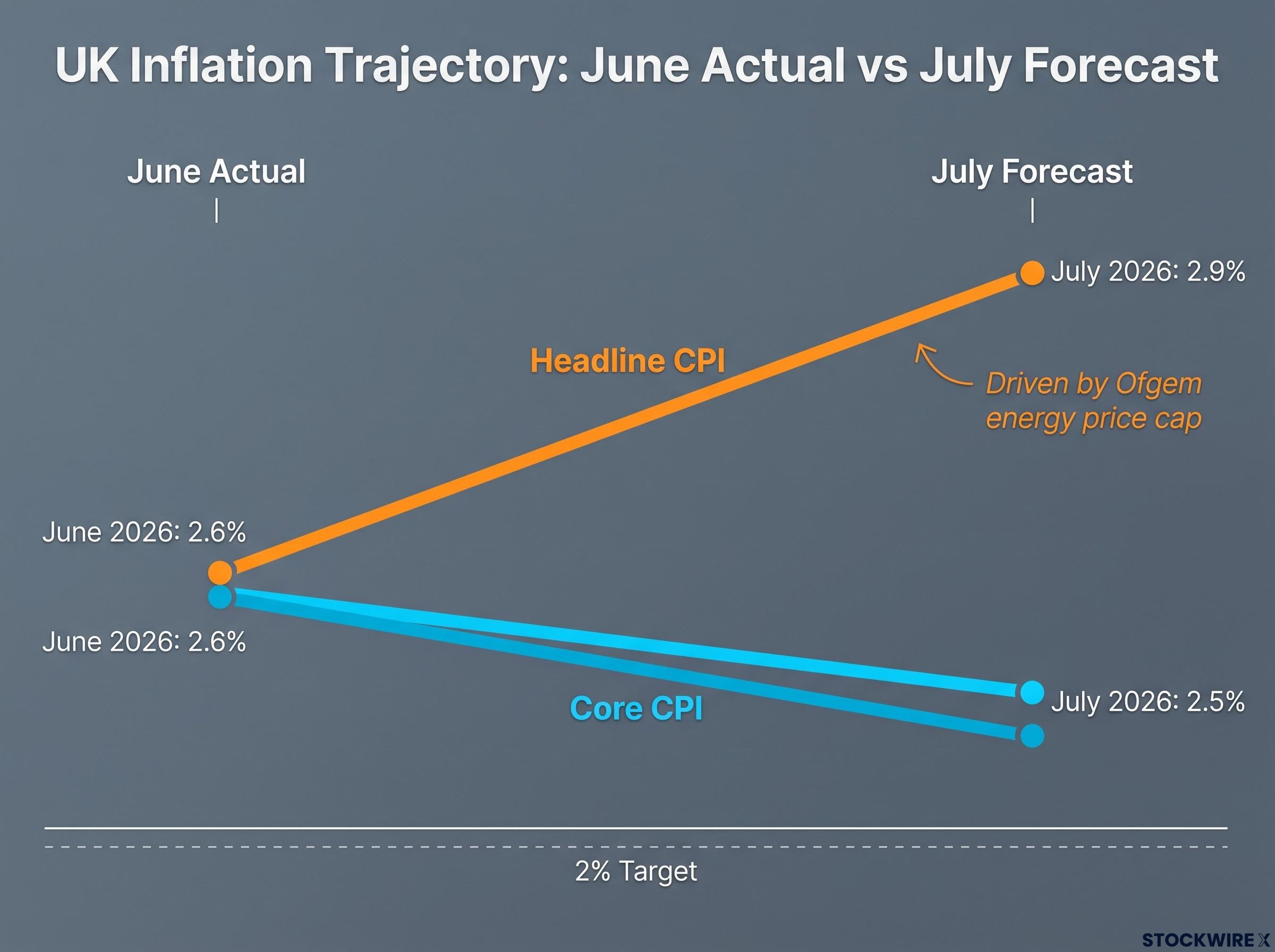
| Metric | June 2026 Actual | July 2026 Forecast |
|---|---|---|
| Headline CPI (y/y) | 2.6% | 2.9% |
| Core CPI (y/y) | 2.6% | 2.5% |
If the data lands in line with forecasts, the divergence between rising headline and easing core actually reinforces the BoE’s patience narrative rather than threatening it. Inflation is expected to remain above the 2% target through the rest of 2026 under most scenarios.
A headline rise driven by energy alone is unlikely to alter the MPC’s calculus. Core is the number that matters.
The interpretive framework for Wednesday is straightforward: a headline beat driven by energy is priced in. A core CPI surprise to the upside would be a different signal entirely, and the one worth watching closely.
When relief could arrive, and what the path to 2027 looks like
The holding pattern has an expiry date, but it is further out than many borrowers and investors hoped at the start of the year.
The mainstream scenario among economists and market participants places the first meaningful rate cut in 2027, not 2026. A Bank of England survey of market participants published in February 2026 showed Bank Rate expected to fall toward approximately 3.0% by the March 2027 meeting. The Reuters poll found that more than half of respondents expect at least one rate reduction to arrive by mid-2027.
That timeline, though, comes with honest uncertainty. “Mid-2027” is an interpretive central scenario drawn from poll distributions, not a BoE commitment. The timing remains contingent on incoming data, and the dispersion across forecasters is meaningful.
Economists generally identify three prerequisites before a cut becomes viable:
- Inflation on a sustained path toward the 2% target
- Core CPI comfortably below current levels
- No fresh energy or geopolitical shock
The timing of any cut remains contingent on incoming data. The 2027 scenario is a central case, not a commitment.
For borrowers, the message is clear: do not plan around a 2026 cut. For investors, the gap between where rates are now and where markets expect them to be by early 2027 tells you how much runway remains before monetary conditions become genuinely accommodative, and that runway is longer than many had expected.
What the extended hold means for gilts, sterling, and rate-sensitive shares
A prolonged hold at 3.75% does not land the same way across every asset class. Each market segment is reading a different part of the same story.
Short-dated gilts benefit from a stable, relatively high Bank Rate that supports nominal yields. But persistent above-target inflation compresses real yields (the return after accounting for inflation) across the curve. Shorter-duration paper looks attractive in nominal terms; the real return is less compelling.
Rate-sensitive equities, particularly housebuilders and consumer discretionary names, remain the most exposed to the delayed easing timeline. The tailwind these sectors need is not absent; it is contingent on the 2027 easing cycle materialising as currently priced. In the interim, balance sheet strength and low refinancing needs are the key differentiators separating companies that can absorb the wait from those that cannot.
UK equity valuations carry a structural 30-35% P/E discount relative to US markets that predates the current rate cycle, meaning the sector-level pressure from a prolonged hold compounds an already-existing drag rooted in weak domestic ownership, poor sector composition, and an IPO market that recorded just 18 listings in 2024.
| Asset Class | Near-Term Implication of Hold | Risk to Watch |
|---|---|---|
| Short-dated gilts | Nominal yield support at current Bank Rate | Real yields compressed by above-target inflation |
| Sterling | Carry support from rate differential vs peers | Forward erosion as 2027 easing is priced in |
| Housebuilders / Consumer Discretionary | Rate tailwind delayed, not absent | Balance sheet strain if hold extends beyond current expectations |
Sterling’s carry trade: support now, erosion later
Sterling currently benefits from a carry advantage: higher UK rates relative to peers attract capital flows that prop up the currency. But the more confident markets become in a 2027 cut, the more the future rate differential narrows. That erosion is already being partially priced in today, which means the carry support you see now is weaker than the headline rate gap suggests.
What to watch before the BoE’s next decision in September
The analytical framework from this piece converts into a short, specific monitoring list for the weeks ahead.
- Wednesday’s July CPI release (20 August 2026): The interpretive lens is already established. Watch core, not headline. A core print at or below 2.5% reinforces the hold narrative. A surprise above 2.6% reopens questions.
- September MPC vote split and policy statement language: All 64 economists surveyed expect a unanimous hold. The rate decision itself will not surprise. But the vote distribution and accompanying language will tell you whether the MPC is beginning to tilt toward an earlier or later first cut, and that signal is worth reading carefully.
- Energy market developments and Iran-related geopolitical risk: This remains the primary external variable capable of disrupting the hold consensus before year-end. A sustained escalation in oil prices beyond the current baseline would force the inflation calculus to shift.
The roughly 10% of economists who retain non-consensus views are a reminder that residual uncertainty persists, even when the majority signal is strong. The September meeting will not move rates, but it will move information.
What the consensus tells you, and what it does not
The 90% hold consensus is the strongest signal this dataset has produced all year. The September outcome is about as close to predetermined as BoE policy gets. For anyone making rate-sensitive decisions in the near term, one layer of uncertainty has been substantially removed.
What the consensus does not resolve is everything beyond that. The exact timing of the first cut, whether inflation returns to target before or after mid-2027, and the vulnerability of the entire framework to an energy or geopolitical shock all remain open questions. A 90% consensus is not a guarantee, and understanding the conditions under which the remaining 10% could be right leaves you better positioned than treating the poll as certainty.
Three developments could disrupt the current consensus:
- A core CPI surprise to the upside that signals re-acceleration in underlying prices
- A sustained energy price shock beyond the current Iran-related baseline
- An unexpected deterioration in UK growth conditions that forces the MPC’s hand in either direction
The value of the Reuters poll is not that it predicts the future. It maps the current distribution of informed opinion, and more usefully, the conditions under which that distribution shifts.
For investors wanting to understand how a central bank navigates a simultaneous growth slowdown and above-target inflation, our dedicated guide to the Fed’s parallel hold calculus examines how the FOMC is weighing war-linked oil shocks, tariff pass-through, and a labour market that has not yet cracked under sustained tightening.
This article is for informational purposes only and should not be considered financial advice. Investors should conduct their own research and consult with financial professionals before making investment decisions.
These statements are speculative and subject to change based on market developments and company performance. Past performance does not guarantee future results.