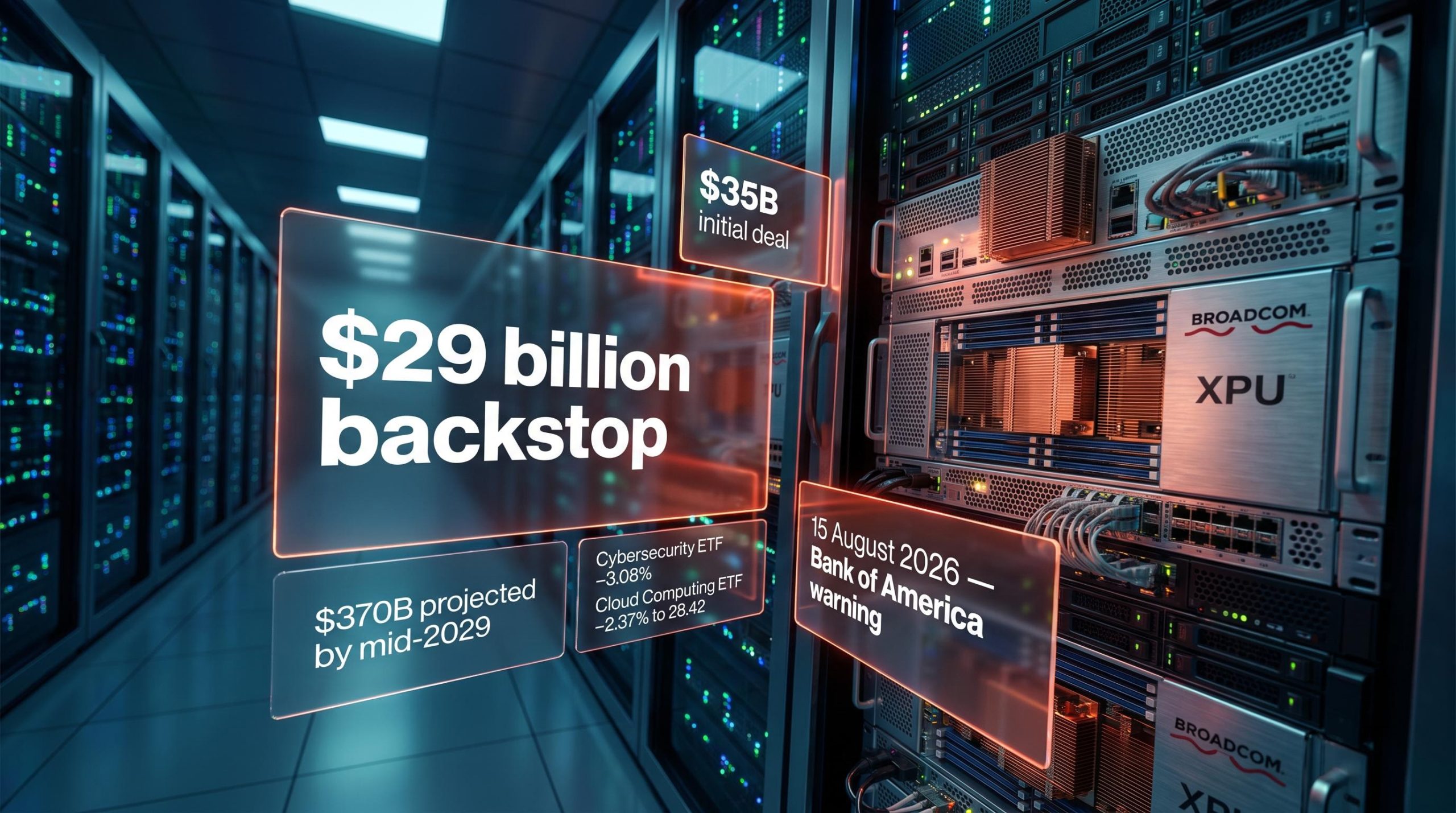
Broadcom carries a $29 billion backstop on a financing arrangement that does not appear as debt on its balance sheet. The obligation sits inside a special-purpose vehicle, a legally separate entity designed to fund AI compute hardware for frontier labs. Unless you read the footnotes, you would never know it was there.
That number surfaced formally on 15 August 2026, when Bank of America published a warning about the scale of Broadcom’s off-balance-sheet exposure through its AI XPV Platform. The reaction was immediate: AI, cloud, cybersecurity, and software names sold off in the same session, even though most of those companies had nothing to do with the financing structure in question. One company’s hidden leverage moved an entire sector’s pricing in a single afternoon.
Here is what the data tells you about your own exposure. This piece covers what off-balance-sheet financing actually is, how Broadcom’s deal is structured, why Bank of America’s stress modelling produced numbers large enough to rattle equity and credit markets, and, most importantly, what specific signals to watch for in your own AI and semiconductor holdings before the next warning arrives.
The warning that moved markets on 15 August 2026
Bank of America’s note landed during the 15 August 2026 session, and the damage spread fast. The Information Technology sector declined 0.42%. The iShares Expanded Tech-Software ETF, having climbed to a six-week high earlier in the day, gave back those gains and closed down 2.0%. The Cloud Computing ETF dropped 2.37% to 28.42. The Semiconductor ETF edged down 0.06% to 550.42.
The sharpest move belonged to the Cybersecurity ETF, which fell 3.08% to 43.09, a striking decline for a segment with no direct connection to Broadcom’s financing arrangements.
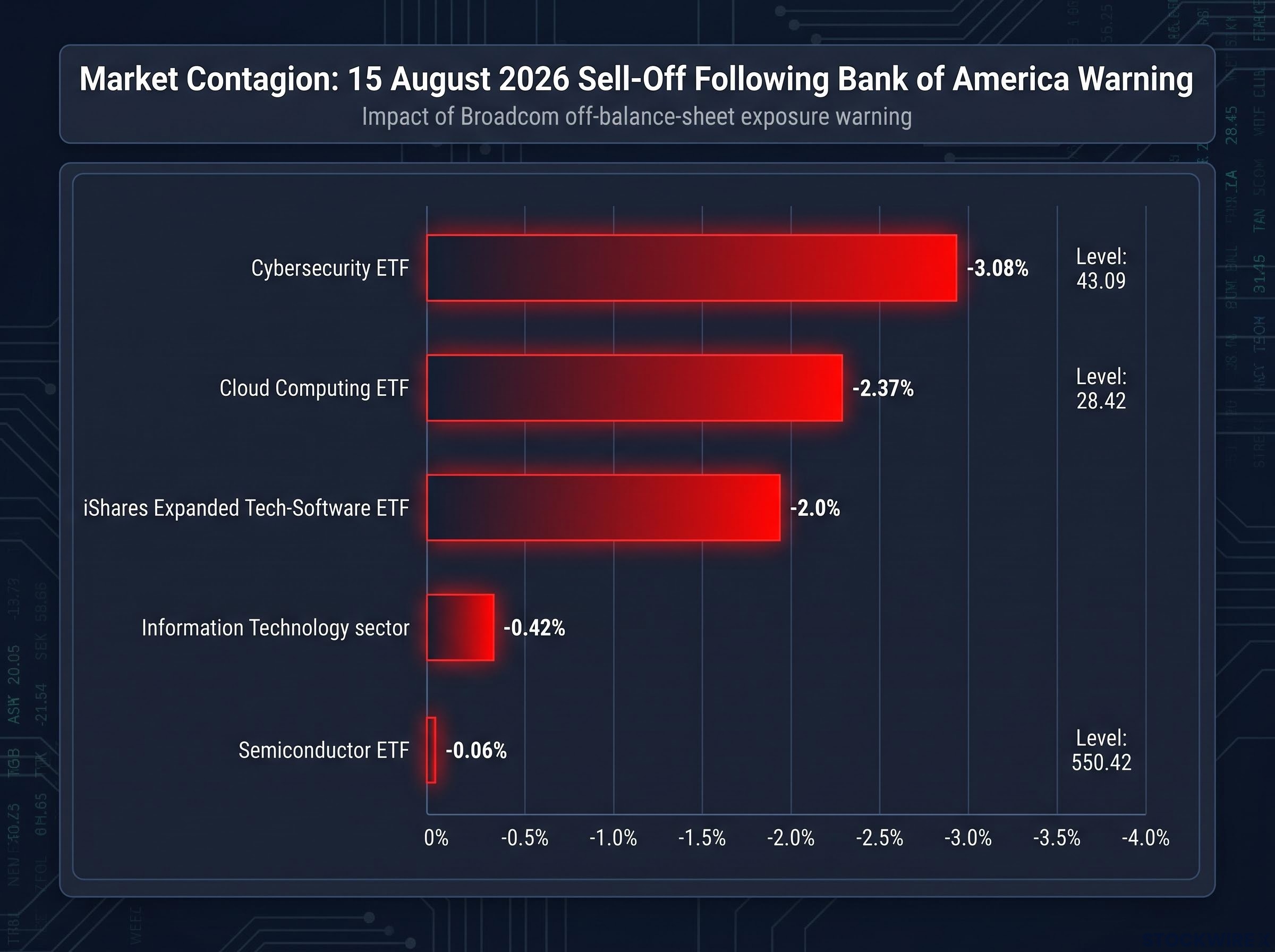
The Cybersecurity ETF’s 3.08% single-session decline illustrates how quickly a structural financing concern at one company can reprice holdings across an entire sector.
Workday shares also fell 3.7% on the same session, but that move had a separate catalyst: Reuters reported that private equity firm Silver Lake had entered talks to acquire the company. That decline was company-specific, not contagion from Broadcom’s warning.
| Asset / ETF | Move | Level |
|---|---|---|
| Information Technology sector | -0.42% | |
| iShares Expanded Tech-Software ETF | -2.0% | Six-week high prior |
| Cloud Computing ETF | -2.37% | 28.42 |
| Cybersecurity ETF | -3.08% | 43.09 |
| Semiconductor ETF | -0.06% | 550.42 |
The breadth of that selloff is the story. Markets are no longer treating AI-sector names as independent bets. When a structural financing concern surfaces at one node, correlated exposures across the sector move together, which means diversification within AI may be providing less protection than you assume.
The 15 August 2026 session is not the first time a structural concern has produced rapid AI sector repricing: the Philadelphia Semiconductor Index fell 10.26% in a single session on 5 June 2026, erasing more than $1 trillion in market capitalisation, after three simultaneous capital-market events forced investors to confront return-on-invested-capital discipline rather than total addressable market optimism.
When big ASX news breaks, our subscribers know first
What off-balance-sheet financing actually means
Start with what you already see when you look at a company’s financials. The balance sheet shows assets on one side and liabilities (including debt) on the other. If a company borrows $10 billion, that figure shows up in its reported debt, raises its debt-to-equity ratio, and is visible to anyone running a basic screening tool.
Off-balance-sheet financing works differently. The company creates or partners with a special-purpose vehicle (SPV), a legally separate entity that borrows the money, owns the assets, and sits outside the parent company’s consolidated financial statements. The debt belongs to the SPV, not the parent, so it does not appear in the parent’s headline debt figures.
Here is how a compute-financing SPV works in sequence:
- The SPV borrows capital from lenders and investors
- The SPV uses that capital to purchase hardware (in Broadcom’s case, AI chips and networking equipment)
- The SPV leases the hardware to an AI lab (in this case, Anthropic)
- Lease payments from the AI lab service the SPV’s debt obligations
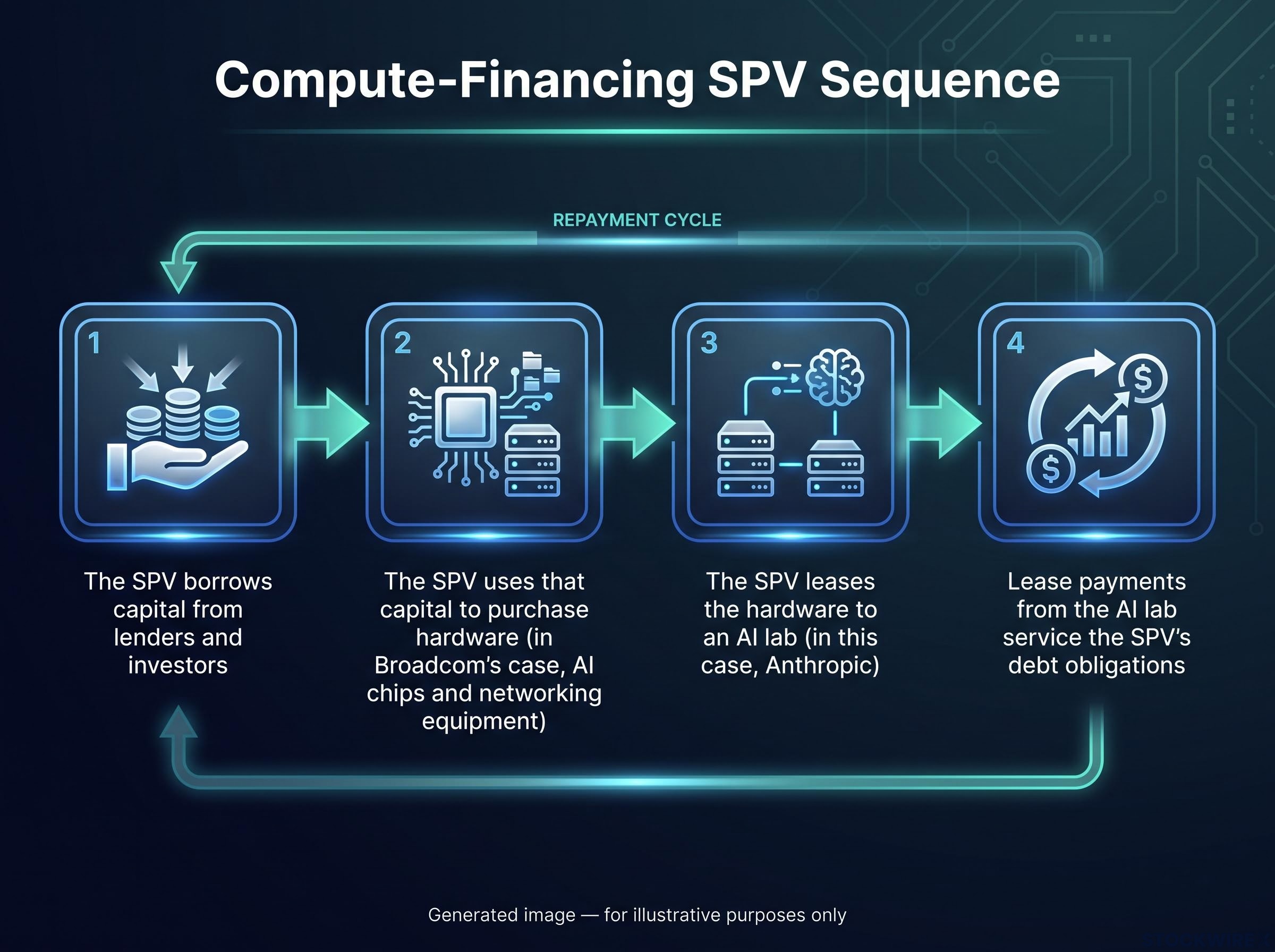
This structure is legal, disclosed (typically in footnotes), and widely used across real estate, aviation, and infrastructure finance. It is not a scandal. But it does create a visibility problem: a company’s reported debt-to-equity ratio can look clean while tens of billions in guarantee obligations sit in the footnotes, meaning standard ratio-screening of AI stocks may be giving you a false sense of safety.
The SEC off-balance-sheet disclosure rules require public companies to report maximum loss exposure on guarantee obligations and variable interest entity involvement in their filings, which is precisely the framework that makes Broadcom’s $29 billion backstop a disclosed item rather than a hidden one.
What a guarantee changes
The SPV borrows the money and owns the chips. But Broadcom has provided residual-value and deficiency guarantees on the senior debt. That means if the AI lab defaults on its lease payments and the chips cannot be resold for enough to repay the lenders, Broadcom must cover the shortfall.
This converts a footnote item into a potential multi-billion dollar cash obligation. The term analysts use is “synthetic leverage”: real economic risk without headline balance-sheet visibility. The guarantee does not raise Broadcom’s reported debt today. But it exposes Broadcom to losses that could, in a severe scenario, function exactly like debt coming due.
Inside the AI XPV Platform: how Broadcom structured the deal
Broadcom launched the AI XPV Platform on 9 June 2026 in partnership with Apollo Global Management and Blackstone. The platform funds Broadcom XPUs and networking hardware for Anthropic’s compute capacity, with the initial deal supporting approximately 1 gigawatt of compute and a stated scaling target of 20 GW globally by 2028.
The initial transaction is approximately $35 billion, one of the largest private-credit facilities ever assembled for a technology infrastructure project. That capital is structured in three tranches, each with a distinct risk profile and holder base.
| Tranche | Size | Approximate Rate | Primary Holders |
|---|---|---|---|
| Senior A1 | $6 billion | Treasury +100 bps | Banks |
| Senior A2 | $24 billion | 5.75% coupon | Institutional investors |
| Junior (first-loss) | $4.5 billion | 8.5% | Apollo, Blackstone |
Apollo and Blackstone anchor the junior, first-loss tranche, taking the highest risk in exchange for the highest yield. If the SPV’s assets lose value, their $4.5 billion absorbs the first losses.
The same private credit stress that is surfacing in BDC redemption gates and JPMorgan collateral markdowns across the $1.8-3 trillion private credit market sits structurally upstream from the Apollo and Blackstone tranches anchoring the XPV Platform’s junior layer, making conditions in that market a relevant leading indicator for how the senior guarantee structure would perform under a broad credit deterioration.
Here is the counterintuitive part. Broadcom’s guarantee exposure does not sit against that junior tranche. It sits against the senior tranches, approximately $30-31 billion of senior debt. Broadcom’s worst-case exposure is not where the private equity firms are sitting but in the larger, seemingly safer layers of the structure.
Broadcom’s maximum disclosed loss exposure on the initial $35 billion deal is approximately $29 billion.
That figure represents a scenario in which all customers default and the hardware recovers nothing on resale. It is not a base-case expectation. But it is a disclosed, real backstop obligation that Broadcom carries without it appearing as conventional debt on its balance sheet.
How big could this get, and what does Bank of America’s stress modelling show?
The initial $35 billion transaction is the starting point, not the ceiling. Bank of America projects that if the AI XPV Platform reaches its full 20 GW scaling target, the associated senior debt could reach approximately $370 billion by mid-2029, with approximately $150 billion of new issuance in 2027 alone.
Projected total senior debt at full scale: approximately $370 billion by mid-2029.
That is a tenfold increase from the initial deal, and it transforms the platform from a large financing arrangement into a systemically significant vehicle within the AI ecosystem, tied to a single platform and a relatively small number of counterparties.
BofA modelled two scenarios for Broadcom’s own loss exposure via guarantees at full scale:
- Moderate scenario (25% customer default rate): approximately $10.5 billion in losses for Broadcom
- Extreme scenario (100% customer default, very poor chip recovery): approximately $42 billion in losses
What the stress scenarios mean in context
Broadcom’s projected 2027 free cash flow is approximately $85 billion. Against that figure, the moderate-scenario exposure of $10.5 billion appears absorbable: a significant hit but not a solvency event. The extreme scenario of $42 billion, while unlikely under baseline assumptions, represents roughly half of one year’s projected free cash flow, a genuine stress event.
The distinction that matters for your portfolio decisions: the extreme scenario does not need to be the base case to move equity prices. Markets can re-rate on the possibility of tail risk becoming visible, not only on its realisation. Credit market participants hedge tail risks structurally, which means changes in Broadcom’s credit default swap (CDS) spreads (the cost of insuring against Broadcom’s debt defaulting) can widen bond spreads and raise the company’s cost of capital even when the probability of the extreme scenario remains low.
Why this financing model could spread across AI infrastructure
The AI XPV Platform is not a one-off arrangement specific to Broadcom. It is explicitly designed as a repeatable template to fund AI compute for Anthropic and potentially other frontier labs over multiple years. The 20 GW scaling target by 2028 implies many additional tranches of similar hardware-backed debt.
The incentives driving this structure apply across the sector. AI capital expenditure demands are outstripping what any single corporate balance sheet can comfortably carry. Apollo and Blackstone, among the world’s largest alternative asset managers, have the capital to fund multiple similar platforms. Other chip designers, cloud providers, and AI labs face the same economics that made this structure attractive to Broadcom in the first place.
Broadcom is not the only company building circular financing structures around AI hardware: Nvidia is reportedly in advanced negotiations to backstop approximately $250 billion in lease and financing obligations for OpenAI’s Ohio data centre, creating a pattern where chip suppliers underwrite the infrastructure capacity required to consume their own products.
The 15 August 2026 session demonstrated the contagion pattern: a structural warning at one company moved correlated exposures across four distinct sector ETFs, even where individual fundamentals were unchanged. For you, holding AI ETFs or a basket of semiconductor and cloud names, the relevant question is not whether any single holding uses a similar structure today. It is whether the sector as a whole is building a layer of hidden leverage that will only become visible during a broader stress event, at which point diversification within the sector provides limited protection.
What to look for in footnotes
When reviewing AI and semiconductor holdings in SEC filings and earnings presentations, search specifically for:
- Variable interest entity (VIE) disclosures, which signal a company’s involvement with off-balance-sheet vehicles
- Maximum loss exposure disclosures on guarantees, the figure equivalent to Broadcom’s $29 billion
- Descriptions of residual-value risk or deficiency guarantees tied to hardware or compute assets
- References to private credit partners, lease securitisation vehicles, or customer-financing platforms
Changes in a company’s CDS spread can also serve as a leading indicator. Credit markets often price in off-balance-sheet risk before equity analysts publish formal warnings, which means watching the credit side can give you earlier signal than waiting for the next Bank of America note.
Sizing the real risk before the next warning arrives
You have now absorbed a complex financing structure. Here is the framework that converts that understanding into a repeatable analytical habit.
- Treat disclosed guarantees as debt-like for analytical purposes. If a company backstops $29 billion in SPV obligations, that exposure belongs in your assessment of its leverage, regardless of whether it appears on the headline balance sheet.
- Track scale trajectory, not just current exposure. The gap between Broadcom’s initial $35 billion deal and the projected $370 billion platform at full scale is where the risk profile changes fundamentally. Watch how quickly SPV-backed debt ramps in quarterly filings.
- Separate fundamental solvency risk from valuation-volatility risk. Broadcom’s projected $85 billion in 2027 free cash flow can likely absorb the moderate stress scenario. But the existence of a $42 billion extreme scenario can move share prices and bond spreads long before any default occurs. Those are two different risks requiring two different responses.
“The appropriate response is not to avoid AI exposure. It is to recognise contingent guarantees and off-balance-sheet vehicles as real risk factors, not footnote trivia.”
The AI infrastructure build-out is still in its early innings for this type of financing. The 15 August 2026 session arrived with little advance notice, and further formal warnings from analysts and credit markets are more likely than not as the sector grows. Building this analytical habit now, while the XPV platform is in its early tranches, is meaningfully less stressful and more effective than trying to assess tail-risk exposures during a fast-moving selloff when the disclosures are still buried in footnotes.
For readers wanting to convert the analytical framework above into concrete preparation steps, our dedicated guide to portfolio resilience under stress covers a four-question diagnostic and eight-point checklist, including liquidity buffer sizing and single-theme concentration rules directly applicable to AI-heavy portfolios.
This article is for informational purposes only and should not be considered financial advice. Investors should conduct their own research and consult with financial professionals before making investment decisions. Financial projections referenced in this article are subject to market conditions and various risk factors. Past performance does not guarantee future results.