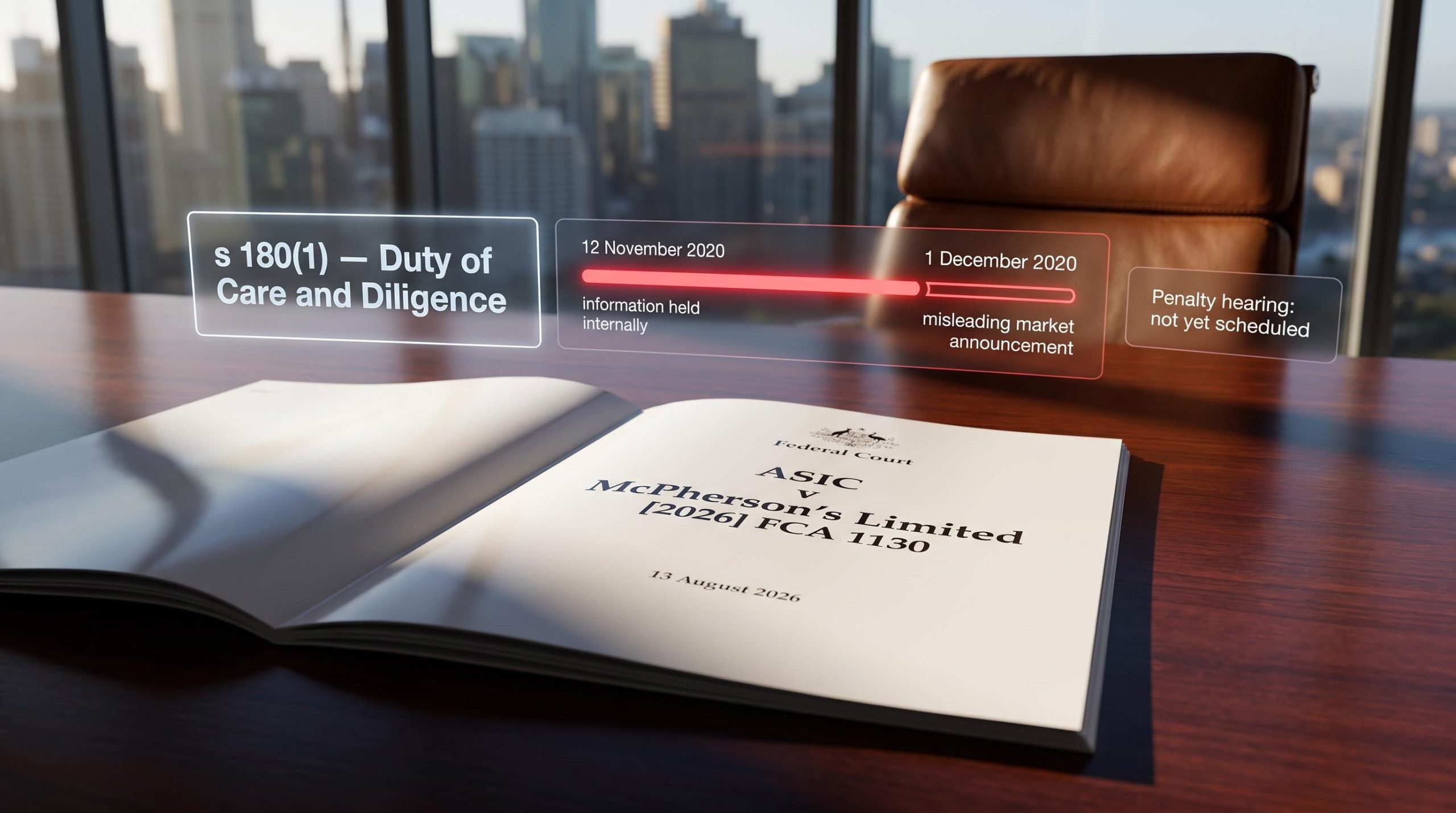
A Federal Court has found that a CEO’s silence, not his actions, was the breach. On 13 August 2026, Justice Markovic delivered judgment in ASIC v McPherson’s Limited [2026] FCA 1130, finding that Laurence McAllister, the former CEO and managing director of McPherson’s Limited, personally fell short of his duty of care and diligence by sitting on material information the company had already obtained without taking the steps his role required.
The judgment arrives at a moment when ASIC is systematically using section 180(1) of the Corporations Act to pursue personal accountability against executives in listed entities. This case now sits alongside Cassimatis and Bekier as evidence that inaction during a disclosure window carries real personal legal consequences. The penalty hearing has not yet been scheduled, meaning the financial and professional stakes for McAllister, including the possibility of disqualification from managing corporations, remain entirely unresolved.
Here is what the law actually requires of directors in these situations, what this case tells you about how seriously regulators and courts now treat failures to meet it, and why the outcome matters whether you hold shares in an ASX-listed company or sit on a board advising one.
What the court actually found
ASIC commenced proceedings against both McPherson’s Limited and its former CEO and managing director Laurence McAllister on 9 December 2022. The liability hearing ran from 10 to 26 June 2025 before Justice Markovic in the Federal Court. Judgment was delivered on 13 August 2026.
Justice Markovic ruled that McPherson’s had breached its continuous disclosure obligations and engaged in conduct that misled the market about its October 2020 profit forecast. McAllister was found personally liable on two separate grounds.
The company’s 1 December 2020 announcement told the market it had only become aware of the need for an earnings downgrade on 27 November 2020. The Court found that was misleading: the relevant information had been available internally from at least 12 November 2020. That gap, fifteen days between when the company held the information and when it characterised its own awareness, is not a procedural technicality. It is precisely the gap the continuous disclosure regime exists to close. This finding tells you that courts will look behind the date a company claims to have “become aware” of adverse information.
The specific findings against McAllister were:
- Breach of section 180(1) of the Corporations Act: failure to exercise the care and diligence a reasonable person in his position would have exercised
- Contravention of section 1309(2): personally approving the provision to the ASX of information that was false or misleading in a material particular
- Failure to take adequate steps to prevent the company’s own corporate contraventions
ASIC is seeking pecuniary penalties, formal declarations, and a disqualification order against McAllister personally. The penalty hearing has not yet been scheduled.
| Item | Detail |
|---|---|
| Case citation | ASIC v McPherson’s Limited [2026] FCA 1130 |
| Judge | Justice Markovic, Federal Court of Australia |
| Proceedings commenced | 9 December 2022 |
| Liability hearing | 10-26 June 2025 |
| Judgment delivered | 13 August 2026 |
| Relevant period (pleaded) | 30 October 2020 – 1 December 2020 |
| Defendants | McPherson’s Limited; Laurence McAllister (former CEO and MD) |
| Provisions contravened | s 180(1) and s 1309(2) (McAllister); continuous disclosure provisions (McPherson’s) |
| Relief sought | Pecuniary penalties, declarations, disqualification order (McAllister); corporate penalties (McPherson’s) |
| Penalty hearing | Not yet scheduled |
When big ASX news breaks, our subscribers know first
What continuous disclosure actually demands of listed companies
ASX Listing Rule 3.1 and section 674 of the Corporations Act create a twin obligation: a listed company must immediately disclose any information that a reasonable person would expect to have a material effect on the price or value of its securities. “Material effect on price or value” is the test. If the information would change how a reasonable investor values the stock, it must be disclosed.
There are narrow exceptions. If the information is confidential and an incomplete proposal, for example, a company may be temporarily exempt. But those exceptions did not apply to McPherson’s situation. The company held internal information showing its Dr LeWinn’s profit guidance was no longer reliable. That information was not confidential in the relevant sense; it was adverse performance data that management already possessed.
The narrow exceptions that temporarily permit non-disclosure, what practitioners call disclosure carve-outs, require all three qualifying conditions to be satisfied simultaneously and continuously; the moment any limb fails, the full obligation to disclose immediately is revived.
The obligation most investors miss is the continuing one. Earnings guidance is not a one-time communication. Once a company has told the market what it expects to earn, that guidance creates a live obligation. If internal performance materially diverges from what was guided, the company must update the market. It cannot wait until results season. It cannot wait until the next board meeting. The obligation arises the moment the company holds information that undermines its prior guidance.
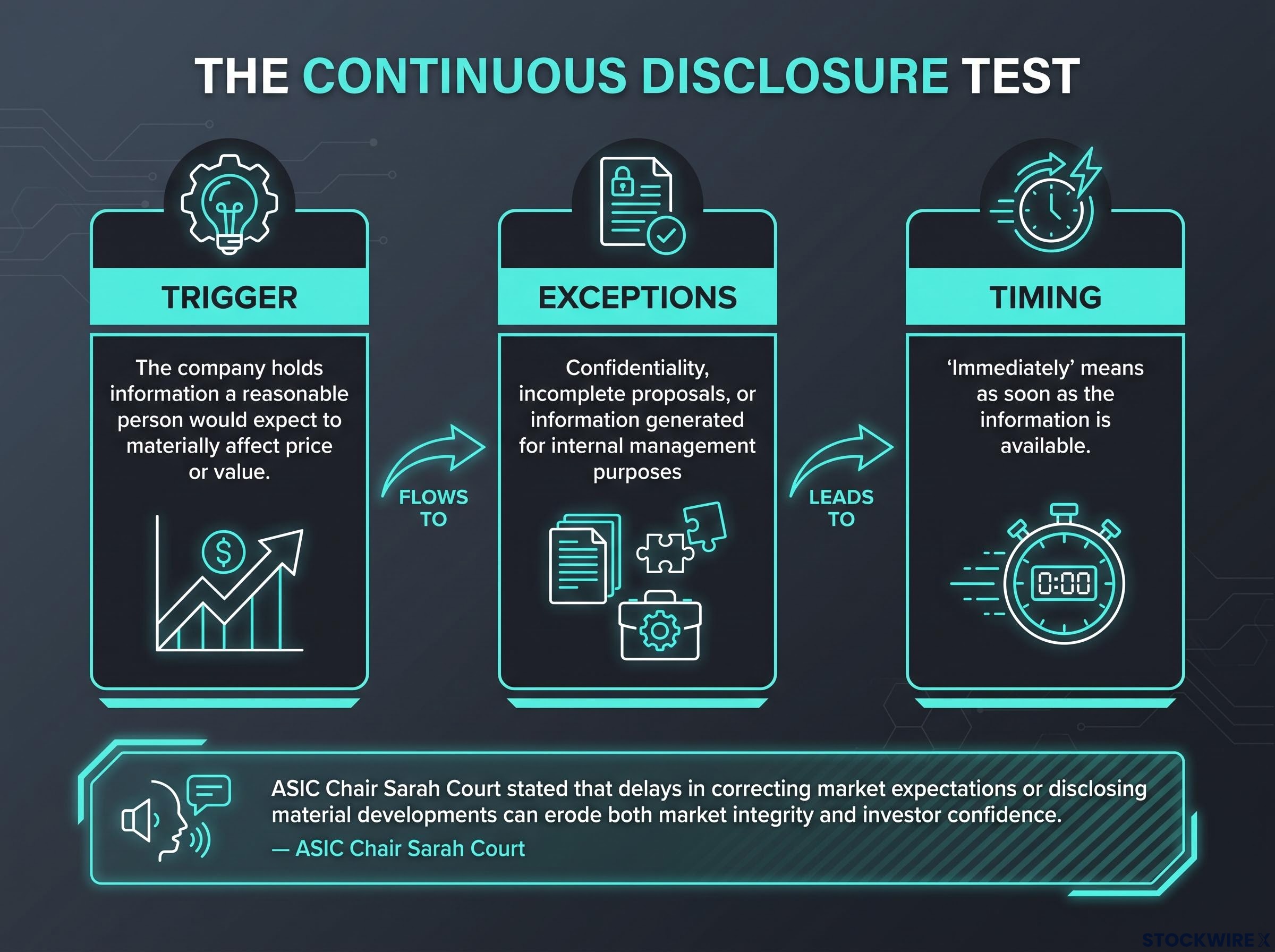
The key elements of the continuous disclosure test are:
- Trigger: The company holds information a reasonable person would expect to materially affect price or value
- Exceptions: Confidentiality, incomplete proposals, or information generated for internal management purposes (narrowly construed)
- Timing: “Immediately” means as soon as the information is available, not when the company decides it is convenient to disclose
ASIC Chair Sarah Court stated that delays in correcting market expectations or disclosing material developments can erode both market integrity and investor confidence.
If you hold shares in a company that has issued earnings guidance, this obligation is what protects your ability to trade on current information rather than stale projections the company privately knows are no longer reliable.
What section 180(1) requires, and why inaction counts as a breach
The assumption most people carry is that a legal breach requires a positive act: a CEO who signs a fraudulent document, a director who approves a reckless transaction. Section 180(1) of the Corporations Act operates differently.
The provision requires a director or officer to exercise the degree of care and diligence that a reasonable person would exercise if they occupied the same position, in the same circumstances, with the same responsibilities. That last phrase is where the standard gets its teeth. It is not a generic benchmark applied identically to every director. It is calibrated to the specific role a person holds.
McAllister served as both CEO and managing director of McPherson’s. That dual role concentrated operational authority and governance responsibility in a single person, and the Court assessed his conduct against the standard expected of someone holding that concentration of power. The benchmark he was measured against was not what a generic non-executive director would do; it was what a reasonable person occupying both the chief executive and managing director roles would do with the same information.
The Court found it was reasonably foreseeable that McAllister’s inaction would result in legal contraventions and regulatory consequences for the company. He held material information from late October 2020. He did not ensure it was escalated or disclosed. That failure to act was itself the breach.
Three conditions compounded the standard in McAllister’s case:
- His dual CEO and managing director role, which concentrated authority and raised the benchmark
- His knowledge of material adverse information from late October 2020
- The foreseeability that inaction would expose McPherson’s to regulatory consequences
For anyone who sits on or advises a board, the practical takeaway is direct: knowing something material and deciding not to escalate it is not a neutral act. Courts will assess it as a decision, and measure it against what a reasonable person in your specific role would have done.
How courts have applied this standard to executive roles
The McPherson’s judgment did not arrive in isolation. In ASIC v Cassimatis (No 8), the Federal Court held that the section 180(1) duty requires directors to balance the foreseeable risk of harm against the burden of taking alleviating action. Breach does not require proof of actual loss. The question is whether the risk was foreseeable and the cost of acting was proportionate.
In ASIC v Bekier, the Court found the former CEO and company secretary of Star Entertainment personally liable under section 180(1) for failing to escalate material regulatory and anti-money laundering issues to the board. Non-executive directors were not found liable, but the judgment made clear that executive directors who hold material information bear an affirmative duty to ensure it reaches the board.
The Bekier ruling extended the section 180 escalation duty beyond financial compliance failures for the first time, finding that executives who controlled information flows to the board bore personal liability even where non-executive directors, who received inadequate reporting, did not breach their own duties.
ASIC v Wilson (No 3) provides the counterpoint. In that case, ASIC failed to prove any of five alleged section 180(1) breaches. The standard is genuinely contested, and ASIC does not win every case it brings.
Section 1309(2) and the personal cost of authorising a misleading disclosure
The second finding against McAllister arises from a distinct provision. Section 1309(2) of the Corporations Act prohibits a person from authorising or permitting the giving of information to the ASX that is false or misleading in a material particular. Where section 180(1) concerns the standard of care, section 1309(2) concerns the specific act of authorising a misleading communication.
McAllister authorised the 1 December 2020 announcement. That announcement told the market McPherson’s had only become aware of the need for an earnings downgrade on 27 November 2020.
The Court found the material information had been available internally from 12 November 2020. The company’s characterisation of when it became aware was misleading.
The same underlying facts, the gap between what McPherson’s knew and what it told the market, gave rise to two distinct personal liability findings against McAllister. Each carries its own penalty exposure.
Australian corporate law runs a dual enforcement track over a single governance failure: a corporate penalty and separate personal proceedings can run simultaneously, with individual liability persisting after a company settles and an executive departs, because directors’ duties under sections 180-183 of the Corporations Act are non-delegable.
Civil penalty proceedings (the type ASIC brought here) operate on the balance of probabilities, the civil standard of proof. ASIC does not need to prove McAllister intended to deceive. It needs to prove, on the balance of probabilities, that he authorised a disclosure that was misleading in a material particular. The Court found that threshold was met.
ASIC is seeking three forms of personal relief against McAllister:
- Pecuniary penalties (financial penalty payable personally)
- Formal declarations of contravention
- A disqualification order preventing him from managing corporations
A CEO who reviews and approves a market announcement is not a passive bystander to its contents. This provision makes clear that authorising a misleading disclosure is itself the conduct, regardless of who drafted the document. The legal architecture is designed to give executives a personal incentive to scrutinise the accuracy of what they sign off on.
What ASIC’s enforcement pattern tells directors and investors
McPherson’s is not an isolated judgment. Placed alongside Cassimatis and Bekier, it forms a coherent pattern of ASIC using section 180(1) to establish personal executive accountability across different sectors and entity sizes.
| Case | Executive role | Provision | Conduct type | Outcome |
|---|---|---|---|---|
| Cassimatis | Directors (financial services) | s 180(1) | Failure to balance foreseeable risk against burden of acting | Liability established |
| Bekier | CEO and company secretary (gaming) | s 180(1) | Failure to escalate material regulatory and AML issues | Personal liability found for executive directors |
| McPherson’s | CEO and MD (listed health and wellness) | s 180(1), s 1309(2) | Inaction on material information; authorising misleading disclosure | Personal liability found; penalty hearing pending |
The pattern has a clear direction. ASIC’s position is that senior executives in listed entities carry a positive obligation to see that material information reaches the right people internally, receives proper consideration, and is put to the market without unnecessary delay. The regulator is increasingly willing to test section 180(1) against senior executives in listed entities.
The dual-role dimension matters. CEOs who also serve as managing directors concentrate authority in a way courts now explicitly treat as raising the standard against which their conduct is measured. If you hold both titles, the benchmark you are assessed against is higher than it would be for either role alone.
The penalty hearing for McAllister has not yet been scheduled as of 13 August 2026. The liability findings are established. Whether those findings translate into a modest financial penalty or a serious disqualification order remains to be determined. For directors and senior executives, the question is no longer whether ASIC will pursue personal liability for disclosure failures. The question is whether the specific facts of your situation are ones the regulator will consider worth testing.
The Star Entertainment penalty ruling provides the clearest available reference point for executive disqualification penalties under section 180(1): the Federal Court imposed six- and seven-year bans on former CEO Matthias Bekier and former Chief Legal and Risk Officer Paula Martin respectively, with Martin’s longer ban reflecting her intensified duty of escalation as the organisation’s most senior legal officer.
Why the penalty quantum will set a reference point
The penalty Justice Markovic determines will become a reference point for future ASIC civil penalty proceedings involving similar section 180(1) and section 1309(2) conduct by executive directors. Disqualification, if ordered, removes McAllister from the director and senior officer class entirely for the period specified, a qualitatively different consequence from a financial penalty alone.
What this case means if you hold shares in an ASX-listed company
Continuous disclosure, when it works, is an investor protection mechanism. It exists so the market price you see reflects the information the company holds, not just the information it has chosen to share. The McPherson’s judgment is a direct illustration of what happens when that mechanism fails: the company held material adverse information from 12 November 2020, but its 1 December 2020 announcement misrepresented when it became aware. For anyone trading McPherson’s shares during that window, the price they saw did not reflect what the company knew.
The limitation is worth stating honestly. Enforcement is retrospective. The continuous disclosure regime protects you through penalty and deterrence after the harm, not through prevention before it. ASIC cannot stop a CEO from sitting on material information in real time. What it can do is pursue personal liability after the fact, and judgments like this one are designed to make the next CEO think twice.
The practical takeaways for you as a retail investor are:
- What continuous disclosure protects you from: Companies withholding information that would change how you value the stock. When it is enforced, it narrows the gap between what the company knows and what the market knows.
- What enforcement achieves and what it cannot prevent: Enforcement creates deterrence through personal consequences for executives. It does not prevent the initial harm. You trade on incomplete information until the disclosure is made or the breach is discovered.
- What to monitor when ASIC brings civil penalty proceedings: A liability finding like this one changes the information environment around a company and its governance. The penalty hearing, once scheduled, will signal how courts calibrate consequences for this category of executive conduct.
This article is for informational purposes only and should not be considered financial advice. Investors should conduct their own research and consult with financial professionals before making investment decisions.
The liability is settled. The accountability question is still open.
Two conclusions emerge from the judgment: McPherson’s, as a corporate entity, violated its continuous disclosure obligations and misled the market, while its CEO personally fell short of his duty of care and diligence and put his name to an announcement that misrepresented what the company knew. Neither conclusion depended on proving that McAllister set out to deceive anyone. The conduct itself, his failure to act and his approval of a misleading disclosure, was sufficient.
The penalty hearing will determine whether those findings translate into consequences serious enough to change executive behaviour across the listed company sector. The gap between a modest fine and a serious disqualification order will tell you how much weight the Court places on the dual-role concentration of authority that made McAllister’s inaction a breach.
If you are a director, this case is a prompt to audit how material information flows within your organisation right now: who holds it, who escalates it, and how long the gap is between knowledge and disclosure. If you are an investor, it is a reason to treat governance quality as a substantive variable when you assess ASX-listed companies, not a box-ticking exercise buried in an annual report.
—