

DroneShield lays out its growth roadmap at Canaccord conference
In its August 2026 presentation to the Canaccord Genuity Growth Conference, DroneShield (ASX:DRO) outlined a record FY2025, a strong first-half FY2026 trading position, and a next-generation product roadmap for its counter-drone technology.
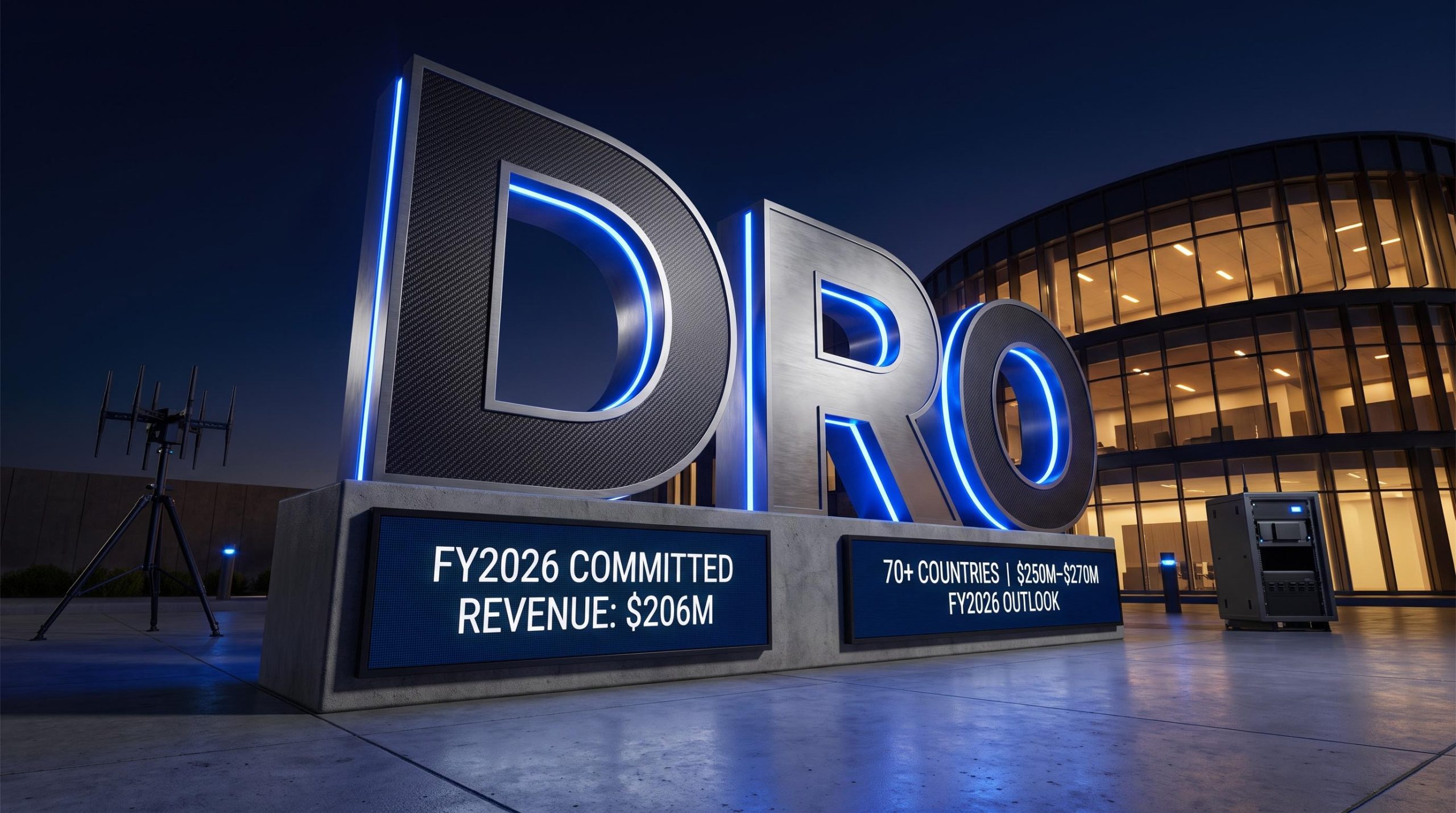
Management led with FY2026 Committed Revenue of $206M after seven months, equivalent to 95% of full FY2025 revenue. The company detailed an FY2026 revenue outlook of $250M to $270M, representing 15% to 25% growth on FY2025.
DroneShield described itself as “the global leader in counter-drone technology” with representation in 70+ countries, spanning Tier 1 militaries, government agencies, law enforcement and critical infrastructure operators. The presentation framed a business scaling rapidly while progressively building recurring, software-driven revenue.
When big ASX news breaks, our subscribers know first
Record FY2025 results underpin the story
The financial foundation of management’s pitch was a completed FY2025 result. DroneShield reported FY2025 revenue of $216.5M, up 276% on FY2024’s $57.5M, alongside a swing from losses to profitability and positive operating cash generation.
The company presented the following key metrics, noting that underlying figures are stated before Individually Significant Items.
| Metric | FY2025 | FY2024 | Change |
|---|---|---|---|
| Revenue | $216.5M | $57.5M | +276% |
| Underlying Gross Profit | $140.3M | $41.2M | +240% |
| Underlying EBITDA | $36.5M | ($4.0M) | +1,013% |
| Underlying PBT | $33.3M | ($2.1M) | +1,686% |
| Operating cash flow | $15.9M | ($62.6M) | +126% |
| Cash & term deposits (no debt) | $209.5M | $219.5M | (4%) |
The FY2025 revenue mix highlighted geographic and product breadth.
By region:
- Europe & UK: 45%
- Asia-Pacific: 26%
- LATAM, MENA & Other: 15%
- United States: 14%
By type:
- Dismounted hardware: 56%
- On-the-move & fixed-site hardware: 35%
- Subscription: 5%
- Warranties & services: 4%
1H FY2026 trading update points to another record year
Management outlined continued momentum through the first half of FY2026. The company recorded 1H 2026 revenue of $125.8M, up 74% on the prior corresponding period, with $14.2M (11.3%) derived from Recurring Revenue.
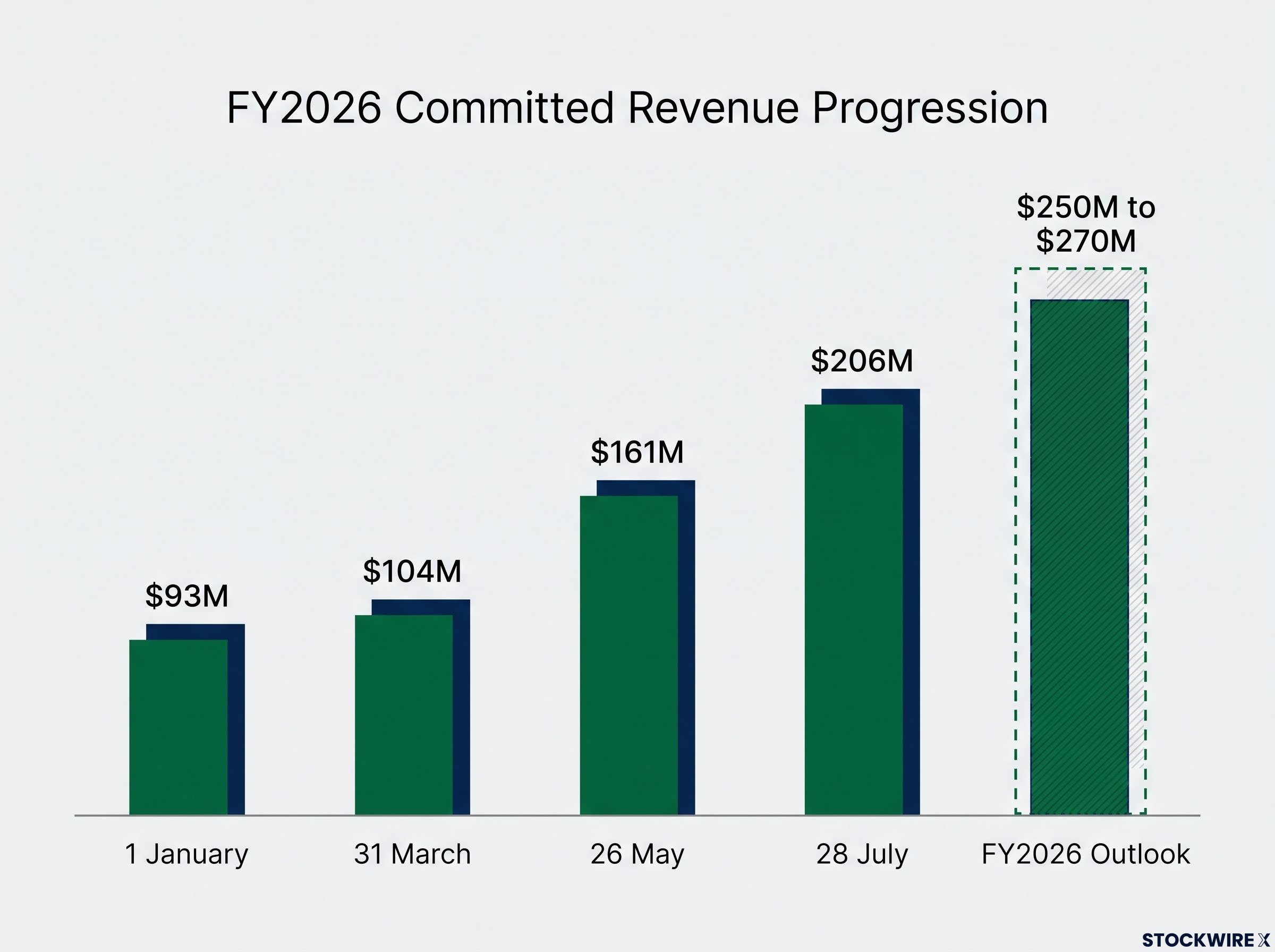
Committed Revenue progressed steadily through 2026, moving from $93M on 1 January to $104M at 31 March, $161M at 26 May, and $206M by 28 July. On that basis, management confirmed an FY2026 revenue outlook of $250M to $270M.
On margins, the company was precise. The 1H 2026 gross margin was estimated at 60%, compared with 65% in the prior corresponding period, attributed to sales mix, currency movements and raw material impairment identified during a facility move and ERP transition. DroneShield targets a blended gross margin of ~65%, expected to blend up in the second half from recurring revenue and initial next-generation sales.
Material contract announcements referenced during the period included:
- 26 February: $21.7M
- 2 June: $19.3M plus $5.6M in options
- 28 July: $23.2M
The company noted that portions of these announced amounts may form part of FY2027 and beyond Committed Revenue, and should not be counted solely within FY2026. FY2027 and beyond Committed Revenue already stood at $26M and growing.
What counter-drone technology is and why it matters
Counter-unmanned systems (C-UxS) is a discipline built around a single principle drawn from a June 2026 report by the Joint Interagency Task Force 401: there is “no silver bullet to protect against drones.” Effective defence is a system combining detection, identification and defeat, not a single product.
DroneShield described a multi-layered ecosystem. This spans RF detect and defeat sensors, the DroneSentry-C2 software layer, radar and optical extensions, and soft-kill non-kinetic effectors such as high-power microwave and laser. The company noted it does not offer hard-kill or kinetic effectors, described as Layer 6.
The layered approach supports customer stickiness. Every deployed sensor becomes more valuable when connected through DroneSentry-C2, supporting retention and recurring revenue. The company cited approximately 5,800 units deployed and around 4,000 software-enabled units.
Hardware wins the deal, software compounds the value
A central thesis of the presentation was recurring revenue. DroneShield explained that quarterly software updates, services and support progressively build a recurring income base, moving from around 7% of FY revenue historically to approximately 13% on FY2026 Committed Revenue.
Next-generation products were positioned as the software growth engine. Management highlighted RfAI-3 and RfRecon as the start of a next-generation product family launching over the next 18 months.
RfAI-3 deploys adaptive AI that analyses the physical characteristics of RF transmissions to generate intelligent classifications of “both known and previously unseen drone activity.” RfRecon was described as “the first of the next-generation,” powered by RfAI-3. Next-generation launches commence 3Q 2026 through 2027.
A massive, well-funded market opportunity
DroneShield sized its addressable market across two segments: a Military & Government TAM of US$35B and a Local & Commercial TAM of US$28B. Management framed commercial demand as an evolving long-term growth market alongside defence, spanning aviation, critical infrastructure, public safety, corrections and major events.
The presentation cited a range of funding tailwinds supporting demand:
- USA: 2027 budget request of US$21B for munitions, C-UAS and advanced capabilities; JIATF-401 with US$900M committed for 2026, with DroneShield on the JIATF-401 C-UAS Marketplace platform.
- Europe & UK: NATO commitment of US$40B in counter-drone capabilities over five years; UK £790 million committed to integrated air, drone and missile defence.
- Australia: Up to A$7B allocated over 10 years for C-UAS and missile defence, with approximately A$1.5B for C-UAS.
The JIATF-401 counter-drone contract secured in June 2026 carries significance beyond its $24.9M headline value; it positions DroneShield as a systems integrator within the US military’s central counter-drone coordination body, requiring third-party interoperable hardware alongside its own products.
On the commercial threat, management referenced 100+ airport drone reports every month in the US, 1,712 prison drone incidents in England & Wales in 2024/25 (up 43% year-on-year), and 27,000+ drones detected near the US southern border.
“if there is one threat that keeps me up at night, it is from drones”
Jessica Tisch, NYPD Police Commissioner (February 2026)
Strategic priorities and leadership evolution
Management outlined three strategic priorities for sustainable growth:
- Accelerate global operational reach through regional headquarters, an expanded commercial team, and regional manufacturing in core markets.
- Activate next-generation C-UxS capabilities via whole-of-lifecycle solutions and strategic technology-focused M&A.
- Expand and diversify markets and end-users across military and non-military segments through a multi-channel go-to-market model.
On governance, the company noted the appointment of Hamish McLennan as Independent Non-Executive Chairman since May 2026, who also chairs REA Group and ARN Media. Angus Bean serves as Chief Executive Officer & Managing Director, having joined in 2016 as employee #7.
The Angus Bean CEO appointment in April 2026 coincided with a Q1 FY26 result that delivered $63 million in revenue and $77 million in customer cash receipts, giving the incoming chief executive an immediate platform of operational momentum rather than a restructuring mandate.
The presentation set out several competitive differentiators:
- Largest real-world dataset for C-UxS solutions
- Users and partners in 70+ countries
- Over 10 years of in-field deployment
- $70M annual R&D spend with 350+ engineers
What investors should watch next
Looking ahead, the presentation pointed to several disclosed items for investors to monitor. The FY2026 revenue outlook of $250M to $270M and the ~65% blended gross margin target frame near-term financial expectations.
The rollout of next-generation platforms, including RfAI-3 and RfRecon, is scheduled from 3Q 2026 through 2027. Management also flagged the growth of recurring and software revenue toward approximately 13% of the mix, alongside a building FY2027 and beyond Committed Revenue base of $26M and growing.
Across the presentation, DroneShield positioned itself as the global counter-drone leader scaling into a large and well-funded market, supported by a record FY2025 result and a next-generation product pipeline still to come.
Don’t Miss the Next Defence Tech Breakout
Get FREE breaking ASX news delivered to your inbox within minutes of release, complete with in-depth analysis already done for you. Join 20,000+ subscribers staying ahead of market-moving announcements across defence, technology and beyond. Click the “Free Alerts” button at StockWire X to start receiving alerts the moment news breaks.