Uber is spending roughly 1.4 times its annual free cash flow on a single acquisition. CEO Dara Khosrowshahi believes the company can absorb the cost without balance-sheet stress. Both of those things can be true at the same time, and both deserve scrutiny.
The deal, announced on 16 July 2026, values Delivery Hero at approximately $14.8 billion in equity, or $13.7 billion net of Uber’s existing stake. It brings 50 markets, $42 billion in gross bookings, and a portfolio of established local delivery brands into Uber’s platform. It also pre-emptively carves out 14 overlapping markets for separate sale to SSW Partners at approximately $1.6 billion, with closing targeted for the second half of 2027.
Here is a framework for evaluating whether the strategic logic holds up against the deal’s three primary risk vectors: regulatory outcomes, financial payback, and integration execution. Each shapes the other, and all three will remain live variables for at least the next 12-18 months.
What Uber is actually buying: 50 markets, 14 carve-outs, and a $42 billion gross bookings base
The $14 billion headline figure is doing too much work. Underneath it sits a more deliberate architecture that tells you more about how Uber is thinking about this deal than the price tag alone.
The $14.8 billion agreed figure arrived after a contested period of shareholder price negotiations in which Delivery Hero’s board rejected Uber’s initial €33 per share approach and key investors demanded above €40, a dynamic that shaped the final deal terms and the premium Uber ultimately accepted.
Uber is directly acquiring Delivery Hero’s operations across 50 markets, which generated approximately $42 billion in gross bookings in 2025. Simultaneously, a separate buyer, SSW Partners, is purchasing Delivery Hero assets in 14 overlapping markets, jurisdictions where Uber Eats already operates, for approximately $1.6 billion. That parallel sale is not a concession extracted by regulators. It is a pre-emptive structural remedy, designed and agreed before regulatory filings are complete.
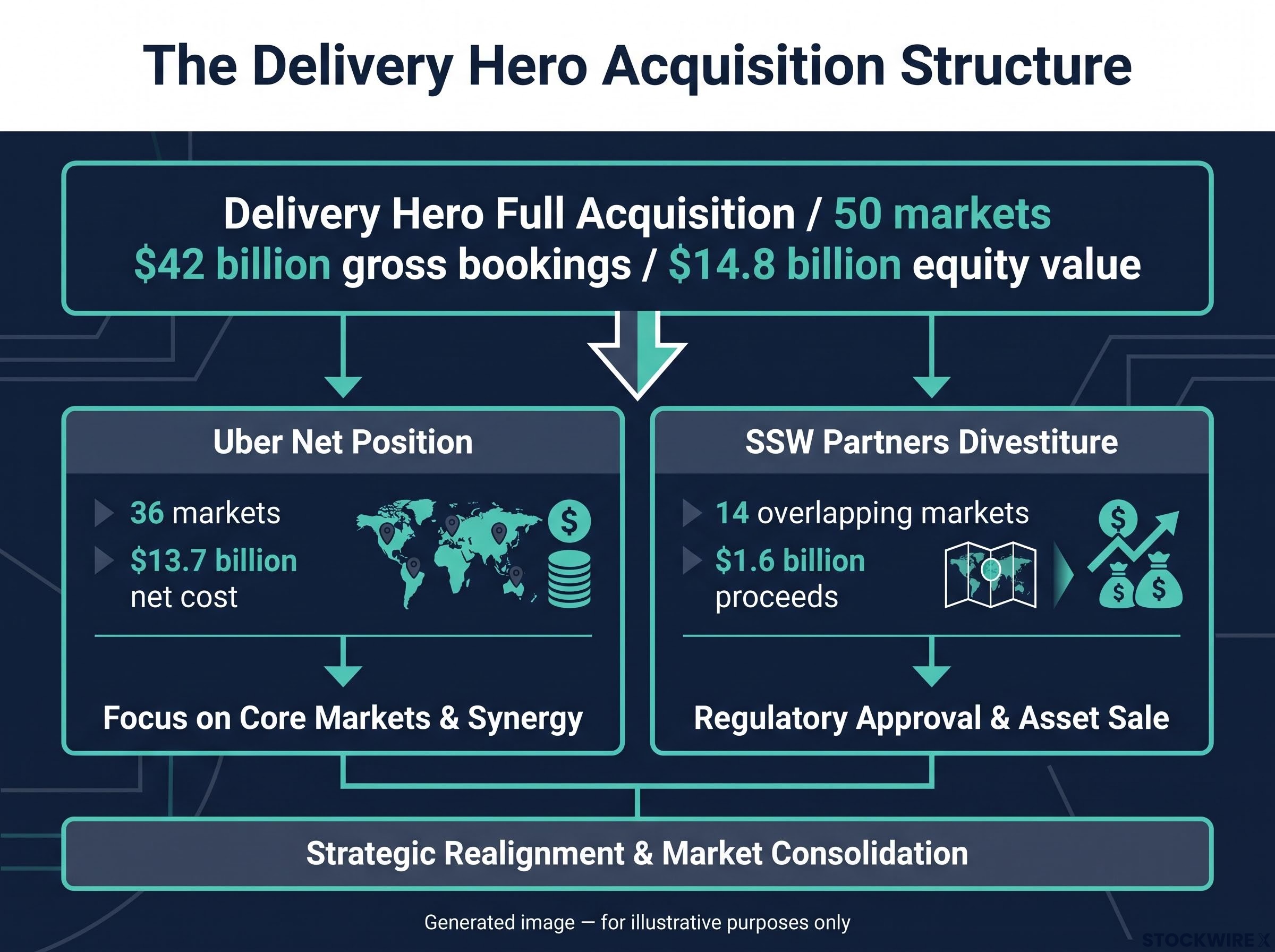
That sequencing matters. It signals that Uber entered this transaction having already mapped where antitrust friction was most likely to surface and having already built the remedy into the deal’s architecture. Regulators will still scrutinise the structure, but the most obvious concentration objections have been addressed at the design stage.
| Component | Markets / Value | Strategic Purpose |
|---|---|---|
| Full acquisition | 50 markets, $42B gross bookings | Expanded global delivery footprint |
| SSW divestiture | 14 markets, $1.6B in proceeds | Pre-agreed antitrust remedy |
| Net position | 36 markets net of overlap, $13.7B cost | Incremental platform expansion |
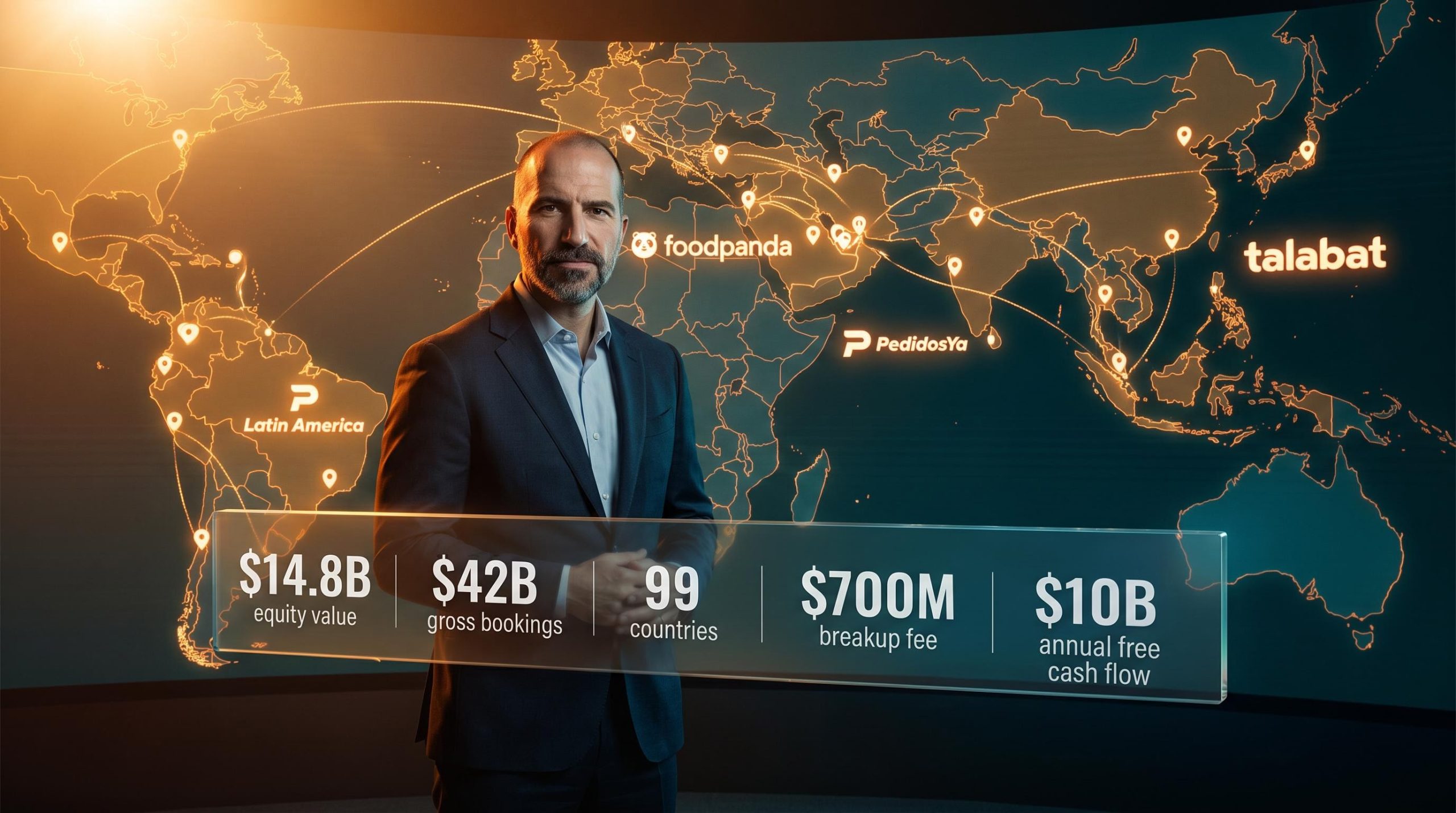
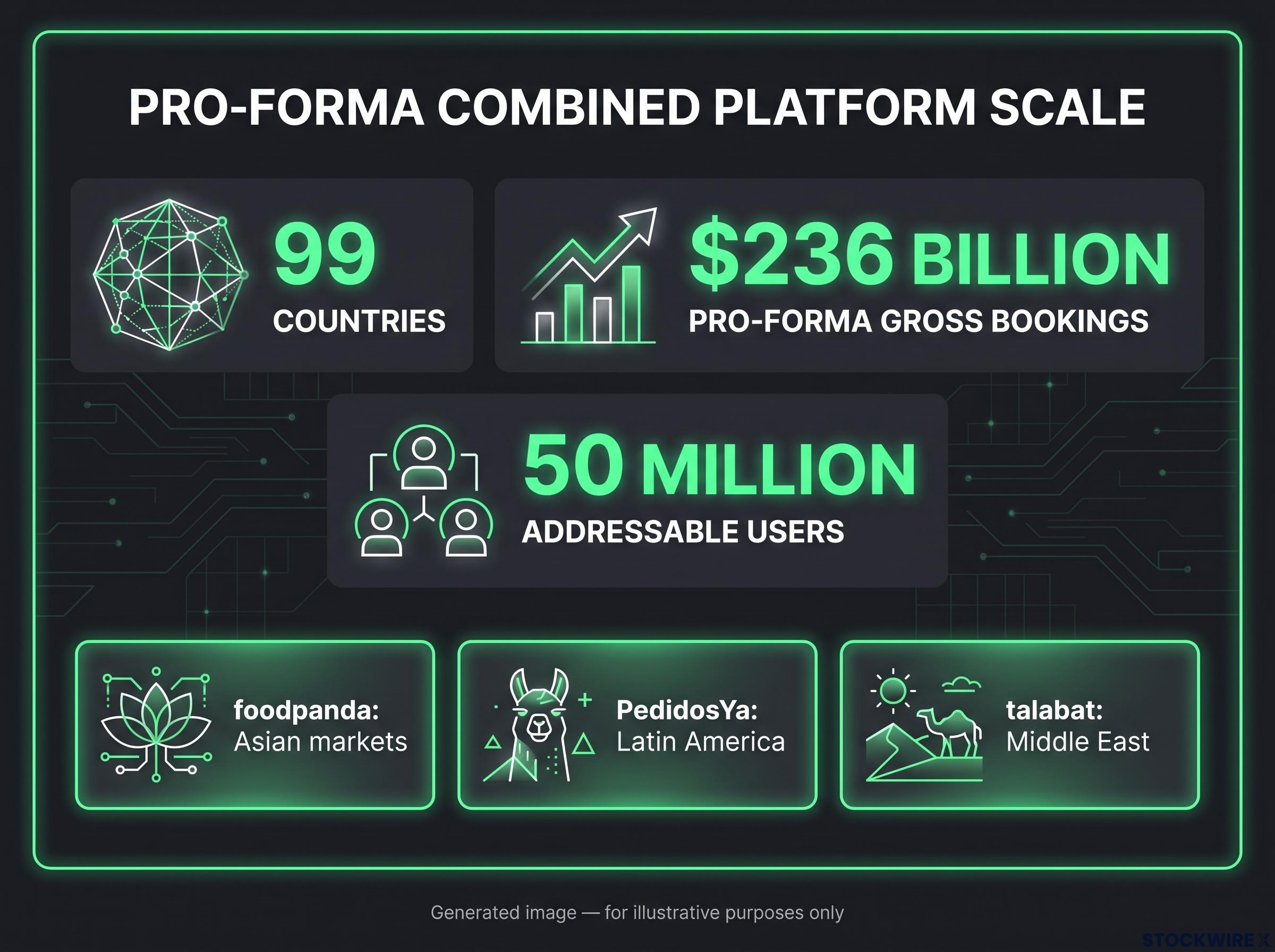
Post-close, the combined platform would operate across approximately 99 countries, with pro-forma gross bookings of roughly $236 billion across mobility and delivery. The brand portfolio Uber is absorbing includes:
- foodpanda: established delivery platform across Asian markets
- PedidosYa: leading delivery brand in Latin America
- talabat: dominant delivery service in the Middle East
Each carries deep local market penetration in regions where organic entry for Uber would be slow, expensive, and uncertain.
Uber’s decision to pursue inorganic scale through this acquisition sits alongside a concurrent retreat from European organic expansion, with the company’s seven-market food delivery build-out having shrunk to two active markets by early July 2026, a sequencing that reinforces the strategic case for acquiring established footprint rather than building it.
When big ASX news breaks, our subscribers know first
The flywheel thesis: how 50 million new users are supposed to compound Uber’s economics
Uber’s strategic logic rests on a specific compounding dynamic. Mobility and delivery users on a single platform create rising switching costs, higher customer lifetime value (the total revenue a customer generates over the full period they use the service), and increasing order frequency. Each additional service a customer adopts makes it harder for a competitor to pull them away. That is the flywheel, and this deal is designed to accelerate it at a scale Uber could not achieve organically.
The acquisition adds roughly 50 million addressable users across delivery and mobility ecosystems, spread across an eventual 99-country combined footprint. But the strategic value of that number depends on three conditions, and none of them is guaranteed:
- Active user composition. Only frequent, transacting users contribute meaningfully to lifetime value and cross-sell potential. The ratio of active to dormant users in Delivery Hero’s base is the first variable that determines whether the flywheel generates real economic returns or remains a presentation slide.
- Geographic overlap with Uber’s mobility footprint. Cross-platform conversion works best where Delivery Hero’s delivery users already live in markets with an existing or planned Uber ride-hailing presence. Where that overlap does not exist, the conversion opportunity is theoretical rather than operational.
- Conversion friction. Even with a unified app and cross-promotion, persuading a delivery-only user to book their first ride, or vice versa, requires changing an established habit. That friction is non-trivial in practice, and historical conversion rates across comparable platform integrations have varied widely.
The 50 million figure is a ceiling, not a forecast. The relevant number for investors is the sub-segment of active users in geographically overlapping markets, and that figure has not been publicly specified.
Where the conversion opportunity is strongest
The Middle East and Latin America are where the conversion logic looks most concrete. talabat operates across the Gulf states, where Uber already runs a substantial ride-hailing business. PedidosYa dominates delivery in several Latin American markets where Uber’s mobility operations are well established. In both regions, the delivery user base and the mobility infrastructure already coexist, making cross-platform conversion a practical operational question rather than a hypothetical one.
Asia presents more complex dynamics. foodpanda has strong delivery market positions, but Uber’s mobility footprint across the region is limited following earlier strategic exits. The cross-platform thesis there depends on whether Uber plans to re-enter mobility in those markets or whether foodpanda’s value lies primarily in standalone delivery economics and advertising revenue.
Reading the financial structure: bridge loan, free cash flow, and the payback clock
Uber plans to fund the acquisition through a bridge loan facility of approximately $14 billion, intended to be refinanced as the deal progresses toward close. The company generates approximately $10 billion in annual free cash flow, establishing a clear context: Uber can absorb this cost, but the question of whether this is the best use of that capital is separate from whether the company can afford it.
Investors will model the payback across three layers, each with different confidence levels and time horizons.
| Return Layer | Source | Conditions Required | Investor Confidence |
|---|---|---|---|
| Base-case contribution | $42B gross bookings across 50 acquired markets | Smooth operational handover; no major market exits | Moderate |
| Cross-platform uplift | User conversion between delivery and mobility; advertising, subscription penetration | Active geographic overlap; successful app integration; habitual user adoption | Lower, execution-dependent |
| Long-tail optionality | Advertising, fintech, on-platform rewards across enlarged user base | Market maturation; regulatory permission; product development | Speculative, multi-year horizon |
If Uber can credibly generate approximately $1-1.5 billion in incremental annual free cash flow from these combined effects within a few years, the deal implies a high-single-digit-year payback horizon. That logic holds only if integration is effective and regulatory conditions do not force material divestitures beyond the pre-agreed SSW carve-out.
The capital allocation trade-off is direct. Uber has been deploying free cash flow toward share repurchases. The central question for shareholders is whether $14 billion spent here outperforms buybacks or smaller bolt-on deals on a risk-adjusted basis. If the acquisition delivers on growth and margin expansion, redirecting capital from repurchases is justified. If returns disappoint, shareholders may prefer future excess cash returned rather than deployed in comparably large transactions.
Decoding the $700 million breakup fee: what it signals and what it does not
The $700 million breakup fee, payable to Delivery Hero if the deal fails to receive regulatory clearance, represents approximately 5% of the $14.8 billion headline value. That sits at the upper end of typical ranges for complex cross-border transactions, and it carries a dual signal.
A fee that large confirms Uber’s management believes regulatory approval is more likely than not. No acquirer accepts a $700 million termination cost as a base case. But the same fee also confirms that material regulatory risk is priced into the deal’s structure. If the outcome were considered near-certain, the fee would be lower. Both readings coexist, and neither cancels the other.
The deal requires approval from EU competition authorities and multiple national regulators, with the process expected to extend through to the second half of 2027. The SSW carve-out addresses concentration in 14 specific overlapping markets, but European regulators in particular have shown increasing willingness to challenge acquisitions on ecosystem dominance grounds, looking beyond current market share to assess potential future competitive effects.
That matters because the most analytically consequential scenario is not a clean block. It is the one in between. Three outcomes are possible:
- Clean approval: deal closes on current terms; Uber captures full strategic and economic value of the 50-market acquisition
- Clean block: deal fails; Uber pays the $700 million breakup fee; financial damage is bounded and the core business reverts to the pre-deal thesis
- Approval with remedies: deal closes, but regulators impose divestitures or behavioural constraints beyond the pre-agreed SSW carve-out, reducing the economic scope and strategic logic of what Uber actually acquires
The third scenario does not trigger the breakup fee. It does not produce a clean win or a clean loss. And it is the outcome that could produce the most sustained drag on shareholder returns, precisely because the deal closes and capital is deployed, but into a structure whose value has been quietly eroded by regulatory conditions.
Most coverage of the breakup fee frames it as deal-failure insurance. The more useful frame treats it as one data point in a probability distribution where the messy middle scenario warrants the most analytical attention.
Integration execution: the risks that show up after regulatory approval
Even a clean regulatory outcome leaves a second, entirely separate set of variables unresolved. Large platform acquisitions at this scale fail most often not because the strategic thesis is wrong but because post-merger integration (the process of combining two companies’ technology, operations, and teams into a single functioning entity) proves slower, more expensive, and more operationally disruptive than projected.
For investors tracking this deal beyond the regulatory milestone, four operational KPIs (key performance indicators, the specific metrics that measure whether a business is performing as expected) function as leading indicators of integration health:
- Technology and logistics migration pace. How quickly Delivery Hero’s brands and operations migrate onto Uber’s technology stack and logistics infrastructure, and with what level of operational disruption during transition
- On-time delivery rates and courier retention. Service quality and workforce stability across acquired markets during the integration period; deterioration here is the earliest visible sign of execution strain
- User cross-adoption metrics. The percentage of Delivery Hero users who begin using Uber mobility or other Uber services, and whether cross-platform users show higher frequency and basket size than single-service users
- Margin trajectory in acquired markets. Whether newly acquired operations move toward Uber’s targeted profitability profile without sustained or escalating cash burn
These are the specific data points to look for in post-close earnings calls and investor presentations. They will surface before headline revenue or bookings figures reveal integration problems, giving investors an early read on whether the flywheel thesis is translating into operations.
What Khosrowshahi’s track record tells us
Khosrowshahi’s prior leadership at Expedia is cited as a precedent for his ability to generate shareholder value through complex deal-making and integration. His tenure at Uber has been characterised by a deliberate shift toward financial discipline, governance, and cash generation, a marked contrast with the “growth at any cost” approach under founder Travis Kalanick, who is no longer involved with the company.
His compensation structure reinforces alignment. Reported annual pay runs in the range of approximately $35-40 million, with the substantial majority, around $30 million, delivered through equity instruments such as stock awards and options rather than cash. Beyond annual pay, his accumulated personal holding in Uber shares is valued in the hundreds of millions of dollars, meaning his wealth is structurally bound to long-run stock performance rather than deal activity.
That alignment reduces but does not eliminate integration risk. Uber’s current cash-generative profile was itself the product of multi-year operational discipline that must now be extended to an enlarged and more complex organisation across dozens of new markets with different competitive dynamics, regulatory environments, and consumer behaviours.
Three scenarios, one decision framework: how to position ahead of the 2027 close
The deal does not change whether Uber is a good business. It changes whether Uber’s next phase of growth arrives faster, slower, or at a different cost than the pre-deal trajectory implied. That is the question investors are actually pricing, and it resolves into three scenarios with distinct triggers and distinct financial consequences.
| Scenario | Trigger Conditions | Uber Financial Impact | Key Variables to Watch |
|---|---|---|---|
| Clean approval | EU and national regulators approve with SSW remedy sufficient | 99-country platform; $236B pro-forma gross bookings; cross-platform monetisation uplift | Integration KPIs from first post-close earnings; user cross-adoption rates |
| Clean block | Regulatory rejection; deal does not close | $700M breakup fee; core thesis reverts to pre-deal outlook | Regulatory filing responses; political signals from EU competition authority |
| Approval with remedies | Additional divestitures or behavioural constraints beyond SSW carve-out | Deal closes at reduced strategic scope; capital deployed into a diminished asset base | Scope of additional remedy demands; which markets or capabilities are constrained |
The base case delivers a materially larger global footprint and genuine cross-platform optionality. The adverse case bounds the downside at a fee that is meaningful but not existential for a business generating $10 billion in annual free cash flow. The messy case, approval with heavy remedies and integration friction, is the one that warrants the closest monitoring because it produces the most sustained drag on returns without triggering a clean resolution either way.
The underlying business remains cash-generative and growing. This acquisition is an acceleration bet with bounded downside on the regulatory dimension and open-ended upside and risk on the execution dimension. Every major development between now and the second half of 2027, from regulatory filings to post-close earnings calls, maps back to which of these three scenarios is unfolding.
This article is for informational purposes only and should not be considered financial advice. Investors should conduct their own research and consult with financial professionals before making investment decisions. Forward-looking statements regarding deal completion, financial projections, and integration outcomes are subject to change based on regulatory decisions, market conditions, and company performance.