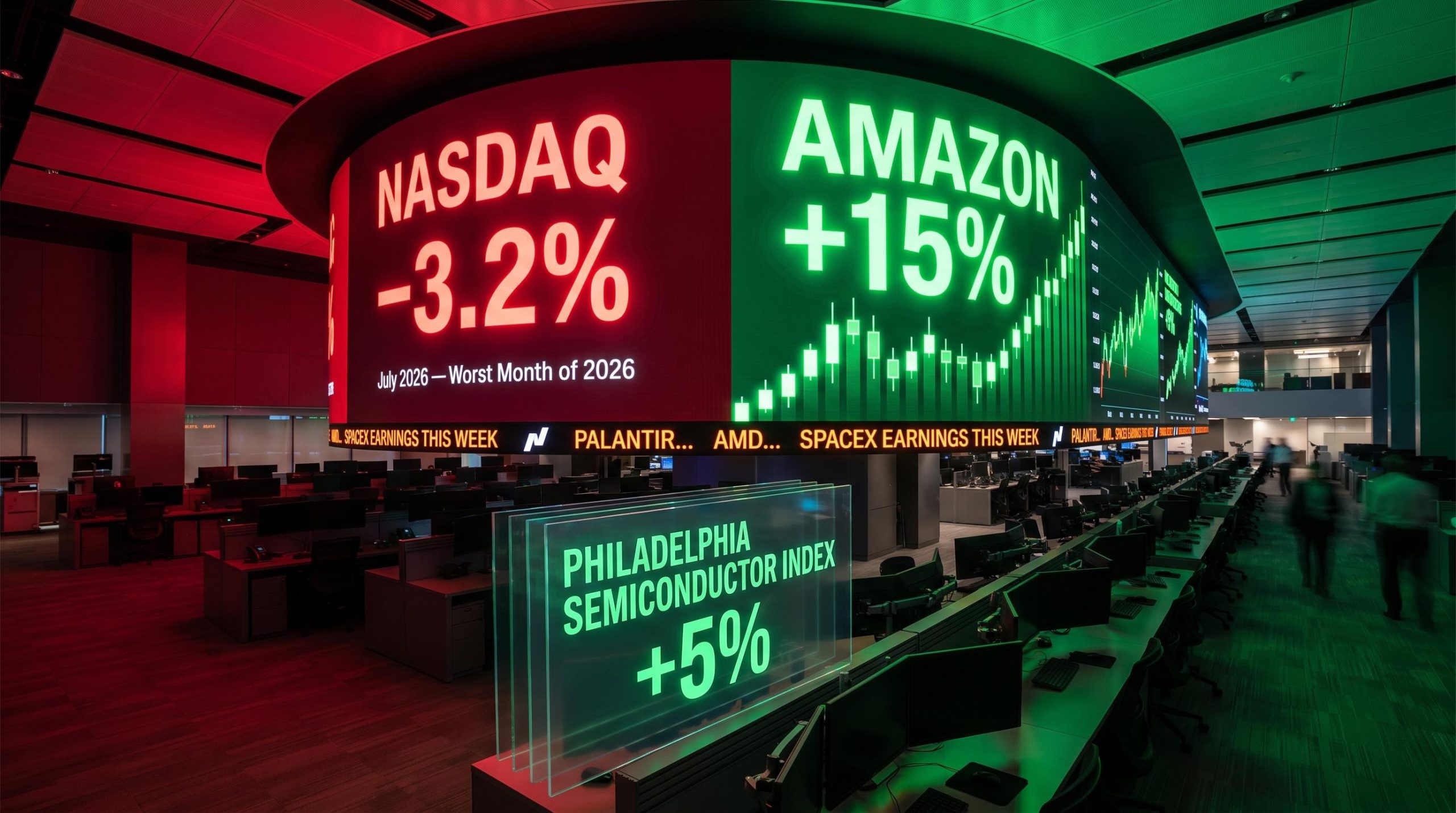
The NASDAQ Composite just closed out its worst month of 2026, dropping 3.2% through July while the S&P 500 and Dow Jones Industrial Average both finished the month in positive territory. Now futures are surging, and the question is whether the bounce has legs.
The tension is real. Late-July earnings from Microsoft and Amazon gave the sector a jolt, but the recovery is still fragile. Today’s report from Palantir, followed by AMD and SpaceX on Tuesday, will determine whether the bounce firms into something durable or fades into another false start.
Here is what the latest tech stock news actually tells you: where July went wrong for the sector, what the big earnings beats signal about AI monetisation, and what to watch this week before drawing any conclusions about a turn. By the end, you will have a clear read on whether this recovery is worth acting on.
How July became tech’s worst month while the rest of the market held up
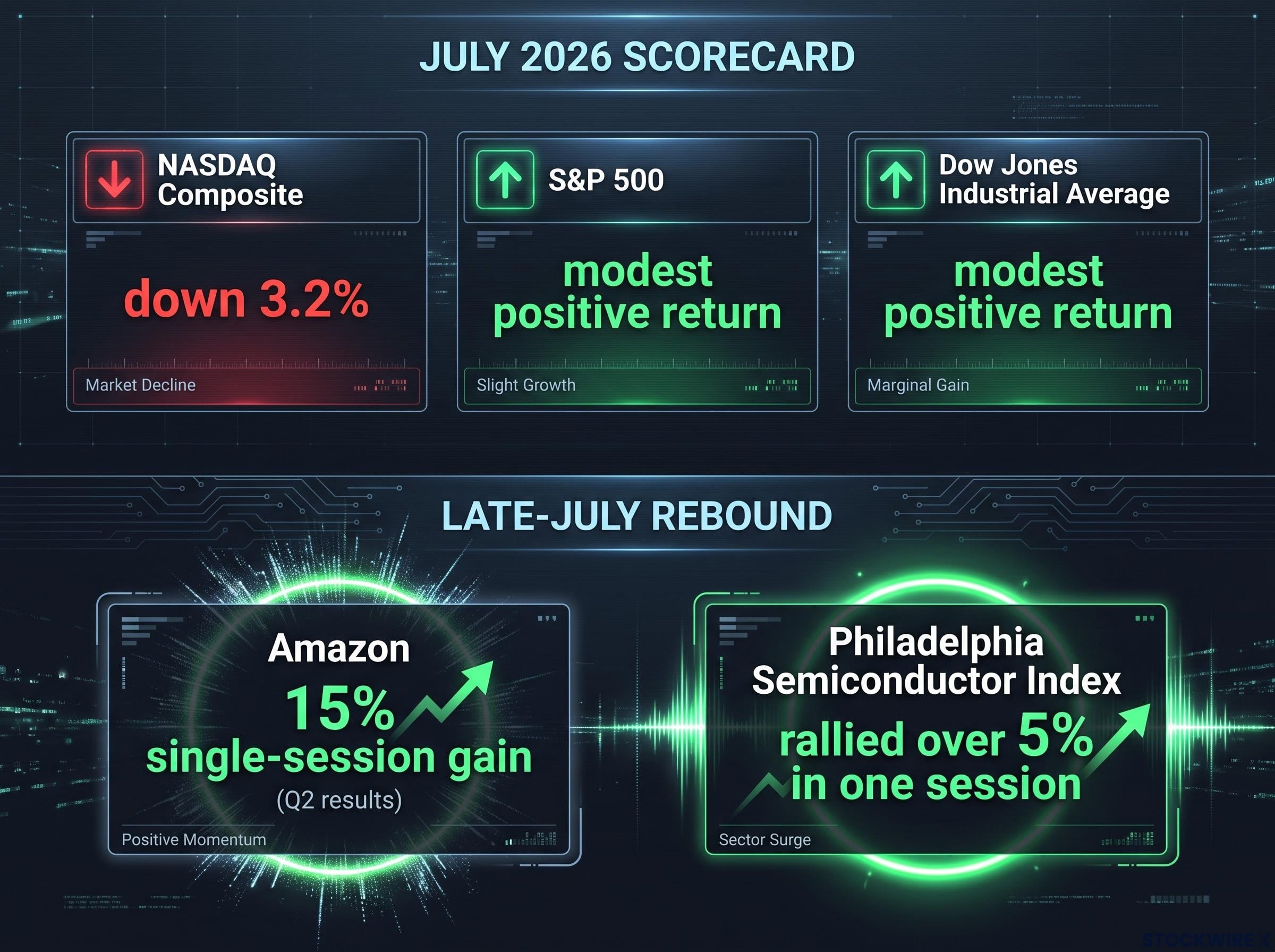
The monthly scorecards tell a pointed story:
- NASDAQ Composite: down 3.2% in July 2026
- S&P 500: modest positive return for July
- Dow Jones Industrial Average: modest positive return for July
Tech and information technology stocks were the primary drag on Wall Street’s monthly performance. But the broader market held up, which tells you something important about the nature of the weakness.
This was not a macro-driven selloff. There was no rate shock, no growth scare, no systemic event. The S&P 500 and Dow posted gains while tech bled. That pattern points to sector rotation, specifically profit-taking in the most stretched AI and growth names after a prolonged run, combined with a derating of AI expectations.
That distinction matters for what comes next. A rotation-driven selloff can reverse faster than a fundamentals-driven one, because the capital that left tech did not leave equities entirely. It moved sideways.
Sector rotation in 2026 has been one of the defining market dynamics of the year: institutional capital exiting stretched AI and mega-cap technology valuations has moved into energy, industrials, healthcare, and real estate, with energy gaining more than 22% year-to-date against a broad US market return of under 1%.
When big ASX news breaks, our subscribers know first
Microsoft and Amazon’s Q2 results gave the sector a reason to buy again
The late-July bounce was not random. It had names attached.
Amazon posted a 15% gain in a single trading session on the back of its Q2 results, representing the sharpest single-stock earnings reaction of the entire reporting period.
The same week, the Philadelphia Semiconductor Index rallied over 5% in one session, and information technology led sector gains even while the S&P 500 and Dow were relatively flat.
What made these reactions so sharp was not just the headline beats. Investors were rewarding something specific:
- Expanding margins, not just growing revenue
- Forward guidance that held or improved, signalling confidence
- Evidence that AI investment is translating into real revenue, not just higher capex
When systemic names like Microsoft and Amazon deliver on all three, the market reads it as a sector-wide signal about the health of enterprise IT, cloud, and AI demand. These are not isolated company stories. They are bellwethers. Amazon’s 15% single-day move and the semiconductor index’s 5%-plus session tell you institutional investors were sitting on cash, waiting for a credible reason to buy back into tech. These results gave them one.
What the AI spending debate actually looks like right now
To make sense of why earnings reactions have become so binary in 2026, you need to understand a structural shift in how investors evaluate AI spending.
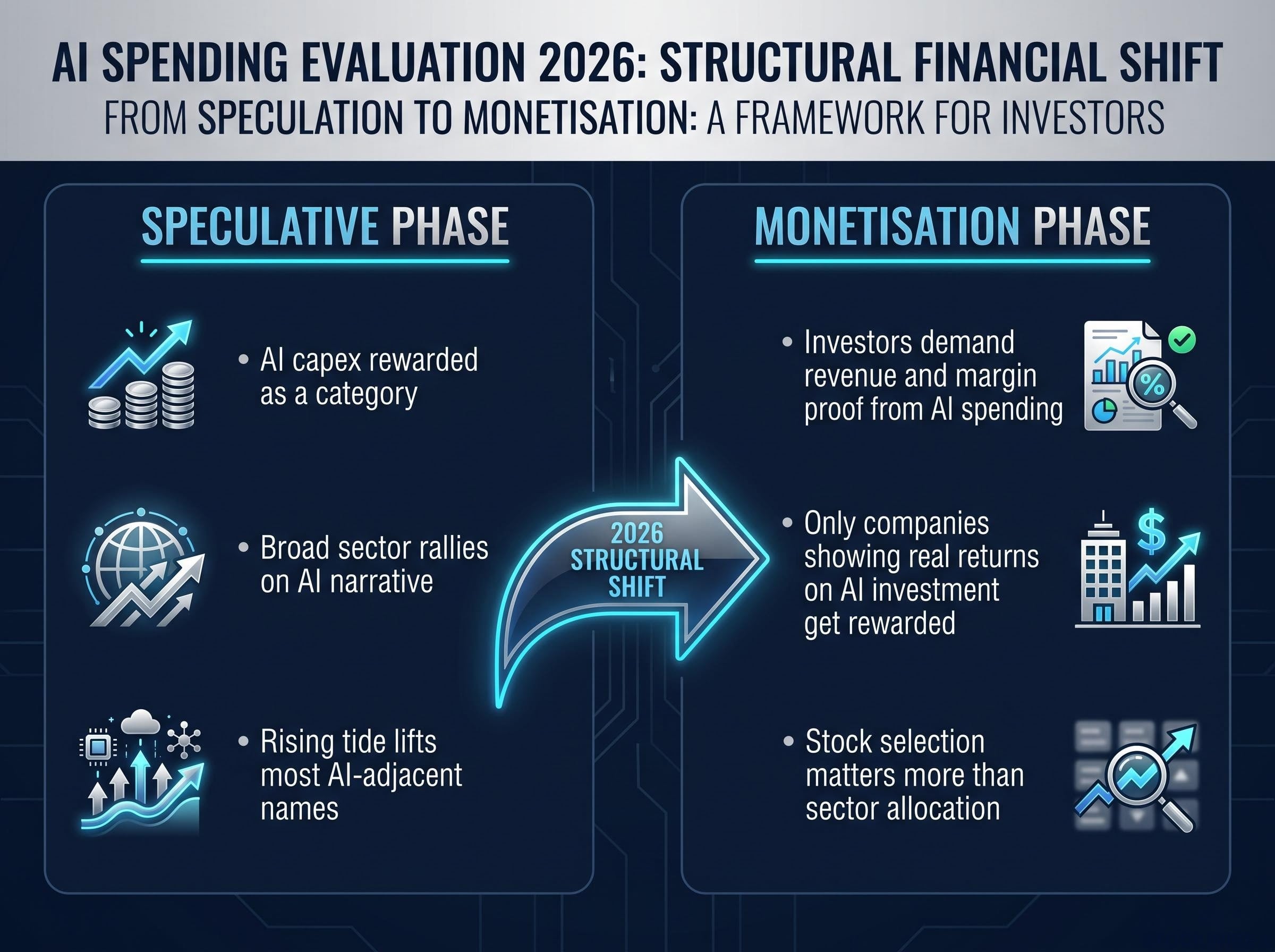
The AI investment cycle has two distinct phases. The first, the speculative phase, is where investors reward any company spending on AI infrastructure. The second, the monetisation phase, is where investors demand proof that the spending is generating revenue and improving margins. July’s price action shows the market has crossed from one to the other.
Here is how the two phases differ:
Speculative phase:
- AI capex rewarded as a category
- Broad sector rallies on AI narrative
- Rising tide lifts most AI-adjacent names
Monetisation phase:
- Investors demand revenue and margin proof from AI spending
- Only companies showing real returns on AI investment get rewarded
- Stock selection matters more than sector allocation
This explains why most Q2 tech companies beat consensus estimates but only a minority saw meaningful post-earnings rallies. Investors are no longer paying for the promise. They are paying for the proof.
Wall Street’s AI monetisation framework has moved decisively away from rewarding capex announcements: five analyst actions in a single week in late July confirmed that measurable usage, paying customers, and EPS flow-through are now the minimum threshold for a premium multiple, explaining why only a minority of Q2 beats translated into meaningful post-earnings rallies.
If you are holding a broad tech position, the monetisation phase means the days of a rising tide lifting all AI-adjacent stocks are over. The rotation pattern in July, from AI hardware and chip positions into software and enterprise AI adoption beneficiaries, reflected exactly this shift.
Three earnings reports this week that could decide whether the bounce holds
Three reports this week test different layers of the technology stack. Together, they will tell the market whether the recovery is broad or just megacap-deep.
| Company | Report Date | Sector Layer | Key Metric to Watch |
|---|---|---|---|
| Palantir | August 3 | AI Software | Operating margin and forward guidance |
| AMD | August 4 | AI Hardware | Data centre GPU share and gross margin |
| SpaceX | August 4 | Space and Communications | Starlink subscriber growth and free cash flow path |
Palantir reports today. The focus is on the split between government and commercial contract growth, operating margin trajectory, and whether forward guidance validates the company’s premium AI and data analytics valuation. A strong margin print would signal that AI software platforms can scale profitably, not just grow revenue.
AMD reports on Tuesday, 4 August. Markets want evidence that MI-series GPUs are gaining share against incumbents in hyperscale AI workloads. Data centre revenue growth needs to more than offset legacy PC headwinds, and gross margin will function as a read on whether AI chip supply and demand are normalising or still overheating.
SpaceX also reports on Tuesday, and the occasion marks a significant milestone: the company is releasing its quarterly financial results to the public for the very first time. Markets will focus on Starlink subscriber growth and average revenue per user, launch services economics and margins, and the Starship capital expenditure path toward positive free cash flow. Beyond SpaceX itself, a transparent, credible financial profile could re-rate the entire commercial space and satellite-communications sector.
If Palantir delivers on AI software margins, AMD confirms AI hardware demand is broadening, and SpaceX shows Starlink is scaling economically, the combined signal would make July look like a rotation scare rather than a structural break.
Why the recovery could still stall before it confirms
The same factors driving the bounce are also the conditions under which a reversal happens fast. Before reading the late-July move as confirmation, consider the three categories of risk that remain live:
- Valuation and crowded positioning: AI leaders and major cloud platforms remain priced for sustained strong growth. Crowded trades can reverse sharply on any sign of capex fatigue or slower AI adoption.
- Technical bounce, not fundamental turn: Chip stocks recaptured only around 10% of their drawdown from recent peaks during late-July sessions. That is real progress, but 90% of the drawdown is still sitting on the books.
- Second-tier tech exposure: Mid-cap and smaller tech firms face disproportionate punishment when they miss on margins or lean too heavily on long-dated AI promises without near-term profitability proof.
Analysts have characterised the chip rebound as “encouraging, but still fragile and easily reversible.”
Tech stock volatility heading into this earnings week is running at documented extremes: April and May 2026 posted the second and third highest monthly return dispersion readings in 30 years of MSCI data, and thin August-September liquidity amplifies every earnings reaction, meaning the binary pattern of severe punishment for margin misses has a structural amplifier behind it.
A single disappointing earnings report from a key name this week could erase the bounce quickly. The highly binary earnings reaction pattern, where margin misses and weak guidance get punished severely, means the recovery’s hold on the sector is only as strong as the next result.
What a confirmed recovery actually requires from here
A full recovery of July’s NASDAQ losses is plausible over the coming quarter, but it requires three conditions to hold simultaneously:
- Megacap earnings remain strong, with no AI or cloud slowdown flagged in forward guidance
- Second-tier names show improving profitability and disciplined AI investment, not just revenue growth
- Macro conditions stay broadly supportive, with no upside surprise in interest rates and no downside surprise in economic growth
The more probable path, however, is choppy upside. That looks like:
- Ongoing leadership by a handful of megacap platforms
- Wide dispersion between AI winners and names that cannot translate AI narratives into earnings
- Short, sharp pullbacks when positioning gets crowded or a major name disappoints
The distinction between a full recovery and a choppy partial one is not academic. It determines whether you add broadly to tech now or wait for this week’s reports to confirm the signal before acting. The environment favours selective exposure to high-quality, cash-generative tech with clear AI monetisation, rather than broad sector bets, until earnings clarify whether the current rebound can evolve into a sustained recovery.
For investors wanting to map the rotation pattern described here onto specific portfolio decisions, our dedicated guide to AI portfolio layers covers the six distinct segments of the AI value chain, from semiconductors to software, each with different S-curve positions and risk levels that the current megacap-led recovery treats very differently.
This article is for informational purposes only and should not be considered financial advice. Investors should conduct their own research and consult with financial professionals before making investment decisions. Past performance does not guarantee future results. Financial projections are subject to market conditions and various risk factors.