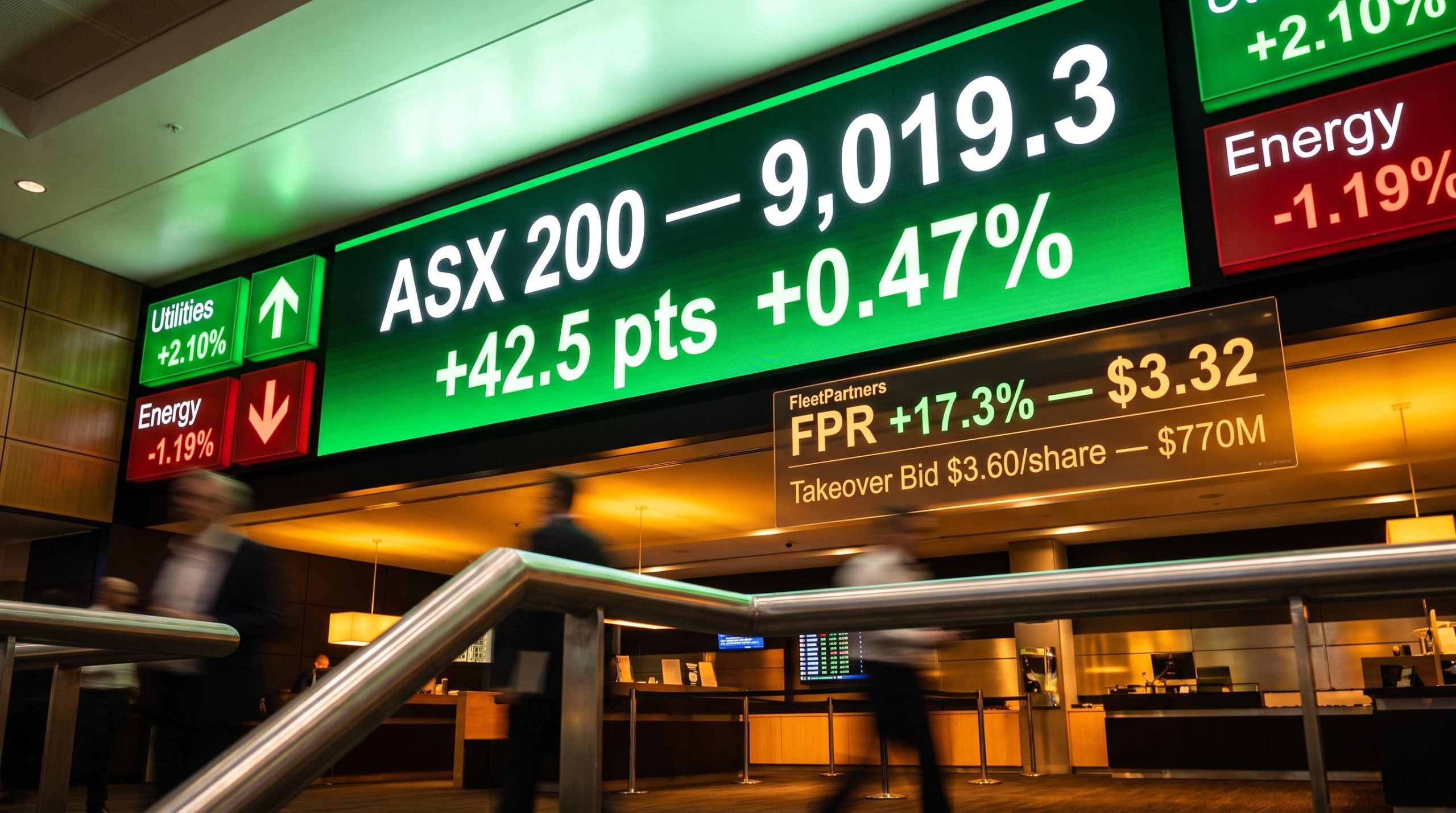
The S&P/ASX 200 closed at 9,019.3 on Monday, up 42.5 points or 0.47%, placing the index within roughly 2% of its all-time high after a programmed institutional buy order swept through major blue chips in the mid-afternoon.
This was not a routine up-day. Advancing stocks outnumbered decliners by two-to-one across the ASX 300, nine of eleven sectors finished in the green, and an unsolicited takeover bid for FleetPartners Group injected genuine M&A energy into the session. The KOSPI shedding more than 5% in South Korea that same day, combined with the calendar position at the start of a new month, are both plausible explanations for the size and timing of the institutional flow, though neither can be confirmed from public data.
Here is what the session actually tells you: which sectors led and which lagged, which individual stocks moved on hard catalysts versus momentum, what the institutional buying concentrated on, and what variables are worth monitoring before the index tests its record again.
How the index finished and how close the record really is
The index ended the day right at its intraday peak, a sign that buying pressure had not yet exhausted itself by the time the closing bell rang. The All Ordinaries kept pace, while the smaller-cap and tech benchmarks outperformed meaningfully:
- S&P/ASX 200: 9,019.3, up 42.5 points (+0.47%)
- All Ordinaries: 9,178.4, up 0.45%
- Small Ordinaries: 3,341.2, up 0.80%
- All Technology Index: 2,967.0, up 0.95%
The all-time price-index high remains 9,202.9, set on 26 February 2026. Monday’s close sits approximately 2% below that peak.
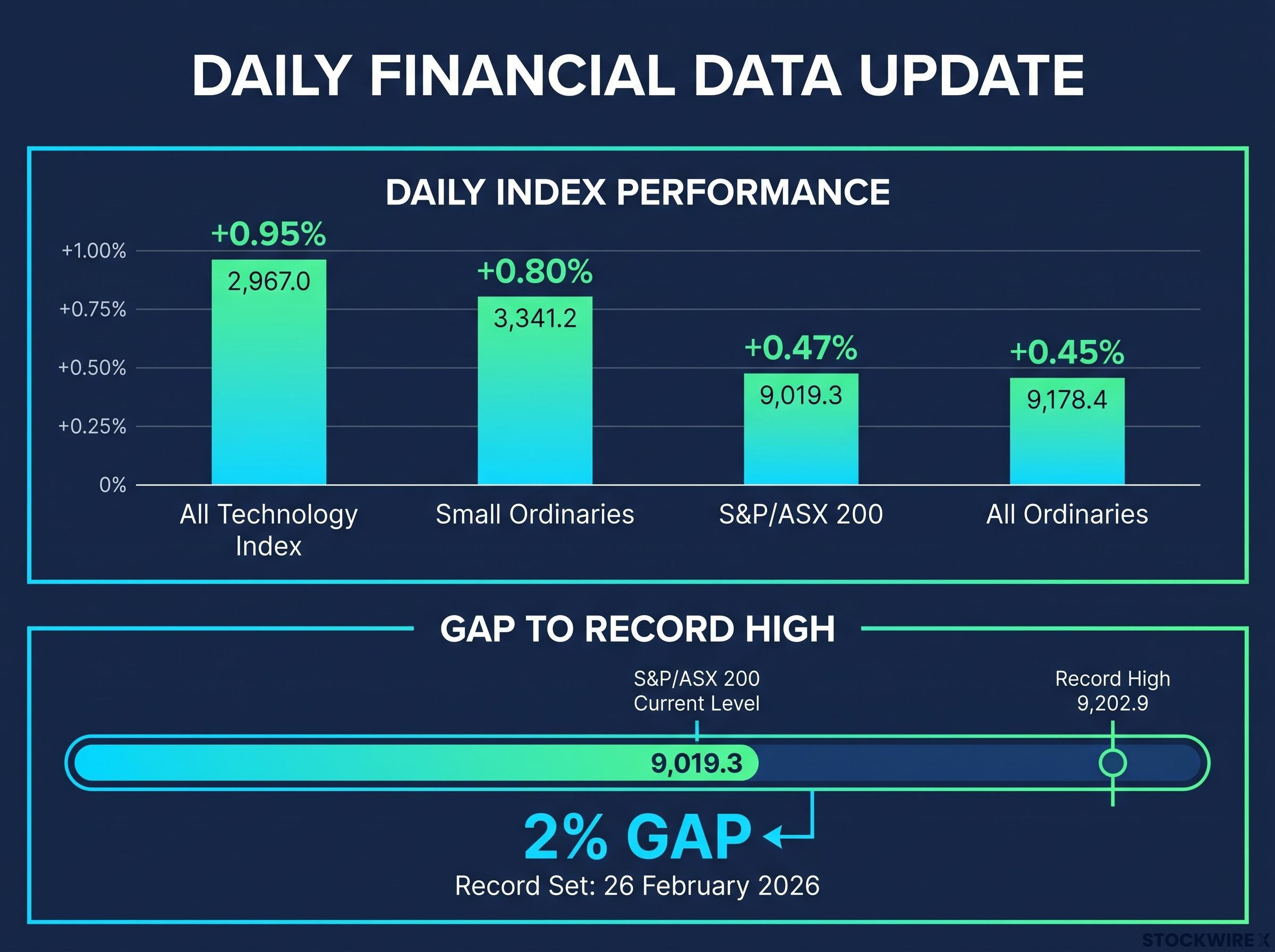
That gap is close enough to matter for anyone watching for a breakout, but the real signal is in the sub-index performance. The Small Ordinaries and the All Technology Index both outpaced the headline number, which tells you that risk appetite on Monday extended well beyond the defensive blue chips targeted by the institutional order. Smaller names and tech names participated more strongly than the large-cap benchmark, a pattern more consistent with genuine breadth than a narrow programmatic bid lifting only the heaviest weights.
When big ASX news breaks, our subscribers know first
The institutional buy order that reshaped the afternoon
A substantial programmed institutional buy order entered the market during the 2:00pm to 2:30pm AEST window, with activity concentrated in the major banks, diversified miners, Wesfarmers, and Telstra. The index had been grinding higher through the morning, but the late-session surge pushed it to close at the day’s highs.
Two contextual explanations are plausible. The first is regional rotation.
South Korea’s KOSPI fell more than 5% on 3 August, its sharpest single-session decline in months.
When a neighbouring Asia-Pacific market suffers that kind of stress, institutional capital has historically sought liquid alternatives, and the ASX’s blue-chip universe fits that profile. The second explanation is simpler: the first trading day of the month is a well-documented window for new institutional allocations and portfolio rebalancing. Both could be at work simultaneously. Neither is provable from public data alone.
ASX 200 August seasonality data going back to 1980 shows an average monthly price return of 0.71%, but concentrated earnings-day swings from index-heavyweight banks and miners have repeatedly broken that pattern in recent years, a dynamic that adds context to any institutional flow arriving on the first trading day of the month.
What is verifiable is the breadth. Within the ASX 300, 180 stocks finished higher while only 89 ended lower. That ratio held across the full session, not only during the buy-order window, which means the rally had genuine spread rather than being entirely manufactured by a single programme.
For you, the distinction matters. Whether this reflects genuine bullish conviction or defensive repositioning away from a stressed Korean market is an open question, and it shapes whether the afternoon strength is likely to carry into subsequent sessions or fade once the flow normalises.
What the sector scorecard reveals about where money moved
Ten of eleven sectors ended the session in positive or flat territory, with only Energy recording a meaningful loss. The full breakdown:
| Sector | Change (%) | Closing level |
|---|---|---|
| Utilities | +2.10% | 9,788.8 |
| Industrials | +1.36% | 8,458.4 |
| Consumer Discretionary | +1.10% | 4,074.4 |
| Consumer Staples | +1.03% | 13,481.4 |
| Health Care | +1.02% | 26,904.9 |
| Information Technology | +0.80% | 1,784.5 |
| Financials | +0.41% | 9,935.6 |
| Materials | +0.30% | 23,256.5 |
| Real Estate | +0.01% | 3,638.5 |
| Communication Services | -0.01% | 1,639.3 |
| Energy | -1.19% | 10,519.3 |
Utilities topped the sector leaderboard, posting a +2.10% advance that left every other sector behind.
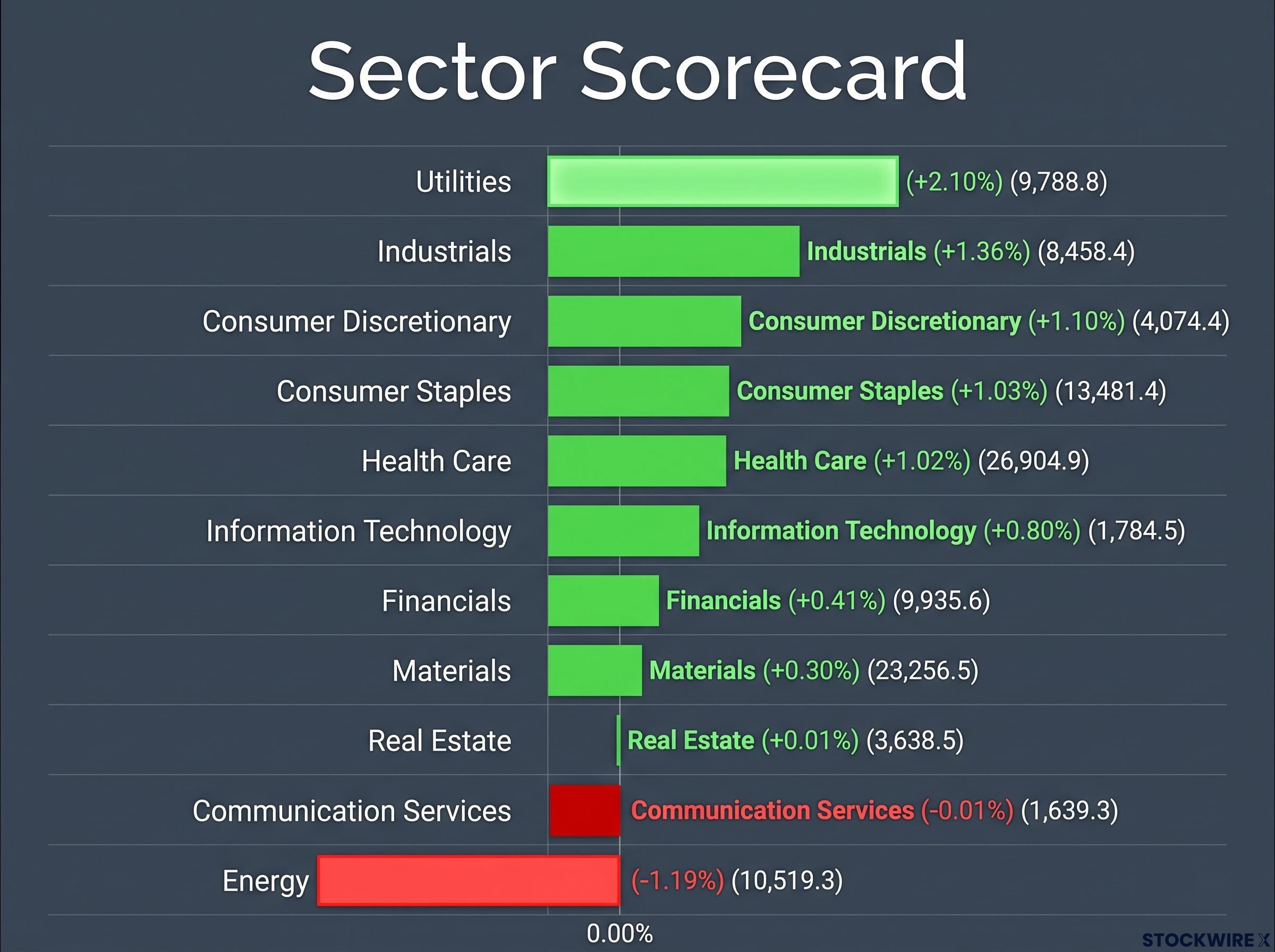
Three patterns stand out. First, the leaders are defensive: Utilities, Consumer Staples, and Health Care all gained more than 1%. Defensive sectors are those that tend to hold their earnings regardless of the economic cycle, think electricity providers, supermarkets, and hospitals. When institutional money flows to these names rather than to cyclicals like Materials or Energy, it signals a preference for stability and yield over growth.
Second, the only sector to fall meaningfully was Energy, down 1.19%, consistent with weaker commodity pricing in the broader period rather than any single company event.
Third, Financials gained just 0.41% despite the institutional order reportedly targeting major banks. That is a modest move for a sector that absorbed a significant programmatic bid, which suggests the order was large enough to be notable but not large enough to create outsized single-session returns in the most liquid names on the exchange.
The defensive tilt in sector leadership tells you that institutional buyers on Monday favoured stability over commodity-exposed growth. That is a risk-off signal dressed in a green headline number.
Defensive sector rotation of this kind, where institutional capital favours utilities, staples, and healthcare over materials and energy in a broadly rising market, is a recognisable pattern in late-cycle positioning, one that historically precedes a period of compressed returns for commodity-exposed names.
FleetPartners, defence names, and the stocks that moved on a reason
Monday’s standout single-stock catalyst was FleetPartners Group (FPR), which jumped 17.3% to close at $3.32 after the company disclosed an unsolicited acquisition approach from SG Fleet Topco. The proposal is pitched at $3.60 per share, placing the implied transaction value at around $770 million, with completion conditional on due diligence and regulatory sign-off.
The gap between Monday’s closing price and the offer price represents a potential 8.4% return if the deal completes. But the stock traded below the bid for a reason: due-diligence and regulatory conditions introduce real uncertainty, and the market priced that conditionality in.
Australian M&A deal mechanics, including the distinction between schemes of arrangement and takeover bids and how each affects the final offer price, determine how much of the theoretical spread is realistically attainable once conditionality is priced in.
The top catalyst-driven gainers:
- FleetPartners (FPR): +17.3% to $3.32; SG Fleet Topco takeover proposal at $3.60/share
- Benz Mining Corp (BNZ): +12.8% to $3.89; investor presentation at the Diggers and Dealers conference in Kalgoorlie (up 489.4% over one year)
- Elsight (ELS): +10.4% to $6.17; company announcement combined with broader tailwinds across the defence sector (up 237.2% over one year)
- 4DMedical (4DX): +9.1% to $3.96; ongoing positive sentiment from the quarterly update published the previous Friday
Defence names moved as a cluster without company-specific news:
- DroneShield (DRO): +7.1% to $1.815 (down 50.0% over one year)
- Electro Optic Systems (EOS): +3.7% to $6.94 (up 129.0% over one year)
Liontown Resources also gained ground on the back of its own presentation to the Diggers and Dealers conference in Kalgoorlie.
The distinction matters. FleetPartners has a defined catalyst with a specific price and identifiable conditions. The defence names rode sector momentum that could reverse in the next session without warning. Knowing which category your holding falls into shapes whether the trade has defined risk parameters or is purely directional.
Which stocks fell and why the Energy sector dragged
Aeris Resources (AIS) was the session’s most consequential single-stock decliner, dropping 7.4% to $0.38. The company’s FY27 production and cost guidance was the trigger: output is expected to remain largely flat compared with FY26, while growth capital spending is set to rise materially, exploration expenditure will increase, and care-and-maintenance costs at the Jaguar operation are forecast to fall sharply. Investors read the combination of stagnant volumes and rising costs as a negative signal.
Fortescue (FMG) shed 3.8% to finish at $17.80, compounding a 6.1% slide over the prior month. The session produced no new company announcement; instead, the move coincided with a wave of broker price target reductions and a pronounced drop in Singapore-listed benchmark iron ore futures, both of which appeared to be follow-on reactions to the quarterly update the company lodged the previous Friday.
That matters beyond a single session. When multiple brokers cut their targets after a quarterly update, it signals that analyst expectations for iron ore earnings are being revised lower on a structural basis. If you hold FMG or have broader Materials exposure, this is a signal to reassess the thesis rather than dismiss as one-day noise.
Energy stocks under commodity pressure
The Energy sector’s 1.19% decline was driven by a cluster of names falling on weaker commodity pricing rather than company-specific events:
- Santos (STO): -1.9% to $7.69
- Viva Energy (VEA): -2.1% to $2.79
- Yancoal (YAL): -1.8% to $5.47
These moves share a common driver. When the entire sector declines on a day when the broader market rallies, it points to commodity-level weakness rather than anything correctable at the company level.
Other notable decliners included Star Entertainment (SGR), down 3.6% to $0.135, and LendLease (LLC), down 1.6% to $2.98 (down 43.5% over one year).
What today’s session position means for the week ahead
The index sits 2% below the all-time high of 9,202.9. That gap is narrow enough that the next significant catalyst, whether positive or negative, is likely to be decisive rather than incremental.
Conditions that close the gap include sustained institutional demand beyond the initial programme order, stabilisation in commodity prices (particularly iron ore), and continued M&A activity that lifts sentiment across adjacent sectors. Conditions that reinforce the resistance include persistent Energy sector drag, further broker downgrades in the Materials space, and any continuation of KOSPI-driven regional stress that pressures Asia-Pacific risk appetite.
Index breadth and support levels from the prior month provide the baseline against which Monday’s two-to-one advancing ratio should be assessed; the 8,656-8,708 support band identified in late July remains the most consequential floor if institutional demand fades before the all-time high is tested.
The FleetPartners deal introduces a live corporate activity signal. If SG Fleet Topco proceeds through due diligence, the implied 8.4% spread to the offer price narrows, and market participants may begin reassessing valuations in adjacent fleet-management and leasing names.
Variables worth monitoring this week:
- Iron ore futures direction, particularly Singapore benchmarks that drive FMG and broader Materials sentiment
- FleetPartners due diligence progress and any formal response from the FPR board
- Whether KOSPI-driven regional rotation persists or reverses as Korean markets stabilise
- Broader institutional flow data to confirm whether Monday’s programmed order was an isolated event or the beginning of a new allocation cycle
The headline number matters less than what sits underneath it. Watching these specific variables will tell you more about the index’s next move than the index level itself.
This article is for informational purposes only and should not be considered financial advice. Investors should conduct their own research and consult with financial professionals before making investment decisions. Past performance does not guarantee future results.