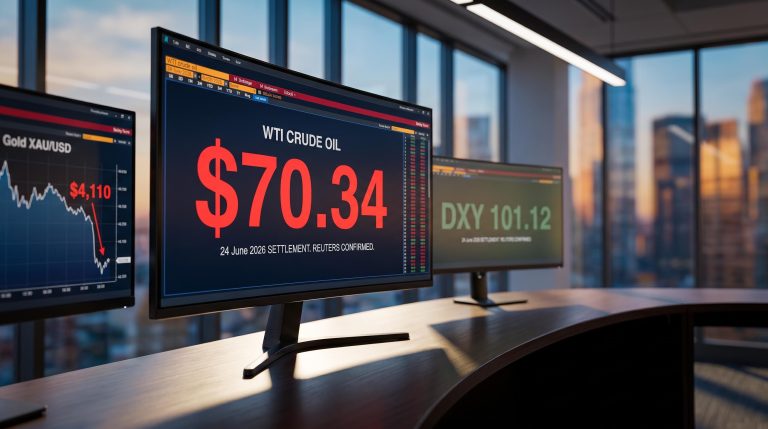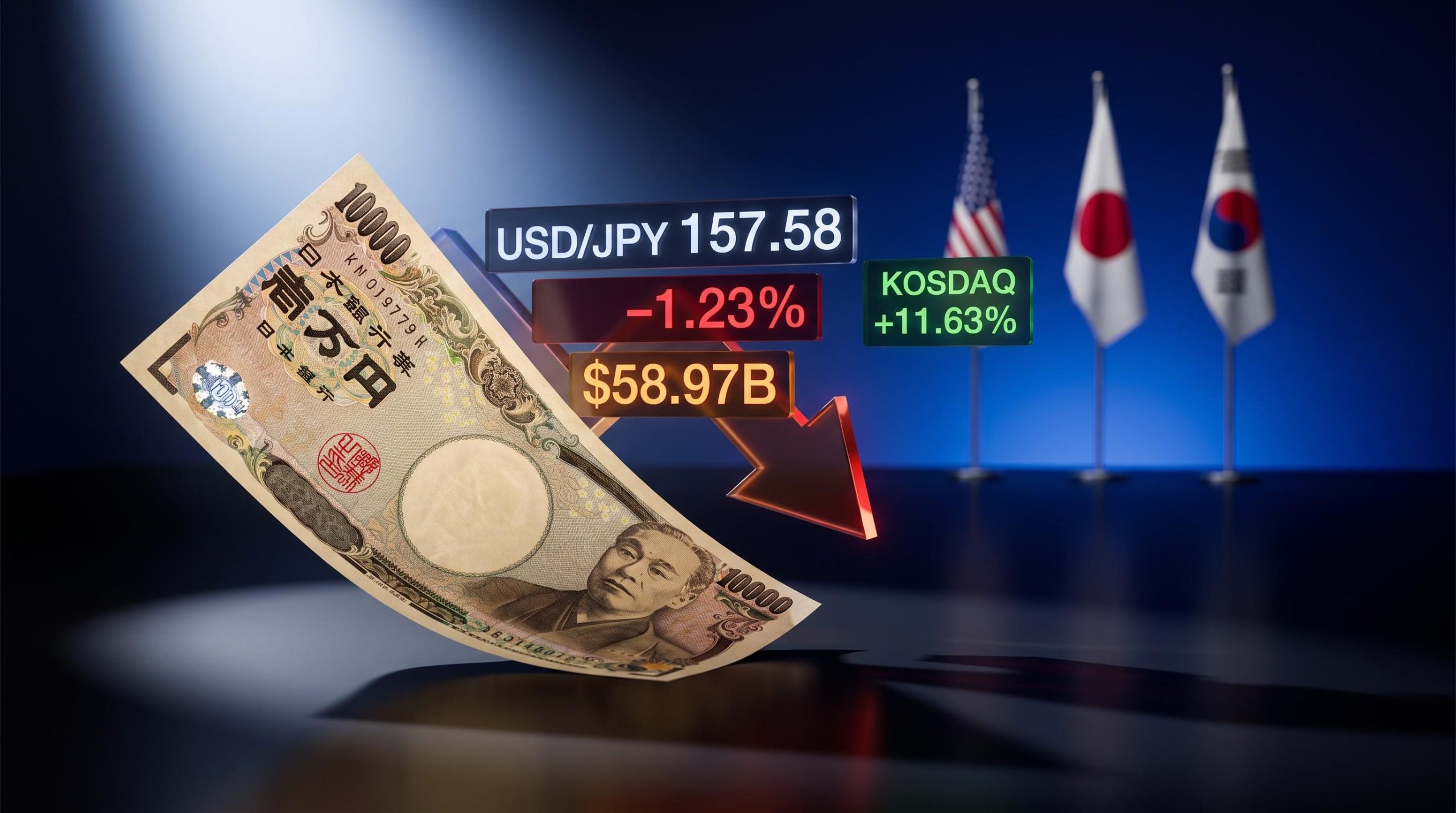
On 1 August 2026, the Federal Reserve Bank of New York sold euros and bought yen through major dealers, acting on behalf of the US Treasury. It was the first time Washington had directly supported the Japanese currency in more than a decade.
All three countries acted in concert rather than independently. Japan and South Korea moved at the same time as the US, forming an unusual trilateral arrangement that observers across the region noted as exceptional. The surface trigger was extreme currency weakness: the yen had approached 40-year lows and the won was under sustained pressure. But Bank of America strategist Michael Hartnett argues the motivations run considerably deeper than stopping a currency slide.
Two frameworks explain the same event. One is well-documented in official communications and market reporting. The other is analytically inferred from the broader architecture of US technology policy. Here is how to evaluate which lens is doing more explanatory work, and why the answer matters before the next move happens.
What the US Treasury actually did, and why it has not done it in years
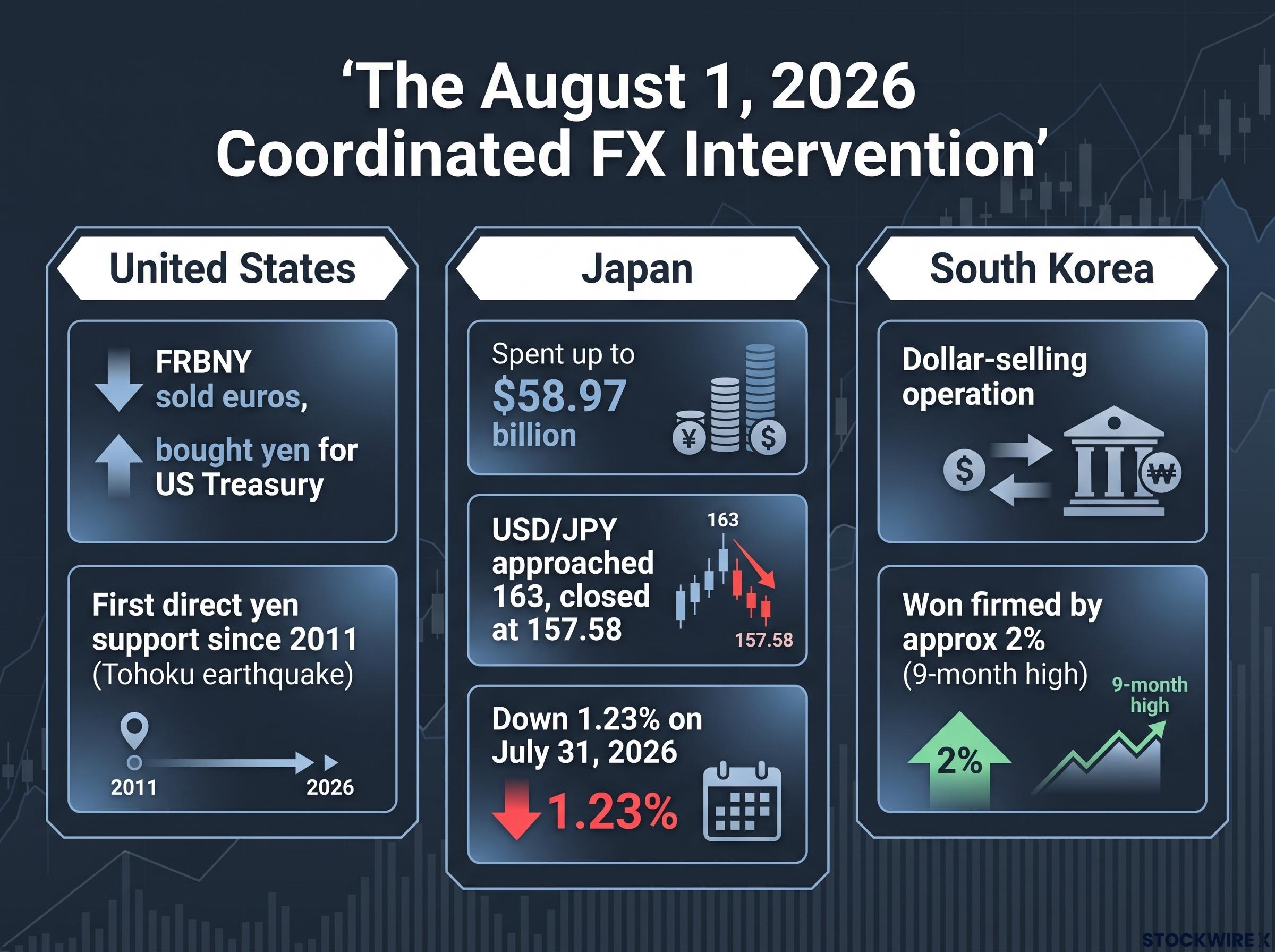
The mechanics were specific. The FRBNY sold euros to buy yen through major dealers on 1 August 2026, acting for the US Treasury. Japan’s Ministry of Finance simultaneously intervened, with Bank of Japan data suggesting the government spent up to $58.97 billion defending the yen. Seoul’s foreign exchange authorities conducted a parallel dollar-selling operation that firmed the won by approximately 2%, pushing it to its strongest level in roughly nine months.
The three-country action broke down as follows:
- United States: FRBNY sold euros and bought yen on the Treasury’s behalf, the first direct US yen support since 2011
- Japan: Massive yen-buying, dollar-selling intervention after USD/JPY approached 163; USD/JPY closed at 157.58, down 1.23%, on 31 July 2026
- South Korea: Rare coordinated dollar-selling that market participants explicitly described as occurring alongside Japan’s operation
Before the operation, the US Treasury had instructed several banks to “stand ready for future action” in the yen market, indicating preparation rather than a panic response.
That pre-positioning detail is what separates this from an emergency reaction. The Treasury did not wake up to a crisis and scramble. It prepared counterparties in advance, which tells you this was a deliberate policy choice with strategic intent. That distinction matters when evaluating what motivated it.
The last comparable US yen-buying action was the G7 coordinated response following the 2011 Tohoku earthquake and tsunami, more than 15 years prior. A gap that long does not close without a reason significant enough to change the calculus.
The August 2026 operation sits in direct contrast to Japan’s prior approach: months of unilateral yen defence that consumed a record $72 billion yet still saw USD/JPY reach 162.40 on 29 June 2026, the weakest yen since 1986, before the three-way coordination finally changed the intervention calculus.
When big ASX news breaks, our subscribers know first
Why allied technology ecosystems became a US policy concern
Before the geopolitical argument is stated, the supply-chain architecture makes it visible. Three US allies occupy irreplaceable positions in the semiconductor stack:
- Taiwan: Leading-edge chip fabrication, dominated by TSMC
- South Korea: Memory production, controlled by Samsung and SK Hynix
- Japan: Semiconductor equipment, specialty materials, and chemicals
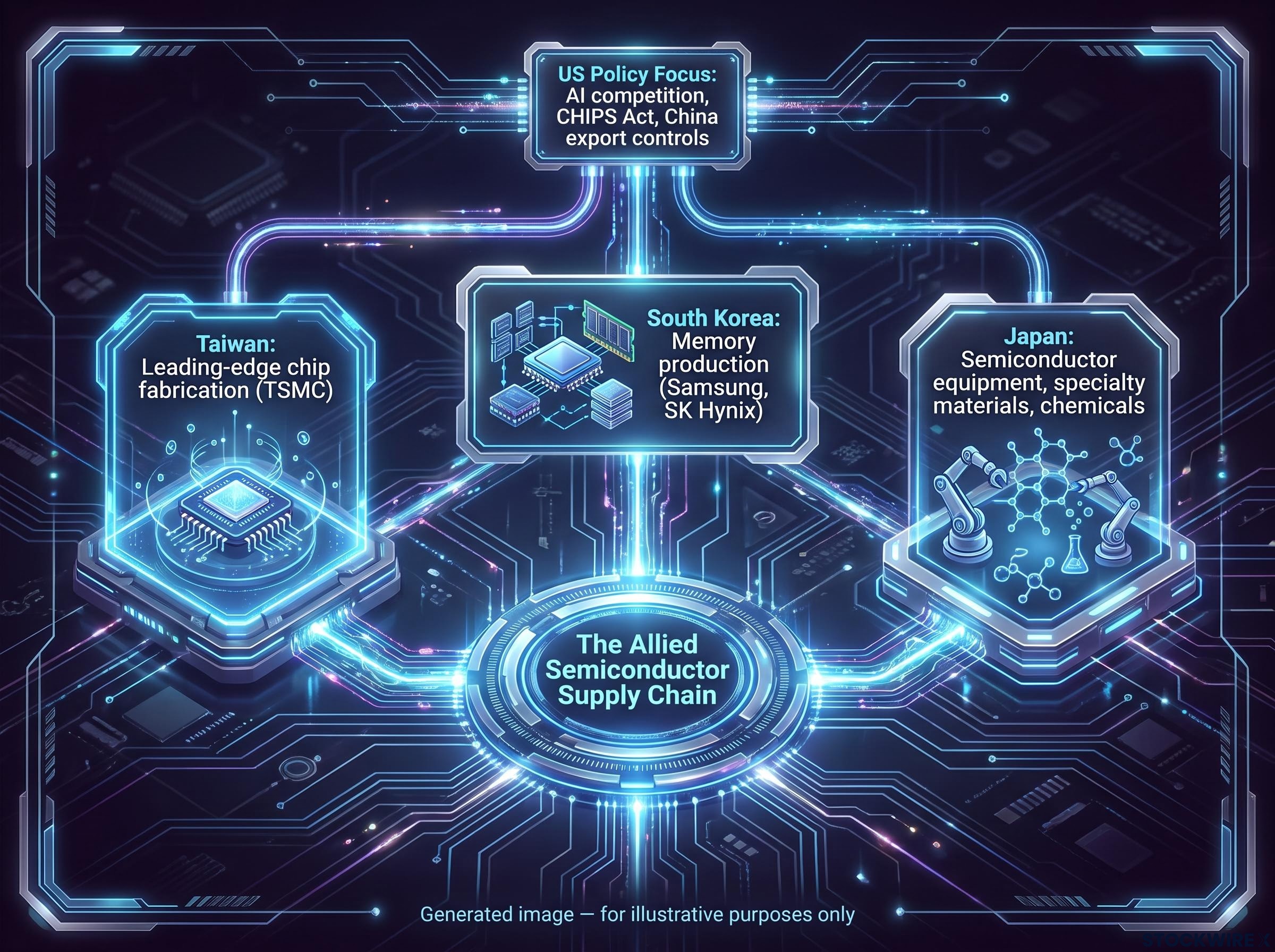
Large-scale AI training and inference require advanced GPUs, CPUs, and high-bandwidth memory at volumes that only this coalition can supply. Whoever controls reliable access to those chips holds a structural advantage in the US-China AI race. Washington has already operationalised this logic through the CHIPS Act and export controls restricting China’s access to advanced semiconductor technology.
The Taiwan semiconductor supply chain anchors this vulnerability most acutely: TSMC produces approximately 90% of the world’s leading-edge chips below the 5nm node, meaning any financial or geopolitical disruption to the island creates a simultaneous input failure for AI accelerators, automotive systems, and virtually every major technology product category.
That national-security framing is well-established in US policy. What has not appeared, however, is any explicit link between semiconductor strategy and FX-specific intervention communications.
Why market instability in these countries is a US technology problem
Financial market stress in these three countries is not an abstract concern for Washington. It has a direct transmission path into technology investment capacity. If equity markets in Taiwan, South Korea, or Japan destabilise, the consequences flow through to research and development budgets, fabrication facility construction timelines, and the ability to attract and retain engineering talent.
These are not incidental trade partners. They are structural nodes in the architecture of US-China AI competition. Hartnett argues that FX policy is now being quietly aligned to the same hierarchy of interests that drives CHIPS Act spending and China export controls. The question for readers is whether that alignment holds in future episodes, because if it does, currency intervention becomes a regular instrument of technology policy rather than a one-off.
In Hartnett’s view, the semiconductor and technology supply chains concentrated across Japan, South Korea, and Taiwan are so central to the outcome of US-China AI competition that Washington cannot afford to let currency stress erode their financial stability.
How policymakers have redefined strategic market stabilisation in the technology era
“Price keeping operations,” or PKOs, historically refer to government or central-bank actions intended to stabilise or support asset prices. The term is most closely associated with the Bank of Japan’s long-running interventions in Japanese equity markets, where authorities bought shares directly to prevent destabilising declines.
Hartnett extends the concept. In his framework, the AI-era PKO is not a domestic central bank propping up a local index. It is a coalition-level effort to prevent equity and currency deterioration in strategically significant technology partners. The motivation shifts from defensive market management to proactive geopolitical positioning.
| Attribute | Classical PKO | AI-era PKO (Hartnett’s framework) |
|---|---|---|
| Trigger | Domestic equity weakness | Currency or equity stress in allied tech economies |
| Geographic scope | Single country | Coalition (US, Japan, South Korea, Taiwan) |
| Asset class targeted | Equities | FX markets, with equity stabilisation as a secondary effect |
| Official acknowledgment | Often implicit or denied | FX action acknowledged; strategic motive not stated |
According to Hartnett, the technology supply chains concentrated in allied nations carry enough strategic weight in the AI race that currency-driven destabilisation in those economies represents an unacceptable risk for US policymakers.
Bank of America references the KOSDAQ index, South Korea’s technology- and growth-oriented equity benchmark, using a chart spanning October 2022 to July 2026 as a geopolitical indicator rather than merely a growth proxy. If Hartnett’s framing is correct, severe drawdowns in KOSDAQ or Taiwan semiconductor indices become potential policy triggers, not just local market events, because they now carry geopolitical signal value.
The KOSPI technology selloff of 15 May 2026, where Samsung fell 8.6% and SK Hynix dropped 7.7% in a single session while South Korean and global bonds fell simultaneously, is the clearest prior illustration of how sharply regional technology equity stress can transmit into cross-asset contagion, the exact scenario Hartnett’s PKO framework treats as a potential policy trigger.
How financial contagion across Asian bond markets threatened global stability
The macro-financial case for intervention follows a sequence. Each step’s logic leads to the next:
- Yen falls sharply: The yen approached approximately 163 per dollar, near 40-year lows, prompting investors to exit yen-denominated assets in search of higher-yielding alternatives
- JGB yields spike: Selling pressure in Japanese government bond markets drives yields upward, tightening financial conditions both domestically and for global investors with JGB exposure
- Regional bond contagion: Deteriorating JGB market conditions transmit into South Korean and Taiwanese bond markets, generating risk-off moves across regional equity indices
- US Treasury pressure: As capital departs Asian bond markets, US Treasuries face additional selling pressure, transforming a disorderly yen depreciation into a domestic US rates problem
What the data showed as the intervention landed
The market snapshot at the 31 July close validated the urgency. JGB prices were down 0.22%, consistent with the bond-market pressure that policymakers were trying to contain. USD/JPY had pulled back to 157.58, reflecting the intervention’s immediate impact. The KOSDAQ index was up 11.63% at the time of publication, indicating the stabilising effect on regional technology equities.
The JGB-to-US-Treasury contagion path is the detail that gives Washington direct financial skin in Japan’s currency level. A yen left to fall freely would eventually become a US rates problem. That structural linkage justifies US participation on macro-financial grounds alone, before any geopolitical argument enters the picture.
Weighing what is documented against what is inferred
The public record supports a clear, sufficient rationale: extreme yen and won weakness to multi-decade lows, documented risk of JGB contagion spreading into global bond markets, and the standard FX-stability logic evident in official statements. The Council on Foreign Relations frames the return of Asian FX intervention in precisely these terms, citing currency weakness and financial-stability concerns.
What is not in the public record is any reference to AI, semiconductors, or supply-chain strategy in official FX intervention communications.
The absence of AI or semiconductor language in official FX communications is itself a relevant evidential point when evaluating Hartnett’s framework.
Hartnett’s AI-supremacy thesis is a strategic-analytic framework, not a statement drawn from US Treasury or BOJ communications specific to this intervention. But both explanations can be true simultaneously. The macro-financial trigger was real and sufficient on its own merits. The AI-strategic backdrop raises the probability that the US crossed the coordination threshold it did, rather than leaving Japan and South Korea to act bilaterally.
| Attribute | Macro-financial rationale | AI-supremacy rationale |
|---|---|---|
| Evidentiary basis | Official statements, market data, historical precedent | Inferred from broader US semiconductor and AI policy |
| Official acknowledgment | Explicitly reflected in FX communications | No reference in intervention-specific communications |
| Explanatory power for three-way coordination | Explains why intervention occurred; less clear on why the US participated directly | Explains the unusual US involvement and three-way format |
The honest read is that the macro-financial case was decisive enough to act on its own merits. But the AI-strategic backdrop likely lowered the threshold for US participation. Readers should weight these two layers accordingly rather than choosing one and discarding the other.
What changes about how to read the next intervention
This operation signals a structural shift in the conditions that trigger US FX participation. When instability threatens countries that are not just trade partners but irreplaceable technology allies, the threshold for three-way coordinated action may be permanently lower than in prior eras.
The signals worth monitoring going forward:
- Large moves in yen or won occurring near semiconductor or AI policy decisions
- Severe drawdowns in KOSDAQ or Taiwan technology benchmarks, which may now carry policy-trigger significance beyond their local market meaning
- Whether future FX coordination is three-way (signalling US strategic engagement) or bilateral (suggesting a narrower, conventional response)
- The gap between historical US intervention thresholds, a 15-year absence prior to this operation, and whatever frequency emerges in the next cycle
Three-way simultaneous action is itself a policy communication. It demonstrates coalition willingness that goes beyond any single bilateral relationship and may deter speculative pressure on allied currencies. If yen and won levels near semiconductor policy moments become a new category of US-relevant market risk, this operation will look less like an outlier and more like a precedent.
A new policy era, or a one-off? How to position yourself for the answer
The macro-financial rationale for this intervention is documented and sufficient. The AI-strategic backdrop is analytically strong but not officially stated. Together, they explain both the decision to act and the unusual three-way format better than either explanation manages alone.
Whether this coordination becomes a repeatable pattern or remains an outlier depends on how the US-China technology competition develops and whether yen-won weakness becomes a recurring pressure point. If you take Hartnett’s framework seriously, the behaviour change is specific: treat allied technology equity markets as geopolitical indicators, not just local growth proxies, and adjust how you interpret FX policy signals accordingly.
For investors wanting to translate Hartnett’s framework into portfolio positioning, our dedicated guide to semiconductor cycle investing examines how TSMC’s $52-56 billion 2026 capital budget and the incoming 2027-2029 supply wave interact with the geopolitical stability assumptions the AI-era PKO thesis depends on.
This article is for informational purposes only and should not be considered financial advice. Investors should conduct their own research and consult with financial professionals before making investment decisions. These statements are speculative and subject to change based on market developments and policy decisions.