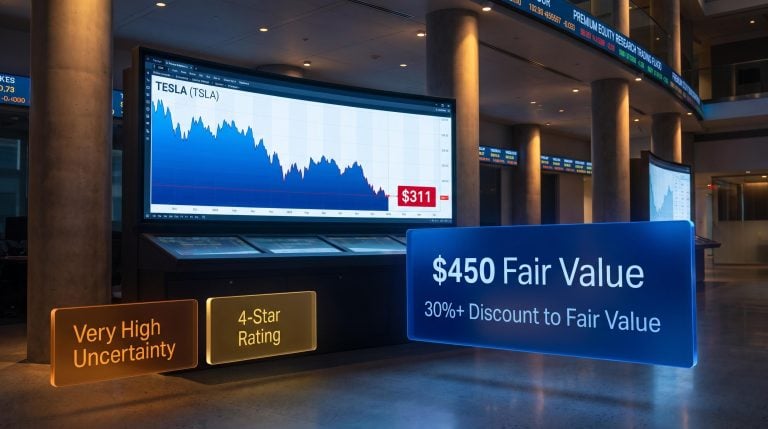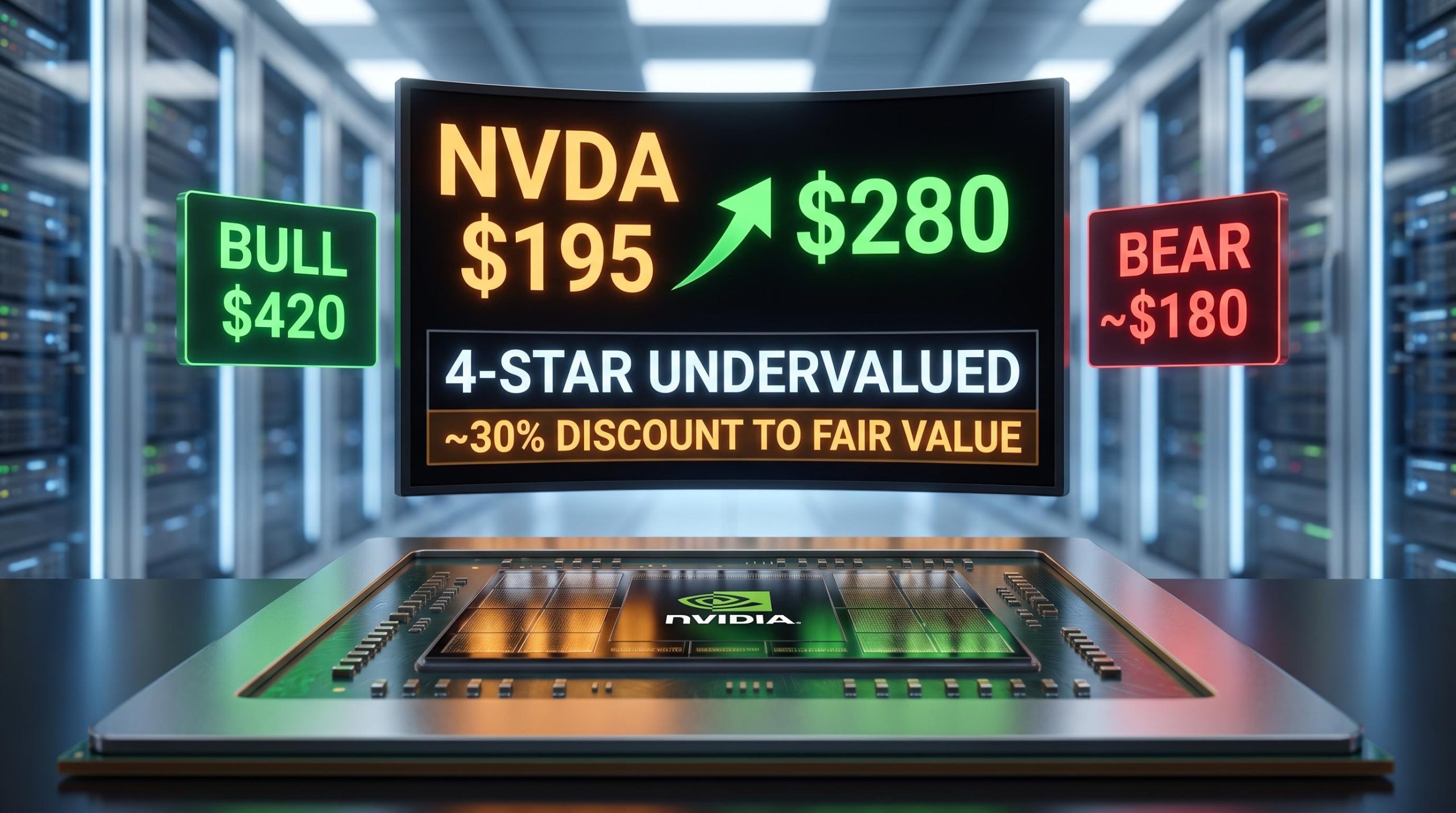
Nvidia’s stock is sitting roughly 30% below what Morningstar’s senior equity analyst believes it is worth. Not because the business is struggling, but because the market has not fully priced in what sustained AI capital spending could mean for the company’s earnings over the next two years.
Morningstar published updated equity research on Nvidia on 31 July 2026, assigning a $280 fair value estimate, a Wide economic moat, a 4-star undervalued rating, and a Very High uncertainty designation. The combination is unusual: strong structural conviction paired with an exceptionally wide range of plausible outcomes. That tension is exactly what makes Nvidia worth examining carefully right now.
Here is the framework behind that rating, the specific numbers, the moat mechanics, the growth assumptions, and the risk factors, so you can decide whether the current discount reflects genuine opportunity or reasonable caution.
What Morningstar’s $280 fair value actually tells you
The gap between where Nvidia trades and where Morningstar says it belongs is not small. At approximately $195-$196 as of late July 2026, the stock sits roughly 30% below Morningstar’s $280 fair value estimate. That is not a rounding error. It is a statement about what the market is missing.
Three designations anchor the rating:
- Fair value estimate: $280 per share, representing Morningstar’s discounted cash flow assessment of what the business is worth under base-case assumptions (Brian Colello, CPA, 28 July 2026)
- Star rating: 4-star (undervalued), meaning the current price sits materially below fair value after adjusting for the uncertainty band
- Uncertainty rating: Very High, reflecting the genuinely wide range of plausible outcomes for AI-driven revenue over the next decade
Morningstar frames Nvidia as a growth-at-a-reasonable-price (GARP) opportunity. This is not a distressed company trading at a discount because something is broken. It is a company growing at extraordinary rates where the market, in Morningstar’s view, is systematically underestimating the duration and scale of AI infrastructure spending.
How the fair value estimate has moved
The $280 figure is not a fixed anchor. Morningstar’s model has evolved as AI capital expenditure assumptions have shifted. Earlier analyses around Nvidia’s GTC event raised fair value from approximately $240 to $260, still with a Wide moat and Very High uncertainty. The $280 figure reflects a subsequent update as spending projections firmed.
A separate UK-published Morningstar analysis placed fair value as high as $910, illustrating just how sensitive the model is to assumptions about the trajectory of AI capex. What that tells you is that $280 is one point on a moving line, and the direction it has moved is consistently upward.
Investors who want to stress-test the $280 figure against alternative discount rate assumptions will find that DCF valuation scenarios for Nvidia produce intrinsic value estimates ranging from $73 to $738 depending on the hurdle rate and revenue trajectory applied, a spread that reinforces exactly why Morningstar’s Very High uncertainty designation is not a formality.
When big ASX news breaks, our subscribers know first
The moat that makes the growth story defensible
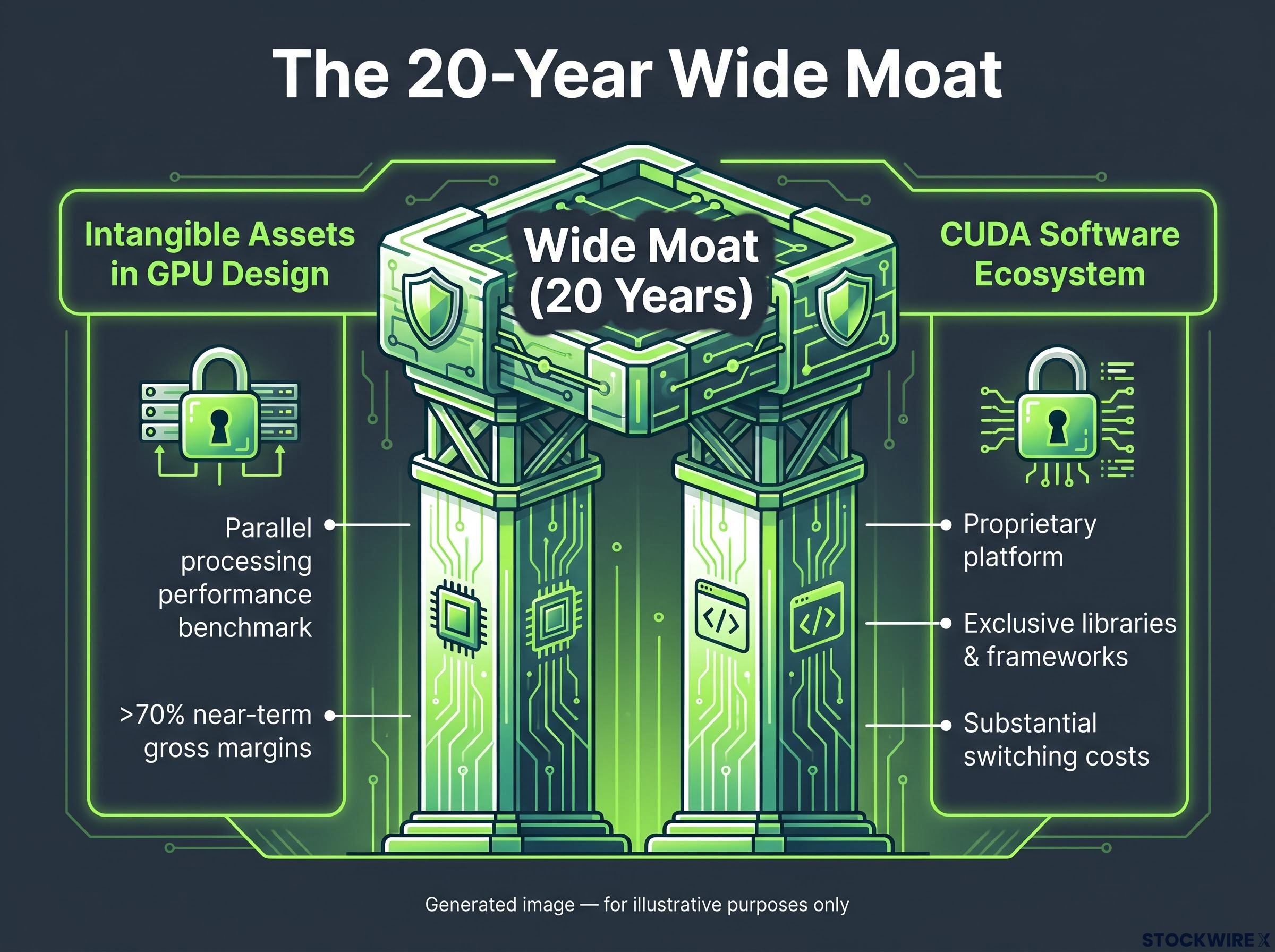
Morningstar assigns a Wide moat based on two sources of competitive advantage, and the distinction between them matters more than either one alone.
| Moat Source | Key Driver | Durability Assessment |
|---|---|---|
| Intangible assets in GPU design | Parallel processing capability sets the performance benchmark for AI accelerators | Strong but hardware advantages can erode as competitors invest |
| CUDA software ecosystem | Proprietary platform with libraries, frameworks, and tools exclusive to Nvidia hardware | Deeply embedded in AI researcher workflows; switching costs are substantial and ongoing |
The hardware moat is real. Nvidia’s GPUs are architected around parallel processing, which is the core computational capability underpinning the matrix operations that AI model training and inference depend on. That performance lead sustains gross margins above 70% in the near term and keeps Nvidia as the benchmark that rivals like AMD are measured against.
But the software moat is what makes the story durable. CUDA is Nvidia’s proprietary development environment, providing the libraries, frameworks, and tooling that AI engineers rely on to construct and deploy models, and it is tied exclusively to Nvidia hardware. Moving a large AI stack off CUDA requires significant engineering effort, cost, and risk. That lock-in is the single most important reason Morningstar assigns a Wide moat, because competing on hardware alone is not sufficient to displace Nvidia as long as CUDA remains the standard development environment for AI.
Morningstar’s position is that Nvidia’s competitive advantages remain intact in its core valuation work, though the scale of the AI market those advantages will serve remains a genuinely open question.
What the 80% revenue growth forecast is actually based on
Eighty per cent. That is Morningstar’s total revenue growth forecast for Nvidia in fiscal 2027. Let that number sit for a moment. For a company already generating revenue at this scale, 80% growth is not a modest beat-and-raise story. It is an assumption that AI capital spending in calendar year 2026 is building momentum rather than levelling off.
The driver is straightforward: hyperscalers and enterprises are pouring capital into AI data centre infrastructure at rates that continue to surprise to the upside. Morningstar analyst Brian Colello models this as “strong growth over the next two years” followed by “inevitable deceleration” thereafter.
What Morningstar’s margin assumptions imply about pricing power
The margin trajectory tells you something important about how Morningstar views competitive pressure over time.
| Metric | Fiscal 2027 | Fiscal 2028 | 10-Year Direction |
|---|---|---|---|
| Gross margin | Mid-70s % | Moderating | Declining to high-60s % |
| GAAP operating margin | High-50s to mid-60s % | High-50s to mid-60s % | Stable within band |
| Implied P/E at $280 fair value | ~30x adjusted earnings | ~20x adjusted earnings | Compressing as earnings grow |
Gross margins declining from the mid-70s to the high-60s over a decade is not a weakness signal. It reflects Morningstar’s expectation that AI hardware becomes more commoditised as competition intensifies, but even the terminal margin assumption sits structurally above typical semiconductor industry levels. The compression reflects more competition, not a broken moat.
At the current price of approximately $195-$196, you are paying a discount to those forward multiples. Roughly 30 times fiscal 2027 adjusted earnings at $280 fair value; at $195, the multiple is lower still. Paying 30 times forward earnings for a company growing revenue at 80% is not obviously expensive, and the comparison point matters: slower-growth semiconductor companies trade at similar or higher multiples on far less growth.
The four risks behind the Very High uncertainty rating
The moat section told you why Morningstar is structurally bullish. This section tells you why the uncertainty rating is as high as it goes.
All four of these risks are simultaneously in flux, which is precisely why the rating is Very High rather than High.
- AI infrastructure spending durability. Morningstar’s entire upside case depends on sustained, very large AI-related capital expenditure over many years. Generative and agentic AI is still in its relative infancy, and if corporate return on AI investment disappoints, spending plans could be scaled back significantly.
- Customer concentration and in-house chip efforts. The cloud and internet platforms that account for the bulk of Nvidia’s revenue have both the engineering resources and the commercial motivation to build their own accelerator solutions. Morningstar’s base case is that in-house chips partially offset but do not displace Nvidia’s share, but this remains a key uncertainty.
The scale of investment flowing into custom silicon programmes at Alphabet, Amazon, and Microsoft adds a structural layer to the customer concentration risk: the same $700 billion in AI capex funding Nvidia’s order book is simultaneously financing the in-house accelerator efforts most likely to erode its share in inference workloads.
- Competitive pressure from AMD and alternatives. AMD is the most credible direct GPU rival, and other firms are pushing alternative architectures including XPUs and custom ASICs. Morningstar’s downside scenario explicitly assumes a world in which the AI market shifts toward diversified competition, eroding Nvidia’s share and pricing power.
Nvidia has put forward projections suggesting annual AI infrastructure spending could approach $3-$4 trillion by 2030. If that figure proves optimistic, the growth assumptions underpinning Morningstar’s base case come under pressure.
Export controls as a structurally separate risk category
- US export restrictions on China sales. This risk is distinct from the others because it is policy-driven rather than market-driven, and therefore less predictable. Washington has imposed restrictions on multiple occasions that have blocked Nvidia from shipping advanced AI chips to Chinese customers. Morningstar has kept fair value estimates in the $240-$260 range in some notes specifically while factoring in evolving restrictions, illustrating the model’s sensitivity to this single variable.
For investors wanting to quantify the export control risk more precisely, our deep-dive into Nvidia’s China revenue collapse covers the move from $6 billion in FY2024 to near zero by FY2026 Q1 and explains why institutional consensus treats any China recovery as a call option rather than a base-case input.
Each of these risks can be modelled independently, but their simultaneous presence is what creates the genuine unpredictability. You need to assess which of these four you are least confident about before sizing a position.
Understanding the bull, base, and bear cases side by side
The three scenarios lay out what you are actually betting on at each price level.
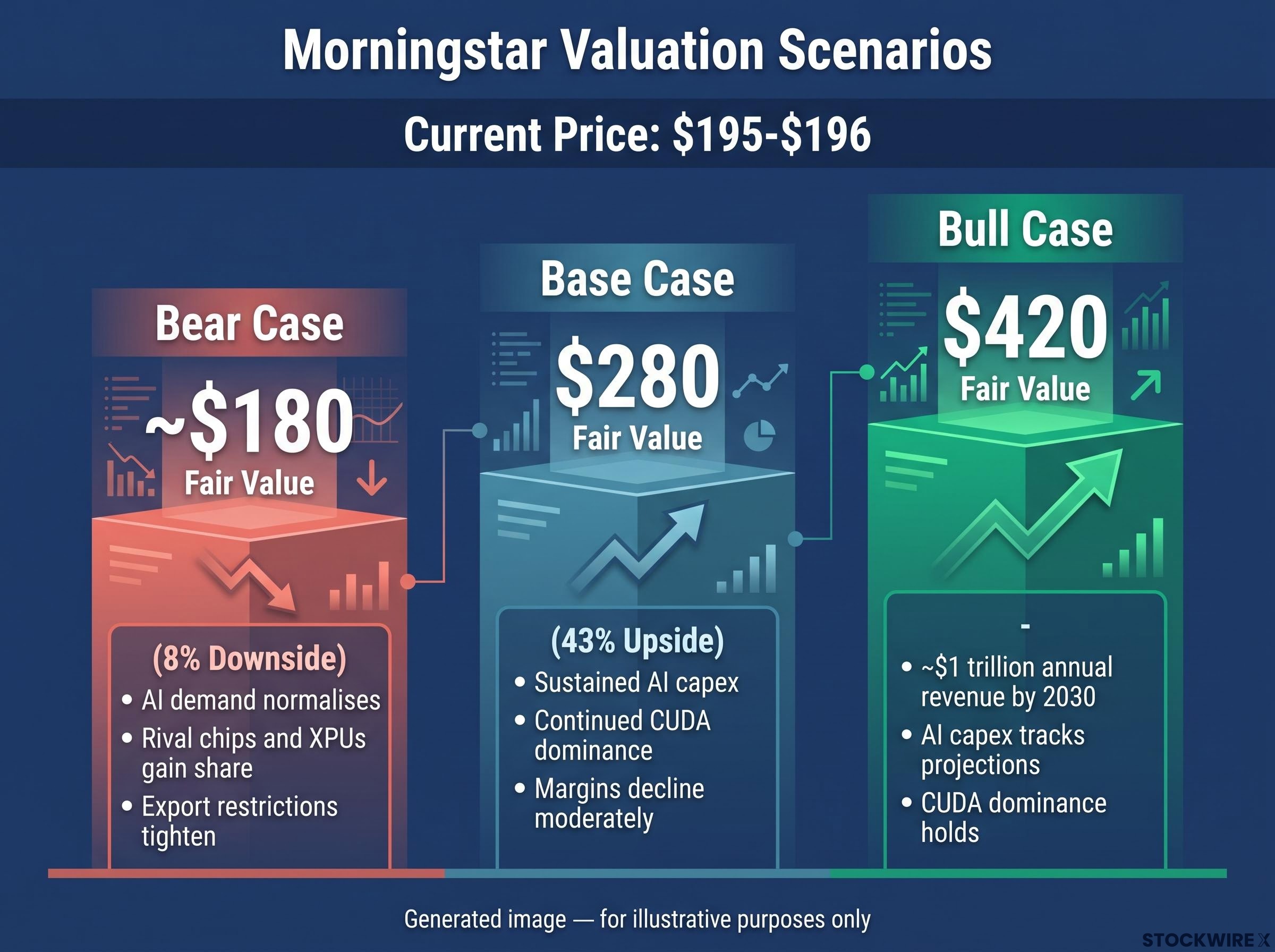
| Scenario | Key Assumptions | Fair Value Estimate |
|---|---|---|
| Bull case | Nvidia reaches ~$1 trillion annual revenue by 2030; AI capex tracks or exceeds Nvidia’s own projections; CUDA dominance holds; competition manageable | $420 |
| Base case | Sustained AI capex; continued CUDA dominance; strong near-term growth then deceleration; margins declining moderately from peak | $280 |
| Bear case | AI demand disappoints or normalises; in-house and rival chips gain meaningful share; export restrictions tighten; margins compress materially; market shifts toward XPUs | ~$180 |
The $240 gap between the bull case at $420 and the bear case at $180 is the most concrete illustration of what a Very High uncertainty rating translates to in actual dollar terms. At a current price near $195, the bear case is only modestly below where the stock trades today.
Morningstar describes current pricing near $195-$196 as “too cheap to ignore” under base-case assumptions.
That characterisation is worth interrogating. The base case at $280 implies roughly 43% upside. The bear case at $180 implies roughly 8% downside. The asymmetry looks favourable. But the bear case is not a floor; it is a scenario with non-trivial probability under the Very High uncertainty designation. The downside is not trivially small, and you need genuine conviction on the base-case assumptions before treating the skew as a free lunch.
What a Wide moat actually means for long-term investors
A Wide moat, in Morningstar’s framework, means the firm is expected to generate returns on invested capital above its cost of capital for at least 20 years. That is a specific, load-bearing claim, not a generic quality label.
What Morningstar is certain about versus uncertain about:
- Certain: Nvidia’s competitive advantages are expected to hold. GPU design leadership combined with the switching costs embedded in the CUDA ecosystem should sustain returns above the cost of capital for two decades, and Morningstar does not identify the moat itself as a source of risk in its core valuation work.
- Uncertain: How large the AI market those advantages serve will ultimately become. The pace at which credible competition emerges. Whether export curbs reduce the addressable opportunity. How AI capital expenditure trends beyond the near-term forecast window.
That distinction matters. The uncertainty rating is not a moat concern. It is a market-size concern.
How the moat rating feeds into the $280 estimate
For the reader evaluating this as an investment, here is why the moat designation is more important than the price target itself. In a discounted cash flow model, a Wide moat justifies higher terminal value assumptions. The model assumes excess returns persist for at least 20 years, which mechanically raises the present value of future cash flows compared to a Narrow moat or no-moat assumption. The $280 figure is not just a growth projection; it is a growth projection multiplied by structural durability.
For a long-term investor with a three-to-five-year horizon, the moat rating matters more than the current fair value estimate, because the moat is what determines whether the gap between price and fair value can actually be closed over time.
Making a considered decision in a high-uncertainty setup
The analytical tension is genuine. On one side: a Wide moat, a GARP setup with 30% implied upside, and a fair value estimate that has moved consistently higher as AI spending data has firmed. On the other: a Very High uncertainty rating, a bear case only 8% below the current price, and four risk categories that are all simultaneously unresolved.
Before acting on this analysis, you need to answer three questions for yourself:
- Do you believe AI capital expenditure is durable? The entire base case depends on hyperscalers and enterprises continuing to spend at elevated rates. If you think spending normalises within two years, the $280 fair value is too high.
- Can you tolerate a bear case near $180? That is roughly 8% below the current price. It is not catastrophic, but it is real downside, and the Very High uncertainty rating means it is not a remote probability.
- Is your time horizon long enough? The moat is a 20-year structural claim. The growth assumptions play out over fiscal 2027 and 2028. If you need the thesis to resolve in six months, this setup is poorly matched to your timeline.
The asymmetry between a 43% potential upside (base case) and an 8% potential downside (bear case) looks favourable at current prices. But the Very High uncertainty rating means the bear case has a non-trivial probability, and investors should size accordingly.
Morningstar’s fair value has already moved from $240 to $260 to $280, and a separate model reached $910. The $280 figure is a living estimate, not a fixed destination. Position sizing should reflect that reality.
Nvidia’s capital return policy represents a separate but additive lever on the valuation gap: at approximately 24.5x forward earnings versus a Magnificent Seven peer average near 49x, the stock’s structural underrepresentation in income fund mandates means a dividend yield increase toward 0.5%-1.0% could catalyse multiple expansion independent of the AI demand thesis.
All analysis referenced in this article is sourced to Brian Colello, CPA, Morningstar senior equity analyst, published 31 July 2026.
This article is for informational purposes only and should not be considered financial advice. Investors should conduct their own research and consult with financial professionals before making investment decisions. Past performance does not guarantee future results. Financial projections are subject to market conditions and various risk factors.