

US biodefense budget puts broad-spectrum antimicrobials in the spotlight
The US Administration for Strategic Preparedness and Response (ASPR) has released a five-year, US$66.9 billion medical countermeasures funding strategy aimed at strengthening national defences against pandemics and drug-resistant superbugs.
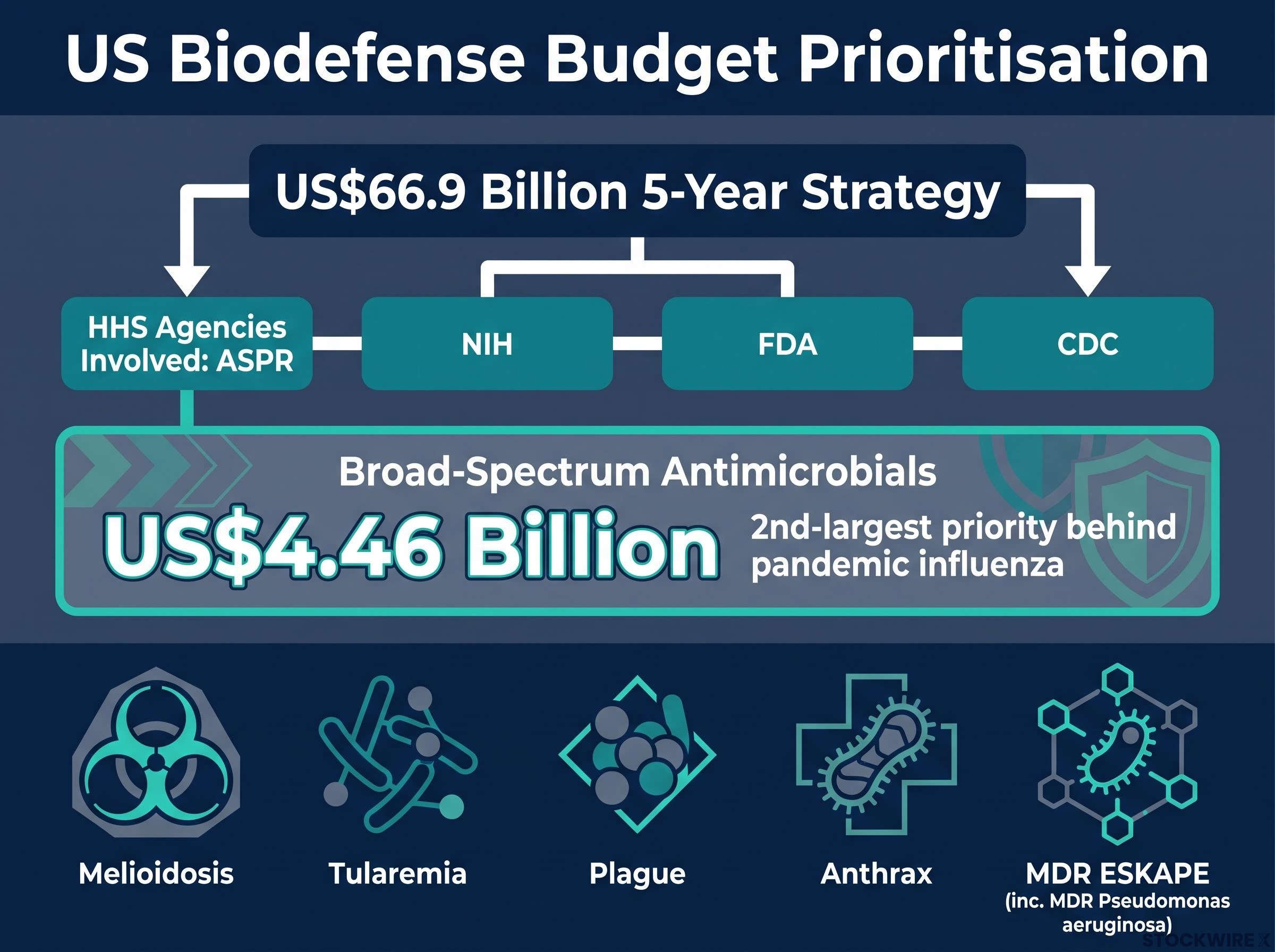
Broad-spectrum antimicrobials rank as the second-largest single-threat priority in the plan, with US$4.46 billion earmarked, behind only pandemic influenza. This is a US Government strategy that Recce Pharmaceuticals (ASX: RCE, FSE: R9Q), a developer of synthetic anti-infectives, is highlighting because it aligns with the company’s existing US Department of War programs.
Importantly, this is not new funding awarded to Recce. The company states it “cannot guarantee that it will receive any new funding opportunities referenced in this announcement.”
When big ASX news breaks, our subscribers know first
What the US$66.9 billion strategy prioritises
The strategy sets out ASPR’s assessed five-year funding need across four agencies within the US Department of Health and Human Services (HHS): ASPR, the National Institutes of Health (NIH), the Food and Drug Administration (FDA) and the Centers for Disease Control and Prevention (CDC).
Its scope spans pandemics, antimicrobial resistance, and chemical, biological, radiological and nuclear threats. Within the pathogen-specific investment, antimicrobial resistance ranks as the second-highest funding priority.
| Metric | Figure | Investor Relevance |
|---|---|---|
| Total five-year assessed need | US$66.9 billion | Signals sustained US Government commitment to medical countermeasures |
| Broad-spectrum antimicrobials allocation | US$4.46 billion | Directly aligned with Recce’s technology focus |
| AMR ranking | 2nd-highest single-threat priority | Reflects a shift in national biodefense priorities |
| Funding scope | Preclinical → clinical trials → FDA approval | Supports a coordinated pathway toward market availability |
The funding aims to assist antimicrobial candidates through each development stage, from preclinical research through to clinical trials and regulatory approval, supporting a coordinated pathway toward FDA approval and market availability.
How this aligns with Recce’s existing US programs
The strategy complements Recce’s current engagements with the US Government, rather than representing new money awarded to the company. Recce’s existing relationships include:
-
Two Cooperative Research and Development Agreements (CRADAs), one with the US Army Medical Research Institute of Infectious Diseases (USAMRIID) and one with the US Army Institute of Surgical Research (USAISR).
-
A US$2 million Congressionally Directed Medical Research Programs (CDMRP) grant.
Recce’s second US Army CRADA, secured with the US Army Institute of Surgical Research, targets R327G activity against MRSA and Pseudomonas aeruginosa in burn wound infections, two of the same MDR pathogen classes named as priority threats in the ASPR strategy.
The budget outlines priority pathogen threats including melioidosis, tularemia, plague, anthrax and MDR ESKAPE pathogens including MDR Pseudomonas aeruginosa. According to the company, RECCE® 327 (R327) has demonstrated activity against these pathogen classes under Recce’s existing US Department of War research programs.
Recce is described as well positioned to benefit from the initiative, though the company cannot guarantee that it will receive any new funding opportunities referenced in the announcement.
CEO Commentary
“This substantial budget confirms the national security and health threats caused by antimicrobial resistance and the U.S. government’s prioritisation of the need for new anti-infective drugs. We are pleased to continue to progress our engagement with the U.S. Department of War to address national security priorities. RECCE® 327 has demonstrated activity against many of the priority pathogens named in this plan, which reinforces the strategic value of our ongoing biodefense collaborations, and we look forward to continuing that work,” said James Graham, Chief Executive Officer.
Understanding antimicrobial resistance and why governments are funding it
Antimicrobial resistance (AMR) occurs when bacteria evolve to defeat the antibiotics designed to kill them. These drug-resistant bacteria, often called superbugs, render standard treatments ineffective and pose a growing public health challenge worldwide.
Broad-spectrum synthetic anti-infectives are intended to address this problem differently. Recce’s technology uses multi-layered mechanisms of action designed to overcome the resistance processes that defeat conventional antibiotics. For investors, a US$66.9 billion government strategy that names AMR as a top priority validates the strategic value of companies with aligned technology already engaged in government research programs.
Recce’s pipeline and regulatory standing
Recce’s asset base extends beyond a single program, encompassing three patented, broad-spectrum synthetic polymer anti-infectives alongside a series of regulatory credentials:
-
RECCE® 327 (R327) — an intravenous and topical therapy for serious Gram-positive and Gram-negative infections, including superbug forms.
-
RECCE® 435 (R435) — an orally administered therapy for bacterial infections.
-
RECCE® 529 (R529) — for viral infections.
-
All three added to the World Health Organization (WHO) list of antibacterial products in clinical development for priority pathogens.
-
R327 granted FDA Qualified Infectious Disease Product designation under the Generating Antibiotic Incentives Now (GAIN) Act, providing Fast Track Designation and 10 years of market exclusivity post-approval.
-
R327 listed on The Pew Charitable Trusts’ Global New Antibiotics in Development Pipeline as the sole synthetic polymer and sepsis drug candidate in development.
Recce’s dual Phase 3 programs, running concurrently in Australia and Indonesia, target regulatory approvals across Australia, the US, MENA, and ASEAN markets, with the Australian arm recently elevated to pivotal registrational status following strong Phase 2 efficacy results.
What it means for investors
The release of a large, prioritised government funding environment aligns directly with Recce’s technology focus and its existing US Department of War collaborations. The company states it is well positioned to benefit from the strategy, though no new funding is guaranteed.
Management has indicated it intends to continue progressing its engagement with the US Department of War to address national security priorities, positioning the strategy as an external tailwind that complements Recce’s ongoing biodefense work.
Don’t Miss the Next Healthcare Breakout
Get FREE breaking ASX healthcare news delivered to your inbox within minutes of release, complete with in-depth analysis. Join 20,000+ investors already staying ahead of the market with Big News Blast. Click the “Free Alerts” button to receive the moment market-moving healthcare announcements hit the ASX.