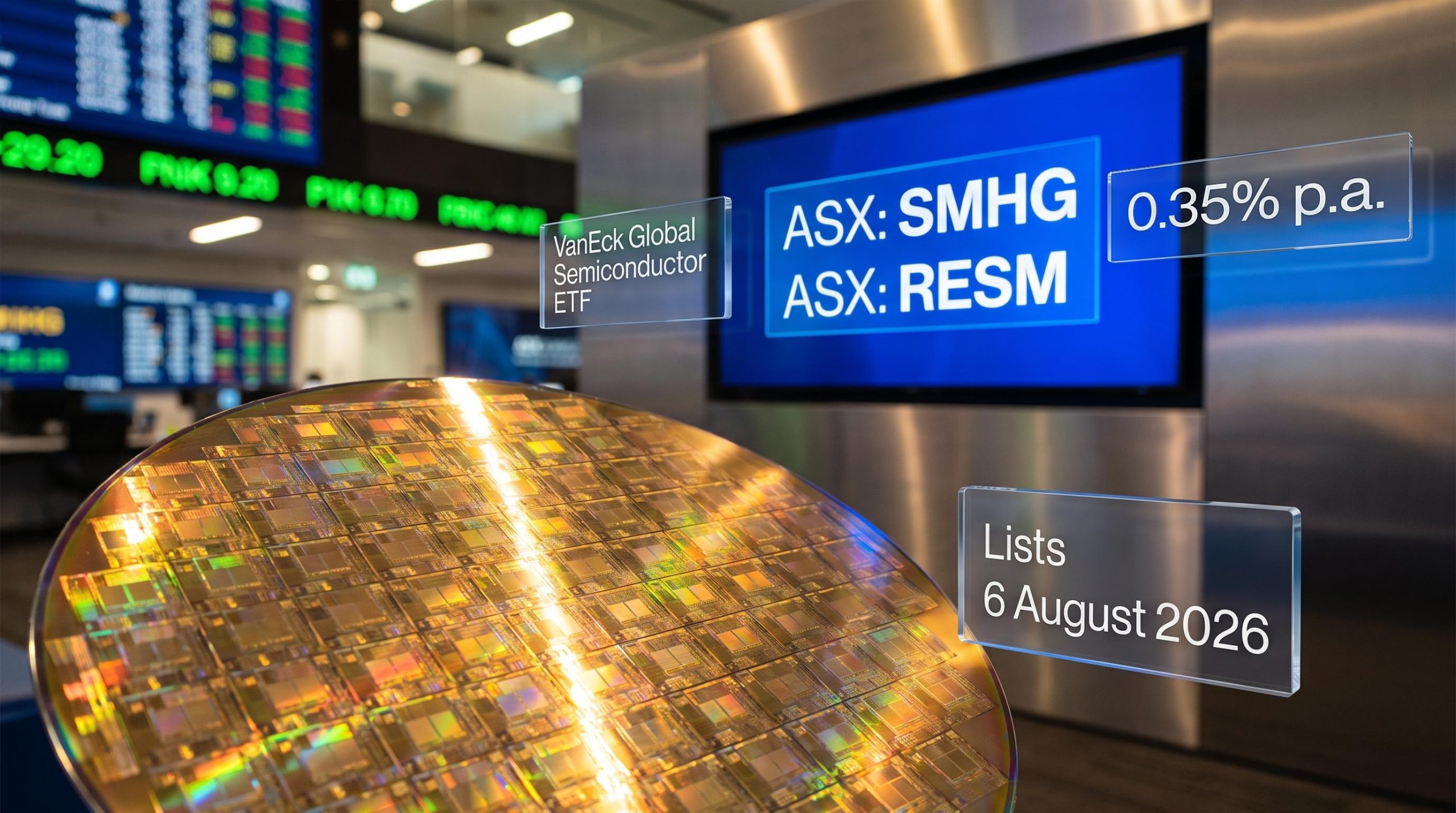
Two new thematic ETFs are listing on the ASX on 6 August 2026, giving Australian investors direct access to the global semiconductor supply chain and the rare earth metals underpinning AI hardware, defence systems, and the energy transition. The window to evaluate them before trading begins is narrow.
VanEck is launching the VanEck Global Semiconductor ETF (ASX: SMHG) and the VanEck Rare Earth and Strategic Metals ex China ETF (ASX: RESM) as part of a broader megatrends product push. Both funds target structural demand themes that have attracted significant institutional attention, but they carry meaningfully different risk profiles and serve different portfolio functions.
Here is a clear picture of what each fund holds, why the ex-China design of RESM matters, how the two funds differ in risk and return expectations, and how to think about sizing them alongside what you already own.
What VanEck is launching and why it matters to ASX investors now
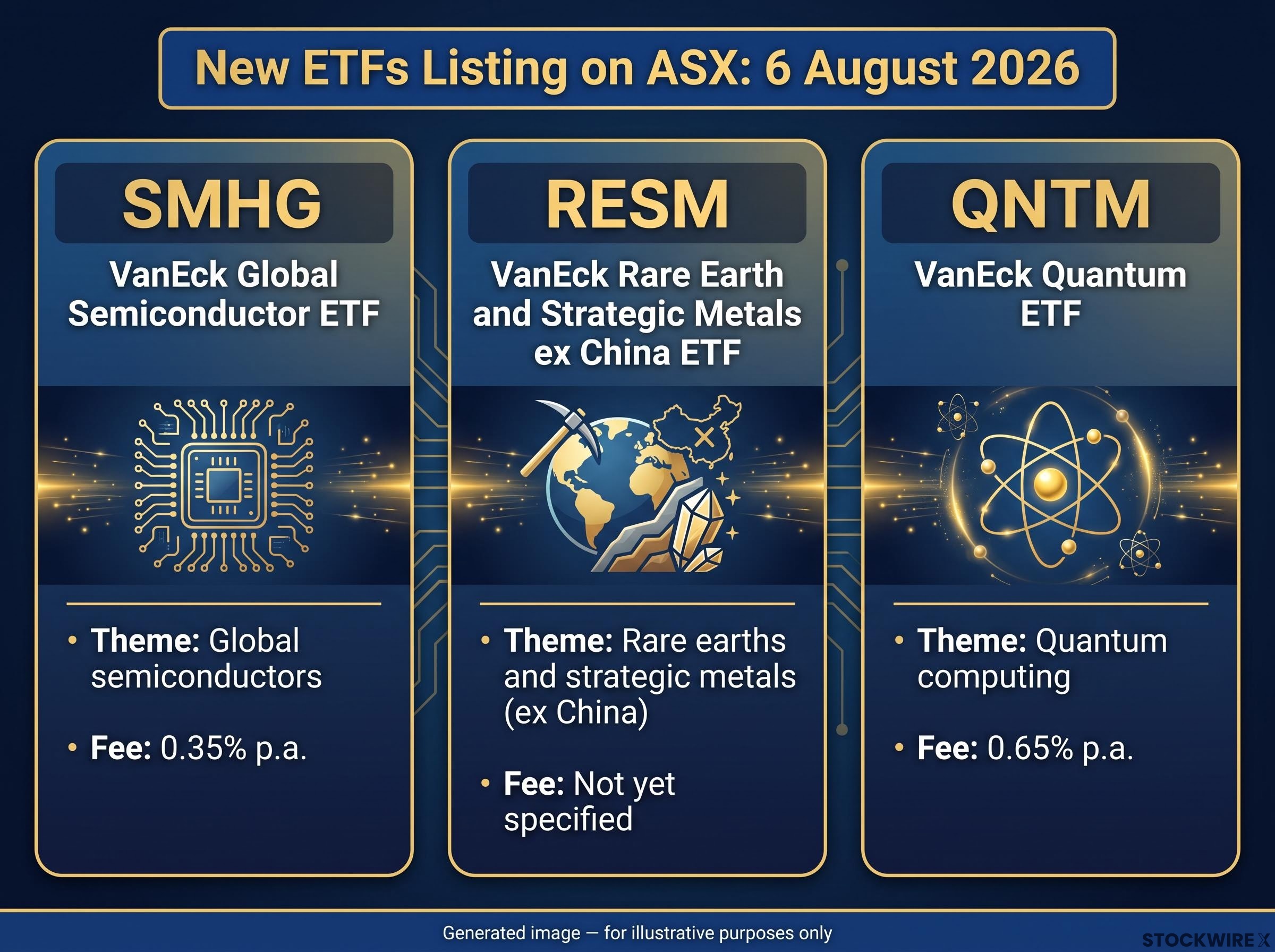
VanEck is listing three thematic ETFs on the ASX on 6 August 2026: SMHG, RESM, and a third fund, the VanEck Quantum ETF (ASX: QNTM), positioned as Australia’s first quantum computing ETF at a management fee of 0.65% p.a. This article focuses on the first two.
| ASX Code | Fund Name | Theme | Fee |
|---|---|---|---|
| SMHG | VanEck Global Semiconductor ETF | Global semiconductors | 0.35% p.a. |
| RESM | VanEck Rare Earth and Strategic Metals ex China ETF | Rare earths and strategic metals (ex China) | Not yet specified |
| QNTM | VanEck Quantum ETF | Quantum computing | 0.65% p.a. |
The launches are not isolated product releases. The ASX ETF market has seen a clear shift in recent years, with providers moving away from plain index replication and toward narrower, theme-driven fund designs, and VanEck is positioning all three funds squarely within that trend. SMHG, at 0.35% p.a., is being marketed as Australia’s lowest-cost global semiconductor ETF, which means Australian investors no longer need to navigate offshore brokerage accounts or individual stock selection to access the full semiconductor supply chain at a competitive fee.
When big ASX news breaks, our subscribers know first
SMHG: what the semiconductor ETF actually holds and who it is for
SMHG tracks the MarketVector Global Semiconductor Index, which captures companies across the full semiconductor supply chain: chip designers, foundries and integrated device manufacturers, equipment suppliers, and selected materials companies whose revenues are tightly tied to chip production.
That breadth is the product’s core differentiation. Rather than concentrating in a single niche, such as GPU designers or lithography equipment makers, the index spreads exposure across the stages that move a chip from design to finished product.
The semiconductor thesis has already delivered outsized returns for early Australian investors, with ASX: SEMI returning 148% in the twelve months to May 2026, though entering after that run means buying at prices that already price in substantial growth expectations.
The structural demand drivers the fund targets are multi-decade themes:
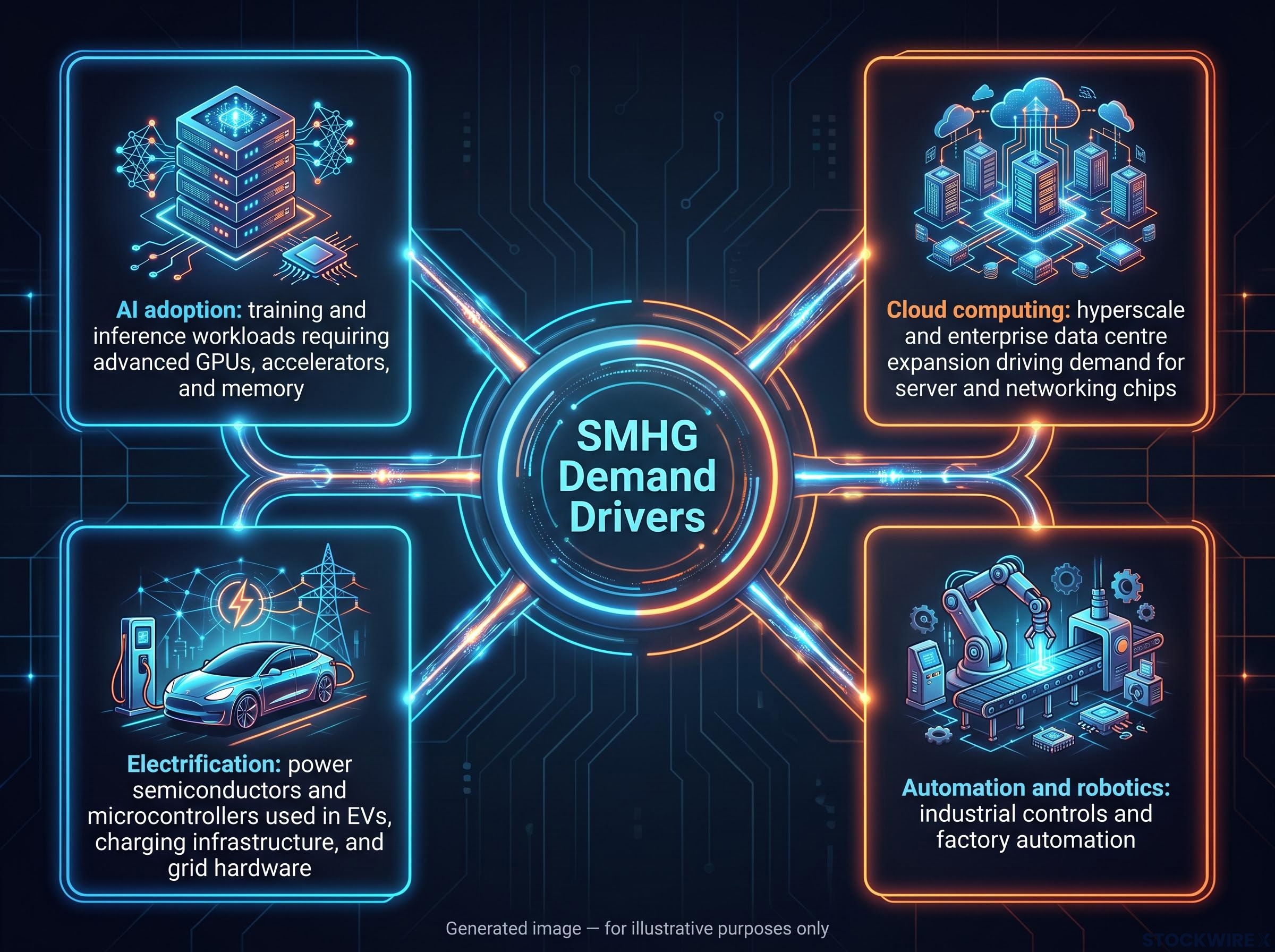
- AI adoption: training and inference workloads requiring advanced GPUs, accelerators, and memory
- Cloud computing: hyperscale and enterprise data centre expansion driving demand for server and networking chips
- Electrification: power semiconductors and microcontrollers used in EVs, charging infrastructure, and grid hardware
- Automation and robotics: industrial controls and factory automation relying on specialised semiconductors
Who this is for
Companies in SMHG are typically established, revenue-generating businesses with global customer bases and scale advantages. For an ASX investor who already holds a broad global equity ETF, adding SMHG is a deliberate tilt toward AI infrastructure, increasing semiconductor weight specifically rather than duplicating what you already own.
What rare earths and strategic metals are, and why the supply chain outside China matters
Rare earth elements and strategic metals are a group of materials with properties that make them difficult to substitute in advanced manufacturing. Neodymium and praseodymium, for example, are used to make the permanent magnets inside EV motors and wind turbines. Without them, the motors do not work at anything close to commercial efficiency.
These materials are inputs across several high-growth sectors:
- AI hardware: high-performance servers and GPUs
- Defence: guidance systems, radar, and advanced alloys
- EV motors and wind energy: permanent magnets and energy-storage components
- Advanced electronics: smartphones, industrial equipment, and communications hardware
China has historically dominated both the mining and processing stages of rare earth supply chains. That dominance creates a structural supply security concern for governments and manufacturers in Western nations, one that has moved from theoretical risk to active policy response.
The reason this theme is attracting an ETF product right now is not that rare earths are new. It is that governments in Australia, North America, and Europe are actively funding and legislating alternative supply chains, creating a structural commercial opportunity that did not exist at the same scale five years ago. That policy momentum is the investment thesis RESM is built around.
Battery metals supply chains face the same structural policy dynamics driving RESM’s investment thesis: Western governments are actively funding alternatives to Chinese-controlled material flows, with copper and lithium facing projected demand growth that existing supply pipelines cannot meet without significant new investment outside China.
RESM: how the rare earth ETF is built and what makes it different from a mining fund
RESM’s defining design choice is the ex-China exclusion. By removing Chinese-listed companies entirely, the fund is not hedging against Chinese dominance. It is a direct bet on the commercial success of alternative supply chains being built in Australia, North America, and Europe. That is a fundamentally different investment proposition from a broad materials fund.
The second design choice is the 50% revenue eligibility threshold. To qualify for inclusion, a business must generate the majority of its revenues specifically from rare earth and strategic metals operations, screening out diversified miners where these materials are a minor business line, keeping the portfolio concentrated in specialists.
RESM targets businesses operating across the full value chain of these materials, from pulling them out of the ground through to finished-product recovery:
- Extraction
- Refining
- Processing
- Recycling
| Feature | SMHG | RESM |
|---|---|---|
| Index tracked | MarketVector Global Semiconductor Index | Rare earth/strategic metals index (ex China) |
| Revenue eligibility | Not specified | ≥50% from rare earth/strategic metals |
| Geographic exclusion | None | Chinese companies excluded |
| Supply-chain stages | Design, fabrication, equipment, materials | Extraction, refining, processing, recycling |
| Risk profile | Earnings-cyclical, established businesses | Higher: commodity, development-stage, geopolitical |
Many investors conflate materials and mining ETFs with rare earth exposure. RESM is a more concentrated, thematic product with an explicit geopolitical investment thesis that a diversified miner fund does not replicate.
How SMHG and RESM compare on risk, and which type of investor each suits
SMHG: cyclical, but grounded in current revenue
SMHG’s risk profile is anchored by the semiconductor inventory and capital expenditure cycle. Share prices will move with demand swings, macro conditions, and electronics spending. But the underlying businesses are established operations with cash flows, scale advantages, and global customer bases. The thesis is measurable in current demand.
RESM: a longer, rougher road
RESM carries additional risk layers that make it a meaningfully different proposition:
- Commodity price sensitivity: revenues and margins are highly exposed to spot and contract pricing for rare earths
- Project development risk: new mines and processing facilities involve long lead times, construction risk, and financing uncertainty
- Permitting and regulatory risk: environmental approvals and community engagement can delay projects by years
- Geopolitical policy risk: even with the China exclusion, shifting trade and industrial-strategy decisions in Western countries can create volatility
The time-horizon difference is the sharpest distinction. SMHG’s thesis plays out across current semiconductor demand cycles. RESM’s thesis may take many years to materialise, and the path will involve setbacks.
The question to ask yourself is personal: do you have the risk appetite and holding period for a thesis that may take a decade to deliver (RESM), or do you want exposure to a structural trend already generating substantial revenues today (SMHG)?
Investors wanting to stress-test RESM’s long development timeline against historical thematic ETF outcomes will find our full explainer on thematic ETF sector rotation risk, which covers how 2026 rotation cycles produced up to 25% drawdowns in technology themes while resources delivered triple-digit gains.
Before you add either fund, check what you already own
Before 6 August, it is worth running a practical overlap check against your existing holdings:
- Existing semiconductor weight: broad global equity ETFs already carry significant semiconductor and technology exposure through large US names. Adding SMHG increases that concentration deliberately. If your portfolio is already heavy in global tech ETFs, you may end up with more semiconductor exposure than intended.
- Existing commodity or materials holdings: diversified resource ETFs may provide partial materials exposure, but RESM offers a more targeted rare earth and strategic metals tilt that most standard portfolios do not already contain.
- Risk tolerance for commodity and development-stage exposure: RESM’s risk profile is materially higher than SMHG’s. Size accordingly.
- Planned holding period: match it to each fund’s investment thesis timeline.
Both SMHG and RESM are designed as satellite positions to complement, not replace, core holdings. Appropriate sizing for many long-term investors is often a single-digit percentage of total portfolio.
Thematic ETF portfolio sizing discipline is especially important for funds like RESM, where the time horizon may stretch a decade and commodity price volatility can produce large drawdowns well before the structural thesis plays out; frameworks that cap any single theme at 5% of total portfolio are designed precisely for these scenarios.
What the 6 August listing means for investors weighing these funds now
Both funds begin trading on 6 August 2026 through standard ASX brokerage. SMHG’s management fee is confirmed at 0.35% p.a. RESM’s fee has not yet been publicly specified. QNTM, at 0.65% p.a., lists on the same date for investors interested in the broader tech-megatrend suite.
The two funds serve distinct propositions. SMHG offers cost-efficient access to the established semiconductor cycle. RESM is for investors with longer-horizon conviction on supply-chain realignment outside China. Neither is a core holding, and the risk profiles are not interchangeable.
The listing date is not a deadline to invest. It is the start of a period in which trading data, liquidity, and price discovery will give you additional signals to evaluate. What to watch after listing:
- Early liquidity and trading volume
- RESM fee confirmation
- Tracking error data as it becomes available
- Macro signals on AI infrastructure demand and Western government materials policy
This article is for informational purposes only and should not be considered financial advice. Investors should conduct their own research and consult with financial professionals before making investment decisions. Past performance does not guarantee future results. Sector-specific and thematic ETFs can be volatile and may result in capital loss.
—