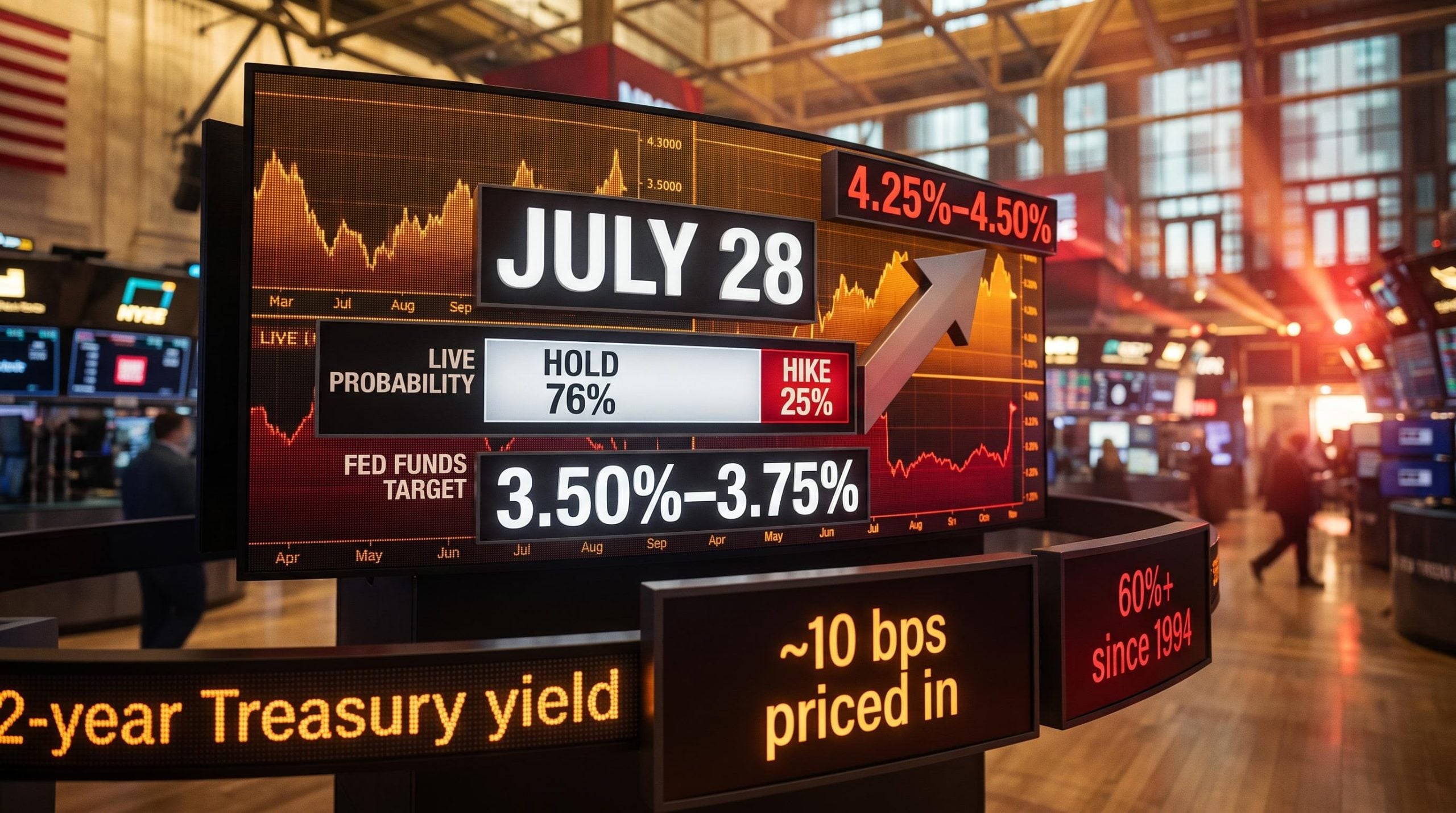
The Federal Reserve is meeting today, 28 July, and one of Wall Street’s largest banks is warning that a surprise rate hike this afternoon would do something the Fed has not done in more than 30 years: act when markets were not ready for it.
Bank of America rates strategist Mark Cabana published an investor note this morning characterising the July decision as a very close call. The note lays out the specific historical threshold the Fed would cross if it moved without adequate market preparation, and details exactly how BofA is positioning its own portfolio around the outcome.
Here is what the precedent argument actually says, what the roughly 10 basis points of tightening currently priced into markets signals about investor expectations, and what a hold versus a hike would mean for the rate path through year-end. The detail most readers will miss at the headline level: three additional hikes are already in BofA’s base case for later in 2026, regardless of what happens this afternoon.
The historical threshold a July hike would cross for the first time since 1994
BofA’s hold call rests on a specific empirical claim, not a vague sense that markets are unprepared. Looking at federal funds futures data going back to 1994, BofA found that the Fed has not once raised rates at a meeting where markets had priced in less than a 60% probability of a hike in advance. That threshold has held without exception across the entire modern era of Fed communication.
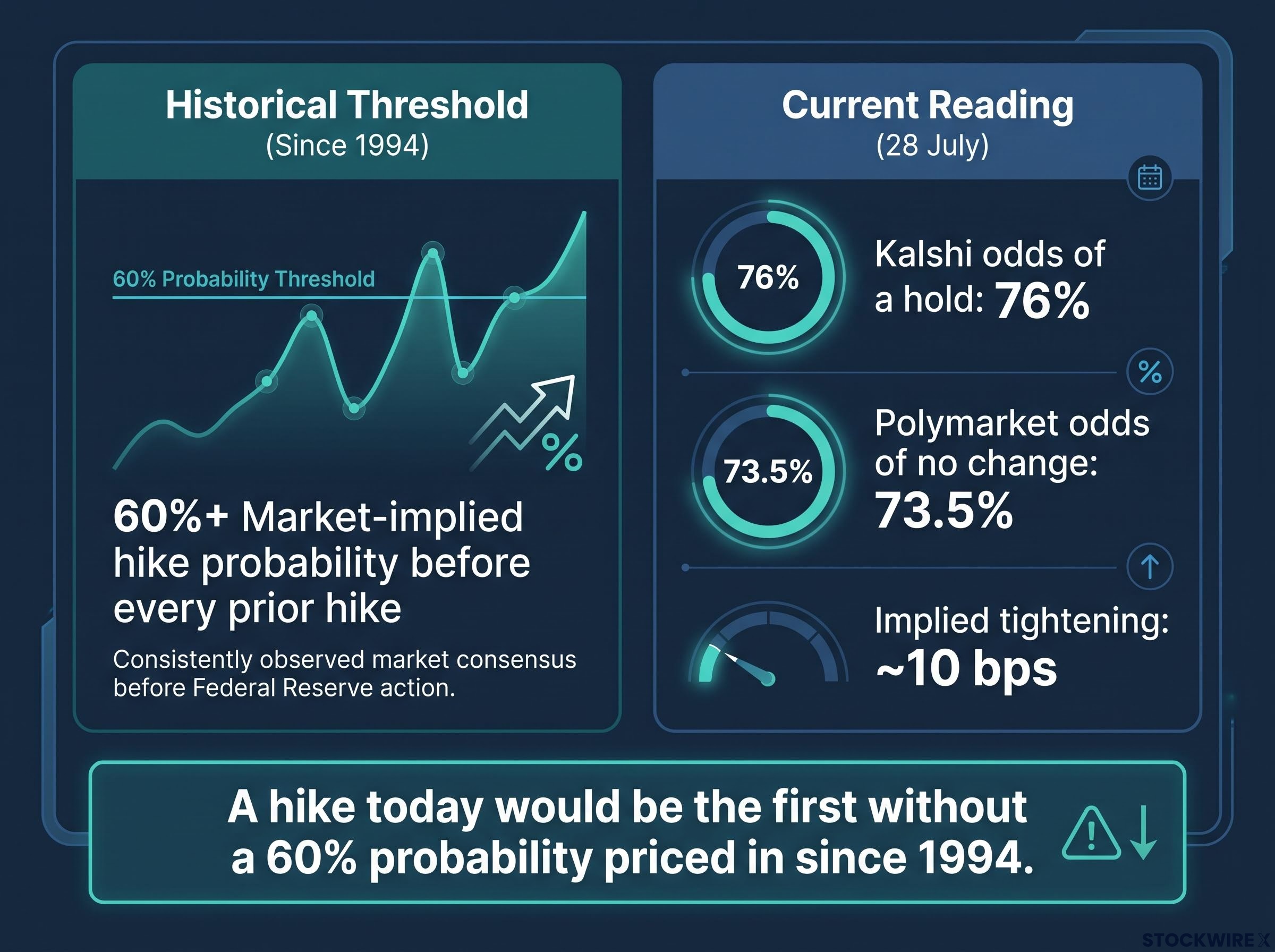
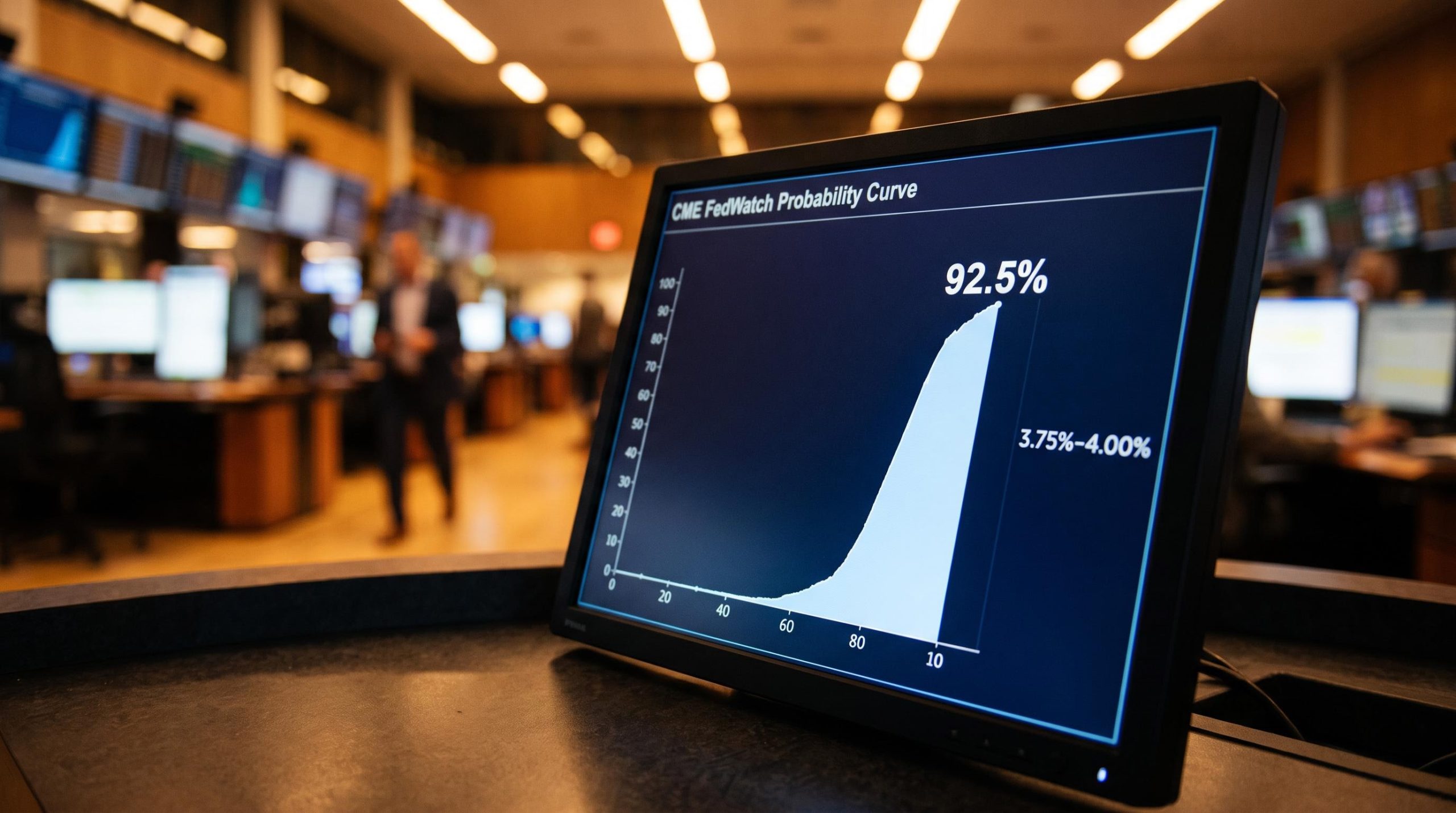
Current rate futures and options reflect only around 10 basis points of tightening baked in, which falls well below what a standard 25-basis-point move would require. Prediction markets tell the same story: Kalshi puts the odds of a hike at roughly 25% with a 76% chance of a hold, while Polymarket prices a 73.5% chance of no change.
Cabana described the July decision as a “very close call,” telling clients that a hike “can’t be ruled out” but that BofA’s base case remains no change.
The gap between what markets are pricing and where the Fed has historically been willing to act is not small. A hike today would not just be a surprise; it would be the single most market-unprepared Fed move in over three decades.
| Measure | Historical threshold (since 1994) | Current reading |
|---|---|---|
| Market-implied hike probability | 60%+ before every prior hike | ~25% |
| Kalshi odds of a hold | N/A | 76% |
| Polymarket odds of no change | N/A | 73.5% |
| Implied tightening (basis points) | 15+ bps (minimum for 60%) | ~10 bps |
When big ASX news breaks, our subscribers know first
The two forces pulling the Fed in opposite directions
The reason Cabana calls this a close call, despite the precedent argument favouring a hold, is that two genuinely countervailing forces are pulling the committee in opposite directions.
- Softer June inflation data argues for patience. The numbers came in below expectations, reducing the immediate urgency to tighten and making the case for waiting until more data arrives.
- A roughly 10% jump in WTI crude keeps a hike on the table. Oil price volatility is a live upside inflation risk, and BofA identifies it as the primary variable that could push the Fed hawkish.
Partial diplomatic easing between the U.S. and Iran could modestly reduce oil-driven price pressure, but it has not changed BofA’s overall assessment that the risk from crude remains to the upside.
Oil shock transmission into core CPI operates on a 6-12 month lag through logistics, agriculture, and manufacturing costs, which is why a single softer June inflation print does not extinguish the upside risk BofA assigns to crude as a driver of further Fed tightening.
The oil variable matters because it is the specific factor most likely to make a July hike look justified in retrospect if one happens. If crude continues climbing through August, today’s inflation data will look like a temporary reprieve rather than a trend. Understanding that logic will help you decode any language in the Fed’s statement or Chair Kevin Warsh’s press conference that references energy prices or supply-side risks.
Inside the committee: two expected dissents and a new chair’s credibility test
Even if the Fed holds today, the vote will not be unanimous. According to BofA’s base case, Lorie Logan and Beth Hammack are both expected to vote for a hike rather than follow the majority into a hold. That tells you something about the committee’s internal temperature that headline “Fed holds” coverage will not capture.
Two hawkish dissents in a hold decision would signal that the FOMC’s balance of opinion is closer to a rate increase than the market-implied 25% probability suggests. That gap between internal sentiment and external pricing is directly relevant for how you think about the September and October meetings.
The FOMC voting structure limits how much any single chair can unilaterally redirect policy, which is precisely why dissents from Logan and Hammack carry signal value: they reveal where the committee’s centre of gravity sits, independent of whatever Warsh’s own preference turns out to be.
BofA noted that a July hike would help “establish Warsh credibility on independence and inflation,” framing the decision as carrying institutional weight beyond its immediate policy effect.
Warsh was sworn in as Chair in May 2026, making today’s meeting among his earliest high-stakes decisions. A hold preserves the historical norm of not surprising markets. A hike would announce that this chair is willing to act ahead of consensus. Either outcome sends a signal about how Warsh intends to run the committee going forward.
What the Fed’s decision today means for the rest of 2026
Regardless of what happens at 2 p.m. Eastern, BofA’s broader forecast calls for significantly higher rates by year-end. The base case, assuming a hold today, projects three additional 25-basis-point hikes at the September, October, and December meetings. That would take the federal funds rate from the current 3.50%-3.75% target range to 4.25%-4.50% by year-end, representing approximately 45 basis points of additional tightening.
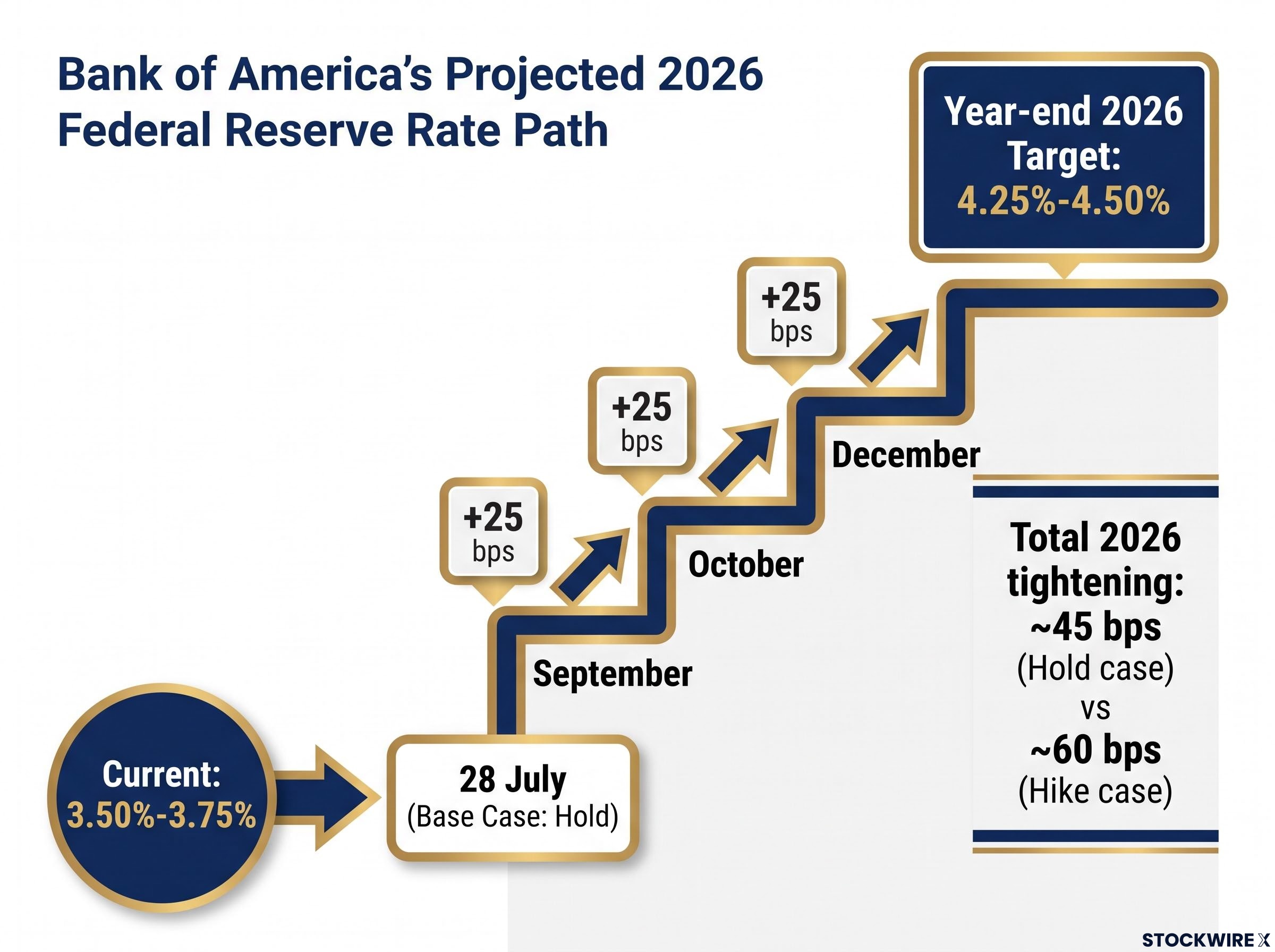
Should the Fed move today instead, that tightening would be brought forward in time, pushing the total volume of projected 2026 hikes from around 45 basis points to roughly 60 basis points across the full year. But the destination stays the same: 4.25%-4.50%.
That framing matters. The July decision is a timing question, not a destination question. BofA sees further tightening as likely either way, which means the rate path has direct implications for mortgage rates, auto loan costs, and any variable-rate debt you carry over the next six months.
Morgan Stanley’s no-hike baseline through all of 2026 sits in direct contrast to BofA’s three-hike projection, and the gap between the two banks’ forecasts reflects genuinely different readings of how quickly oil-driven inflation feeds into core PCE.
| Scenario | July action | Year-end rate target | Total 2026 tightening | Next hike meeting |
|---|---|---|---|---|
| Hold (base case) | No change | 4.25%-4.50% | ~45 bps | September 2026 |
| Hike | +25 bps | 4.25%-4.50% | ~60 bps | September 2026 |
How BofA is positioning its own money around the outcome
Forecasts are one thing. Capital allocation is another. Here is where BofA is actually putting money to work heading into today’s decision, per Cabana’s 28 July investor note:
- Long 2-year Treasuries: Front-end yields are the most sensitive instrument to near-term Fed expectations. Whether the Fed holds or delivers a one-off hawkish surprise, the 2-year sits at the point of maximum policy sensitivity.
- 2s/10s curve flattener: BofA expects the yield curve between the 2-year and 10-year to flatten further if the Fed leans hawkish.
- Bullish U.S. dollar: A Fed that is tighter than markets expected, or that keeps future hike risk alive, supports dollar strength relative to other currencies.
Reading the curve flattening signal
Cabana used the phrase “twisting flattening” to describe the expected curve move, meaning short-dated yields at the 2-year rise at a faster pace than long-dated yields at the 10-year. In plain terms, it signals that tighter monetary policy is being priced in at the front of the curve while growth expectations soften further out. If risk assets weaken following a hawkish surprise, the long end could actually rally as investors seek safety, reinforcing the flattening even if the Fed does not hike again immediately.
The combination of long 2-years, a flattener, and a long dollar is a coherent macro bet that the Fed will be more hawkish than markets currently price over the coming months. Knowing how a major Wall Street firm is positioned, not just what it forecasts, gives you a more honest read on BofA’s conviction level than the words in any note alone.
What the decision changes, and what it does not
BofA’s base case is a hold. But the more consequential forecast is the one that persists in either scenario: a year-end funds rate of 4.25%-4.50%, driven by hikes at the September, October, and December meetings. Today’s binary outcome matters less than the trajectory.
After the announcement, three signals are worth watching closely:
- Statement language on future meetings: Any shift in the characterisation of risks or the forward guidance phrasing will tell you how the committee is framing September.
- Dissent patterns: Whether Logan and Hammack dissent, and whether their hawkish stance is echoed in the post-meeting statement or press conference language.
- Oil price trajectory into August: Crude is the exogenous variable most capable of reshaping the rate path regardless of today’s outcome. A sustained move higher in WTI would strengthen the case for every hike BofA already projects.
Today’s decision will generate the headlines. The September meeting and the oil data between now and then matter more for anyone making borrowing, saving, or investment decisions over a six-to-twelve month horizon. Rate risk in 2026 remains skewed upward, and BofA’s three-hike base case for the remainder of the year is the forecast worth anchoring to.
For investors assessing how equities are likely to behave if the Fed delivers a hawkish surprise today or at September’s meeting, our full explainer on S&P 500 performance during rate hikes covers historical return patterns across tightening cycles and the four variables that determine whether this cycle tracks the average or departs from it.
This article is for informational purposes only and should not be considered financial advice. Investors should conduct their own research and consult with financial professionals before making investment decisions. Forward-looking statements, including rate path projections, are subject to change based on market developments and Federal Reserve policy decisions.