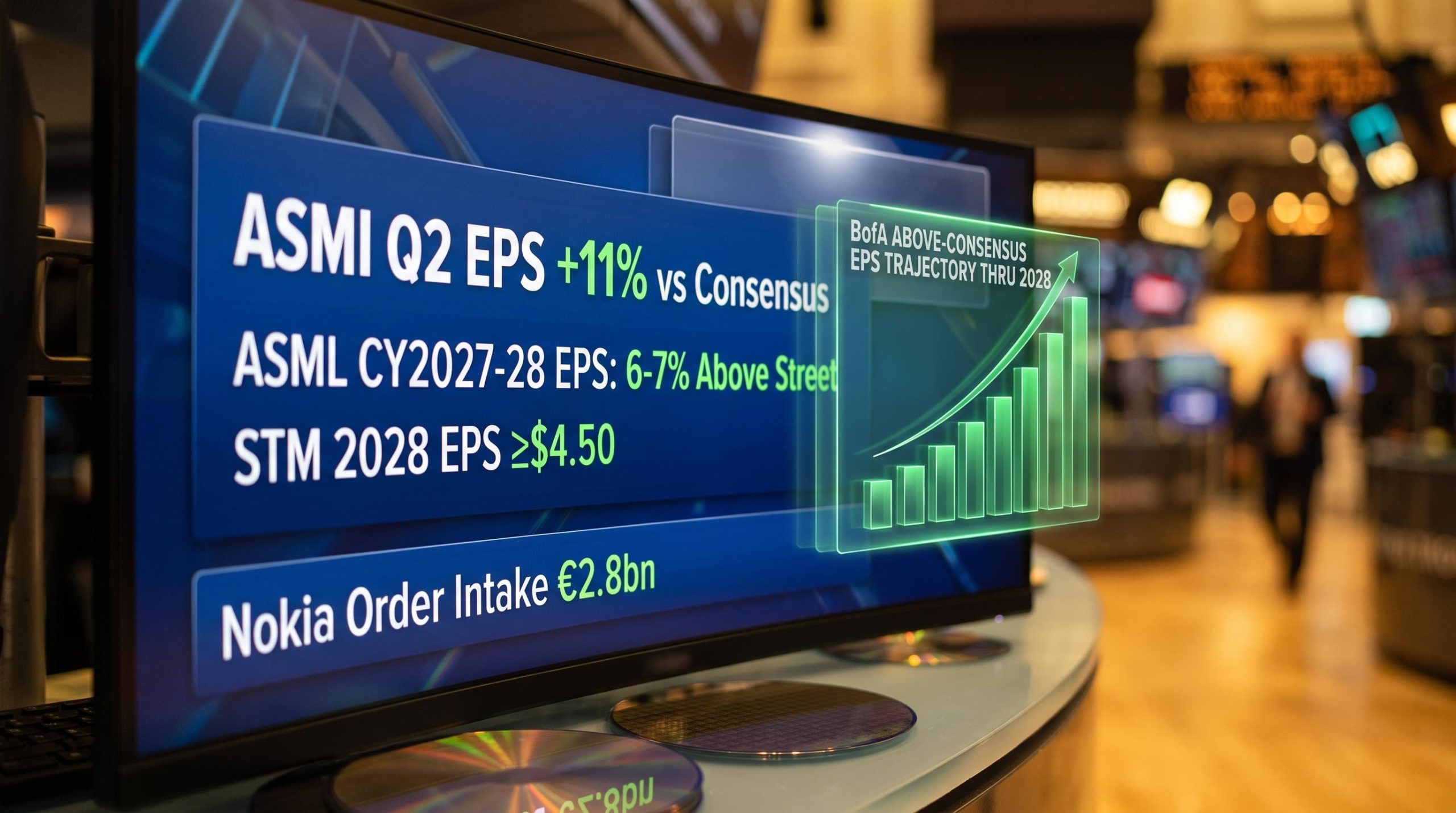
Bank of America has published a European technology research note that puts two semiconductor equipment names at the top of its conviction list. With one of them reporting earnings on Wednesday, the thesis is about to be tested in real time.
The framework spans six European-listed technology names, combining structural semiconductor equipment calls with a relative-value split inside telecom equipment and explicit Underperform warnings on Ericsson and Logitech. The timing gives the note unusual immediacy: ASM International’s Q2 results, due after European market close on Wednesday 29 July 2026, are the live catalyst the bank is staking part of its bullish case on.
Here is what BofA sees in each name, where its estimates diverge meaningfully from consensus, and what Wednesday’s earnings print will confirm or complicate for investors positioned in European technology equities.
Why ASML sits at the top of BofA’s European semiconductor framework
ASML earns the anchor position in BofA’s European tech framework on structural grounds the market already broadly acknowledges but, in the bank’s view, has not fully priced. BofA maintains a Buy rating built on three pillars:
- Near-monopoly in extreme ultraviolet (EUV) lithography, the most advanced chipmaking technology available
- Structurally rising average selling prices as EUV adoption deepens across leading-edge fabs
- Expanding gross margins over a multi-year horizon as the installed base grows
The differentiating element is not the rating itself. It is the earnings trajectory BofA is modelling behind it.
For CY2027 and CY2028, BofA’s earnings per share forecasts for ASML are running 6-7% ahead of where the broader Street consensus currently sits.
That gap is not a rounding difference. It signals BofA believes the market is systematically underpricing ASML’s profitability through the EUV pricing cycle, and a higher earnings trajectory implies a higher justified valuation than current share prices reflect. UBS, Bernstein, and Morgan Stanley each treat ASML as their top European semiconductor pick, so the directional call is consensus. BofA’s edge is quantified: proprietary estimates that sit meaningfully above what the rest of the Street is modelling.
ASML’s monopoly pricing power and installed base growth are the mechanics behind the above-consensus earnings trajectory BofA is modelling; the gap between analyst models and EUV order book reality became concrete when ASML raised its full-year 2026 revenue guidance a second time, lifting the midpoint by roughly €6 billion in a single announcement.
When big ASX news breaks, our subscribers know first
ASM International’s Wednesday earnings as BofA’s near-term conviction test
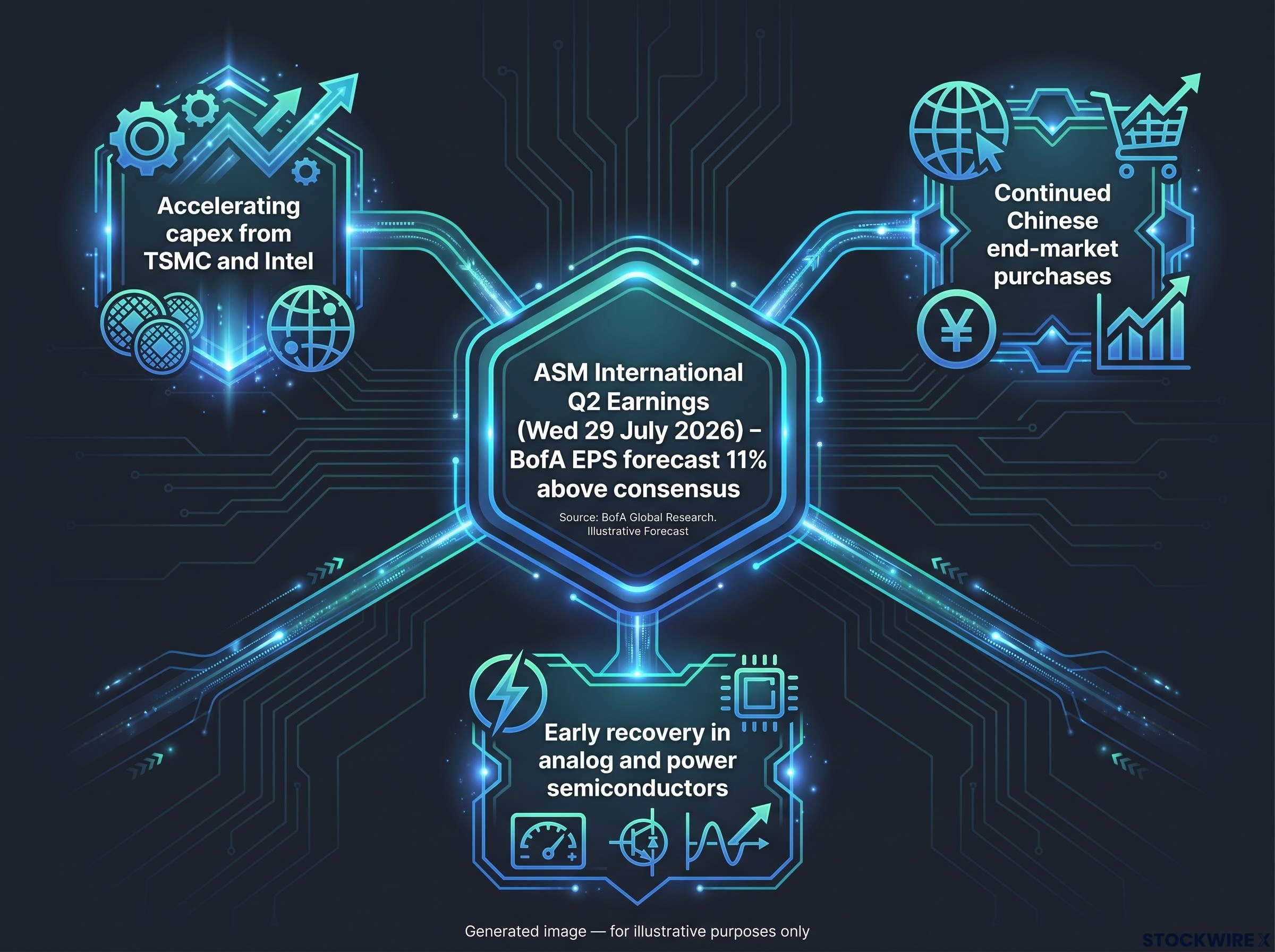
Every number in BofA’s bull case for ASM International is about to meet an actual result. The company reports Q2 earnings after European market close on Wednesday 29 July 2026, and BofA’s internal Q2 EPS forecast is running roughly 11% higher than where consensus estimates currently stand.
The above-consensus view rests on three demand drivers, each representing an independent channel of semiconductor equipment demand:
- Accelerating capital expenditure from TSMC and Intel, both significant purchasers of ASM International’s advanced deposition equipment
- Continued Chinese end-market purchases of European semiconductor equipment, notwithstanding ongoing trade-policy uncertainty
- An early recovery in analog and power semiconductors, a segment that had been lagging but is now showing signs of restocking and fresh investment
Morgan Stanley rates ASM International Overweight and has raised its price target, reinforcing that major brokers see structural strength in its deposition franchise. But BofA’s specific 11% gap above consensus makes Wednesday’s print the sharpest near-term test in the bank’s entire European tech framework.
TSMC’s 2026 capital expenditure increase to as much as $64 billion, driven by AI and high-performance computing demand, directly amplifies the purchasing pipeline for ASM International’s advanced deposition equipment, which sits at the centre of BofA’s above-consensus Q2 thesis.
What a beat would confirm
A result in line with BofA’s expectations would validate the bank’s demand view across all three channels simultaneously. It would support the broader bullish stance on European semiconductor capital equipment into 2026-2028 and reinforce the structural demand narrative across ASML and the wider complex.
What a miss would signal
A miss or in-line result would raise questions about the pace of capex acceleration and analog and power cycle rebuild. The market would likely re-examine the more aggressive upside scenarios embedded in BofA and peer models for the sector. For investors, the specific channel management credits in its earnings call commentary matters as much as the headline number.
The risk that a result lands in line with BofA’s expectations and still fails to move the stock in the anticipated direction is real: the prior session showed that expectations positioning and not just the headline number determines who wins and who gets punished, with BESI falling 3.7% despite 128.8% order growth because one specific omission undermined the bull narrative.
The European semiconductor equipment thesis in context
BofA is not picking individual names in isolation. The bank operates inside a clear sector hierarchy: semiconductor capital equipment at the top, analog second, telecom equipment third. That preference ordering is consistent with wider Street positioning at peer firms, making BofA’s stance a consensus-directional call differentiated by proprietary earnings estimates rather than a contrarian one.
Within that hierarchy, STMicroelectronics occupies the patient recovery slot. BofA maintains a Buy rating and projects 2028 EPS of $4.50 or more per share, with the bank pointing to a 2x book-to-bill ratio as evidence of tangible demand visibility today. Manufacturing efficiency improvements are expected to contribute approximately 4 percentage points to gross margin by mid-2028, while the bank also identifies optical components and low-earth-orbit satellite products as two additional growth areas underpinning its CY2028 earnings thesis. The book-to-bill ratio, which measures new orders relative to recognised revenue, stands at 2x per BofA. That means orders are running at double recognised revenue, a concrete demand-visibility metric that anchors the recovery thesis in something measurable today rather than a forecast alone.
UBS and Morgan Stanley similarly rank STMicroelectronics among preferred European semiconductor names, typically behind ASML and ASM International in analyst preference ordering.
| Company | BofA Rating | Key BofA Metric | Timeframe |
|---|---|---|---|
| ASML | Buy | EPS 6-7% above consensus | CY2027-CY2028 |
| ASM International | Buy | Q2 EPS ~11% above consensus | Q2 2026 (report 29 July) |
| STMicroelectronics | Buy | 2028 EPS ≥$4.50; +4pp gross margin; 2x book-to-bill | CY2028 / mid-2028 |
| Nokia | Buy | €2.8bn order intake (underappreciated) | Period unspecified |
All BofA-specific figures are proprietary internal estimates and have not been independently verified in public sources.
For investors building a portfolio of European semiconductor exposure rather than selecting single names, understanding where STM sits in this preference ranking signals which catalysts need to materialise first before the patient thesis pays off.
Investors building European semiconductor exposure across both equipment and memory names should note that equipment and memory divergence can reach 49 percentage points across a single cycle, a structural gap driven by the timing mismatch between capex commitments and memory price cycles that makes the two sub-sectors poor proxies for each other.
Nokia preferred, Ericsson avoided: BofA’s telecom equipment split
BofA is not bearish on European telecom infrastructure broadly. It is making a specific directional bet within it.
Nokia holds a Buy rating built around a focused argument: that its order intake of €2.8 billion is receiving less recognition from consensus models than its scale warrants, with BofA contending that the pipeline is stronger than prevailing market estimates reflect.
The contrast with Ericsson is direct. BofA assigns Ericsson an Underperform rating, pointing to a weaker outlook for both its margin development and overall growth trajectory. No granular financial metrics are provided for the Underperform case, making this a relative-weight call on order momentum and margin visibility rather than a detailed quantitative thesis.
- Nokia (Buy): €2.8 billion order intake; BofA views pipeline as stronger than consensus models reflect
- Ericsson (Underperform): Margin trajectory and growth outlook concerns; positioned as the weaker side of the telecom equipment trade
For investors with telecom infrastructure exposure on their radar, the Nokia versus Ericsson split is the most practically actionable allocation signal in BofA’s note outside the semiconductor names. You do not have to choose between owning or avoiding European telecom equipment altogether; BofA is telling you which side of that trade has the better near-term pipeline data.
Where BofA sees risk: Logitech and the case against consumer peripherals
Logitech, which operates in PC and gaming peripherals, sits at the bottom of BofA’s European tech preference ranking with an Underperform rating, reflecting the bank’s view that its margin profile and growth prospects are less attractive than the capital equipment and infrastructure names it favours. No specific financial metrics or forward targets are provided, making this a qualitative relative-weight call rather than a quantitative one.
Its inclusion in a note primarily focused on semiconductor capital equipment and telecom infrastructure is itself a signal. BofA is explicitly ranking consumer peripherals below capital equipment and infrastructure in its European tech preference ordering.
BofA’s sector preference hierarchy: Semiconductor capital equipment at the top, analog second, telecom equipment third (Nokia over Ericsson), consumer peripherals at the bottom.
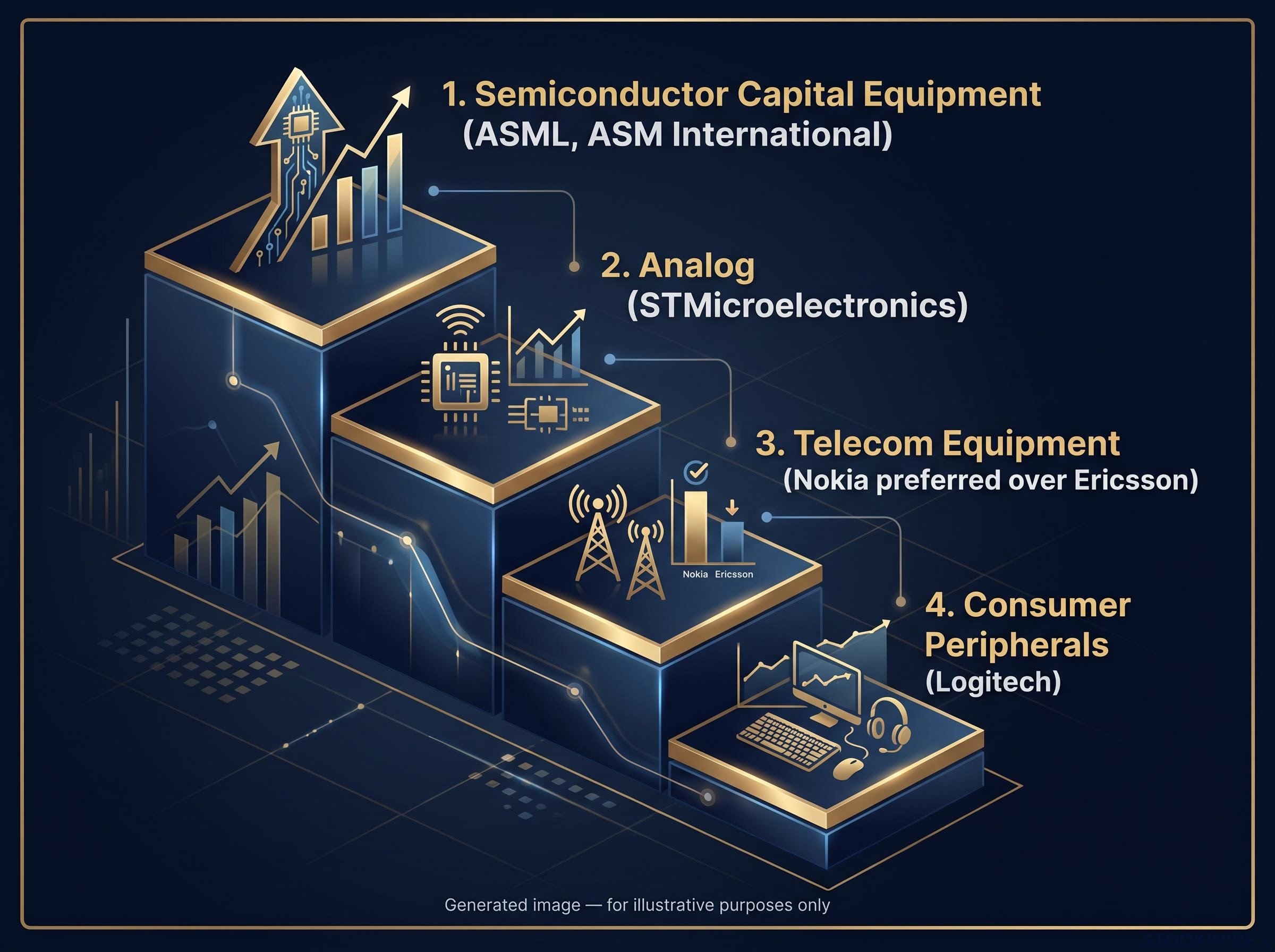
The Logitech Underperform is less about Logitech specifically and more about what BofA is telling investors to do with the capital instead: rotate toward capital equipment and infrastructure exposure where the proprietary earnings upside is concentrated. Understanding the Logitech and Ericsson Underperform ratings as a pair gives you a clearer picture of which parts of the European tech universe BofA is actively steering away from, which is as useful for portfolio construction as knowing which names to buy.
Wednesday’s print and the 2027-2028 earnings gap that matters beyond it
Two time horizons sit inside BofA’s framework, and they reinforce each other. The near-term test is ASM International’s Q2 print on Wednesday, where BofA’s EPS estimate sits approximately 11% above consensus. The longer-term thesis is ASML’s earnings trajectory running 6-7% above consensus through 2028.
Does Wednesday’s result change the probability that BofA’s 2027-2028 earnings projections are achievable?
That is the question investors in European semiconductor equipment should be calibrating against. If the Q2 beat materialises across the specific demand channels BofA has identified, it raises the probability that the bank’s multi-year above-consensus view is grounded in current demand data rather than modelling optimism. If it does not, investors and the wider market will reassess how aggressive those 2027-2028 projections really are.
All specific BofA figures cited in this article are proprietary estimates from one institution and have not been independently verified in public sources. Investors should treat them as one data point in their own analysis. The broader Street is directionally aligned, with ASML, ASM International, and STMicroelectronics ranking highly across multiple major banks, but BofA differentiates through specific proprietary estimates and identified catalysts.
The combination of a 48-hour catalyst and a multi-year earnings gap above consensus means investors in European technology equities have an unusually concrete near-term read on whether a major bank’s structural thesis is grounded in reality.
For investors wanting to frame BofA’s 2027-2028 earnings projections against the broader cycle timeline, our dedicated guide to semiconductor cycle positioning covers the five-indicator framework for capturing peak-cycle gains without holding premium multiples past their expiry date as the 2027-2029 supply wave arrives.
This article is for informational purposes only and should not be considered financial advice. Investors should conduct their own research and consult with financial professionals before making investment decisions. Past performance does not guarantee future results. Financial projections are subject to market conditions and various risk factors.