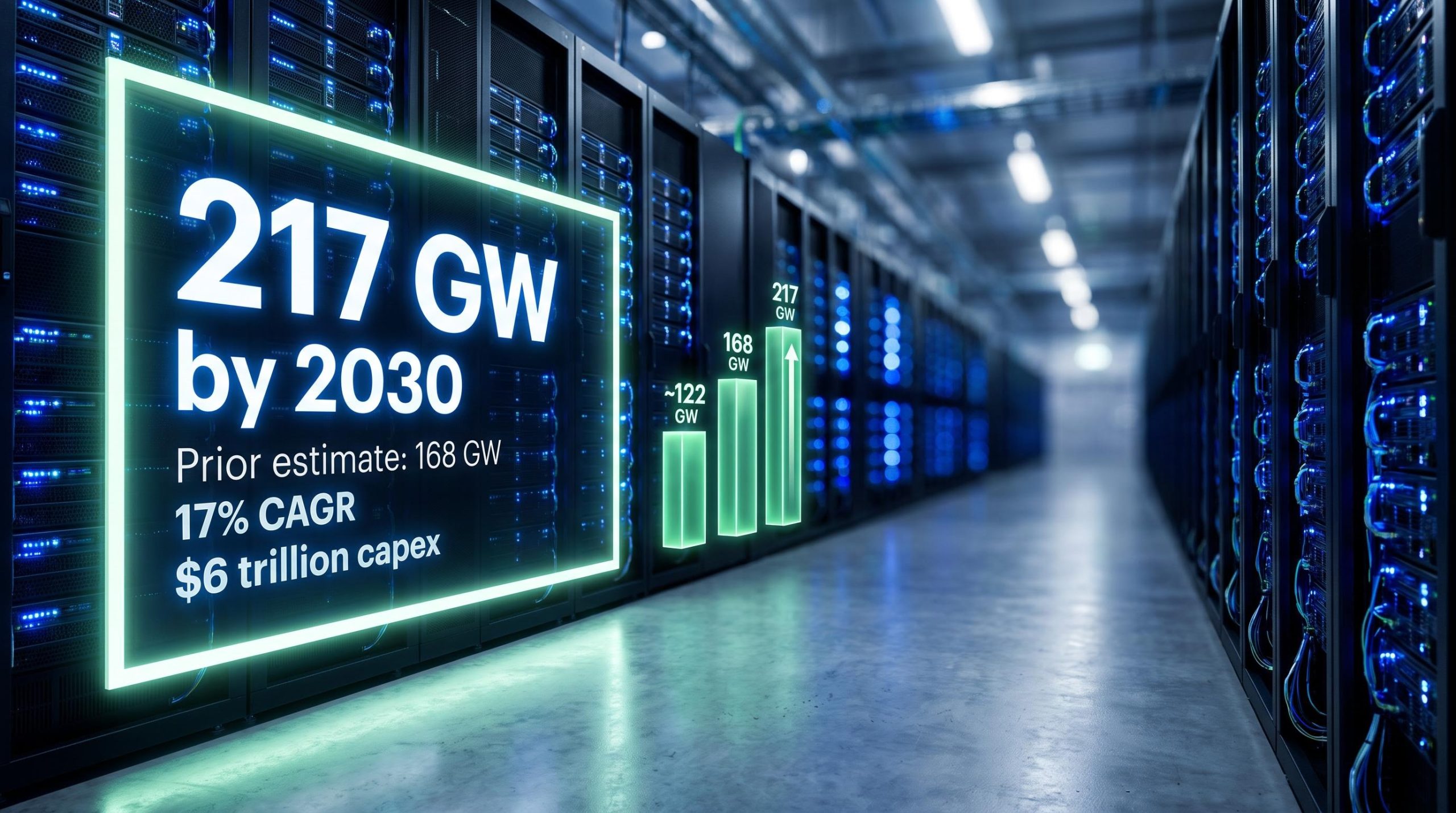
Goldman Sachs has nearly doubled its global data centre capacity forecast, landing on 217 GW by 2030 in a report published 24 July 2026. The prior estimate was 168 GW. The baseline today is roughly 101 GW. That is a projection to more than double the world’s installed data centre capacity within five years.
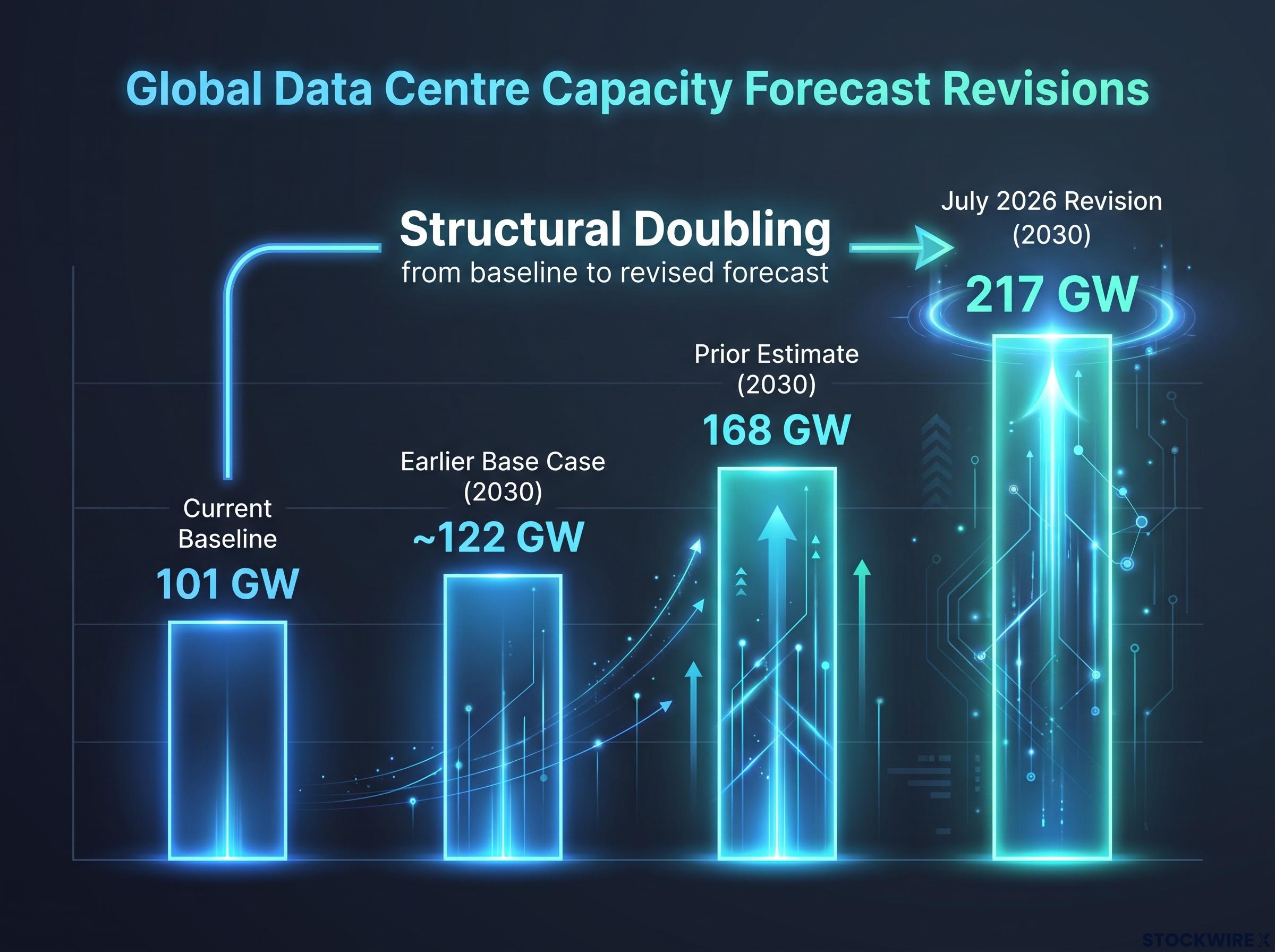
This is not a routine update. Goldman is recalibrating the scale of what is shaping up to be the largest infrastructure investment cycle in modern history. The bank’s own earlier base case sat at approximately 122 GW. It revised that to 168 GW. Now it has moved to 217 GW. Each revision has been overtaken by the pace of AI-driven demand, and each upgrade has been larger than the last.
Here is what the numbers actually tell you: why Goldman believes $6 trillion in capital expenditure is supportable, what is driving demand faster than any prior model anticipated, and what the revision means for anyone watching AI infrastructure as an investment theme.
What Goldman’s revised forecast actually says
The scale ladder runs like this. Global data centre capacity sits at approximately 101 GW today. Goldman’s 24 July 2026 report projects that figure reaching 217 GW by 2030, implying 116 GW of incremental new capacity built within five years. The compound annual growth rate underpinning that trajectory is 17%.
That 217 GW target did not arrive in a single leap. Goldman’s earlier public base case for 2030 capacity was approximately 122 GW. The bank revised that to 168 GW before the latest report pushed it to 217 GW. Each estimate was considered aggressive at the time it was published.
| Vintage | Goldman Estimate (GW) | Note |
|---|---|---|
| Earlier base case | ~122 GW | Pre-revision baseline |
| Prior estimate | 168 GW | Already elevated above consensus |
| July 2026 revision | 217 GW | Nearly doubled from earlier base case |
The step from 101 GW to 217 GW is not incremental expansion. It is a structural doubling of the world’s compute infrastructure inside half a decade, and even Goldman’s “prior estimate” was already aggressive by any historical standard.
When big ASX news breaks, our subscribers know first
Why AI infrastructure demand is growing faster than Goldman previously modelled
The revision is data-driven, not speculative. Goldman cited 451 Research project activity data showing heightened global development pipelines as the empirical basis for the upgrade.
Three categories of demand are stacking on top of each other:
- Generative AI model development: The initial wave of large language model training that triggered the infrastructure arms race remains active and expanding.
- Enterprise inference workloads: Production-scale AI deployment across industries is scaling faster than Goldman’s earlier frameworks anticipated.
- Agentic AI deployment: AI agents operating autonomously across enterprise systems represent a newer demand layer Goldman expects to sustain power growth even as hardware efficiency improves.
The demand case Goldman cites rests heavily on enterprise inference and agentic workloads scaling at speed, yet enterprise AI adoption data shows only 12-20% of enterprises have achieved meaningful operational AI embedding as of mid-2026, with agentic deployment sitting at just 17%, suggesting the demand trajectory Goldman models represents an acceleration from a low current base.
That last point addresses the most common sceptical question: what happens when chips get more efficient? Goldman’s answer is that each gain in efficiency enables more applications and more deployments rather than reducing total consumption. This is a dynamic economists call Jevons paradox applied to compute, and Goldman expects it to hold through 2030.
According to its July 2026 report, Goldman Sachs expects worldwide data centre power consumption to be 170% higher in 2030 than it was in 2025, as AI adoption continues to accelerate.
The 170% power demand increase is the engine behind the capacity forecast. Efficiency is not slowing this down; it is accelerating it by making more use cases economically viable.
How Goldman gets to $6 trillion in supportable capital expenditure
The headline number is $6 trillion. Goldman estimates that is the total capital expenditure required to build the incremental 116 GW of new capacity between the 2025 baseline and the 2030 target.
That figure is distinct from Goldman’s separately published $720 billion grid infrastructure investment estimate, which covers electric grid reinforcement only. The $6 trillion encompasses the full scope: land, construction, power systems, cooling, compute hardware, and connectivity for new data centre capacity. Broader industry syntheses from multiple analysts have arrived at a similar $6-7 trillion total investment range through 2030.
| Figure | Amount | Scope |
|---|---|---|
| Total data centre capex (116 GW) | $6 trillion | All infrastructure for new capacity, 2025-2030 |
| Grid investment | $720 billion | Electric grid reinforcement only |
Goldman describing $6 trillion as “supportable” is a significant institutional endorsement. The bank has reviewed existing and announced hyperscaler capital expenditure plans and concluded the committed capital is large enough to fund the buildout without requiring a new leap of faith in funding. For investors evaluating AI infrastructure exposure, that distinction between a speculative capex estimate and one grounded in confirmed spending trajectories is a meaningful signal about execution risk.
The committed capital underpinning Goldman’s supportable capex case is not hypothetical: hyperscaler capital expenditure from Amazon, Microsoft, Alphabet, and Meta reached $130 billion in Q1 2026 alone, with full-year 2026 combined guidance running at approximately $725 billion.
Understanding what 217 GW actually means in the real world
A gigawatt (GW) is a measure of continuous electrical power draw, not a measure of storage or computing capacity. A single large hyperscale data centre campus might draw 100-500 megawatts. Building 116 GW of new capacity is the equivalent of constructing hundreds of those campuses from scratch.
Goldman Sachs Research has described the projected growth in global data centre power demand as equivalent to “adding another top-10 power-consuming country” to the global grid.
The concentration is overwhelmingly American. Goldman’s forecast places roughly 60-70% of all new capacity built globally through 2030 within the United States. The US power demand trajectory tells that story in granular terms:
- 2025: 31 GW of data centre power demand
- 2026: 41 GW
- 2027: 66 GW
- End-2027 installed capacity: approximately 95 GW
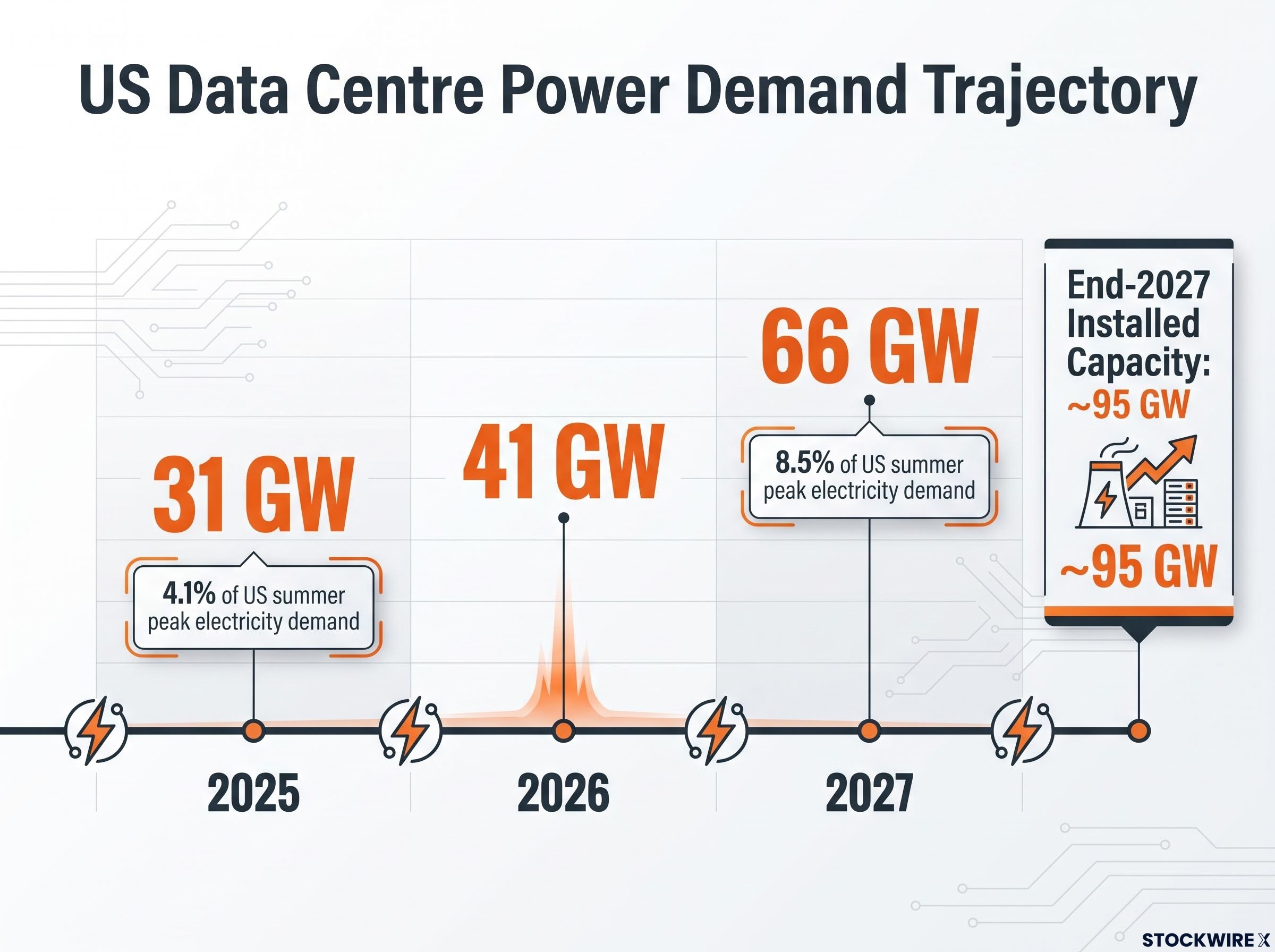
By 2027, data centres are expected to account for 8.5% of US summer peak electricity demand, up from 4.1% in 2025. When data centres double their share of national peak electricity demand in two years, that is not a technology sector story. It is a national energy infrastructure story, and the power system implication is as significant as the compute implication for investors watching the sectors most directly exposed.
The scale of that transition has developed into a structural grid crisis that extends well beyond any single utility market, with the IEA projecting combined data centre and AI electricity consumption to exceed 1,000 TWh by 2026 and Goldman separately estimating AI-specific incremental demand could add 800-1,000 TWh against a no-AI baseline by 2030.
The constraints Goldman says could limit delivery on these projections
Goldman has built its own friction framework into the forecast. The bank’s “6 Ps” framework identifies the binding constraints that stand between the 217 GW projection and actual delivery:
- Power availability: The primary limiting factor. Tightening power markets and regional grid constraints could slow or geographically redirect data centre development.
- Permitting: Regulatory delays and local community opposition present logistical and political obstacles at scale.
- Labour: Shortages of skilled construction and technical workers constrain expansion timelines across multiple geographies.
- Equipment: Lead times for specialised cooling systems, power infrastructure, and compute hardware create supply-chain bottlenecks.
The $720 billion grid investment figure gives a sense of the scale of reinforcement required just on the power side. Resolving that constraint alone is a multi-year infrastructure programme (with the US spelling reserved for proper nouns only).
Goldman’s July 2026 report notes that the supply pipeline has not brought relief to the market, with occupancy running at historically high levels and operators continuing to gain pricing power as available capacity shrinks.
That market tightness is itself a signal. Earlier Goldman frameworks had anticipated some supply-demand easing around 2025-2026. It has not materialised. Demand has absorbed each successive supply upgrade, which is the most bullish data point in the entire forecast.
CBRE North America data centre trends for the second half of 2025 recorded vacancy rates falling to 1.4% by year-end, with net absorption reaching 2,497.6 MW across the year, corroborating Goldman’s observation that supply additions have consistently failed to ease market tightness.
What the Goldman revision signals for AI infrastructure as an investment theme
When the most watched Wall Street forecaster nearly doubles a multi-year infrastructure projection, it communicates institutional conviction that goes beyond a routine update. Goldman is telling the market that AI-driven capital expenditure is durable, scaled, and financeable.
The sectors most directly implicated by the forecast revision:
- Power generation and transmission: The primary bottleneck and the largest adjacent investment theme, with $720 billion in grid reinforcement alone.
- Hyperscale data centre operators and developers: Declining vacancy and strengthening pricing power position current operators ahead of the supply curve.
- Cooling and electrical infrastructure suppliers: Every new gigawatt of capacity requires specialised thermal and power delivery systems at scale.
- Construction: The physical buildout of hundreds of large-scale campuses demands sustained construction activity through 2030.
A 17% CAGR over five years in a capital-intensive infrastructure sector, with $6 trillion in capex that Goldman considers supportable, is an unusual combination of scale and institutional backing. Investors following AI themes should distinguish between long-cycle infrastructure positioning and near-term catalyst trades. Goldman’s 217 GW target is a 2030 endpoint, not a next-quarter call.
For investors wanting to understand how the global buildout translates into specific equity exposures across colocation operators, property trusts, and network services, our full explainer on AI infrastructure investment examines each business model’s revenue structure and the dilution risk that capital-intensive build programmes introduce.
This article is for informational purposes only and should not be considered financial advice. Investors should conduct their own research and consult with financial professionals before making investment decisions.
What comes after 217 GW and why Goldman expects the upgrade cycle to continue
The revision trajectory itself is the signal. Goldman moved from approximately 122 GW to 168 GW to 217 GW. Each estimate was overtaken by demand reality before the next publication cycle. In that context, the 2030 target reads as a floor as much as a ceiling.
| Variable | Upside case | Downside case |
|---|---|---|
| Capacity by 2030 | Above 217 GW if enterprise agentic AI adoption accelerates | Below 217 GW if grid constraints bind |
| Capex | Exceeds $6 trillion | Constrained by permitting and labour delays |
| US concentration | Above 70% | Below 60% if regional constraints redirect investment |
The two variables Goldman cites as most decisive: agentic AI adoption on the upside and power grid constraints on the downside. The capital is committed. The demand case, anchored by a 17% CAGR and $6 trillion in supportable capex, remains intact. The question facing investors is no longer whether the investment cycle is real. It is how fast the infrastructure can be built to meet it.
These forward-looking projections are subject to change based on market developments, technological progress, and infrastructure delivery outcomes. Past forecast revisions do not guarantee future accuracy.