

New Genetype test flags 42% more lung cancer cases for screening
Rhythm Biosciences (ASX: RHY) has developed a new Genetype lung cancer risk prediction test that identifies more at-risk adults for screening than current Australian guidelines. The test combines genetic and clinical risk factors and, in testing, outperformed existing eligibility criteria.
The significance is straightforward. Lung cancer is the world’s leading cause of cancer deaths, killing around 1.8 million people every year.
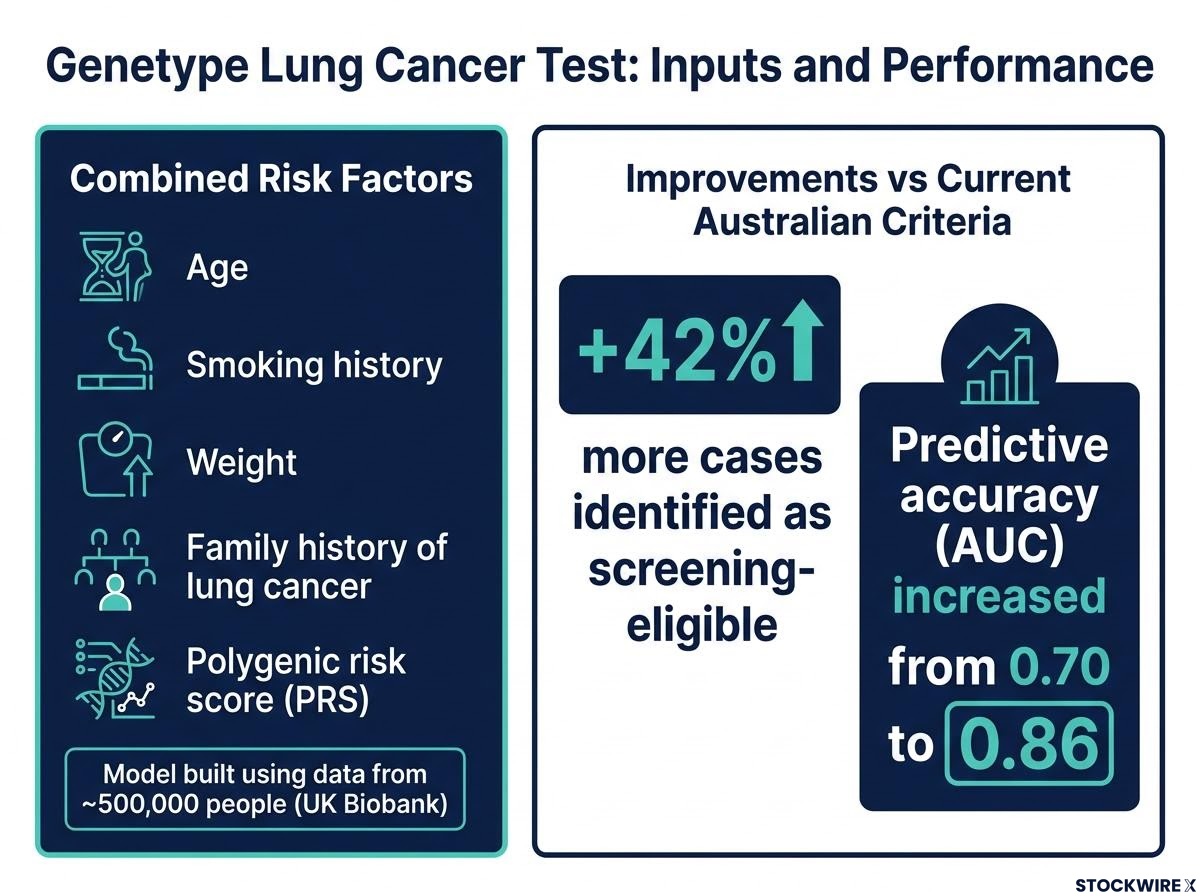
According to the Company, the new model identified 42% more lung cancer cases as eligible for screening compared with current Australian criteria. Its predictive accuracy, measured by Area Under the Curve (AUC), improved from 0.70 to 0.86.
The test was built and tested using data from around 500,000 people in the UK Biobank study, one of the world’s largest health databases. For context, low-dose CT (LDCT) screening has been shown to cut lung cancer deaths by up to 24% in high-risk groups, making earlier identification of at-risk individuals a clear clinical priority.
For investors, a validated, higher-accuracy test broadens the addressable screening population and strengthens the commercial case for Rhythm’s Genetype portfolio.
When big ASX news breaks, our subscribers know first
How the new model works
The Genetype test algorithm combines well-established clinical risk factors with a polygenic risk score (PRS). This layered approach aims to capture inherited risk that clinical factors alone do not reflect.
The clinical risk factors combined in the algorithm are:
-
Age
-
Smoking history
-
Weight
-
Family history of lung cancer
-
Plus a polygenic risk score (PRS)
The model was built and tested using UK Biobank data. When measured against current Australian screening eligibility rules, the results showed clear gains across both accuracy and reach.
| Metric | Current Australian Criteria | Genetype Model | Improvement |
|---|---|---|---|
| Predictive accuracy (AUC) | 0.70 | 0.86 | |
| Cases identified as screening-eligible | Baseline | 42% more | +42% |
These figures are described in the announcement as unpublished data, which Rhythm intends to submit for independent peer review.
What genetic risk scoring means, and why it matters for screening
A polygenic risk score adds up the small effects of many genetic variations to estimate a person’s inherited risk of developing a disease. It provides insight that clinical factors alone cannot capture, giving a fuller picture of overall risk.
Current US and Australian screening guidelines rely mainly on age and smoking history. This leaves many at-risk people outside the screening net, because a significant number of lung cancers occur in people who do not meet these criteria.
The practical benefit is a wider, more precise screening pool. The test identifies more people who would benefit from screening, including some light smokers who fall outside today’s age and smoking-history cut-offs.
Reducing the stigma barrier to screening
Because current guidelines are based explicitly on smoking history, some smokers and former smokers may feel shame or self-blame that deters participation, even though screening could save their lives.
By showing that genetics also plays a significant role in lung cancer risk, the test may help reduce this stigma and encourage more eligible people to come forward for screening.
Why this strengthens Rhythm’s diagnostics story
The new test adds to Rhythm’s existing Genetype portfolio of risk assessment tests. That platform already covers breast cancer, cardiovascular disease, diabetes, colorectal cancer, prostate cancer and melanoma, delivered through healthcare providers and genetic counsellors.
The strategic link matters. The Company frames the test as complementary to its blood-based biomarker work, aiming to achieve the same longitudinal disease approach for lung cancer that it has pursued for bowel cancer, with Genetype working in conjunction with ColoSTAT®.
According to Rhythm, the findings support the case for including genetic risk information in national lung cancer screening programs in both the US and Australia, based on unpublished data. The Company notes the test works across both US and Australian healthcare settings, though any future application is subject to further validation and regulatory considerations.
Dr Erika Spaeth, Director of Clinical Affairs at Rhythm
“This model represents a meaningful advance in how we identify individuals who stand to benefit most from lung cancer screening. By combining genetic risk information with clinical data, we can look beyond traditional smoking thresholds and reach the people at highest risk who are currently falling through the cracks of existing programs. Furthermore, this complements the work we are doing on blood-based biomarkers designed to ultimately be a screen for lung cancer. The goal is to achieve the same longitudinal approach to disease for lung cancer as we have for bowel cancer – Genetype working in conjunction with ColoSTAT®.”
Commercialisation plans and next steps
Rhythm intends to transfer the novel clinical test to production over the next quarter to support future commercialisation. The Company has framed this as an intention, rather than a confirmed timeline.
The roadmap is as follows:
-
Submit the research for independent peer review
-
Transfer the clinical test to production over the next quarter
-
Add the test to the existing Genetype risk assessment portfolio for future commercialisation
The development sits within Rhythm’s broader mission of delivering simple, affordable blood tests for the accurate and early detection of cancers. Should the model progress through peer review and validation, it would extend that early-detection focus into one of the world’s most lethal cancers, reinforcing the Company’s positioning across both genetic risk assessment and blood-based diagnostics.
Don’t Miss the Next Healthcare Breakthrough on ASX
Big News Blast delivers FREE breaking ASX healthcare news directly to your inbox within minutes of release, complete with in-depth analysis. Over 20,000 subscribers already rely on it to stay ahead of market-moving announcements. Click the “Free Alerts” button at StockWire X to get the next big healthcare story the moment it breaks.