
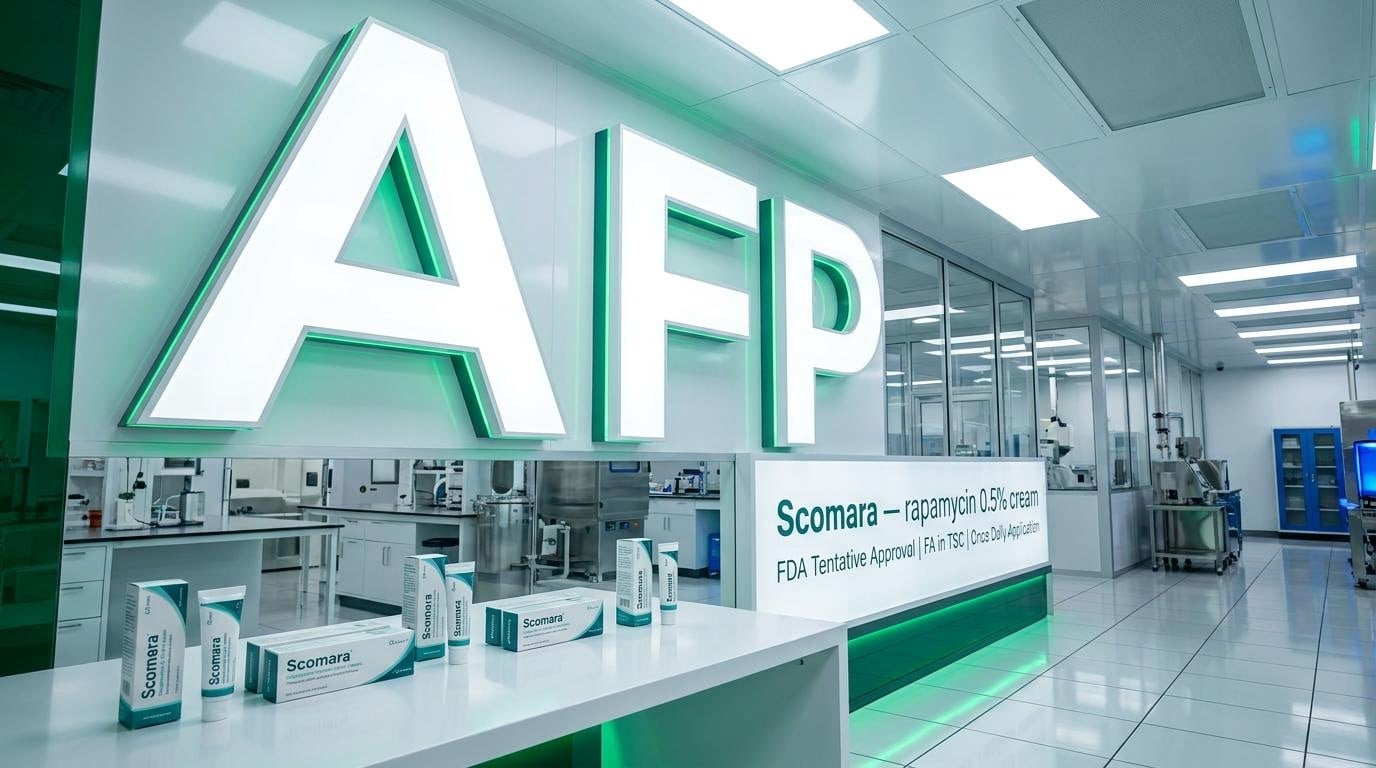
FDA issues tentative approval for AFT’s Scomara — regulatory validation with a global growth angle
On 21 July 2026, AFT Pharmaceuticals (NZX: AFT; ASX: AFP) announced that the US Food and Drug Administration (FDA) has issued a tentative approval for Scomara (rapamycin 0.5% cream) for the treatment of Facial Angiofibromas in Tuberous Sclerosis (FA in TSC).
The FDA has evaluated the quality, efficacy and safety data, with product labelling and claims tentatively approved. However, the launch and commercialisation in the US remains subject to an existing “orphan exclusivity” held by a competing product, granted in 2022 and expiring on 22 March 2029.
For investors, the significance lies less in near-term US access and more in what the approval unlocks elsewhere. The regulatory validation supports approval in non-US markets where AFT already operates directly.
When big ASX news breaks, our subscribers know first
What the tentative approval means — and what it doesn’t
The distinction between regulatory endorsement and commercial timing is central to this announcement. The FDA has validated AFT’s data package, with product labelling and claims tentatively approved.
What it does not do is open the US market. The launch and commercialisation there is delayed until at least 22 March 2029 because a competitor holds orphan exclusivity for the same indication. FA in TSC affects an estimated 15,000 to 30,000 patients in the US.
The tentative approval therefore confirms the science while leaving the largest single market gated for several years. The genuine opportunity sits in markets not covered by the US exclusivity.
| Item | Detail |
|---|---|
| Product | Scomara (rapamycin 0.5% cream) |
| Indication | FA in TSC |
| FDA status | Tentative approval |
| US patient population | 15,000–30,000 |
| US launch earliest | 22 March 2029 |
Dr Hartley Atkinson, Managing Director
“We are pleased to achieve this tentative approval following FDA review of our regulatory application but are disappointed that the US launch will be delayed at least until 22 March 2029. However, the tentative approval is a catalyst for AFT to develop new and significant markets for the medicine outside the US which is positive.”
Understanding orphan exclusivity
Orphan exclusivity is a regulatory incentive granted to pharmaceutical companies to encourage the development of treatments for rare diseases. It rewards firms that invest in conditions affecting relatively small patient populations.
In the United States, orphan exclusivity provides seven years of market protection. During this period, the FDA cannot approve any other application for the same drug for the same rare disease indication.
Why does this matter to investors? It explains why AFT’s US launch is blocked despite a positive data review. The exclusivity is held by the competing product, not by AFT.
Critically, US orphan exclusivity does not apply in many other significant markets around the world. This is where AFT’s near-term opportunity lies.
The global opportunity outside the US
The FDA approval will support regulatory approval in markets not covered by the US orphan exclusivity. AFT has identified several territories where it can pursue commercialisation while the US remains gated.
These include Canada, Australia and New Zealand, where AFT operates directly itself, alongside many markets in Asia. In these regions, AFT believes Scomara will hold a competitive advantage over the existing orphan product.
AFT Pharmaceuticals FY26 results showed operating revenue of NZ$254.7M, up 22% year-on-year, with the Asia segment growing 41% and international product sales and royalties rising 66%, providing context for why near-term non-US regulatory wins carry commercial weight for the group.
The company points to two practical differentiators:
-
Applied once a day, compared with the competitor’s twice-per-day regimen.
-
Stored at ambient temperature, whereas the competing product must be refrigerated.
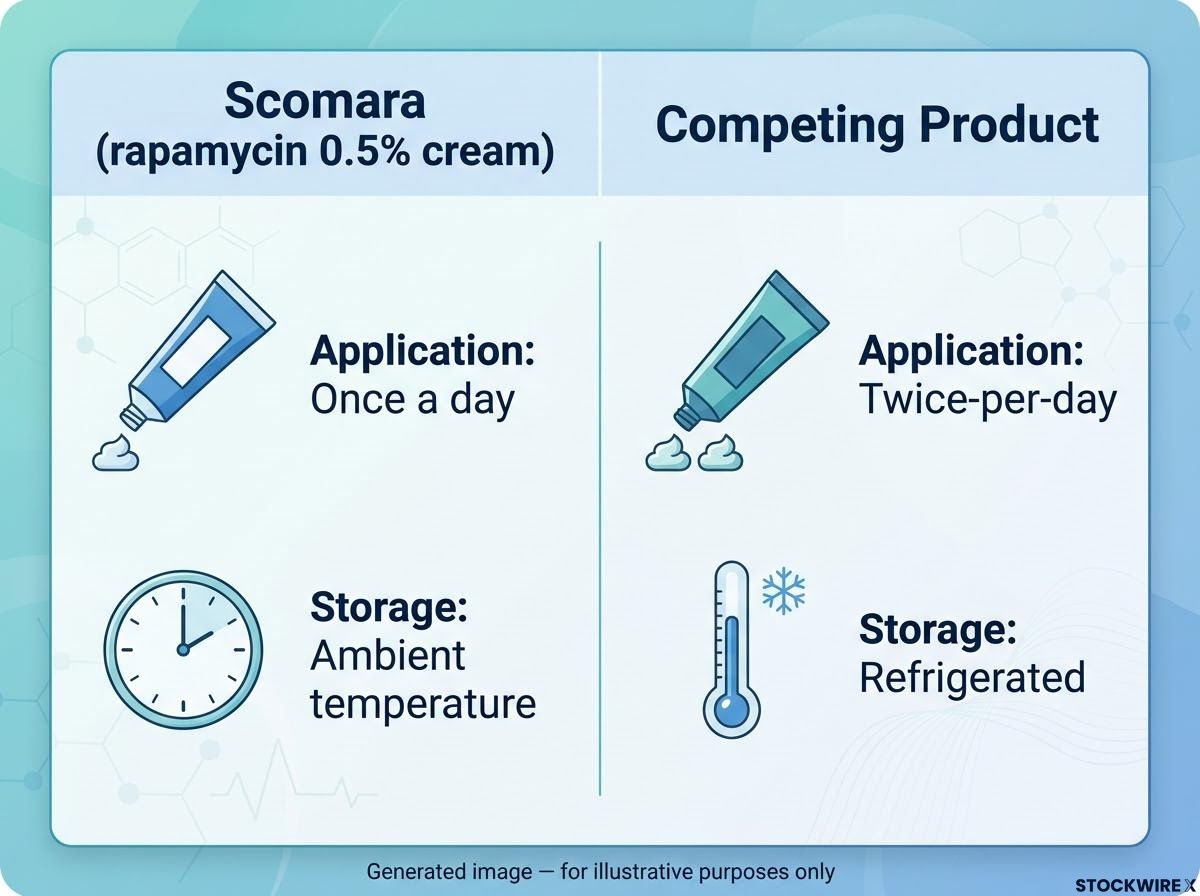
For investors, the takeaway is optionality. AFT can pursue near-term commercialisation abroad while retaining a future US position from 2029.
Financial impact and earnings structure
AFT has not forecast any revenue from the medicine in its budgets. As a result, the tentative approval does not impact AFT’s forecast for FY27.
The earnings structure is tiered. AFT receives a 65% share of earnings from the opportunity world-wide after the recovery of development costs. The remaining 35% accrues to the 35% owner of AFT Orphan Pharmaceuticals.
AFT also separately receives a royalty for the use of its proprietary technology in the medicine, which is due prior to any profit share calculations. The net effect is no downside to FY27 guidance, with upside optionality tied to non-US markets.
FY27 revenue guidance of NZ$300M or more and operating profit of NZ$28M-NZ$32M was reaffirmed in July 2026, with management noting that the Scomara programme carries no revenue assumption in the current budget, meaning any non-US commercialisation progress would represent unmodelled upside against existing targets.
What comes next for AFT
The near-term focus is developing new and significant markets for Scomara outside the US, where regulatory approval is not blocked by the competitor’s exclusivity. The US remains a future opportunity from 22 March 2029.
AFT is a growing New Zealand-based multinational pharmaceutical company that develops, markets and distributes products across over the counter (OTC), prescription and hospital channels. It operates directly in Australia, New Zealand, Singapore, Malaysia, Hong Kong, USA, Canada, EU ex Ireland and UK, and out-licenses its products to over 125 countries.
Don’t Miss the Next Healthcare Breakout on the ASX
Big News Blast delivers FREE breaking ASX healthcare news directly to your inbox within minutes of release, complete with in-depth analysis already done. Join 20,000+ investors staying ahead of market-moving announcements. Click the “Free Alerts” button at Big News Blast to start receiving real-time alerts the moment news breaks.