

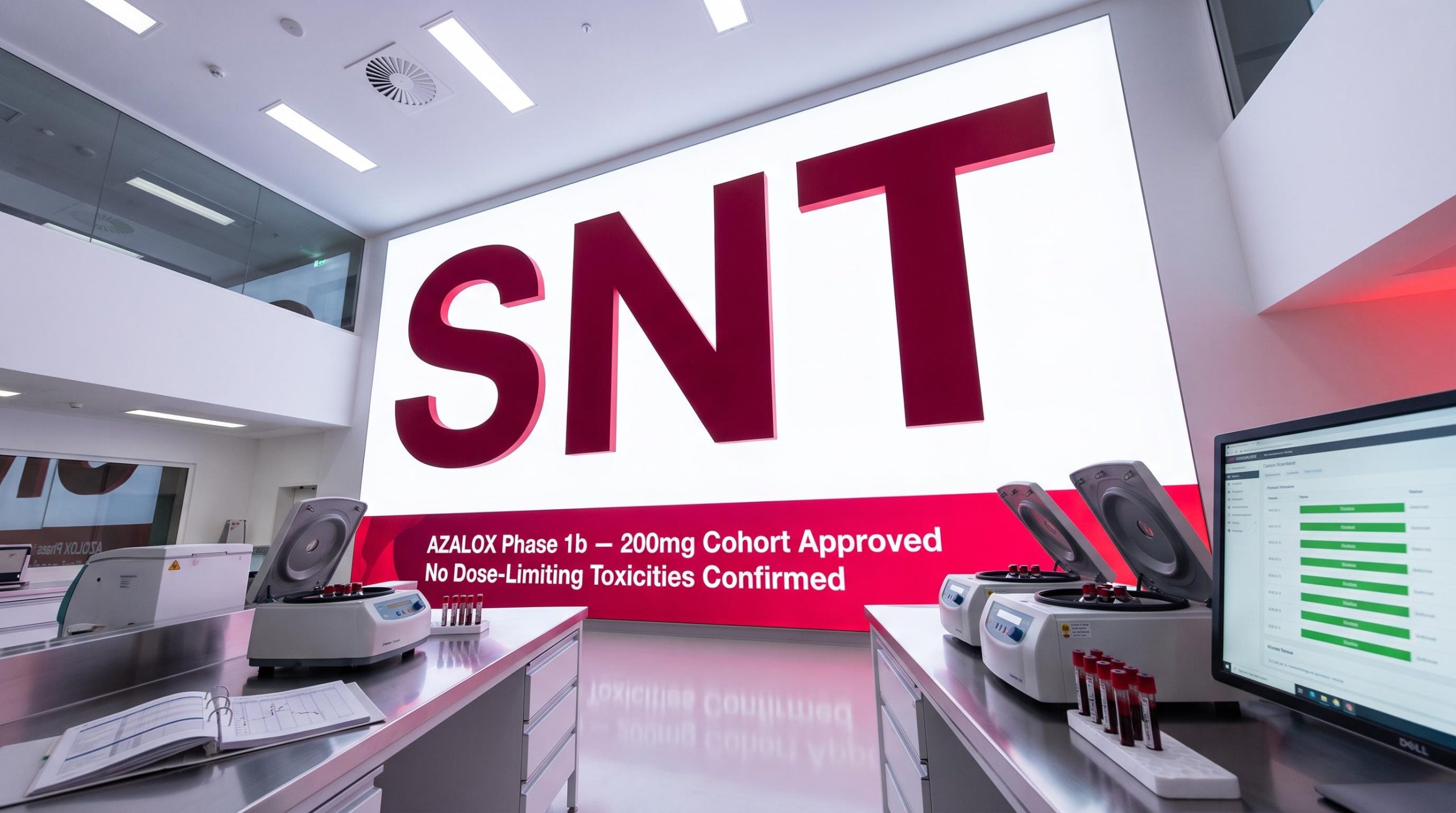
Syntara’s AZALOX trial clears safety hurdle and advances to final Phase 1b dose cohort
Syntara (ASX: SNT) has completed the first dose-escalation cohort of the Phase 1b AZALOX trial evaluating its lead candidate amsulostat in combination with the hypomethylating agent 5-Azacitidine (5-AZA) in patients with high-risk myelodysplastic neoplasms.
The independent Drug Safety Monitoring Board (DSMB) has approved escalation to the final Phase 1b cohort after observing no dose-limiting toxicities and no new adverse events attributable to amsulostat. The trial targets patients with high-risk Myelodysplastic Neoplasms (MDS) and Chronic Myelomonocytic Leukaemia (CMML), with preliminary data expected in Q4 CY26.
When big ASX news breaks, our subscribers know first
Safety data clears the path to the 200 mg cohort
The first cohort evaluated amsulostat at 150 mg twice daily in combination with 5-AZA. Following independent review of the safety data, the DSMB cleared the study to proceed to the final cohort, which will evaluate amsulostat at 200 mg twice daily in combination with 5-AZA.
All 10 German clinical sites have been initiated and are open for recruitment. Sites have been actively pre-screening potential participants while awaiting the DSMB review, with patients already pre-registered for the 200 mg cohort.
Key points from the trial progress include:
-
First cohort: 150 mg twice daily plus 5-AZA — completed
-
Safety result: no dose-limiting toxicities, no new adverse events attributable to amsulostat
-
Final cohort: 200 mg twice daily plus 5-AZA
-
All 10 German sites open; patients pre-registered
-
Preliminary Phase 1b data expected Q4 CY26
| Phase Component | Dose | Combination | Patient Population | Status / Next Step |
|---|---|---|---|---|
| Phase 1b Cohort 1 | 150 mg BID | 5-AZA | High-risk MDS & CMML | Completed — no DLTs |
| Phase 1b Cohort 2 | 200 mg BID | 5-AZA | High-risk MDS & CMML | Escalation approved |
| Phase 2 (planned) | RP2D | 5-AZA | ~30 patients | Subject to 1b completion |
The Phase 1b component is intended to establish the safety profile and recommended Phase 2 dose of amsulostat in combination with 5-AZA. Subject to completion of the 200 mg cohort and review of the associated safety data, the study is expected to progress to a Phase 2 component designed to evaluate safety and efficacy in approximately 30 patients.
Understanding high-risk MDS and why amsulostat matters
Myelodysplastic neoplasms (MDS) are a group of bone marrow disorders in which the production of healthy blood cells is disrupted. Patients often become dependent on regular blood transfusions and face the risk of disease progression to acute myeloid leukaemia (AML), an aggressive form of blood cancer.
The AZALOX study was initiated following encouraging preclinical research indicating that combining amsulostat with a hypomethylating agent may reactivate red blood cell and platelet production. The ongoing clinical study is assessing whether this approach may reduce patients’ dependence on blood transfusions and lower the risk of progression to acute myeloid leukaemia.
For investors, high-risk MDS represents a potential indication expansion for amsulostat beyond its FDA-supported myelofibrosis pathway. It is important to note the programme remains early-stage, and efficacy has not yet been demonstrated in this patient population.
Building a broader clinical package across MDS populations
Syntara is pursuing a two-study strategy designed to evaluate amsulostat across distinct MDS populations. AZALOX addresses high-risk disease, while a parallel Australian programme targets lower-risk patients.
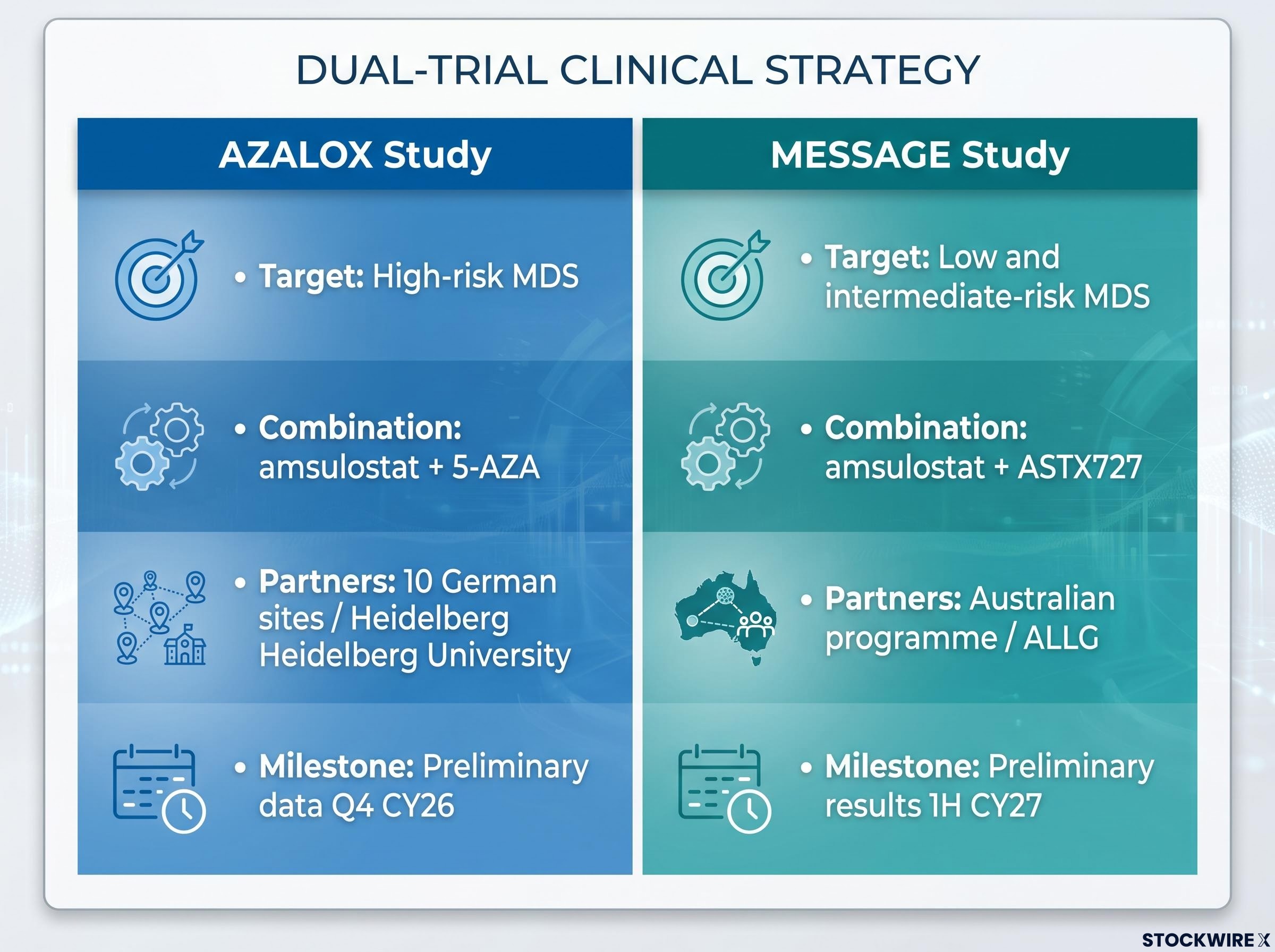
The Australasian Leukaemia & Lymphoma Group (ALLG) is leading the Australian MDS05/D3 MESSAGE study, evaluating amsulostat in combination with the oral hypomethylating agent ASTX727 in patients with transfusion-dependent low and intermediate-risk MDS. The MESSAGE study remains in recruitment for its initial dose-escalation cohort, with Syntara anticipating preliminary results during the first half of calendar 2027.
AZALOX is being conducted through the German MDS Study Group under the sponsorship of Heidelberg University, in collaboration with the Coordination Centre for Clinical Studies Heidelberg. The study is financially supported by German Cancer Aid, providing external funding for the trial.
Syntara’s non-dilutive funding model extends beyond AZALOX: German Cancer Aid is supporting the AZALOX trial financially, consistent with a broader capital strategy that has secured over $10 million in external grant funding across four programmes, including a $3 million government-funded pancreatic cancer trial requiring zero company cash outlay.
CEO Commentary
“High-risk MDS represents a significant potential indication expansion and commercial opportunity for amsulostat beyond the FDA-supported development pathway in myelofibrosis. Together with the Australian MESSAGE study in lower-risk disease, AZALOX provides the opportunity to evaluate amsulostat across distinct MDS populations and build a broader clinical data package around the asset,” said Gary Phillips, Chief Executive Officer of Syntara.
Together, the two studies are intended to establish a broader clinical and commercial profile for amsulostat across haematological cancers characterised by dysfunction of the extracellular matrix and blood cell production.
What comes next for the amsulostat program
Upcoming catalysts for the programme include:
-
Completion of the 200 mg cohort and associated DSMB safety review
-
Preliminary Phase 1b data expected Q4 CY26
-
Progression to the Phase 2 component (~30 patients), subject to safety review
-
MESSAGE study preliminary results anticipated 1H CY27
Amsulostat’s lead indication remains myelofibrosis, where it holds Fast Track Designation and FDA Orphan Drug Designation, with high-risk MDS representing a potential expansion opportunity for the asset.
Amsulostat’s myelofibrosis pathway remains the lead regulatory programme, having received FDA Fast Track Designation and Orphan Drug Designation alongside positive feedback from a Type C meeting that backed the Phase 2b trial design in approximately 100 patients.
Don’t Miss the Next ASX Healthcare Breakthrough
Big News Blast delivers FREE breaking ASX healthcare news directly to your inbox within minutes of release, complete with in-depth analysis. Join 20,000+ subscribers already getting the edge on market-moving announcements the moment they drop. Click the “Free Alerts” button at Big News Blast to stay ahead of the next big healthcare development.