

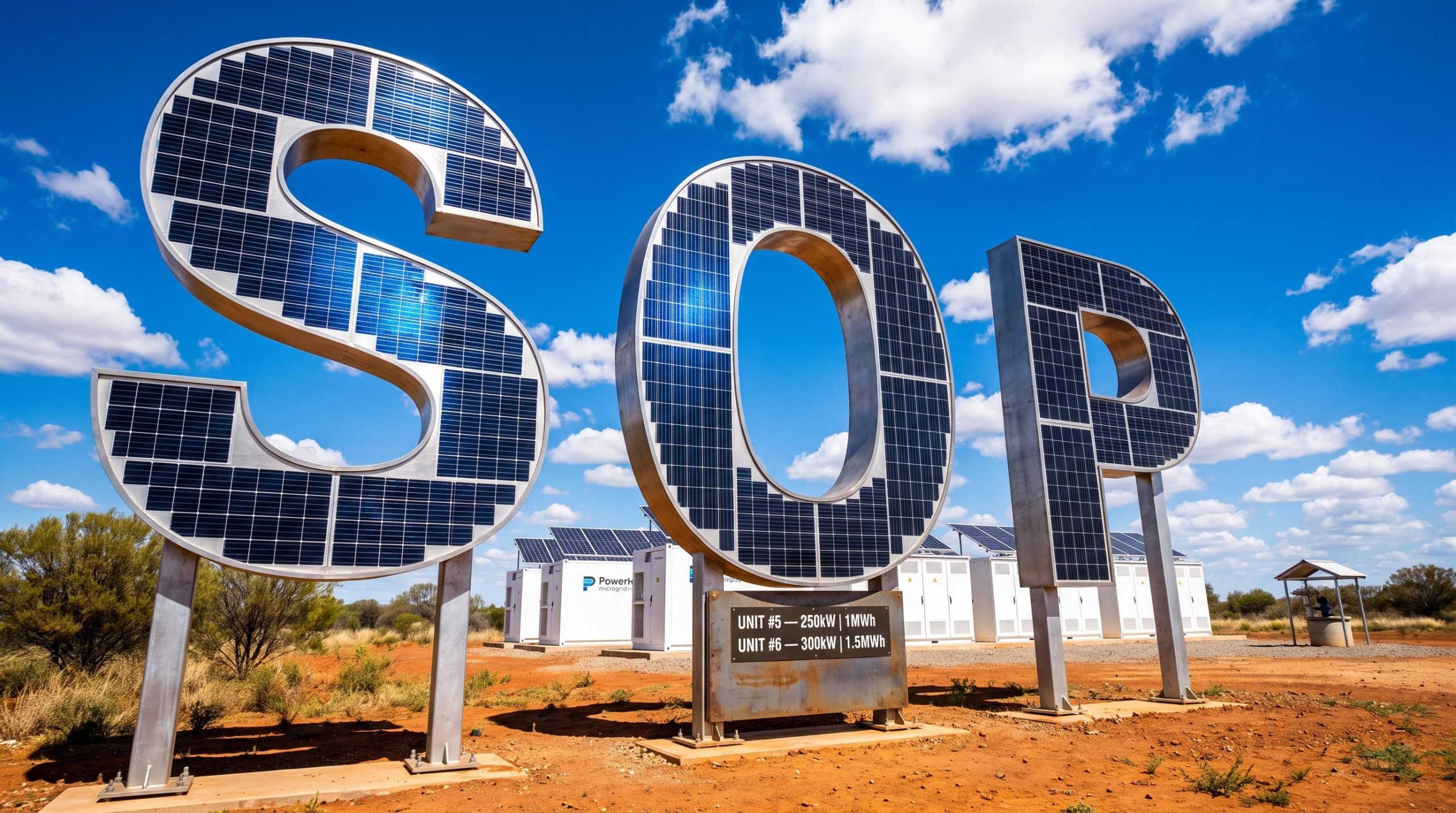
Santos orders two more Powerhouse systems, lifting contracted fleet to six
Synertec Corporation (ASX: SOP) has executed contracts with Santos for two additional Powerhouse systems, Unit #5 and Unit #6, for its GLNG operations. Both contracts were issued under the standing Master Service Agreement (MSA) and on a long-term Build, Own, Operate and Maintain (BOOM) commercial arrangement.
The two orders take the total number of contracted units with Santos to six, covering an estimated 20 to 25 CSG (coal seam gas) wells. Under the BOOM model, all six units are structured to deliver circa 90% EBITDA margins, underpinning a recurring, annuity-style revenue base for the company.
When big ASX news breaks, our subscribers know first
Inside the new contracts, Unit #5 and Unit #6
The two new systems differ in scale but share the same commercial structure and installation window. Both are scheduled for installation in H1 FY27 at two of GLNG’s more remote developments.
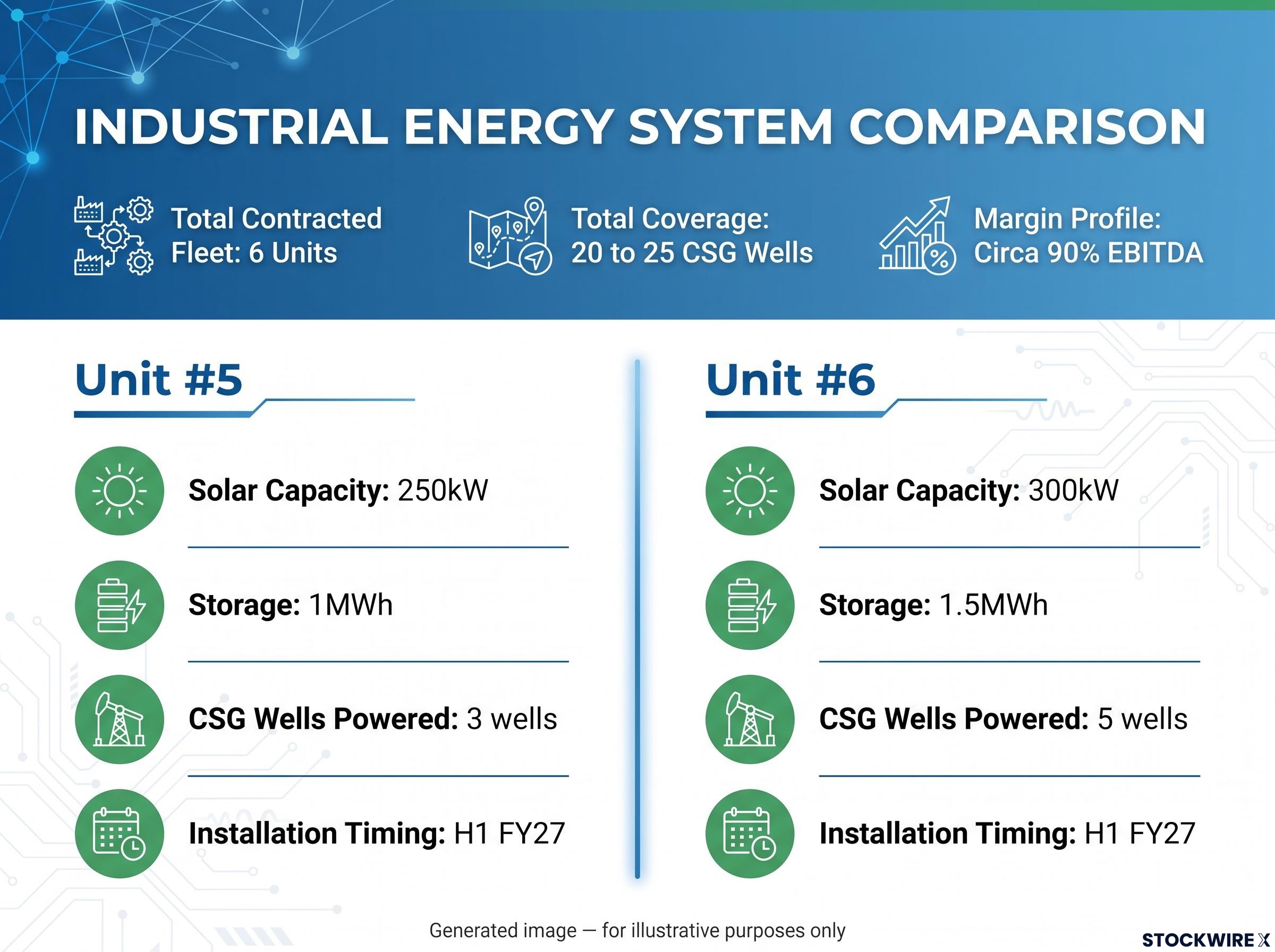
| Unit | Solar Capacity | Storage | CSG Wells Powered | Installation Timing |
|---|---|---|---|---|
| Unit #5 | 250kW | 1MWh | 3 wells | H1 FY27 |
| Unit #6 | 300kW | 1.5MWh | 5 wells | H1 FY27 |
Unit #6 remains subject to Santos’ final investment sanction, currently expected around end of Q1 FY27. The company noted the unit has already progressed through the majority of permitting and regulatory approval processes, positioning it for execution once final sanction is received.
Both units form part of Santos’ progressive well development program, under which new wells and associated infrastructure are developed to support gas supply to the GLNG JV. For investors, the latest orders reflect the increasing integration of Powerhouse into Santos’ upstream development activities and new GLNG JV production areas.
The BOOM model, why recurring revenue matters to investors
Under the BOOM commercial model, effectively described as “Power-as-a-Service”, Synertec receives a flat monthly rental fee that includes the provision of remote supervisory and maintenance services. Rather than selling equipment outright, the company retains ownership and earns predictable, contracted income over the life of each unit.
This structure delivers annuity-style recurring revenue at high margins, with the company citing circa 90% EBITDA and contract terms consistent across all six units. The underlying platform operates autonomously, predicting, analysing and controlling the real-time interplay between energy harvesting and pump load management while continuously reporting data to Santos Operations in Brisbane and Synertec’s Control Centre in Melbourne.
Reliability data supports the model’s appeal. Installed units have delivered long-term availability of better than 99.95% across 6 years of cumulative operation, which the company said effectively eliminates unplanned site visits and down-time of critical well site equipment.
The strategic benefits to Santos, as outlined by the company, are threefold:
- Reduces the need to consume saleable gas to generate electricity for its own operations
- Preserves more gas for domestic and international markets
- Lowers the cost and emissions intensity of production
Managing Director, Michael Carroll
“Reinforced by the recent global disruption to traditional energy markets, it is clear Powerhouse is at the forefront of a significant and enduring global thematic. That being a re-thinking away from traditional energy supply chains and an adoption of cost effective, flexible, highly available, low emission energy that is resilient to global geo-political disruption. For our customers it is a hedge against energy supply disruption and cost escalation.”
Scaling capacity through a global supply chain
Synertec’s ability to fulfil a multi-unit rollout rests on its supply chain readiness. Unit #4, previously announced to the ASX on 1 September 2025, was the first unit to be fabricated via Synertec’s low cost, high-capacity global supply chain.
That unit completed a comprehensive and successful Factory Acceptance Testing (FAT) regime both in the company’s overseas factory and its Australian factory, with Santos engineering personnel participating in a final review before release to site. The company said the “plug and play” strategies embedded in the design enable rapid site mobilisation requiring few site personnel.
Synertec has also developed proprietary large-scale factory testing and simulation systems capable of simulating field conditions on fully assembled units at the extreme of design loads and voltages before any unit leaves the factory. The company said this investment positions Powerhouse as a supplier of high-quality systems for mission-critical power applications designed for efficiency in large-scale rollout programs.
What is Powerhouse and where can it go next?
Powerhouse is described by the company as the only commercialised islanded microgrid electrification technology that uses smart Predictive Intelligence to create, control and deliver reliable, cost-effective and scalable zero-emission renewable energy for remote operations, with no fossil-fuel generator back-up.
In simple terms, a microgrid is a self-contained local energy system that can operate independently of the main power grid. The portable, flexible and remote-controlled system is reported to operate at a cost advantage to traditional fossil-fuelled generators, saving on major operating costs such as fuel and maintenance while enabling safe remote operation.
The company said the strength of the platform lies in its application across multiple large, identifiable market segments beyond oil and gas, including energy, mining, critical infrastructure and the rapidly growing data centre sector. The four defined segments include:
-
Powerhouse Remote: Renewable microgrids with high availability and low maintenance for critical infrastructure, targeting energy companies across oil, gas and mining.
-
Powerhouse Urban: Compact, lower-noise systems for urban environments delivering advanced grid services, aimed at state power utilities.
-
Powerhouse Industry Resilience: Fast-response battery systems supporting hydrocarbon generation and wider grid services, targeting energy, mining and data centre buyers.
-
Powerhouse Grid Resilience: Edge-of-grid and weak-network solutions improving reliability and power quality for distribution network service providers and remote communities.
The TasNetworks community battery contract, covering six front-of-the-meter Powerhouse BESS units across Tasmania’s distribution network, demonstrates that the same platform underpinning the Santos BOOM deployments is already being deployed in a structurally different customer segment, namely publicly accessible community battery sites selected by a distribution network service provider.
These multiple addressable segments give the technology scalability optionality well beyond its current oil and gas anchor deployments.
What it means for investors
The two new orders extend a growing anchor relationship with a blue-chip customer. The GLNG JV is an unincorporated joint venture between Santos, TotalEnergies, Petronas and Kogas, operating primarily in the Surat and Bowen basins in Queensland.
For investors, the investment case combines recurring high-margin BOOM revenue, a deepening relationship with a major energy customer, and a demonstrated reliability track record across six years of operation. The near-term timeline is as follows:
The Powerhouse battery pipeline reached $122M following a 74% surge in a single month, a backdrop that gives the Santos unit orders additional commercial weight as contracted BOOM revenue begins converting pipeline momentum into recurring cash flow.
- Unit #5: installation in H1 FY27
- Unit #6: installation in H1 FY27, subject to final investment sanction expected around end of Q1 FY27
With supply chain capacity in place and multiple market segments identified across energy, mining, critical infrastructure and data centres, the company said it is well-positioned to scale Powerhouse across both domestic and global markets.
Don’t Miss the Next ASX Industrial Breakout
Big News Blast, the FREE alert service from StockWire X, delivers breaking ASX announcements straight to your inbox within minutes of release, complete with in-depth analysis already done for you. Join 20,000+ subscribers staying ahead of the market. Click the “Free Alerts” button to start receiving real-time coverage the moment news breaks.