

Syntara reports encouraging Phase 2 signal for SNT-4728 in Parkinson’s-linked sleep disorder
Syntara (ASX: SNT) has reported preliminary results from the first tranche of data in its SNT-4728 Phase 2 trial, showing a reduction in brain inflammation among patients with isolated REM Sleep Behaviour Disorder (iRBD), a condition associated with high risk of progression to Parkinson’s.
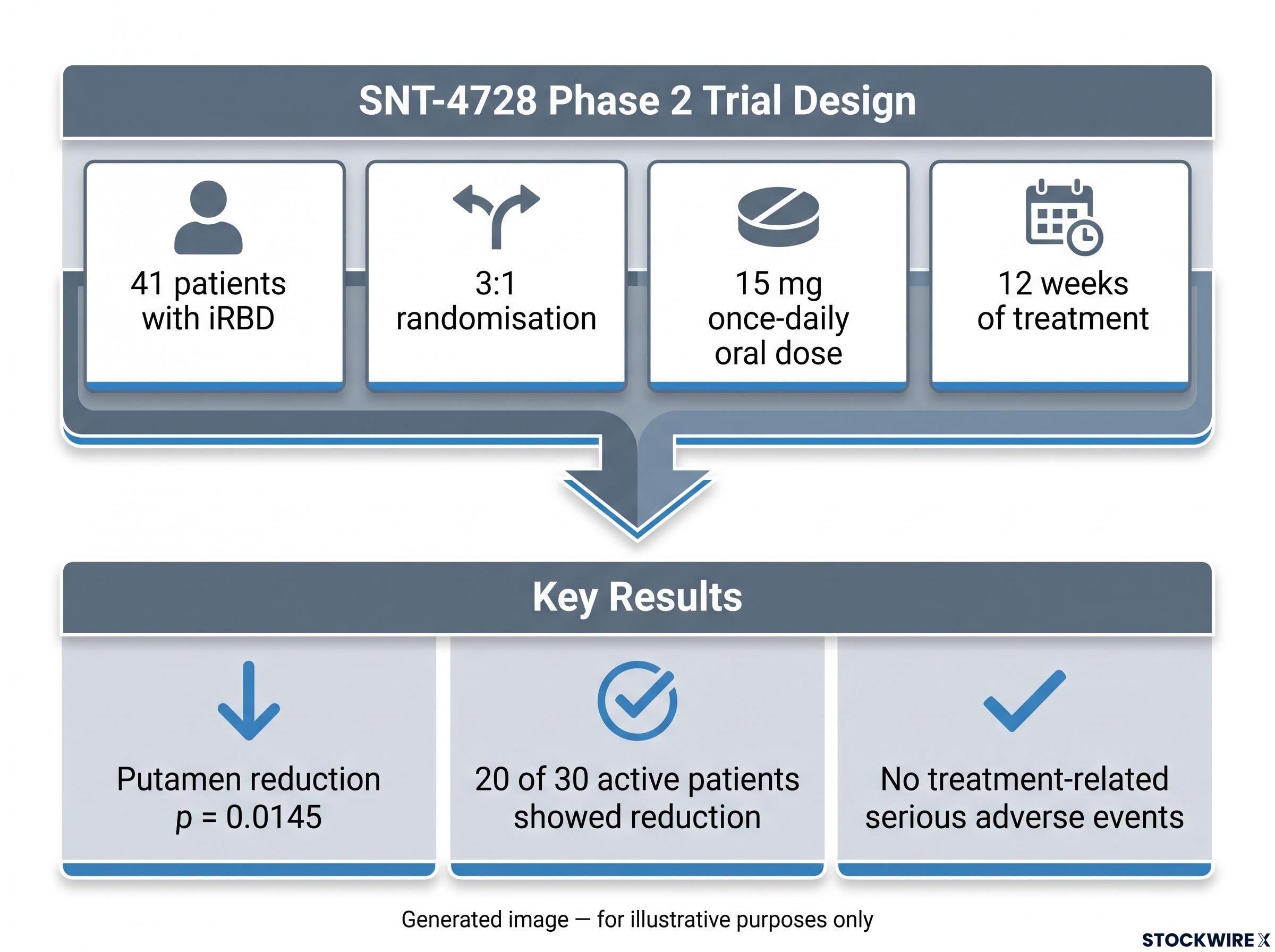
The clinical-stage drug developer recorded a statistically significant reduction unilaterally in the putamen (p = 0.0145), with 20 of 30 active-treatment patients showing a reduction from baseline. Syntara describes the study as the first interventional study to directly target neuroinflammation in iRBD.
Full results, including further digital and biological markers, are expected in Q3 2026. Based on the emerging activity, the company has filed a new provisional patent application.
When big ASX news breaks, our subscribers know first
Inside the trial: what the putamen data revealed
The randomised, double-blind, placebo-controlled Phase 2 study evaluated the safety and efficacy of SNT-4728 across 41 patients with iRBD, randomised on a 3:1 basis. Patients received a once-daily oral 15 mg dose over 12 weeks of treatment at multiple sites.
To measure neuroinflammation, researchers used Positron Emission Tomography (PET) imaging with the Translocator Protein (TSPO). This tracked the activation of microglia, the brain’s immune cells, at baseline and again after 12 weeks. TSPO signalling serves as a marker for inflammation within brain tissue.
The trial demonstrated a statistically significant reduction in inflammation unilaterally in the putamen (p = 0.0145), with 20 of 30 patients on active treatment recording a reduction from baseline. The putamen is a key region underlying the hallmark motor symptoms of Parkinson’s, including bradykinesia, rigidity, and tremor.
Broader analyses further validated the anti-inflammatory effect, identifying additional areas of statistically significant reduced TSPO signalling, including regions within the temporal lobe. No statistically significant change was detected in other predefined regions of interest, namely the substantia nigra, caudate, and occipital cortex.
On safety, SNT-4728 was well tolerated with no treatment-related serious adverse events reported. All adverse events observed across the treatment arms were either mild or moderate in severity.
| Metric | Result | Significance |
|---|---|---|
| Region of interest (putamen) | Reduction, p = 0.0145 | Region underlying motor symptoms |
| Responders | 20 of 30 active patients | High response rate |
| Dose | 15 mg once-daily oral | Crosses blood-brain barrier |
| Safety | No treatment-related SAEs | Safe and well tolerated |
| Full data | Q3 2026 | Complete imaging/biomarker readout |
Professor Simon Lewis, Director of the Parkinson’s Disease Research Clinic at Macquarie University
“SNT-4728 is being evaluated in a prodromal Parkinson’s population where progression to symptomatic disease is very slow and can take over a decade. Therefore, any measurable change over only three months of treatment is notable, and seeing a statistically significant reduction in TSPO signal in the putamen, a region central to motor symptoms, is encouraging and suggests the drug may be modulating disease relevant neuroinflammatory pathways.”
Why iRBD and neuroinflammation matter for investors
Isolated REM Sleep Behaviour Disorder is a sleep disorder in which individuals physically act out their dreams. It is associated with a high risk of progression to Parkinson’s and related neurodegenerative conditions, making it a valuable window for early intervention.
Previous studies have estimated that approximately 2% of people over 50 are affected by iRBD. Long-term observational studies suggest that up to 90% of individuals with iRBD subsequently develop a neurodegenerative disease, including Parkinson’s and Dementia with Lewy Bodies, positioning iRBD as one of the strongest recognised clinical predictors of these disorders.
SNT-4728 is a first-in-class neuro-targeted anti-inflammatory therapy that works through dual inhibition of two enzyme targets, SSAO and MAO-B. The 15 mg dose is predicted to provide target engagement for both enzymes in the brain, supporting a meaningful reduction of neuroinflammation.
The investment relevance is clear. According to Parkinson’s Research Ventures, no drug can currently stop or slow the progression of Parkinson’s. A disease-modifying signal in a well-defined at-risk population therefore addresses a substantial unmet need.
The trial successfully recruited an enriched, high-risk population. Of the 41 patients enrolled, with a median age of 68:
-
93% were male
-
90% were hyposmic or anosmic (reduced or lost sense of smell)
-
46% had low colour discrimination
-
95% had misfolded alpha-synuclein detected in cerebrospinal fluid
The investment case: a differentiated neuro asset
The early proof-of-concept signal in a high-value neurodegeneration indication helps de-risk the SNT-4728 programme. Demonstrating measurable biological activity years before diagnosis strengthens the rationale for continued development in iRBD.
Reinforcing its intellectual property position, Syntara has filed a new provisional patent application based on the emerging evidence of SNT-4728’s activity as a first-in-class neuro-targeted anti-inflammatory therapy.
The study was funded by Parkinson’s Research Ventures, a Parkinson’s UK-led initiative run in partnership with the Parkinson’s Foundation. This external backing provides both validation and non-dilutive support for the programme.
The Parkinson’s Research Ventures partnership has delivered non-dilutive milestone funding across the trial lifecycle, with Syntara receiving A$1.7 million upon dosing the final patient and a further A$0.45 million due on project completion.
SNT-4728 sits within a broader Syntara pipeline. This includes lead candidate amsulostat in myelofibrosis (which holds Fast Track and Orphan Drug designations), topical pan-LOX inhibitors, and multiple fibrosis programmes, with the neuro asset adding further optionality.
The amsulostat myelofibrosis programme, which holds both FDA Fast Track and Orphan Drug designations, received positive Type C meeting feedback from the FDA in April 2026, supporting a Phase 2b design across approximately 100 patients.
Dr Lynsey Bilsland, Managing Director of Parkinson’s Research Ventures
“Right now, no drug can stop or slow the progression of Parkinson’s. With SNT4728, Syntara have shown that they are able to modify a key process linked to Parkinson’s progression through short-term treatment many years before Parkinson’s is diagnosed.”
What’s next: full data readout in Q3 2026
The complete dataset is expected to sharpen the conclusions drawn from this exploratory study. Upcoming catalysts include:
-
Full clinical and imaging datasets, expected towards the end of Q3 2026
-
Digital and biological marker analyses
-
Determination of the developmental path forward in iRBD
The company will host an investor webinar at 1:30pm AEST on 6 July 2026, featuring CEO Gary Phillips, Chief Medical Officer Jana Baskar, and principal investigator Professor Simon Lewis. A replay will be made available via the Syntara website.
Gary Phillips, Chief Executive Officer
“This study pushes the boundaries of what is technically possible and, when complete, will amass a significant body of evidence in this world first interventional study in iRBD. It would not have been possible without the support from Parkinson’s Research Ventures who funded the study, the dedication of our two principal investigators, Prof Simon Lewis (Sydney) and Prof Michele Hu (Oxford), and the healthcare teams at the sites and, of course, the patients. The study has generated a great deal of interest in the wider Parkinson’s community and we look forward to working with our collaborators to deliver the remaining trial results in Q3 2026 and evaluate the path forward after this promising start.”
The full data readout in Q3 2026 shapes up as the next key value inflection point for the SNT-4728 programme, informing the durability and clinical significance of the effect observed to date.
Don’t Miss the Next Healthcare Breakthrough on ASX
Big News Blast delivers FREE breaking ASX healthcare news directly to your inbox within minutes of release, complete with in-depth analysis. Over 20,000 investors already rely on it to stay ahead of market-moving announcements. Click the “Free Alerts” button to start receiving alerts the moment ASX healthcare stocks make their next big move.