
Osteopore Ltd Completes Recruitment for Queensland Cleft Lip Trial

Osteopore completes patient recruitment for Queensland cleft lip trial
Osteopore Limited (ASX: OSX) has completed recruitment of all 5 patients for its paranasal augmentation clinical trial at Queensland Children’s Hospital (QCH), a study targeting paediatric patients with unilateral (one-sided) cleft lip.
The trial focuses on augmentation of the nose and surrounding upper jaw structure. As previously announced on 2 June 2026, QCH will conduct a single-arm feasibility trial, with the recruitment of up to 5 patients expected by end of 2026.
Osteopore is an Australian-Singaporean regenerative medicine company and a global leader in 3D-printed biomimetic and bioresorbable implants. The single-arm feasibility trial, which includes a 12-month patient follow-up post-surgery, is led by Dr. Yun Phua, a Plastic and Reconstructive Surgeon based at QCH and Mater Hospital.
When big ASX news breaks, our subscribers know first
Inside the QCH paranasal augmentation study
The study marks the second paediatric trial led by Dr. Phua. The first, announced on 23 May 2025, addressed the treatment of temporal hollowing. This latest collaboration extends a deepening clinical relationship between the company and one of Australia’s leading children’s hospitals.
The cleft lip trial at QCH was first announced on 2 June 2026, at which point 3 of the 5 patients had already been recruited, with full recruitment now confirmed ahead of the originally stated end-of-2026 target.
The trial is structured as a single-arm feasibility study with 5 patients and a follow-up period of 12 months after surgery. Outcomes will be measured using the validated Cleft-Q patient-reported outcome tool, which captures patient-reported results following cleft-related treatment.
Trial at a glance:
-
Site: Queensland Children’s Hospital
-
Lead investigator: Dr. Yun Phua
-
Patients: 5 (recruitment complete)
-
Design: single-arm feasibility trial
-
Follow-up: 12 months post-surgery
-
Outcome measure: Cleft-Q tool
How Osteopore’s 3D-printed scaffolds work
The trial utilises Osteopore’s medical-grade polycaprolactone-tricalciumphosphate (mPCL-TCP) scaffolds, manufactured using additive manufacturing (3D printing) to produce patient-specific implants precisely matched to each patient’s anatomy.
These scaffolds are 3D printed from a bioresorbable composite (PCL-TCP) that gradually degrades as the body regenerates bone, mimicking the mechanical properties of trabecular bone throughout the healing process. In simple terms, the implant supports new bone growth and then dissolves over time, rather than remaining permanently in the body.
Each implant is designed using a patient’s CT imaging data and manufactured under Osteopore’s established Patient Specific Implant (PSI) workflow, which is already in clinical use at QCH.
The PSI workflow has also been validated in new markets recently, with the first Hong Kong orthopaedic procedure completed at Queen Mary Hospital in June 2026, demonstrating that the same patient-specific design approach can be deployed efficiently across different regulatory environments.
The current standard of care for this condition involves cancellous bone grafting harvested from the hip, an approach associated with poor long-term graft retention and unpredictable outcomes for nasal form. Osteopore’s scaffold is designed to replace this graft entirely.
| Feature | Current standard of care | Osteopore scaffold | Investor relevance |
|---|---|---|---|
| Source material | Hip cancellous bone graft | 3D-printed bioresorbable mPCL-TCP scaffold | Removes the need for a separate graft harvest |
| Long-term retention | Poor long-term graft retention | Supports bone regeneration without adding surgical time | Potential for more durable outcomes |
| Nasal form | Unpredictable outcomes | Structurally accurate and reproducible | Consistency may support broader adoption |
The company has described the scaffold as a meaningful clinical advancement over existing practice, offering a reproducible alternative that supports bone regeneration and nasal base support.
A growing market for cleft repair
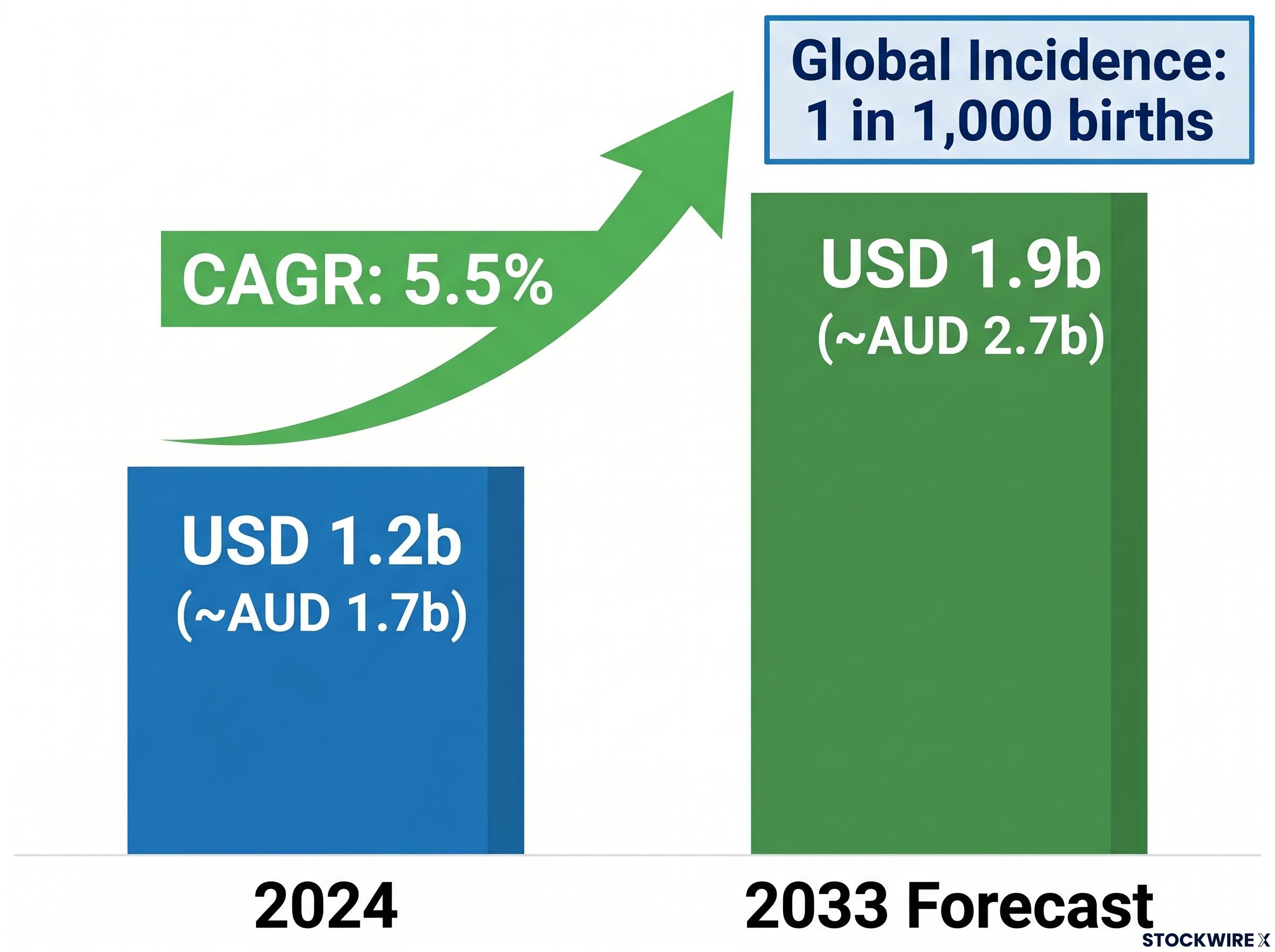
Cleft lip and palate affects approximately 1 in 1,000 births globally, making it one of the most prevalent congenital conditions worldwide. Patients typically undergo multiple reconstructive procedures throughout childhood and adolescence, creating a recurring clinical need.
The global cleft lip and palate repair market was valued at approximately USD 1.2b (~AUD 1.7b) in 2024 and is forecast to reach USD 1.9b (~AUD 2.7b) by 2033, growing at a CAGR of 5.5%. Growth is being driven by rising surgical volumes, increasing awareness of treatment options, and the adoption of advanced biomaterials and surgical techniques.
This trial, conducted at one of Australia’s leading children’s hospitals, provides a strong clinical and commercial foundation for broader market adoption.
The next major ASX story will hit our subscribers first
Why this milestone matters for Osteopore
Completed recruitment moves the trial into its active surgical and follow-up phase, advancing the clinical validation that underpins Osteopore’s longer-term commercial case. The progression also reinforces the deepening QCH relationship, with this being the second paediatric study led by Dr. Phua and a further demonstration of the PSI workflow in a clinical setting.
According to the company, the technology has the potential to reduce revision surgeries, improve facial symmetry, and enhance quality of life for patients, with these outcomes being measured using the Cleft-Q tool.
Next steps for the study:
-
Surgical procedures for the 5 recruited patients
-
12-month patient follow-up using Cleft-Q outcomes
-
Data generation to support broader market adoption
With recruitment now complete, the focus shifts to surgical delivery and the 12-month follow-up window that will generate the clinical evidence supporting any future expansion.
Don’t Miss the Next Healthcare Breakthrough on ASX
Big News Blast delivers FREE breaking ASX healthcare news to your inbox within minutes of release, complete with in-depth analysis. Join 20,000+ investors already staying ahead of the market and click the “Free Alerts” button at StockWire X to receive the moment market-moving healthcare announcements drop.